Questions on Electric Current and Resistance, the kind your examinations ask. Solve one on paper. Then tell the book how it went. The book believes you, and it uses your answer to plan your revision.
0%
Nothing marked yetMark honestly. Peek at the answer only after your own attempt.
Drift Velocity, Ohm's Law and Resistivity
22 questions · after Lesson 4, Resistance and Temperature, Non-Ohmic Conductors
Current and charge
Q1
A steady current of \(3.2\) A flows in a wire. Take \(e = 1.6 \times 10^{-19}\) C.
Find the charge that passes a cross-section in \(10\) s.
Find the number of electrons that pass a cross-section every second.
Answer(i) \(32\) C (ii) \(2 \times 10^{19}\)
Solution
\(q = It = 3.2 \times 10 = 32\) C.
Charge per second \(= 3.2\) C. Number of electrons \(= \dfrac{3.2}{1.6 \times 10^{-19}} = 2 \times 10^{19}\).
How did it go?
Q2
A charge of \(600\) C passes through a lamp in \(5\) minutes.
Find the current.
At this current, how long does \(1\) C take to pass?
Answer(i) \(2\) A (ii) \(0.5\) s
Solution
\(I = \dfrac{q}{t} = \dfrac{600}{300} = 2\) A.
\(t = \dfrac{q}{I} = \dfrac{1}{2} = 0.5\) s.
How did it go?
Q3
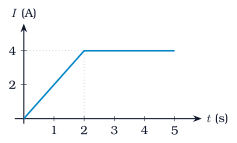
The current in a wire varies as \(i = 2t + 3\). Here \(i\) is in amperes and \(t\) is in seconds.
Find the charge that passes from \(t = 0\) to \(t = 2\) s.
\(t = \dfrac{1}{1.25 \times 10^{-4}} = 8000\) s, more than two hours.
How did it go?
Q6
The same current now flows through a copper wire of half the diameter. By what factor does the drift velocity change? Give the reason.
Answer\(4\) times larger
Solution
Half the diameter means one quarter of the area. \(v_d = \dfrac{I}{neA}\) with the same \(I\) and \(n\), so \(v_d\) becomes \(4\) times larger. The same number of electrons per second must pass through a smaller area, so they must move faster.
How did it go?
Q7
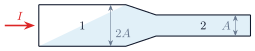
A current \(I\) flows through the wire in the figure. Part \(1\) has cross-section \(2A\) and part \(2\) has cross-section \(A\). Find the ratio, part \(1\) to part \(2\), of
A wire has resistance \(8\ \Omega\). The wire is stretched uniformly. Find the new resistance if the length becomes
twice the original,
\(1.5\) times the original.
Answer(i) \(32\ \Omega\) (ii) \(18\ \Omega\)
Solution
The volume \(AL\) stays the same. If \(L\) becomes \(kL\), then \(A\) becomes \(A/k\), and \(R = \dfrac{\rho L}{A}\) becomes \(k^2 R\).
\(k = 2\): \(R' = 4 \times 8 = 32\ \Omega\).
\(k = 1.5\): \(R' = 2.25 \times 8 = 18\ \Omega\).
How did it go?
Q11
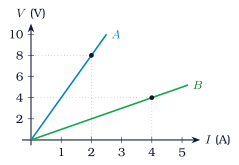
The figure shows \(V\) against \(I\) for two wires \(A\) and \(B\).
Find the resistance of each wire.
Which wire is the better conductor? Give the reason.
Answer(i) \(4\ \Omega\), \(1\ \Omega\) (ii) \(B\)
Solution
On a \(V\)-\(I\) graph the slope is \(R\). \(R_A = \dfrac{8}{2} = 4\ \Omega\) and \(R_B = \dfrac{4}{4} = 1\ \Omega\).
\(B\) has the smaller resistance, so \(B\) carries more current for the same voltage. \(B\) is the better conductor.
How did it go?
Q12
A coil has resistance \(20\ \Omega\) at \(20^\circ\)C. The temperature coefficient of resistance is \(\alpha = 4 \times 10^{-3}\) per \(^\circ\)C. Find the resistance at \(120^\circ\)C.
Use \(\rho = \frac{m}{ne^2\tau}\) to find the resistivity of copper. Take \(n = 8.5 \times 10^{28}\) m\(^{-3}\), \(\tau = 2.5 \times 10^{-14}\) s and \(m = 9.1 \times 10^{-31}\) kg.
\(\rho = \dfrac{9.1 \times 10^{-31}}{5.44 \times 10^{-23}} = 1.67 \times 10^{-8} \approx 1.7 \times 10^{-8}\ \Omega\) m, the measured value for copper.
How did it go?
Q17
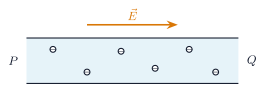
The figure shows a wire with an electric field \(\vec E\) directed from \(P\) to \(Q\).
In which direction is the force on a free electron? In which direction do the electrons drift?
In which direction does the conventional current flow? Which end is at the higher potential?
The field is constant, yet the electrons do not keep accelerating. Give the reason.
Answer(i) towards \(P\); towards \(P\) (ii) \(P\) to \(Q\); \(P\) (iii) collisions
Solution
The force on an electron is \(\vec F = -e\vec E\), opposite to the field, so towards \(P\). The electrons drift towards \(P\).
Conventional current is opposite to the electron drift, so from \(P\) to \(Q\), along \(\vec E\). The field points from high to low potential, so \(P\) is at the higher potential.
An electron accelerates only for a short time \(\tau\) before a collision with an ion. The collision resets its velocity in a random direction. The average of these short accelerations is the steady drift velocity.
How did it go?
Q18
A wire of cross-section \(A\) has \(n\) free electrons per unit volume, each drifting with speed \(v_d\). Show that the current is \(I = neAv_d\).
Answerderivation
Solution
In time \(t\) every electron drifts a distance \(v_d t\). So all the electrons in a cylinder of length \(v_d t\) and area \(A\) cross the end face in time \(t\).
Number of electrons in the cylinder \(= n \times A v_d t\). Charge \(= neAv_d t\).
\(I = \dfrac{\text{charge}}{t} = neAv_d\).
How did it go?
Q19
The drift velocity in a wire is of the order of \(0.1\) mm/s. Yet a bulb lights up at once when the switch is closed. Explain.
Answerfield set up almost instantly
Solution
When the switch closes, the electric field is set up along the whole wire almost instantly, at nearly the speed of light. Free electrons everywhere in the circuit, including those inside the bulb, begin to drift at the same moment. The bulb does not wait for electrons from the switch to arrive.
How did it go?
Q20
When the temperature rises, the resistance of a metal increases but the resistance of a semiconductor decreases. Explain both in terms of \(n\) and \(\tau\).
\(\rho = \dfrac{m}{ne^2\tau}\). In a metal \(n\) is fixed. At a higher temperature the ions vibrate more, collisions are more frequent, \(\tau\) falls and \(\rho\) rises.
In a semiconductor heat frees many more charge carriers, so \(n\) rises steeply. This effect is far larger than the fall in \(\tau\), so \(\rho\) falls.
How did it go?
Q21
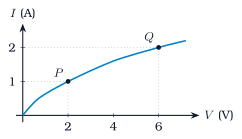
The figure shows \(I\) against \(V\) for the filament of a bulb.
Does the filament obey Ohm's law? Give the reason.
Find the resistance of the filament at \(P\) and at \(Q\).
Why does the resistance change between \(P\) and \(Q\)?
Answer(i) no (ii) \(2\ \Omega\), \(3\ \Omega\) (iii) heating
Solution
No. For Ohm's law the \(I\)-\(V\) graph must be a straight line through the origin. This graph bends.
\(R = \dfrac{V}{I}\). At \(P\): \(R = \dfrac{2}{1} = 2\ \Omega\). At \(Q\): \(R = \dfrac{6}{2} = 3\ \Omega\).
At \(Q\) the current is larger, so the filament is hotter. Resistance of a metal rises with temperature, so \(R\) is larger at \(Q\).
How did it go?
Q22
A block of metal measures \(4\) cm \(\times\) \(2\) cm \(\times\) \(1\) cm. Its resistivity is \(4 \times 10^{-6}\ \Omega\) m.
Find the resistance between the two \(2\) cm \(\times\) \(1\) cm faces.
Find the resistance between the two \(4\) cm \(\times\) \(2\) cm faces.
Series resistance \(= 300\ \Omega\), so \(I = \dfrac{150}{300} = 0.5\) A. \(P_A = I^2R_A = 0.25 \times 100 = 25\) W and \(P_B = 0.25 \times 200 = 50\) W.
\(B\) produces its rated \(50\) W, so \(B\) glows normally. \(A\) produces only \(25\) W of its rated \(100\) W and glows dimly. In series the bulb with the smaller rating glows brighter.
How did it go?
Q29
The bulbs of Question 6 are now connected in parallel across \(100\) V. Find the power of each bulb, the total power and the total current.
Answer\(100\) W, \(50\) W; \(150\) W; \(1.5\) A
Solution
In parallel each bulb has its rated \(100\) V, so each gives its rated power: \(100\) W and \(50\) W. Total \(= 150\) W. Total current \(= \dfrac{150}{100} = 1.5\) A.
How did it go?
Q30
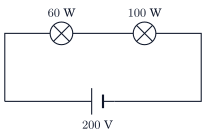
The bulbs in the figure are rated \(60\) W and \(100\) W, both at \(200\) V.
Find the ratio of their resistances.
Find the ratio of the powers they now produce. Which bulb glows brighter?
Find the total power of the circuit.
Answer(i) \(5 : 3\) (ii) \(5 : 3\); \(60\) W bulb (iii) \(37.5\) W
Solution
\(R = \dfrac{V^2}{P}\) with the same \(V\), so \(R \propto \dfrac{1}{P}\). \(\dfrac{R_{60}}{R_{100}} = \dfrac{100}{60} = \dfrac{5}{3}\).
In series the current is the same, so \(P = I^2R \propto R\). The powers are in the ratio \(5 : 3\). The \(60\) W bulb has the larger resistance and glows brighter.
Total power \(= \dfrac{P_1P_2}{P_1 + P_2} = \dfrac{60 \times 100}{160} = 37.5\) W (see Question 20).
How did it go?
Q31
Bulbs rated \(200\) V, \(100\) W are available.
Two of them are connected in series across \(200\) V. Find the power of each.
Three of them are connected in parallel across \(200\) V. Find the total power.
Answer(i) \(25\) W (ii) \(300\) W
Solution
Each bulb gets \(100\) V, half its rated voltage. \(P = \dfrac{V^2}{R}\) becomes one quarter: \(25\) W each.
In parallel each bulb gets its full \(200\) V and gives \(100\) W. Total \(= 300\) W.
How did it go?
Q32
A kettle has two heating coils. Each coil alone boils a given amount of water in \(10\) minutes. Find the time to boil the same water when the coils are
in series,
in parallel.
Answer(i) \(20\) min (ii) \(5\) min
Solution
Let each coil have resistance \(R\). The heat needed is fixed: \(H = \dfrac{V^2}{R} \times 10\) min.
Series: resistance \(2R\), power halves, time doubles: \(20\) min.
Parallel: resistance \(\dfrac{R}{2}\), power doubles, time halves: \(5\) min.
How did it go?
Q33
The coil of a heater is cut into two equal halves and one half is used at the same voltage. How does the power change? How does the time to heat a given amount of water change?
Answerdoubles; halves
Solution
Half the coil has half the resistance. \(P = \dfrac{V^2}{R}\) doubles. The same heat is produced in half the time.
How did it go?
Q34
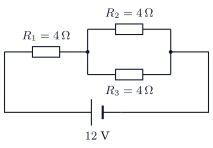
In the circuit shown, all three resistors are \(4\ \Omega\).
Find the current drawn from the battery.
Find the power in each resistor and the total power.
Which resistor heats up fastest?
Answer(i) \(2\) A (ii) \(16\), \(4\), \(4\) W; \(24\) W (iii) \(R_1\)
Solution
\(R_2\) and \(R_3\) in parallel give \(2\ \Omega\). Total \(= 4 + 2 = 6\ \Omega\). \(I = \dfrac{12}{6} = 2\) A.
\(P_1 = I^2R_1 = 4 \times 4 = 16\) W. The \(2\) A splits equally: \(1\) A in each of \(R_2\) and \(R_3\), so \(P_2 = P_3 = 1 \times 4 = 4\) W. Total \(= 24\) W. Check: \(VI = 12 \times 2 = 24\) W.
\(R_1\) carries the full current and produces \(16\) W, four times as much as each of the others. \(R_1\) heats fastest.
How did it go?
Heat, efficiency, fuses
Q35
A \(3\ \Omega\) wire carries \(4\) A for \(7\) minutes. The wire is placed in ice at \(0^\circ\)C. Find the heat produced and the mass of ice melted. Take \(L = 3.36 \times 10^{5}\) J/kg.
Answer\(20160\) J; \(60\) g
Solution
\(H = I^2Rt = 16 \times 3 \times 420 = 20160\) J.
\(m = \dfrac{H}{L} = \dfrac{20160}{3.36 \times 10^{5}} = 0.06\) kg \(= 60\) g.
How did it go?
Q36
A \(500\) W kettle heats \(1\) kg of water from \(20^\circ\)C to \(70^\circ\)C. Take \(c = 4200\) J/(kg K) and ignore losses. Find the heat needed and the time taken.
\(t = \dfrac{Q}{P} = \dfrac{210000}{500} = 420\) s \(= 7\) min.
How did it go?
Q37
A \(1\) kW immersion heater takes \(7\) minutes to heat \(1\) kg of water from \(20^\circ\)C to \(90^\circ\)C. Find the heat gained by the water, the energy supplied and the efficiency of the heater.
Efficiency \(= \dfrac{294}{420} = 0.7 = 70\%\). The rest warms the vessel and the air.
How did it go?
Q38
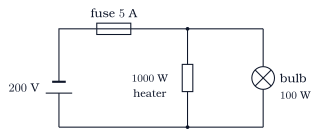
The fuse in the figure melts if the current through it exceeds \(5\) A.
Find the current drawn by the heater and by the bulb.
Does the fuse melt when both are on? Does it melt with the heater alone?
Answer(i) \(5\) A, \(0.5\) A (ii) yes; no
Solution
\(I = \dfrac{P}{V}\). Heater: \(\dfrac{1000}{200} = 5\) A. Bulb: \(\dfrac{100}{200} = 0.5\) A.
Both on: the fuse carries \(5 + 0.5 = 5.5\) A, more than \(5\) A, so it melts. Heater alone: exactly \(5\) A, not more, so it does not melt.
How did it go?
Q39
A \(100\ \Omega\) resistor is rated \(1\) W.
Find the largest current and the largest voltage it can safely take.
Two such resistors are in series. Find the largest safe voltage across the pair.
Two such resistors are in parallel. Find the largest safe voltage and the total power then.
Answer(i) \(0.1\) A, \(10\) V (ii) \(20\) V (iii) \(10\) V, \(2\) W
Solution
\(P = I^2R\): \(1 = I^2 \times 100\), so \(I_{\max} = 0.1\) A. \(V_{\max} = IR = 0.1 \times 100 = 10\) V.
In series the same \(0.1\) A flows through both. Each can have \(10\) V, so the pair can have \(20\) V.
In parallel both have the same voltage, at most \(10\) V. Each then produces \(1\) W, so the total is \(2\) W.
How did it go?
Q40
A motor draws \(5\) A at \(200\) V and delivers \(800\) W of mechanical power.
Find the electrical power input and the power lost as heat.
Find the efficiency and the resistance of the windings.
Answer(i) \(1000\) W, \(200\) W (ii) \(80\%\), \(8\ \Omega\)
Solution
Input \(= VI = 200 \times 5 = 1000\) W. Heat \(= 1000 - 800 = 200\) W.
Efficiency \(= \dfrac{800}{1000} = 80\%\). The heat is \(I^2R\): \(200 = 25R\), so \(R = 8\ \Omega\).
How did it go?
Derivations and comparisons
Q41
A current \(I\) flows through a resistor \(R\) for time \(t\). Start from the work done by the field on a charge \(q\) moving through a potential difference \(V\). Show that the heat produced is \(H = I^2Rt\).
Answerderivation
Solution
A charge \(q\) moving through a potential difference \(V\) has work \(W = qV\) done on it by the field. In a resistor this work becomes heat.
In time \(t\) the charge is \(q = It\) and \(V = IR\). So \(H = qV = It \times IR = I^2Rt\).
How did it go?
Q42
Two bulbs of powers \(P_1\) and \(P_2\) are rated for the same voltage \(V\). Show that in series across \(V\) the total power is \(\frac{P_1 P_2}{P_1 + P_2}\), and in parallel it is \(P_1 + P_2\). Evaluate both for \(40\) W and \(60\) W.
Answerderivation; \(24\) W, \(100\) W
Solution
\(R_1 = \dfrac{V^2}{P_1}\) and \(R_2 = \dfrac{V^2}{P_2}\).
Parallel: each bulb has its rated \(V\), so \(P = P_1 + P_2\).
For \(40\) W and \(60\) W: series \(\dfrac{2400}{100} = 24\) W, parallel \(100\) W.
How did it go?
Q43
Two wires of the same material and length have radii \(r\) and \(2r\). Find the ratio of the power in the thin wire to the power in the thick wire when they are connected
in parallel,
in series.
Answer(i) \(1 : 4\) (ii) \(4 : 1\)
Solution
\(R \propto \dfrac{1}{r^2}\), so the thin wire has \(4\) times the resistance of the thick wire.
Parallel: same \(V\), \(P = \dfrac{V^2}{R} \propto \dfrac{1}{R}\). Thin to thick \(= 1 : 4\).
Series: same \(I\), \(P = I^2R \propto R\). Thin to thick \(= 4 : 1\).
How did it go?
Q44
The filament of a \(200\) V, \(100\) W bulb has resistance \(40\ \Omega\) when cold and \(400\ \Omega\) when glowing.
Find the current at the instant of switching on and the current when glowing.
Why does the resistance change so much? Why do bulbs usually fail at the moment of switching on?
Answer(i) \(5\) A, \(0.5\) A (ii) temperature; large starting current
Solution
At switching on: \(I = \dfrac{200}{40} = 5\) A. Glowing: \(I = \dfrac{200}{400} = 0.5\) A.
The filament is a metal, and its resistance rises with temperature. Glowing at about \(2500^\circ\)C, its resistance is ten times the cold value. The starting current is ten times the running current, and this surge breaks a weak filament.