Questions on Circuits: Kirchhoff's Laws, Networks and RC Transients, the kind your examinations ask. Solve one on paper. Then tell the book how it went. The book believes you, and it uses your answer to plan your revision.
0%
Nothing marked yetMark honestly. Peek at the answer only after your own attempt.
Equivalent Resistance
22 questions · after Lesson 2, Symmetry, Bridges and Ladders
Series and parallel
Q1
Resistors of \(2\ \Omega\) and \(3\ \Omega\) are connected
in series,
in parallel.
Find the equivalent resistance in each case.
Answer(i) \(5\ \Omega\) (ii) \(1.2\ \Omega\)
Solution
Series: \(R = 2 + 3 = 5\ \Omega\).
Parallel: \(\dfrac{1}{R} = \dfrac{1}{2} + \dfrac{1}{3} = \dfrac{5}{6}\), so \(R = 1.2\ \Omega\). Less than the smaller one.
How did it go?
Q2
Three resistors of \(6\ \Omega\) each are available. Find the equivalent resistance when
all three are in series,
all three are in parallel,
two in parallel are in series with the third.
Answer(i) \(18\ \Omega\) (ii) \(2\ \Omega\) (iii) \(9\ \Omega\)
Solution
\(R = 3 \times 6 = 18\ \Omega\).
\(R = \dfrac{6}{3} = 2\ \Omega\).
Two in parallel give \(3\ \Omega\). In series with \(6\ \Omega\): \(R = 9\ \Omega\).
How did it go?
Q3
\(n\) identical resistors \(R\) are connected first all in series and then all in parallel. Find the ratio of the series resistance to the parallel resistance. Evaluate it for \(n = 5\).
Answer\(n^2\); \(25\)
Solution
Series: \(R_s = nR\). Parallel: \(R_p = \dfrac{R}{n}\). Ratio \(\dfrac{R_s}{R_p} = n^2\). For \(n = 5\) the ratio is \(25\).
How did it go?
Q4
Two resistors \(R_1\) and \(R_2\) are in parallel across a potential difference \(V\). Explain why both have the same \(V\), and hence show that \(\frac{1}{R} = \frac{1}{R_1} + \frac{1}{R_2}\).
Answerderivation
Solution
Both resistors are joined to the same two points, so the potential difference across each is \(V\).
The currents add at the junction: \(I = I_1 + I_2 = \dfrac{V}{R_1} + \dfrac{V}{R_2}\).
The combination has \(R = \dfrac{V}{I}\), so \(\dfrac{1}{R} = \dfrac{I}{V} = \dfrac{1}{R_1} + \dfrac{1}{R_2}\).
How did it go?
Q5
A resistor of \(3\ \Omega\) is given.
What resistance must be joined in parallel with it to make \(2\ \Omega\)?
What resistance must be joined in series with it to make \(5\ \Omega\)?
Answer(i) \(6\ \Omega\) (ii) \(2\ \Omega\)
Solution
\(\dfrac{1}{2} = \dfrac{1}{3} + \dfrac{1}{x}\), so \(\dfrac{1}{x} = \dfrac{1}{2} - \dfrac{1}{3} = \dfrac{1}{6}\) and \(x = 6\ \Omega\).
\(3 + x = 5\), so \(x = 2\ \Omega\).
How did it go?
Q6
Two resistors give \(9\ \Omega\) in series and \(2\ \Omega\) in parallel. Find the two resistances.
Answer\(3\ \Omega\) and \(6\ \Omega\)
Solution
\(R_1 + R_2 = 9\) and \(\dfrac{R_1 R_2}{R_1 + R_2} = 2\), so \(R_1 R_2 = 18\).
Two numbers with sum \(9\) and product \(18\) are \(3\) and \(6\). So the resistors are \(3\ \Omega\) and \(6\ \Omega\).
How did it go?
Q7
Resistors of \(4\ \Omega\) and \(12\ \Omega\) are in parallel. A total current of \(4\) A enters the combination. Find the current in each resistor.
Answer\(3\) A, \(1\) A
Solution
In parallel the current divides in inverse ratio of the resistances: \(I_1 : I_2 = 12 : 4 = 3 : 1\).
\(I_1 = \dfrac{3}{4} \times 4 = 3\) A in the \(4\ \Omega\) and \(I_2 = 1\) A in the \(12\ \Omega\). Check: \(3 \times 4 = 1 \times 12 = 12\) V across both.
How did it go?
Q8
Resistors of \(6\ \Omega\), \(3\ \Omega\) and \(2\ \Omega\) are connected in parallel across \(6\) V. Find the current in each resistor, the total current and the equivalent resistance.
Each resistor has \(6\) V across it. \(I = \dfrac{6}{6} = 1\) A, \(\dfrac{6}{3} = 2\) A and \(\dfrac{6}{2} = 3\) A.
Total current \(= 1 + 2 + 3 = 6\) A. Equivalent resistance \(= \dfrac{6}{6} = 1\ \Omega\). Check: \(\dfrac{1}{6} + \dfrac{1}{3} + \dfrac{1}{2} = 1\).
How did it go?
Networks
Q9
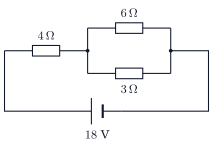
Consider the circuit in the figure.
Find the equivalent resistance.
Find the current drawn from the battery.
Find the current in the \(6\ \Omega\) and in the \(3\ \Omega\) resistor.
Answer(i) \(6\ \Omega\) (ii) \(3\) A (iii) \(1\) A, \(2\) A
Solution
\(6\ \Omega\) and \(3\ \Omega\) in parallel give \(\dfrac{6 \times 3}{9} = 2\ \Omega\). In series with \(4\ \Omega\): \(R = 6\ \Omega\).
\(I = \dfrac{18}{6} = 3\) A.
The parallel pair has \(3 \times 2 = 6\) V across it. Current in the \(6\ \Omega\): \(\dfrac{6}{6} = 1\) A. Current in the \(3\ \Omega\): \(\dfrac{6}{3} = 2\) A. Check: \(1 + 2 = 3\) A.
How did it go?
Q10
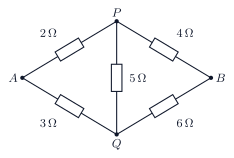
The figure shows a bridge of five resistors.
Show that the bridge is balanced, so that \(P\) and \(Q\) are at the same potential.
Find the current in the \(5\ \Omega\) resistor.
Find the equivalent resistance between \(A\) and \(B\).
Answer(i) \(\frac{2}{4} = \frac{3}{6}\) (ii) \(0\) (iii) \(3.6\ \Omega\)
Solution
Balance condition: \(\dfrac{R_{AP}}{R_{PB}} = \dfrac{R_{AQ}}{R_{QB}}\). Here \(\dfrac{2}{4} = \dfrac{1}{2}\) and \(\dfrac{3}{6} = \dfrac{1}{2}\). Both arms divide the voltage in the same ratio, so \(V_P = V_Q\).
No potential difference across the \(5\ \Omega\), so its current is \(0\). It can be removed.
Resistors of \(1\ \Omega\), \(2\ \Omega\) and \(3\ \Omega\) are all connected in parallel. Find the equivalent resistance. Then find the largest and the smallest resistance that can be made from resistors of \(2\ \Omega\), \(4\ \Omega\) and \(6\ \Omega\) using all three.
Largest: all in series, \(2 + 4 + 6 = 12\ \Omega\). Smallest: all in parallel, \(\dfrac{1}{R} = \dfrac{1}{2} + \dfrac{1}{4} + \dfrac{1}{6} = \dfrac{11}{12}\), so \(R = \dfrac{12}{11}\ \Omega \approx 1.09\ \Omega\).
How did it go?
Cutting, stretching, folding
Q12
A wire of resistance \(9\ \Omega\) is cut into three equal parts. The parts are connected in parallel. Find the equivalent resistance.
Answer\(1\ \Omega\)
Solution
Each part has resistance \(\dfrac{9}{3} = 3\ \Omega\). Three \(3\ \Omega\) in parallel: \(\dfrac{3}{3} = 1\ \Omega\). In general, cutting into \(n\) parts and joining in parallel divides \(R\) by \(n^2\).
How did it go?
Q13
A wire of resistance \(4\ \Omega\) is stretched uniformly. Find the new resistance if
the length becomes twice the original,
the radius becomes half the original.
Answer(i) \(16\ \Omega\) (ii) \(64\ \Omega\)
Solution
Volume is constant, so \(R \propto L^2\) and also \(R \propto \dfrac{1}{r^4}\).
Length doubles: \(R' = 4 \times 4 = 16\ \Omega\).
Radius halves: area becomes one quarter and length becomes \(4\) times. \(R' = 16 \times 4 = 64\ \Omega\).
How did it go?
Q14
A wire of resistance \(20\ \Omega\) is folded in half and the two halves are twisted together. Find the resistance now. What is the resistance if the wire is instead folded into four equal parts?
Answer\(5\ \Omega\); \(1.25\ \Omega\)
Solution
Folding in half gives two wires of \(10\ \Omega\) each, side by side, in parallel: \(\dfrac{10}{2} = 5\ \Omega\).
Folding into four gives four wires of \(5\ \Omega\) in parallel: \(\dfrac{5}{4} = 1.25\ \Omega\). Folding into \(n\) divides \(R\) by \(n^2\), like cutting.
How did it go?
Q15
Two wires of the same material and the same length have radii \(r\) and \(2r\).
Find the ratio of their resistances, thin to thick.
The thin wire has resistance \(4\ \Omega\). Find the resistance when the two wires are connected in parallel.
Answer(i) \(4 : 1\) (ii) \(0.8\ \Omega\)
Solution
\(R = \dfrac{\rho L}{\pi r^2}\), so \(R \propto \dfrac{1}{r^2}\). Thin to thick: \(\dfrac{(2r)^2}{r^2} = 4 : 1\).
The thick wire has \(1\ \Omega\). In parallel: \(\dfrac{4 \times 1}{5} = 0.8\ \Omega\).
How did it go?
Q16
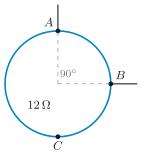
The figure shows a uniform wire ring of total resistance \(12\ \Omega\). Find the resistance between
\(A\) and \(B\), a quarter of the ring apart,
\(A\) and \(C\), at opposite ends of a diameter.
Answer(i) \(2.25\ \Omega\) (ii) \(3\ \Omega\)
Solution
The ring splits into two arcs in parallel: a quarter, \(3\ \Omega\), and three quarters, \(9\ \Omega\). \(R = \dfrac{3 \times 9}{12} = 2.25\ \Omega\).
Two half rings of \(6\ \Omega\) each in parallel: \(R = 3\ \Omega\).
How did it go?
Q17
A uniform wire of resistance \(R\) is bent into a circle. Show that the resistance between two points at the ends of a diameter is \(\frac{R}{4}\). Find the resistance between two points that divide the ring in the ratio \(1 : 2\).
Answerderivation; \(\frac{2R}{9}\)
Solution
The two half rings have \(\dfrac{R}{2}\) each and are in parallel: \(\dfrac{R/2 \times R/2}{R} = \dfrac{R}{4}\).
For points dividing the ring \(1 : 2\), the arcs are \(\dfrac{R}{3}\) and \(\dfrac{2R}{3}\). In parallel: \(\dfrac{(R/3)(2R/3)}{R} = \dfrac{2R}{9}\).
How did it go?
Q18
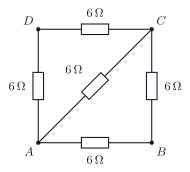
Five resistors of \(6\ \Omega\) form a square \(ABCD\) with one diagonal \(AC\), as in the figure. Find the equivalent resistance between
\(A\) and \(C\),
\(A\) and \(B\).
Answer(i) \(3\ \Omega\) (ii) \(3.75\ \Omega\)
Solution
Between \(A\) and \(C\) there are three paths in parallel. The path \(A\)-\(B\)-\(C\) is \(12\ \Omega\), the path \(A\)-\(D\)-\(C\) is \(12\ \Omega\) and the diagonal is \(6\ \Omega\). \(\dfrac{1}{R} = \dfrac{1}{12} + \dfrac{1}{12} + \dfrac{1}{6} = \dfrac{1}{3}\), so \(R = 3\ \Omega\).
Between \(A\) and \(B\): the direct \(6\ \Omega\) is in parallel with the route \(A\) to \(C\) to \(B\). From \(A\) to \(C\) the diagonal (\(6\)) is in parallel with \(A\)-\(D\)-\(C\) (\(12\)): \(4\ \Omega\). Then \(C\) to \(B\) adds \(6\): the route is \(10\ \Omega\). \(R = \dfrac{6 \times 10}{16} = 3.75\ \Omega\).
How did it go?
Q19
Five identical resistors \(R\) form a Wheatstone bridge, one in each of the four arms and one across the middle. Find the resistance between the two end points. Explain why the middle resistor can be removed.
Answer\(R\); no current in it
Solution
The bridge is balanced because \(\dfrac{R}{R} = \dfrac{R}{R}\). The two middle points are at the same potential, so no current flows in the middle resistor and it can be removed.
Each arm is then \(2R\), and two \(2R\) in parallel give \(R\).
How did it go?
Infinite ladders and symmetry
Q20
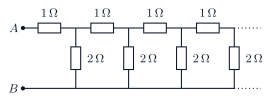
The ladder in the figure continues to infinity. Let the resistance between \(A\) and \(B\) be \(x\).
Explain why removing the first \(1\ \Omega\) and the first \(2\ \Omega\) leaves a ladder of resistance \(x\) again.
The ladder is infinite. Removing one section from the front leaves a ladder with exactly the same pattern, so its resistance is still \(x\).
The first \(1\ \Omega\) is in series with the first \(2\ \Omega\) rung in parallel with \(x\): \(x = 1 + \dfrac{2x}{2 + x}\).
\(x(2 + x) = 2 + x + 2x\), so \(x^2 - x - 2 = 0\) and \((x - 2)(x + 1) = 0\). The positive root gives \(x = 2\ \Omega\).
How did it go?
Q21
An infinite ladder has resistance \(R\) in every series arm and \(R\) in every rung. Show that the resistance between its input terminals is \(\frac{(1 + \sqrt 5)}{2}R \approx 1.62R\).
Answerderivation
Solution
Let the input resistance be \(x\). Removing the first section leaves \(x\) again, so \(x = R + \dfrac{Rx}{R + x}\).
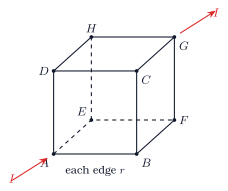
Twelve equal resistors \(r\) form the edges of a cube. A current \(I\) enters at corner \(A\) and leaves at the opposite corner \(G\).
By symmetry, find the current in each of the three edges at \(A\), and in each of the six middle edges.
Find the potential difference between \(A\) and \(G\) along the path \(A\)-\(B\)-\(C\)-\(G\).
Hence find the equivalent resistance between \(A\) and \(G\).
Answer(i) \(\frac{I}{3}\), \(\frac{I}{6}\) (ii) \(\frac{5Ir}{6}\) (iii) \(\frac{5r}{6}\)
Solution
The three edges at \(A\) look alike, so the current splits equally: \(\dfrac{I}{3}\) in each. At \(B\) the current \(\dfrac{I}{3}\) splits equally into two middle edges: \(\dfrac{I}{6}\) each. The three edges at \(G\) carry \(\dfrac{I}{3}\) each again.
21 questions · after Lesson 4, Solving Networks: the Nodal Method
Junction rule
Q23
Currents of \(3\) A and \(5\) A enter a junction and \(2\) A leaves it through a third wire. Find the current in the fourth wire and state whether it enters or leaves.
Answer\(6\) A, leaves
Solution
Current in \(= 3 + 5 = 8\) A. Current out so far \(= 2\) A. The fourth wire must carry \(6\) A out of the junction.
How did it go?
Q24
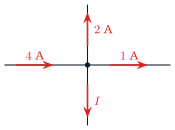
Four wires meet at the junction in the figure.
Find \(I\).
Suppose the calculation had given a negative \(I\). What would that mean?
Answer(i) \(1\) A (ii) \(I\) enters
Solution
In \(= 4\) A. Out \(= 1 + 2 + I\). So \(I = 4 - 3 = 1\) A, leaving as drawn.
A negative value means the arrow was drawn the wrong way. The current has the size found, but it enters the junction.
How did it go?
Q25
State Kirchhoff's junction rule. Which conservation law is behind it? What would happen at a junction if the rule were broken?
Answercharge conservation
Solution
The total current entering a junction equals the total current leaving it.
It follows from conservation of charge. A junction cannot create or destroy charge, and in a steady current it cannot store charge either.
If more current entered than left, charge would pile up at the junction. Its potential would rise without limit, which does not happen in a steady state.
How did it go?
Q26
State Kirchhoff's loop rule. Which conservation law is behind it?
Answerenergy conservation
Solution
The algebraic sum of the potential changes around any closed loop is zero.
It follows from conservation of energy. Potential is the energy per unit charge, and a charge carried around a loop returns to the same point with the same energy.
How did it go?
Q27
A loop is traced in a chosen direction. Write the sign of the potential change in each case. The trace crosses:
A resistor \(R\) carrying current \(I\) along the trace direction.
The same resistor against the current.
A cell of emf \(E\) from its negative to its positive terminal.
The same cell from positive to negative.
Answer(i) \(-IR\) (ii) \(+IR\) (iii) \(+E\) (iv) \(-E\)
Solution
\(-IR\). Moving with the current means moving from high to low potential.
\(+IR\).
\(+E\). The positive terminal is higher by \(E\) (ideal cell).
\(-E\).
How did it go?
Single loop
Q28
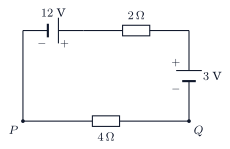
In the loop shown, the \(3\) V cell opposes the \(12\) V cell.
Write the loop equation and find the current.
Find the potential difference across the \(4\ \Omega\) resistor.
Which cell is being charged?
Answer(i) \(1.5\) A (ii) \(6\) V (iii) \(3\) V cell
Solution
Take the current \(I\) clockwise, out of the positive plate of the \(12\) V cell. Going clockwise: \(+12 - 2I - 3 - 4I = 0\), so \(6I = 9\) and \(I = 1.5\) A.
\(V = IR = 1.5 \times 4 = 6\) V.
The current enters the \(3\) V cell at its positive plate, so that cell is being charged.
How did it go?
Q29
The \(3\) V cell of Question 6 is reversed so that it helps the \(12\) V cell. Find the current and the potential difference across the \(4\ \Omega\) resistor now.
Answer\(2.5\) A; \(10\) V
Solution
Now the emfs add: \(12 + 3 - 2I - 4I = 0\), so \(I = \dfrac{15}{6} = 2.5\) A. Across the \(4\ \Omega\): \(2.5 \times 4 = 10\) V.
How did it go?
Q30
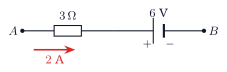
The figure shows part of a larger circuit. A current of \(2\) A flows from \(A\) to \(B\).
Find \(V_A - V_B\).
Find \(V_A - V_B\) if the cell is reversed.
Answer(i) \(12\) V (ii) \(0\)
Solution
Walk from \(A\) to \(B\). Across the resistor, with the current: \(-2 \times 3 = -6\) V. Across the cell from \(+\) to \(-\): \(-6\) V. So \(V_B = V_A - 12\), and \(V_A - V_B = 12\) V.
With the cell reversed we cross it from \(-\) to \(+\): \(+6\) V. \(V_A - V_B = 6 - 6 = 0\).
How did it go?
Q31
The potential at a point \(A\) is \(10\) V. Going from \(A\) to \(B\) we first pass through a \(4\ \Omega\) resistor carrying \(2\) A in our direction. We then pass through a \(5\) V cell from its negative to its positive terminal. Find the potential at \(B\).
Answer\(7\) V
Solution
\(V_B = V_A - IR + E = 10 - 2 \times 4 + 5 = 7\) V.
How did it go?
Two loops
Q32
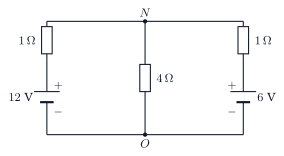
Take the potential of \(O\) as zero and let the potential of \(N\) be \(V\).
Write the current in each branch in terms of \(V\), taking currents from each cell towards \(N\).
Apply the junction rule at \(N\) and find \(V\).
Find the three currents.
Answer(ii) \(8\) V (iii) \(4\) A, \(2\) A, \(-2\) A
Solution
Left branch, from the \(12\) V cell up to \(N\): \(I_1 = \dfrac{12 - V}{1}\). Right branch: \(I_2 = \dfrac{6 - V}{1}\). Middle branch, down from \(N\) to \(O\): \(I_3 = \dfrac{V}{4}\).
At \(N\): \(I_1 + I_2 = I_3\). So \((12 - V) + (6 - V) = \dfrac{V}{4}\). Then \(72 - 8V = V\) and \(V = 8\) V.
\(I_1 = 4\) A, \(I_3 = 2\) A, \(I_2 = 6 - 8 = -2\) A. The minus sign means \(2\) A flows down through the \(6\) V branch, into the cell's positive plate.
How did it go?
Q33
For the circuit of Question 10:
Which cell is being charged? Give the reason.
Find the power delivered by the \(12\) V cell, the power absorbed by the \(6\) V cell and the total heat in the resistors. Check that the powers balance.
Answer(i) \(6\) V cell (ii) \(48\) W; \(12\) W; \(36\) W
Solution
The \(6\) V cell. The current enters it at the positive plate, so the cell absorbs energy.
Delivered: \(12 \times 4 = 48\) W. Absorbed by the \(6\) V cell: \(6 \times 2 = 12\) W. Heat: \(4^2 \times 1 + 2^2 \times 4 + 2^2 \times 1 = 16 + 16 + 4 = 36\) W. Check: \(48 = 12 + 36\).
How did it go?
Q34
The \(4\ \Omega\) resistor of Question 10 is replaced by \(2\ \Omega\). Find \(V\) and the three currents.
Answer\(7.2\) V; \(4.8\), \(3.6\), \(-1.2\) A
Solution
\((12 - V) + (6 - V) = \dfrac{V}{2}\), so \(36 - 4V = V\) and \(V = 7.2\) V.
\(I_1 = 12 - 7.2 = 4.8\) A, \(I_3 = \dfrac{7.2}{2} = 3.6\) A, \(I_2 = 6 - 7.2 = -1.2\) A. Check: \(4.8 - 1.2 = 3.6\).
How did it go?
Q35
Describe the nodal method in three steps. Why is it faster than writing loop equations for a circuit with many parallel branches?
Answerdescriptive
Solution
Step 1: choose one node as the reference and call its potential zero. Step 2: give each other node a potential symbol. Write the current in every branch as (potential difference)/(resistance), including the emf of any cell in the branch. Step 3: apply the junction rule at each unknown node and solve.
Parallel branches share the same two nodes, so one unknown handles all of them. The loop method needs one unknown current per branch and one equation per loop.
How did it go?
Q36
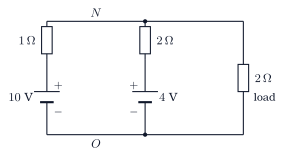
In the circuit shown, take \(V_O = 0\) and let \(V_N = V\).
Write the junction equation at \(N\) and find \(V\).
Find the current in each branch. State the direction of the current in the \(4\) V cell.
Answer(i) \(6\) V (ii) \(4\) A, \(-1\) A, \(3\) A; into its \(+\)
Solution
Currents towards \(N\): \(\dfrac{10 - V}{1}\) and \(\dfrac{4 - V}{2}\). Current away through the load: \(\dfrac{V}{2}\). So \(10 - V + \dfrac{4 - V}{2} = \dfrac{V}{2}\). Multiply by \(2\): \(20 - 2V + 4 - V = V\), so \(V = 6\) V.
\(10\) V branch: \(10 - 6 = 4\) A upward. \(4\) V branch: \(\dfrac{4 - 6}{2} = -1\) A, so \(1\) A flows downward into the positive plate of the \(4\) V cell. Load: \(\dfrac{6}{2} = 3\) A. Check: \(4 - 1 = 3\).
How did it go?
Q37
For the circuit of Question 14, find the power delivered by the \(10\) V cell and the power absorbed by the \(4\) V cell. Find the heat produced in the three resistors. Check that the powers balance.
Answer\(40\) W; \(4\) W; \(36\) W
Solution
Delivered: \(10 \times 4 = 40\) W. Absorbed by the \(4\) V cell: \(4 \times 1 = 4\) W.
A \(2\) V cell and a \(4\) V cell, each of internal resistance \(1\ \Omega\), are connected in parallel with like terminals together. A \(2\ \Omega\) resistor is connected across them. Find the potential difference across the resistor and the current through each cell.
Answer\(2.4\) V; \(-0.4\) A, \(1.6\) A
Solution
Let the common voltage be \(V\). Currents towards the top node: \(\dfrac{2 - V}{1}\) and \(\dfrac{4 - V}{1}\); through the load: \(\dfrac{V}{2}\).
\(2 - V + 4 - V = \dfrac{V}{2}\), so \(12 - 4V = V\) and \(V = 2.4\) V.
\(2\) V cell: \(2 - 2.4 = -0.4\) A, so \(0.4\) A flows into the cell (it is being charged). \(4\) V cell: \(1.6\) A out. Load: \(1.2\) A. Check: \(1.6 - 0.4 = 1.2\).
How did it go?
Q39
Two identical cells are connected in a loop with a resistor so that their emfs oppose each other. Find the current in the loop and the potential difference across the resistor. Give the reason.
Answer\(0\); \(0\)
Solution
Going around the loop the two emfs cancel: \(E - E - IR = 0\), so \(I = 0\). No current means no potential difference across the resistor.
How did it go?
Q40
Two cells of emf \(E_1\) and \(E_2\) and internal resistances \(r_1\) and \(r_2\) are in parallel, like terminals together. Use the junction rule to show that the open-circuit voltage across them is \(V = \frac{E_1/r_1 + E_2/r_2}{1/r_1 + 1/r_2}\).
Answerderivation
Solution
Let the voltage across the pair be \(V\), with nothing connected outside. Current from cell 1 towards the positive node: \(\dfrac{E_1 - V}{r_1}\). From cell 2: \(\dfrac{E_2 - V}{r_2}\).
No current leaves the pair, so the two currents add to zero: \(\dfrac{E_1 - V}{r_1} + \dfrac{E_2 - V}{r_2} = 0\).
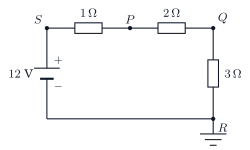
In the figure, the point \(R\) is earthed, so \(V_R = 0\).
Find the current in the loop.
Find the potentials of \(S\), \(P\) and \(Q\).
Answer(i) \(2\) A (ii) \(12\), \(10\), \(6\) V
Solution
Total resistance \(= 1 + 2 + 3 = 6\ \Omega\). \(I = \dfrac{12}{6} = 2\) A.
Start at \(R\) (\(0\) V) and go backwards against the current to the positive plate: \(V_S = 12\) V. Then move with the current: \(V_P = 12 - 2 \times 1 = 10\) V, \(V_Q = 10 - 2 \times 2 = 6\) V, \(V_R = 6 - 2 \times 3 = 0\) V. Consistent.
How did it go?
Q42
The earth connection in Question 19 is moved from \(R\) to \(Q\). Find the potentials of \(S\), \(P\), \(Q\) and \(R\) now. Does the current change?
Answer\(6\), \(4\), \(0\), \(-6\) V; no
Solution
Earthing only fixes the zero; the differences stay the same. With \(V_Q = 0\): \(V_P = 4\) V, \(V_S = 6\) V, \(V_R = -6\) V.
The current does not change. The earth connection carries no current, and the loop equation does not depend on where the zero is.
How did it go?
Q43
Using the numbers of Question 19, write the sum of the potential changes going once around the loop from \(S\) back to \(S\). Show that the sum is zero.
Answer\(-2 - 4 - 6 + 12 = 0\)
Solution
From \(S\) with the current: \(-2 \times 1 - 2 \times 2 - 2 \times 3 = -12\) V across the three resistors. Then through the cell from \(-\) to \(+\): \(+12\) V.
Sum \(= -2 - 4 - 6 + 12 = 0\), as the loop rule requires.
How did it go?
RC Circuits
21 questions · after Lesson 6, Discharging and Reading RC Graphs
Time constant and charging
Q44
A \(500\ \mu\)F capacitor is charged through a \(2\) k\(\Omega\) resistor.
Find the time constant \(\tau = RC\).
Show that the unit ohm \(\times\) farad is the second.
\(\Omega \times\) F \(= \dfrac{\text{V}}{\text{A}} \times \dfrac{\text{C}}{\text{V}} = \dfrac{\text{C}}{\text{A}} = \dfrac{\text{C}}{\text{C/s}} =\) s.
How did it go?
Q45
The circuit of Question 1 is connected to a \(12\) V battery at \(t = 0\). The charge grows as \(q = CE(1 - e^{-t/\tau})\). Take \(\frac{1}{e} = 0.37\).
Find the final charge on the capacitor.
Find the charge at \(t = 1\) s.
Answer(i) \(6\) mC (ii) \(3.8\) mC
Solution
\(q_{\max} = CE = 500 \times 10^{-6} \times 12 = 6 \times 10^{-3}\) C \(= 6\) mC.
For the circuit of Question 2, the current is \(i = \frac{E}{R}e^{-t/\tau}\). Find the current at \(t = 0\), at \(t = 1\) s and after a very long time.
Answer\(6\) mA; \(2.2\) mA; \(0\)
Solution
\(i_0 = \dfrac{E}{R} = \dfrac{12}{2000} = 6\) mA. At \(t = 1\) s \(= \tau\): \(i = 6 \times 0.37 = 2.2\) mA. After a long time the capacitor is full and \(i = 0\).
How did it go?
Q47
For the circuit of Question 2, take \(\ln 2 = 0.69\) and \(\ln 100 = 4.6\).
Find the time at which the charge is half its final value.
Find the time at which the charge is \(99\%\) of its final value.
Answer(i) \(0.69\) s (ii) \(4.6\) s
Solution
\(1 - e^{-t/\tau} = \dfrac{1}{2}\), so \(e^{-t/\tau} = \dfrac{1}{2}\) and \(t = \tau \ln 2 = 0.69\) s.
\(e^{-t/\tau} = 0.01\), so \(t = \tau \ln 100 = 4.6\) s. After about five time constants the capacitor is practically full.
How did it go?
Q48
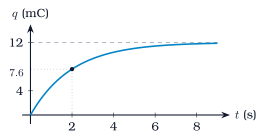
The figure shows the charge on a capacitor being charged through a resistor from a \(6\) V battery.
Read the final charge and find the capacitance.
The charge reaches \(63\%\) of its final value at \(t = 2\) s. What is the time constant?
Find the resistance.
Answer(i) \(12\) mC; \(2\) mF (ii) \(2\) s (iii) \(1\) k\(\Omega\)
Solution
The curve levels off at \(12\) mC. \(C = \dfrac{q_{\max}}{E} = \dfrac{12 \times 10^{-3}}{6} = 2 \times 10^{-3}\) F \(= 2\) mF.
At \(t = \tau\) the charge is \((1 - 1/e) = 63\%\) of the maximum. So \(\tau = 2\) s.
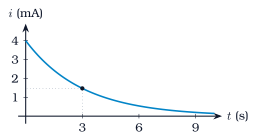
The figure shows the current while a capacitor discharges through a resistor. The current falls to \(\frac{1}{e}\) of its initial value at \(t = 3\) s.
Read the initial current and the time constant.
The capacitor is \(300\ \mu\)F. Find the resistance and the initial voltage on the capacitor.
Answer(i) \(4\) mA; \(3\) s (ii) \(10\) k\(\Omega\); \(40\) V
Solution
At \(t = 0\) the graph gives \(i_0 = 4\) mA. The current is \(i_0/e\) at \(t = \tau\), so \(\tau = 3\) s.
One quarter is two halvings: \(t = 2 \times 0.69 = 1.38\) s. Each halving takes the same time, like radioactive decay.
How did it go?
Q52
A capacitor discharges through a resistor. The charge falls to \(\frac{1}{e}\) of its initial value in \(5\) s. The capacitor is \(100\ \mu\)F. Find the time constant and the resistance.
Answer\(5\) s; \(50\) k\(\Omega\)
Solution
The charge falls to \(\dfrac{1}{e}\) in one time constant, so \(\tau = 5\) s. \(R = \dfrac{\tau}{C} = \dfrac{5}{10^{-4}} = 5 \times 10^{4}\ \Omega = 50\) k\(\Omega\).
How did it go?
t = 0 and t = infinity
Q53
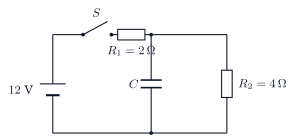
In the circuit shown, \(C = 3\ \mu\)F and the switch \(S\) is closed at \(t = 0\).
Find the current drawn from the battery just after the switch is closed.
Find the current drawn after a long time.
Find the final potential difference across the capacitor and the final charge on it.
Answer(i) \(6\) A (ii) \(2\) A (iii) \(8\) V; \(24\ \mu\)C
Solution
At \(t = 0\) the capacitor has no charge and no voltage. It acts as a wire across \(R_2\), so \(R_2\) carries no current. \(I = \dfrac{12}{2} = 6\) A.
After a long time no current flows into the capacitor. \(R_1\) and \(R_2\) are in series: \(I = \dfrac{12}{6} = 2\) A.
The capacitor is across \(R_2\): \(V_C = 2 \times 4 = 8\) V. \(q = CV = 3 \times 8 = 24\ \mu\)C.
How did it go?
Q54
Explain why a capacitor behaves like a plain wire at \(t = 0\) and like a gap in the circuit at \(t = \infty\). State what is the same and what is different in the two cases.
Answerdescriptive
Solution
At \(t = 0\) the capacitor is uncharged, so the potential difference across it is zero, exactly like a wire. Current flows into it freely.
At \(t = \infty\) the capacitor is full. Its voltage balances the rest of the circuit and no more current flows into it, exactly like a gap.
Same in both cases: no current can pass between the plates. Different: at \(t = 0\) the voltage is zero, at \(t = \infty\) the current is zero.
How did it go?
Q55
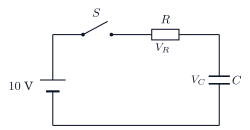
In the circuit shown, the switch is closed at \(t = 0\). Take \(\frac{1}{e} = 0.37\).
Find \(V_R\) and \(V_C\) at \(t = 0\).
Find \(V_R\) and \(V_C\) at \(t = \tau\).
Find \(V_R\) and \(V_C\) after a long time. What is \(V_R + V_C\) at every instant?
Answer(i) \(10\) V, \(0\) (ii) \(3.7\) V, \(6.3\) V (iii) \(0\), \(10\) V; \(10\) V
Solution
\(V_C = 0\) (uncharged), so \(V_R = E = 10\) V.
\(V_C = E(1 - e^{-1}) = 10 \times 0.63 = 6.3\) V. \(V_R = E e^{-1} = 3.7\) V.
\(V_C = 10\) V and \(V_R = 0\). By the loop rule \(V_R + V_C = E = 10\) V at every instant.
How did it go?
Q56
A \(100\ \mu\)F capacitor is charged through \(10\) k\(\Omega\) from \(10\) V. Take \(\ln 10 = 2.3\).
Find the charge and the current at \(t = \tau\).
Find the time at which the charge is \(900\ \mu\)C.
Answer(i) \(630\ \mu\)C, \(0.37\) mA (ii) \(2.3\) s
Solution
\(\tau = 10^{4} \times 10^{-4} = 1\) s. \(q_{\max} = CE = 10^{-4} \times 10 = 10^{-3}\) C \(= 1000\ \mu\)C. At \(t = \tau\): \(q = 0.63 \times 1000 = 630\ \mu\)C and \(i = \dfrac{10}{10^{4}} \times 0.37 = 0.37\) mA.
\(900 = 1000(1 - e^{-t})\), so \(e^{-t} = 0.1\) and \(t = \ln 10 = 2.3\) s.
How did it go?
Energy
Q57
The \(500\ \mu\)F capacitor of Question 2 is fully charged from the \(12\) V battery.
Find the energy supplied by the battery.
Find the energy stored in the capacitor.
Find the heat produced in the resistor. What fraction of the supplied energy is this?
Answer(i) \(72\) mJ (ii) \(36\) mJ (iii) \(36\) mJ; half
Solution
The battery moves charge \(q = CE\) through \(E\): \(W = CE^2 = 500 \times 10^{-6} \times 144 = 0.072\) J \(= 72\) mJ.
\(U = \dfrac{1}{2}CE^2 = 36\) mJ.
Heat \(= 72 - 36 = 36\) mJ, exactly half. This is true for any \(R\); the resistance only sets how fast the heat is produced.
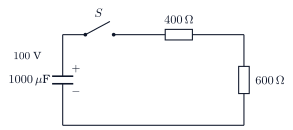
How did it go?
Q58
In the circuit shown, the switch is closed at \(t = 0\). Take \(\frac{1}{e} = 0.37\).
Find the time constant and the initial current.
Find the potential difference across the \(600\ \Omega\) resistor at \(t = 0\) and at \(t = 1\) s.
Answer(i) \(1\) s; \(0.1\) A (ii) \(60\) V; \(22\) V
At \(t = 0\): \(V = 0.1 \times 600 = 60\) V. At \(t = 1\) s \(= \tau\): \(i = 0.037\) A, so \(V = 0.037 \times 600 = 22\) V.
How did it go?
Q59
For the circuit of Question 15, find the total heat produced during the discharge and the heat produced in each resistor.
Answer\(5\) J; \(2\) J, \(3\) J
Solution
All the stored energy becomes heat: \(H = \dfrac{1}{2}CV^2 = \dfrac{1}{2} \times 10^{-3} \times 10^{4} = 5\) J.
The same current flows through both resistors at every instant, so the heat divides in the ratio of the resistances, \(400 : 600 = 2 : 3\). Heat in \(400\ \Omega\): \(2\) J. Heat in \(600\ \Omega\): \(3\) J.
How did it go?
Understanding
Q60
In a charging RC circuit, the initial current does not depend on \(C\), and the final charge does not depend on \(R\). Explain both.
Answerdescriptive
Solution
At \(t = 0\) the capacitor has no voltage, so the whole emf is across \(R\) and \(i_0 = \dfrac{E}{R}\). The capacitor plays no part yet.
At \(t = \infty\) the current is zero, so there is no voltage across \(R\). The whole emf is across the capacitor and \(q = CE\). The resistance only decides how long this takes.
How did it go?
Q61
A capacitor of \(2\ \mu\)F is charged through \(1\) M\(\Omega\). Find the time constant. The resistance is doubled and the capacitance is halved. What happens to the time constant?
Answer\(2\) s; unchanged
Solution
\(\tau = 10^{6} \times 2 \times 10^{-6} = 2\) s. With \(2R\) and \(\dfrac{C}{2}\) the product \(RC\) is unchanged, so \(\tau\) stays \(2\) s.
How did it go?
Q62
Show by differentiation that \(q = CE(1 - e^{-t/RC})\) satisfies the loop equation \(E - \frac{q}{C} - R\frac{dq}{dt} = 0\).
Answerderivation
Solution
\(\dfrac{dq}{dt} = CE \times \dfrac{1}{RC}e^{-t/RC} = \dfrac{E}{R}e^{-t/RC}\).
Substitute: \(E - \dfrac{q}{C} - R\dfrac{dq}{dt} = E - E(1 - e^{-t/RC}) - E e^{-t/RC} = E - E + E e^{-t/RC} - E e^{-t/RC} = 0\).
How did it go?
Q63
Show that \(RC\) has the dimensions of time, starting from \(R = \frac{V}{I}\) and \(C = \frac{q}{V}\).
Answerderivation
Solution
\(RC = \dfrac{V}{I} \times \dfrac{q}{V} = \dfrac{q}{I}\). Current is charge per time, so \(\dfrac{q}{I}\) is a time. \([RC] = \dfrac{[\text{AT}]}{[\text{A}]} = [\text{T}]\).
How did it go?
Q64
In the circuit of Question 10 the battery is replaced by a plain wire after the capacitor is fully charged. Through what resistance does the capacitor discharge? Find the time constant of the discharge.
Answer\(\frac{4}{3}\ \Omega\); \(4\ \mu\)s
Solution
With the battery replaced by a wire, the capacitor sees \(R_2\) in parallel with \(R_1\): \(R = \dfrac{2 \times 4}{6} = \dfrac{4}{3}\ \Omega\).