Questions on Cells, Bridges and Measuring Instruments, the kind your examinations ask. Solve one on paper. Then tell the book how it went. The book believes you, and it uses your answer to plan your revision.
0%
Nothing marked yetMark honestly. Peek at the answer only after your own attempt.
Cells, Internal Resistance and Combinations of Cells
22 questions · after Lesson 2, Combinations of Cells
Emf and terminal voltage
Q1
A cell of emf \(12\) V and internal resistance \(1\ \Omega\) is connected to a \(5\ \Omega\) resistor.
Find the current.
Find the terminal voltage of the cell and the potential drop inside the cell.
\(V = IR = 2 \times 5 = 10\) V. Drop inside the cell \(= Ir = 2 \times 1 = 2\) V. Check: \(10 + 2 = 12\) V.
How did it go?
Q2
Define the emf \(E\) and the terminal voltage \(V\) of a cell. When is \(V = E\)? When is \(V\) greater than \(E\)?
Answer\(V = E\) at \(I = 0\); \(V > E\) when charging
Solution
The emf is the work done by the cell per unit charge moved through it. It equals the potential difference across the terminals when no current flows.
The terminal voltage is the potential difference across the terminals when the cell is in a circuit: \(V = E - Ir\) when discharging.
\(V = E\) when \(I = 0\) (open circuit, or \(r = 0\)). \(V = E + Ir\), greater than \(E\), when the cell is being charged.
How did it go?
Q3
A cell reads \(2\) V on an ideal voltmeter when nothing else is connected. When the cell sends \(1\) A through a resistor, the voltmeter reads \(1.5\) V. Find the internal resistance and the external resistance.
Answer\(0.5\ \Omega\); \(1.5\ \Omega\)
Solution
With no current \(V = E = 2\) V. With \(1\) A: \(1.5 = 2 - 1 \times r\), so \(r = 0.5\ \Omega\).
Find the power delivered to a load \(R\) for \(R = \frac{r}{2}\), \(R = r\) and \(R = 2r\), each as a multiple of \(\frac{E^2}{r}\). What do you notice about the first and the third?
\(P = \dfrac{E^2R}{(R + r)^2}\). For \(R = \dfrac{r}{2}\): \(\dfrac{E^2 (r/2)}{(3r/2)^2} = \dfrac{2}{9}\dfrac{E^2}{r}\). For \(R = r\): \(\dfrac{1}{4}\dfrac{E^2}{r}\). For \(R = 2r\): \(\dfrac{2E^2 r}{9r^2} = \dfrac{2}{9}\dfrac{E^2}{r}\).
The loads \(\dfrac{r}{2}\) and \(2r\) receive the same power. In general, \(R\) and \(\dfrac{r^2}{R}\) give equal power.
How did it go?
Charging and energy
Q9
A battery of emf \(12\) V and internal resistance \(0.5\ \Omega\) is charged by a charger that pushes \(4\) A into its positive terminal.
Find the terminal voltage during charging.
Find the power stored as chemical energy and the power lost as heat.
Answer(i) \(14\) V (ii) \(48\) W; \(8\) W
Solution
During charging the current is forced in against the emf: \(V = E + Ir = 12 + 4 \times 0.5 = 14\) V.
Stored: \(EI = 12 \times 4 = 48\) W. Heat: \(I^2r = 16 \times 0.5 = 8\) W. The charger supplies \(VI = 14 \times 4 = 56\) W \(= 48 + 8\).
How did it go?
Q10
A cell of emf \(E\) and internal resistance \(r\) sends a current \(I\) through a load. Use the power balance \(EI = VI + I^2r\) to show that \(V = E - Ir\).
Answerderivation
Solution
\(EI\) is the power supplied by the chemical reaction. \(VI\) is the power delivered to the outside circuit and \(I^2r\) is the heat inside the cell.
Energy is conserved: \(EI = VI + I^2r\). Divide by \(I\): \(E = V + Ir\), so \(V = E - Ir\).
How did it go?
Q11
The headlights of a car dim for a moment when the starter motor runs. Explain using the internal resistance of the battery.
Answerlarge \(I\), large \(Ir\)
Solution
The starter motor draws a very large current, perhaps \(100\) A. The drop \(Ir\) inside the battery becomes large, so the terminal voltage \(V = E - Ir\) falls. The headlights are across the terminals, so they get less voltage and dim. When the motor stops, \(I\) falls and \(V\) recovers.
How did it go?
Combinations
Q12
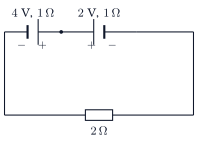
Two cells are connected in opposition, as in the figure.
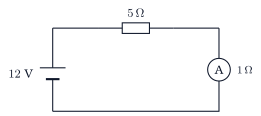
Find the net emf and the current.
Find the terminal voltage of each cell.
Answer(i) \(2\) V; \(0.5\) A (ii) \(3.5\) V, \(2.5\) V
Solution
Net emf \(= 4 - 2 = 2\) V. Total resistance \(= 1 + 1 + 2 = 4\ \Omega\). \(I = \dfrac{2}{4} = 0.5\) A, driven by the \(4\) V cell.
The \(4\) V cell discharges: \(V = 4 - 0.5 \times 1 = 3.5\) V. The \(2\) V cell is being charged: \(V = 2 + 0.5 \times 1 = 2.5\) V. Check: \(3.5 - 2.5 = 1\) V \(= 0.5 \times 2\) across the resistor.
How did it go?
Q13
Four cells, each of emf \(2\) V and internal resistance \(1\ \Omega\), are connected in series to a \(4\ \Omega\) resistor. Find the total emf, the total internal resistance and the current.
The four cells of Question 13 are now connected in parallel, like terminals together, to a \(0.75\ \Omega\) resistor. Find the emf and internal resistance of the combination and the current.
Compare Questions 13 and 14. When does a series combination give the larger current, and when does a parallel combination? State the rule in terms of \(R\) and \(r\).
Answerseries if \(R \gg r\); parallel if \(R \ll r\)
If \(R \gg r\) the internal resistance hardly matters and series wins because the emf is \(n\) times larger. If \(R \ll r\) the internal resistance controls the current and parallel wins because it is \(n\) times smaller.
How did it go?
Q16
Twelve cells, each of emf \(2\) V and internal resistance \(1\ \Omega\), are arranged in \(3\) parallel rows of \(4\) cells each. The combination drives a load of \(\frac{4}{3}\ \Omega\).
Find the emf and the internal resistance of the combination.
Find the current.
Show that this arrangement gives the largest current for this load.
Answer(i) \(8\) V; \(\frac{4}{3}\ \Omega\) (ii) \(3\) A (iii) \(R = \frac{nr}{m}\)
Solution
Each row: \(4 \times 2 = 8\) V and \(4\ \Omega\). Three rows in parallel: \(E = 8\) V, \(r = \dfrac{4}{3}\ \Omega\).
\(I = \dfrac{8}{4/3 + 4/3} = \dfrac{8}{8/3} = 3\) A.
For \(m\) rows of \(n\) cells the internal resistance is \(\dfrac{nr}{m}\). The current is largest when this equals \(R\) (Question 6). Here \(\dfrac{nr}{m} = \dfrac{4}{3} = R\), so the current is the largest possible.
How did it go?
Q17
Cells of emf \(6\) V and \(3\) V, each with internal resistance \(1\ \Omega\), are connected in parallel, like terminals together. Find the emf and the internal resistance of the combination. Find the current through a \(4\ \Omega\) load connected across the combination.
\(n\) identical cells of emf \(E\) and internal resistance \(r\) are connected in series, but one cell is connected the wrong way round. Find the net emf and the total internal resistance. Evaluate both for \(n = 6\).
Answer\((n - 2)E\); \(nr\); \(4E\), \(6r\)
Solution
The reversed cell subtracts its emf instead of adding it: net emf \(= (n - 1)E - E = (n - 2)E\). Internal resistances add regardless of direction: \(nr\).
For \(n = 6\): \(4E\) and \(6r\).
How did it go?
Measurement and circuits
Q19
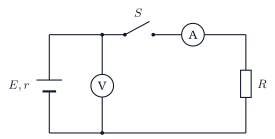
In the circuit shown, the meters are ideal. With the switch open the voltmeter reads \(6\) V. With the switch closed it reads \(5\) V and the ammeter reads \(2\) A.
Find the emf and the internal resistance of the cell.
Find \(R\).
Answer(i) \(6\) V; \(0.5\ \Omega\) (ii) \(2.5\ \Omega\)
Solution
Switch open: no current, so the voltmeter reads the emf, \(E = 6\) V. Switch closed: \(5 = 6 - 2r\), so \(r = 0.5\ \Omega\).
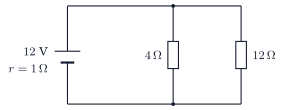
In the circuit shown, find the current drawn from the cell, the terminal voltage, and the current in each resistor.
Answer\(3\) A; \(9\) V; \(2.25\) A, \(0.75\) A
Solution
Load: \(\dfrac{4 \times 12}{16} = 3\ \Omega\). \(I = \dfrac{12}{3 + 1} = 3\) A. Terminal voltage \(V = 3 \times 3 = 9\) V.
Currents: \(\dfrac{9}{4} = 2.25\) A in the \(4\ \Omega\) and \(\dfrac{9}{12} = 0.75\) A in the \(12\ \Omega\). Check: \(2.25 + 0.75 = 3\) A.
How did it go?
Q21
A torch has two cells in series, each of emf \(1.5\) V and internal resistance \(0.5\ \Omega\), and a bulb of resistance \(2\ \Omega\). Find the current, the power of the bulb and the heat produced per second inside the cells.
Answer\(1\) A; \(2\) W; \(1\) W
Solution
\(E = 3\) V, \(r = 1\ \Omega\). \(I = \dfrac{3}{2 + 1} = 1\) A. Bulb: \(I^2R = 2\) W. Cells: \(I^2r = 1\) W. Total \(3\) W \(= EI\).
How did it go?
Q22
A cell gives a terminal voltage of \(5.5\) V when it supplies \(1\) A and \(5\) V when it supplies \(2\) A. Find its internal resistance and its emf.
Answer\(0.5\ \Omega\); \(6\) V
Solution
\(5.5 = E - r\) and \(5 = E - 2r\). Subtract: \(0.5 = r\), so \(r = 0.5\ \Omega\) and \(E = 6\) V.
How did it go?
Meter Bridge, Post Office Box and Potentiometer
24 questions · after Lesson 5, The Potentiometer
Wheatstone bridge and meter bridge
Q23
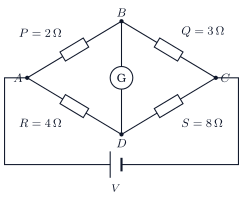
State the balance condition of a Wheatstone bridge with arms \(P\), \(Q\), \(R\), \(S\). Why does no current flow through the galvanometer at balance?
Answer\(\frac{P}{Q} = \frac{R}{S}\); \(B\) and \(D\) at the same potential
Solution
Balance: \(\dfrac{P}{Q} = \dfrac{R}{S}\). The two arms \(P\) and \(R\) then drop the same fraction of the cell voltage. So the junctions \(B\) and \(D\) are at the same potential. With no potential difference across the galvanometer, no current flows through it.
How did it go?
Q24
A Wheatstone bridge is balanced. Does removing the galvanometer change the current in any arm? Give the reason.
Answerno; \(G\) carried no current anyway
Solution
No. At balance the galvanometer carries no current, so removing it leaves every current exactly as it was. The two branches \(P\)-\(Q\) and \(R\)-\(S\) behave as two independent series pairs across the cell.
How did it go?
Q25
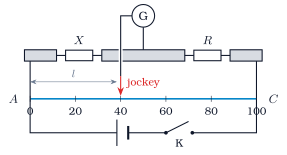
The known resistance is \(R = 6\) Ω and the null point is at \(40\) cm.
Find \(X\).
\(X\) and \(R\) are interchanged. Where is the new null point?
With \(R\) on the left: \(\dfrac{6}{4} = \dfrac{l}{100 - l}\), so \(l = 60\) cm. The null point mirrors about the middle.
How did it go?
Q26
Why is \(R\) chosen so that the null point lies near the middle of the wire?
Answerleast percentage error; equal arm resistances
Solution
The error in \(X\) from a small error \(\delta l\) in reading the null point is least when \(l = 50\) cm, because \(\dfrac{\delta X}{X} = \delta l\left(\dfrac{1}{l} + \dfrac{1}{100 - l}\right)\) is smallest there. The bridge is also most sensitive when all four arms are of the same order.
How did it go?
Q27
Known resistances of \(2\) Ω and \(3\) Ω give a null point at \(40.1\) cm. Interchanged, the null point is at \(60.4\) cm. Find the end corrections \(\alpha\) and \(\beta\) in cm, using \(\frac{P}{Q} = \frac{l + \alpha}{100 - l + \beta}\).
A resistance is put in series with the galvanometer of a balanced meter bridge. Does the null point move? Why is such a resistance useful while searching for the null point?
Answerno; protects \(G\) from large deflections
Solution
No. At the null point no current flows through the galvanometer branch, so its resistance does not matter. While hunting for the null point, the series resistance keeps the galvanometer current small and protects the instrument. It is shorted near balance for full sensitivity.
How did it go?
Q29
The bridge wire warms up uniformly during a long experiment. Does the null point shift? What if instead the unknown copper coil \(X\) warms up?
Answerno; yes, moves right
Solution
Uniform warming multiplies the resistance of every centimetre of the wire by the same factor, so the ratio \(\dfrac{l}{100 - l}\) at balance is unchanged: no shift. If \(X\) alone warms, its resistance rises, so the null point moves to the right (larger \(l\)) to keep \(\dfrac{X}{R} = \dfrac{l}{100 - l}\).
How did it go?
Q30
In a balanced Wheatstone bridge the cell and the galvanometer are interchanged. Is the bridge still balanced? Explain.
Answeryes; the balance condition is symmetric
Solution
Yes. The condition \(\dfrac{P}{Q} = \dfrac{R}{S}\) can be rewritten \(\dfrac{P}{R} = \dfrac{Q}{S}\), which is the balance condition for the bridge with the cell and galvanometer swapped. Balance does not depend on which diagonal carries the cell.
How did it go?
Post office box
Q31
With \(P = Q = 10\) Ω the deflection reverses between \(R = 27\) Ω and \(28\) Ω.
What does this tell you about \(X\)?
With \(P = 100\) Ω, \(Q = 10\) Ω the reversal is between \(273\) Ω and \(274\) Ω. Find the range of \(X\).
With \(P = 1000\) Ω, \(Q = 10\) Ω the null is at \(R = 2734\) Ω. Find \(X\).
Answer(i) \(27 < X < 28\) Ω (ii) \(27.3 < X < 27.4\) Ω (iii) \(27.34\) Ω
Solution
\(X = R\dfrac{Q}{P} = R\). The reversal shows \(X\) lies between \(27\) and \(28\) Ω.
\(X = \dfrac{R}{10}\), so \(X\) lies between \(27.3\) and \(27.4\) Ω.
Why are the ratio arms of a post office box given the values \(10\), \(100\) and \(1000\) Ω?
Answer\(X = R\frac{Q}{P}\) to \(1\), \(0.1\), \(0.01\) Ω
Solution
\(X = R\dfrac{Q}{P}\). With \(P = 10\), \(100\), \(1000\) and \(Q = 10\), the box reads \(X\) to \(1\) Ω, then \(0.1\) Ω, then \(0.01\) Ω. The same resistance box in steps of \(1\) Ω serves every stage. Each step adds one decimal place.
How did it go?
Q33
In the post office box the battery key is pressed before the galvanometer key. Give the reason.
Answerlet the current settle; avoid induced jolts of \(G\)
Solution
The coils have some inductance, so the current takes a moment to settle when the battery key is closed. If the galvanometer were already connected, it would receive a transient jolt that has nothing to do with balance. Pressing the battery key first lets the current become steady.
How did it go?
Potentiometer
Q34
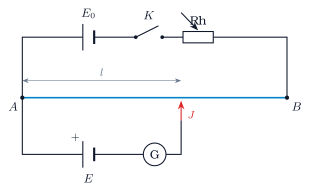
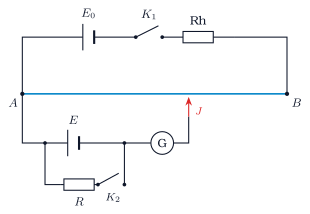
The wire \(AB\) is \(4\) m long with resistance \(8\) Ω. \(E_0 = 2\) V has negligible internal resistance and \(Rh = 0\).
Find the potential gradient along the wire.
The cell \(E\) balances at \(l = 2.4\) m. Find \(E\).
\(Rh\) is set to \(8\) Ω. Find the new gradient. Can \(E\) still be balanced?
Answer(i) \(0.5\) V/m (ii) \(1.2\) V (iii) \(0.25\) V/m; no, \(4.8\) m needed
Solution
The whole \(2\) V drops across the wire: gradient \(= \dfrac{2}{4} = 0.5\) V/m.
\(E = 0.5 \times 2.4 = 1.2\) V.
Current \(= \dfrac{2}{8 + 8} = 0.125\) A, drop across the wire \(= 1\) V, gradient \(0.25\) V/m. Balancing \(1.2\) V would need \(4.8\) m, longer than the wire, so no null point is found.
How did it go?
Q35
With \(K_2\) open the null point is at \(3\) m. With \(K_2\) closed and \(R = 10\) Ω it is at \(2.5\) m.
Why does the null point move towards \(A\) when \(K_2\) is closed?
Find the internal resistance \(r\) of the cell.
Answer(i) terminal voltage \(< E\) (ii) \(2\) Ω
Solution
With \(K_2\) closed the cell drives a current through \(R\). The potentiometer now balances the terminal voltage \(V = E - Ir\), which is less than \(E\). A smaller voltage needs a shorter length.
Two cells balance at \(3\) m and \(2\) m on the same potentiometer. Find the ratio of their emfs.
Answer\(3 : 2\)
Solution
At balance \(E = kl\) with the same gradient \(k\): \(\dfrac{E_1}{E_2} = \dfrac{3}{2}\).
How did it go?
Q37
Why does a potentiometer measure the emf of a cell correctly, while a voltmeter across the cell reads less than the emf?
Answerno current drawn at balance; voltmeter draws current, \(V = E - Ir\)
Solution
At the null point the potentiometer draws no current from the cell. There is no drop across the internal resistance, so the balanced voltage is the full emf. A voltmeter must draw a small current \(I\) to deflect, so it reads \(V = E - Ir\).
How did it go?
Q38
State what happens to the null point length \(l\) in each case. (i) The driver emf \(E_0\) is increased. (ii) A resistance is added in series with the wire. (iii) The emf of the cell \(E\) exceeds the potential drop across the whole wire.
Answer(i) \(l\) decreases (ii) \(l\) increases (iii) no null point
Solution
(i) The gradient rises, so the same \(E\) balances at a shorter \(l\). (ii) The current falls, the gradient falls, and \(l\) increases. (iii) No point on the wire has a potential drop as large as \(E\). The galvanometer deflects the same way everywhere: no null point.
How did it go?
Q39
A \(2\) V driver cell is connected to a \(4\) m wire of resistance \(4\) Ω through a series resistance of \(4\) Ω. Find the current, the potential drop across the wire and the potential gradient.
Answer\(0.25\) A; \(1\) V; \(0.25\) V/m
Solution
\(I = \dfrac{2}{4 + 4} = 0.25\) A. Drop across the wire \(= 0.25 \times 4 = 1\) V. Gradient \(= \dfrac{1}{4} = 0.25\) V/m.
How did it go?
Q40
How can a potentiometer be made more sensitive? Give two ways and the reason.
Answerlonger wire; series resistance; smaller gradient
Solution
Reduce the potential gradient: use a longer wire, or add resistance in series with the wire to lower the current. A smaller gradient means a given change in \(E\) moves the null point through a larger length, which is easier to read.
How did it go?
Q41
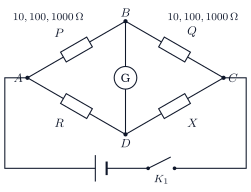
Take \(V = 10\) V for the cell and ignore its internal resistance.
Is the bridge balanced?
Find the potentials of \(B\) and \(D\) with \(G\) removed, taking \(C\) as \(0\) V.
In which direction does current flow through \(G\)? What value of \(S\) balances the bridge?
Answer(i) no (ii) \(V_B = 6\) V; \(V_D \approx 6.67\) V (iii) \(D\) to \(B\); \(6\) Ω
Solution
\(\dfrac{P}{Q} = \dfrac{2}{3}\) but \(\dfrac{R}{S} = \dfrac{4}{8} = \dfrac{1}{2}\). Not balanced.
Branch \(ABC\): \(I = \dfrac{10}{5} = 2\) A, so \(V_B = 3 \times 2 = 6\) V above \(C\). Branch \(ADC\): \(I = \dfrac{10}{12}\) A, so \(V_D = 8 \times \dfrac{10}{12} \approx 6.67\) V.
\(D\) is higher, so current flows from \(D\) to \(B\) through \(G\). Balance needs \(\dfrac{4}{S} = \dfrac{2}{3}\), so \(S = 6\) Ω.
How did it go?
Q42
In a bridge with \(P = Q\), \(R = 5\) Ω and \(S = 5.2\) Ω, which arm should be changed, and how, to reach balance?
Answerraise \(R\) to \(5.2\) Ω or lower \(S\) to \(5\) Ω
Solution
Balance needs \(R = S\) when \(P = Q\). Either raise \(R\) to \(5.2\) Ω or lower \(S\) to \(5\) Ω; in practice the adjustable arm is changed by \(0.2\) Ω.
How did it go?
Small situations
Q43
A meter bridge with \(R = 5\) Ω balances at \(50\) cm. Find \(X\). A \(5\) Ω resistor is now connected across \(X\). Find the new null point.
Answer\(5\) Ω; \(33.3\) cm
Solution
\(\dfrac{X}{5} = \dfrac{50}{50}\), so \(X = 5\) Ω. With \(5\) Ω in parallel the left gap has \(2.5\) Ω: \(\dfrac{2.5}{5} = \dfrac{l}{100 - l}\), so \(100 - l = 2l\) and \(l = 33.3\) cm.
How did it go?
Q44
A \(1.5\) V cell balances at \(300\) cm on a potentiometer. Another cell balances at \(250\) cm. Find its emf.
Why are the connecting strips of a meter bridge made of thick copper?
Answernegligible resistance in the gaps
Solution
The strips join the wire ends to the gaps holding \(X\) and \(R\). Thick copper has negligible resistance. The only resistances in the bridge arms are then \(X\), \(R\) and the two parts of the wire, as the formula assumes.
How did it go?
Q46
A cell of emf \(E\) and internal resistance \(r\) balances at \(l_1\) on open circuit and at \(l_2\) with a resistance \(R\) across it. Show that \(r = R\frac{l_1 - l_2}{l_2}\).
Answer\(\frac{E}{V} = \frac{l_1}{l_2}\) with \(V = \frac{ER}{R + r}\)
Solution
Open circuit: \(E = kl_1\). With \(R\) across the cell the current is \(I = \dfrac{E}{R + r}\) and the terminal voltage \(V = IR = \dfrac{ER}{R + r} = kl_2\). Dividing: \(\dfrac{E}{V} = \dfrac{R + r}{R} = \dfrac{l_1}{l_2}\), so \(1 + \dfrac{r}{R} = \dfrac{l_1}{l_2}\) and \(r = R\dfrac{l_1 - l_2}{l_2}\).
How did it go?
Galvanometer to Ammeter and Voltmeter
24 questions · after Lesson 6, Galvanometer to Ammeter and Voltmeter
Sensitivity
Q47
Define the current sensitivity and the voltage sensitivity of a galvanometer. A galvanometer of resistance \(50\) Ω deflects \(20\) divisions for \(1\) mA. Find both sensitivities.
Current sensitivity is the deflection per unit current, \(\dfrac{\theta}{I}\). Voltage sensitivity is the deflection per unit voltage, \(\dfrac{\theta}{V} = \dfrac{\theta}{IG}\). Here \(\dfrac{\theta}{I} = 20\) div/mA and \(\dfrac{\theta}{V} = \dfrac{20}{1 \times 50} = 0.4\) div/mV.
How did it go?
Q48
A galvanometer has full-scale current \(I_g\) and resistance \(G\). Why can it not be used directly to measure a current of a few amperes or a voltage of a few volts?
Answercoil burns above \(I_g\); needs only \(I_gG\) volts for full scale
Solution
The coil is fine and deflects fully at a current of only \(I_g\), typically a milliampere or less. More current would drive the needle past the stop and burn the coil. Likewise it needs only \(I_gG\), a fraction of a volt, for full deflection, so a few volts would overload it.
How did it go?
Ammeter
Q49
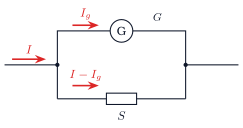
The galvanometer has \(G = 100\) Ω and \(I_g = 1\) mA. It is to read \(1\) A at full scale.
Write the condition that fixes \(S\).
Find \(S\).
Find the resistance of the ammeter so formed.
Answer(i) \(I_gG = (I - I_g)S\) (ii) \(\approx 0.1\) Ω (iii) \(\approx 0.1\) Ω
Solution
\(G\) and \(S\) are in parallel, so they have the same potential difference: \(I_gG = (I - I_g)S\).
Why is the shunt a small resistance, and why is it connected in parallel with the galvanometer?
Answerto carry almost all the current; same voltage as \(G\)
Solution
The shunt must carry almost all the current, leaving only \(I_g\) for the coil, so it must be much smaller than \(G\). Only a parallel connection divides the current between two paths while keeping the same voltage across both.
How did it go?
Q51
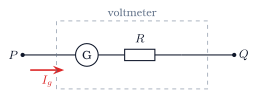
The same galvanometer (\(G = 100\) Ω, \(I_g = 1\) mA) is to read \(10\) V at full scale.
Find \(R\).
Find the resistance of the voltmeter.
Answer(i) \(9900\) Ω (ii) \(10^{4}\) Ω
Solution
At full scale \(I_g\) flows through \(G + R\) with \(10\) V across: \(R = \dfrac{V}{I_g} - G = \dfrac{10}{10^{-3}} - 100 = 9900\) Ω.
\(R_V = G + R = 10^{4}\) Ω.
How did it go?
Q52
The ammeter of Q3 is to be changed to read \(5\) A at full scale. Find the new shunt.
Answer\(\approx 0.02\) Ω
Solution
\(S = \dfrac{10^{-3} \times 100}{5 - 0.001} = \dfrac{0.1}{4.999} \approx 0.02\) Ω. A larger range needs a smaller shunt.
How did it go?
Q53
The ammeter of Q3 carries \(0.5\) A. What fraction of full scale does the needle show? Why is the scale linear?
Answerhalf; \(I_g \propto I\) for fixed \(S\)
Solution
Half scale. The current divides in the fixed ratio \(S : G\), so the coil current is always the same fraction \(\dfrac{S}{S + G}\) of the total. Half the total gives half of \(I_g\), and the deflection is proportional to the coil current.
How did it go?
Q54
What fraction of the total current passes through the galvanometer coil in the ammeter of Q3? Why must an ammeter have a very low resistance?
Answer\(0.1\%\); not to change the current it measures
Solution
\(\dfrac{I_g}{I} = \dfrac{10^{-3}}{1} = 0.1\%\); the shunt carries \(99.9\%\). An ammeter goes in series with the circuit element, so its resistance adds to the circuit. A low resistance keeps the current almost what it was before the meter was inserted.
How did it go?
Q55
A galvanometer of \(G = 50\) Ω and \(I_g = 2\) mA is converted into an ammeter of range \(2\) A. Find the shunt.
Find the current that flowed before the ammeter was inserted.
Find the percentage error caused by the ammeter.
Answer(i) \(2\) A (ii) \(2.4\) A (iii) \(16.7\%\)
Solution
\(I = \dfrac{12}{5 + 1} = 2\) A.
Without the meter: \(\dfrac{12}{5} = 2.4\) A.
Error \(= \dfrac{2.4 - 2}{2.4} = 16.7\%\). The meter's own resistance reduces the current it is trying to measure.
How did it go?
Q57
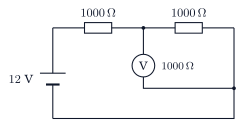
The voltmeter has resistance \(1000\) Ω.
Find the resistance of the second resistor with the voltmeter across it.
Find the voltmeter reading.
What would an ideal voltmeter read?
Answer(i) \(500\) Ω (ii) \(4\) V (iii) \(6\) V
Solution
\(1000\) Ω in parallel with \(1000\) Ω: \(500\) Ω.
Total resistance \(1500\) Ω, current \(\dfrac{12}{1500} = 8\) mA. Reading \(= 0.008 \times 500 = 4\) V.
With no current drawn, the two equal resistors share \(12\) V equally: \(6\) V.
How did it go?
Q58
Why must a voltmeter have a very high resistance? What is the resistance of an ideal voltmeter and of an ideal ammeter?
Answernot to draw current from the circuit; infinite; zero
Solution
A voltmeter goes across the element. If its resistance is high it draws almost no current, so the currents and voltages in the circuit stay as they were. An ideal voltmeter has infinite resistance; an ideal ammeter has zero resistance.
How did it go?
Q59
A voltmeter is rated \(1000\) Ω per volt. Find its resistance on the \(10\) V range. Would it give a better reading than the meter of Q11? Explain.
Answer\(10^{4}\) Ω; yes, \(\approx 5.7\) V, closer to \(6\) V
Solution
\(1000 \times 10 = 10^{4}\) Ω. Across the \(1000\) Ω resistor: parallel value \(\dfrac{1000 \times 10000}{11000} \approx 909\) Ω, current \(\dfrac{12}{1909} \approx 6.3\) mA, reading \(\approx 5.7\) V. Much closer to the true \(6\) V than the \(4\) V of Q11, because the meter draws far less current.
How did it go?
Q60
A galvanometer of \(G = 50\) Ω and \(I_g = 2\) mA is converted into a voltmeter of range \(5\) V. Find the series resistance.
The voltmeter of Q14 is to have its range raised to \(20\) V. Find the extra resistance to be added in series.
Answer\(7500\) Ω
Solution
For \(20\) V: \(R' = \dfrac{20}{0.002} - 50 = 9950\) Ω. Extra resistance \(= 9950 - 2450 = 7500\) Ω.
How did it go?
Q62
The galvanometer of Q3 is connected in series with \(9900\) Ω across a \(5\) V cell of negligible internal resistance. What fraction of full scale does it show?
Answerhalf
Solution
Total resistance \(100 + 9900 = 10^{4}\) Ω. Current \(= \dfrac{5}{10^{4}} = 0.5\) mA, half of \(I_g\): the needle stands at half scale. This is just the \(10\) V voltmeter of Q5 reading \(5\) V.
How did it go?
Two-range meters and small situations
Q63
The galvanometer has \(G = 100\) Ω and \(I_g = 1\) mA.
An ammeter of resistance \(0.1\) Ω reads \(1\) A at full scale. A \(0.1\) Ω resistor is connected across it. Find the new full-scale current.
Answer\(2\) A
Solution
The added \(0.1\) Ω equals the meter's resistance, so at full deflection it carries the same \(1\) A as the meter. Total \(= 2\) A.
How did it go?
Q65
A student connects an ammeter directly across the terminals of a cell. Why is this dangerous for the meter?
Answerlow resistance, huge current
Solution
An ammeter has a very low resistance, about \(0.1\) Ω or less. Across a cell it lets a current of many amperes flow, limited only by the cell's internal resistance, far above the meter's full-scale value. The shunt or coil overheats and may burn.
How did it go?
Q66
In a circuit, which meter is connected in series with the element and which in parallel? Give the reason in terms of their resistances.
Answerammeter in series (low \(R\)); voltmeter in parallel (high \(R\))
Solution
The ammeter goes in series so that the whole current passes through it; its low resistance then hardly changes that current. The voltmeter goes in parallel so that it has the element's voltage across it; its high resistance then draws almost no current.
How did it go?
Q67
The galvanometer of Q1 (20 divisions for \(1\) mA) is shunted to read \(1\) A at full scale. What current does one division now represent?
Answer\(50\) mA per division
Solution
Full scale is \(20\) divisions for \(1\) A, so one division is \(\dfrac{1}{20}\) A \(= 50\) mA. The shunt trades sensitivity for range.
How did it go?
Q68
A galvanometer of \(G = 100\) Ω is shunted with \(S = 1\) Ω. What fraction of the total current goes through the coil?
Answer\(\frac{1}{101} \approx 1\%\)
Solution
\(\dfrac{I_g}{I} = \dfrac{S}{S + G} = \dfrac{1}{101} \approx 1\%\). The rest, about \(99\%\), passes through the shunt.
How did it go?
Q69
Show that the resistance of an ammeter is approximately equal to its shunt when \(S \ll G\).
Answer\(\frac{GS}{G + S} \approx S\)
Solution
\(R_A = \dfrac{GS}{G + S} = \dfrac{S}{1 + S/G}\). When \(S \ll G\) the denominator is nearly \(1\), so \(R_A \approx S\). For Q3, \(\dfrac{100 \times 0.1}{100.1} = 0.0999\) Ω.
How did it go?
Q70
Starting from the fact that \(G\) and \(S\) have the same potential difference across them, derive \(S = \frac{I_gG}{I - I_g}\).
Answer\(I_gG = (I - I_g)S\)
Solution
The coil carries \(I_g\) and the shunt carries the rest, \(I - I_g\). Equal potential differences: \(I_gG = (I - I_g)S\). Solving for the shunt: \(S = \dfrac{I_gG}{I - I_g}\).