Questions on Magnetic Force on Moving Charges, the kind your examinations ask. Solve one on paper. Then tell the book how it went. The book believes you, and it uses your answer to plan your revision.
0%
Nothing marked yetMark honestly. Peek at the answer only after your own attempt.
Lorentz Force, Circular and Helical Paths, Cyclotron
24 questions · after Lesson 5, The Cyclotron
Lorentz force
Q1
Write the magnetic force on a moving charge as a cross product and give its magnitude. A proton moves at \(2 \times 10^{6}\) m/s perpendicular to a field of \(0.5\) T. Find the force. Take \(e = 1.6 \times 10^{-19}\) C.
Answer\(\vec F = q\vec v \times \vec B\), \(F = qvB\sin\theta\); \(1.6 \times 10^{-13}\) N
Solution
\(\vec F = q\vec v \times \vec B\), magnitude \(qvB\sin\theta\), perpendicular to both \(\vec v\) and \(\vec B\). \(F = 1.6 \times 10^{-19} \times 2 \times 10^{6} \times 0.5 = 1.6 \times 10^{-13}\) N.
How did it go?
Q2
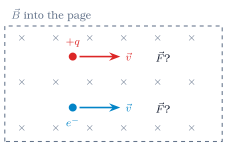
The field points into the page.
Find the direction of the force on \(+q\).
Find the direction of the force on the electron.
Answer(i) up the page (ii) down the page
Solution
\(\vec v\) is to the right (\(\hat i\)) and \(\vec B\) into the page (\(-\hat k\)): \(\hat i \times (-\hat k) = \hat j\). For a positive charge the force is up the page.
The electron's charge is negative, so its force is opposite: down the page.
How did it go?
Q3
Why does the magnetic force never do work on a charge? What does this say about its speed and kinetic energy?
Answer\(\vec F \perp \vec v\); both constant
Solution
\(\vec F = q\vec v \times \vec B\) is always perpendicular to \(\vec v\), so \(\vec F \cdot \vec v = 0\) and the power delivered is zero. The force changes only the direction of motion; the speed and the kinetic energy stay constant.
How did it go?
Q4
Find the magnetic force on (i) a charge moving parallel to \(\vec B\), (ii) a charge at rest in \(\vec B\).
Answer(i) zero (ii) zero
Solution
(i) \(\sin\theta = 0\), so \(F = 0\): the charge moves on undisturbed. (ii) \(v = 0\), so \(F = 0\): a magnetic field does not act on a stationary charge.
How did it go?
Q5
A charge of \(2\) μC moves with \(\vec v = (3\hat i + 4\hat j) \times 10^{4}\) m/s in \(\vec B = 0.1\hat k\) T. Find the force and its magnitude.
Answer\((8\hat i - 6\hat j) \times 10^{-3}\) N; \(0.01\) N
Solution
\(\vec v \times \vec B = 10^{4} \times 0.1\,(3\hat i + 4\hat j) \times \hat k = 10^{3}(-3\hat j + 4\hat i)\). \(\vec F = 2 \times 10^{-6} \times 10^{3}(4\hat i - 3\hat j) = (8\hat i - 6\hat j) \times 10^{-3}\) N, magnitude \(10^{-2}\) N.
How did it go?
Q6
In a velocity selector \(\vec E\) and \(\vec B\) are crossed. Show that a charge passes undeflected if \(v = \frac{E}{B}\). Find \(v\) for \(E = 10^{5}\) V/m and \(B = 0.2\) T.
Answer\(qE = qvB\); \(5 \times 10^{5}\) m/s
Solution
The electric force \(qE\) and the magnetic force \(qvB\) are arranged to be opposite. They cancel when \(qE = qvB\), that is \(v = \dfrac{E}{B}\), whatever the charge or mass. \(v = \dfrac{10^{5}}{0.2} = 5 \times 10^{5}\) m/s.
How did it go?
Circular motion
Q7
A charge moves perpendicular to a uniform field. Derive the radius and the period of its circular path. Find both for a proton at \(10^{6}\) m/s in \(0.1\) T. Take \(m_p = 1.67 \times 10^{-27}\) kg.
Answer\(r = \frac{mv}{qB}\), \(T = \frac{2\pi m}{qB}\); \(0.1\) m; \(6.6 \times 10^{-7}\) s
Solution
The force \(qvB\) is the centripetal force: \(qvB = \dfrac{mv^2}{r}\), so \(r = \dfrac{mv}{qB}\). \(T = \dfrac{2\pi r}{v} = \dfrac{2\pi m}{qB}\). Proton: \(r = \dfrac{1.67 \times 10^{-27} \times 10^{6}}{1.6 \times 10^{-19} \times 0.1} \approx 0.1\) m; \(T = \dfrac{2\pi \times 1.67 \times 10^{-27}}{1.6 \times 10^{-20}} \approx 6.6 \times 10^{-7}\) s.
How did it go?
Q8
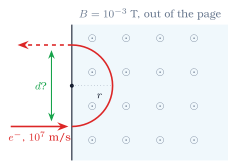
The electron enters the field at right angles to the boundary. Take \(m_e = 9.1 \times 10^{-31}\) kg.
Find the radius of the path.
Find the distance \(d\) between the entry and exit points.
Find the time spent inside the field.
Answer(i) \(5.7\) cm (ii) \(11.4\) cm (iii) \(1.8 \times 10^{-8}\) s
The path is a semicircle, so \(d = 2r \approx 11.4\) cm.
Half a period: \(t = \dfrac{\pi m}{qB} = \dfrac{\pi \times 9.1 \times 10^{-31}}{1.6 \times 10^{-22}} \approx 1.8 \times 10^{-8}\) s.
How did it go?
Q9
A proton and an alpha particle enter the same field perpendicular to it. Compare the radii of their paths when they have (i) the same kinetic energy, (ii) the same momentum.
\(r = \dfrac{mv}{qB} = \dfrac{\sqrt{2mK}}{qB}\). (i) Same \(K\): \(\dfrac{r_\alpha}{r_p} = \dfrac{\sqrt{4m}/2e}{\sqrt{m}/e} = 1\): equal radii. (ii) Same momentum \(p\): \(r = \dfrac{p}{qB}\), so \(\dfrac{r_p}{r_\alpha} = \dfrac{2e}{e} = 2\).
How did it go?
Q10
Find the frequency of revolution of an electron in a field of \(10^{-3}\) T. Does it depend on the speed?
Answer\(2.8 \times 10^{7}\) Hz; no
Solution
\(f = \dfrac{1}{T} = \dfrac{qB}{2\pi m} = \dfrac{1.6 \times 10^{-19} \times 10^{-3}}{2\pi \times 9.1 \times 10^{-31}} \approx 2.8 \times 10^{7}\) Hz. It does not depend on the speed: a faster electron moves on a bigger circle in the same time.
How did it go?
Q11
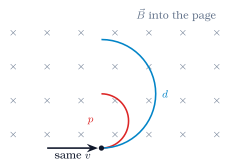
A proton and a deuteron enter with the same speed.
Find \(\frac{r_d}{r_p}\).
Find \(\frac{T_d}{T_p}\).
Answer(i) \(2\) (ii) \(2\)
Solution
\(r \propto \dfrac{m}{q}\) at the same speed. The deuteron has twice the mass and the same charge: \(\dfrac{r_d}{r_p} = 2\).
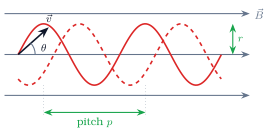
\(v\sin\theta\), perpendicular to \(\vec B\), feels the force and produces the circle. \(v\cos\theta\), along \(\vec B\), feels no force and carries the particle steadily along the field.
\(r = \dfrac{mv\sin\theta}{qB}\) and \(p = v\cos\theta \times T = \dfrac{2\pi mv\cos\theta}{qB}\).
How did it go?
Q16
For what angle \(\theta\) is the pitch of the helix equal to the circumference of its circle?
Answer\(45^\circ\)
Solution
Pitch \(= 2\pi r\) means \(\dfrac{2\pi mv\cos\theta}{qB} = \dfrac{2\pi mv\sin\theta}{qB}\), so \(\tan\theta = 1\) and \(\theta = 45^\circ\).
How did it go?
Q17
Charged particles from the Sun spiral along the Earth's magnetic field lines and reach the atmosphere near the poles. Explain using the helical motion.
Answer\(v_\parallel\) carries them along the lines, which dip into the poles
Solution
A particle with a velocity component along the field spirals around a field line and drifts along it. The Earth's field lines run from pole to pole and dip into the surface near the poles. The spiralling particles are guided there and strike the upper atmosphere, giving the aurora.
How did it go?
Cyclotron and selector
Q18
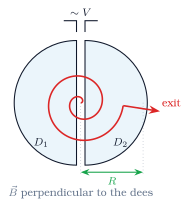
Protons are accelerated in a cyclotron with \(B = 1.5\) T.
Why must the oscillator frequency equal the cyclotron frequency?
Find that frequency.
Answer(i) the gap voltage must reverse each half turn (ii) \(2.3 \times 10^{7}\) Hz
Solution
The proton gains energy only while crossing the gap. It crosses once every half revolution, alternately in opposite directions, so the gap voltage must reverse every half period. The oscillator must therefore run at the frequency of revolution, \(\dfrac{qB}{2\pi m}\), which is the same for every radius.
The dees of Q18 have radius \(0.5\) m. Find the maximum kinetic energy of the protons in joules and in MeV. Take \(1\) MeV \(= 1.6 \times 10^{-13}\) J.
At the edge \(v = \dfrac{qBR}{m}\), so \(K = \dfrac{q^2B^2R^2}{2m} = \dfrac{(1.6 \times 10^{-19})^2 \times 2.25 \times 0.25}{2 \times 1.67 \times 10^{-27}} \approx 4.3 \times 10^{-12}\) J \(\approx 27\) MeV.
How did it go?
Q20
Why is an ordinary cyclotron unsuitable for accelerating electrons to high energies?
Answerelectron mass grows with speed; falls out of step
Solution
Electrons are light and reach speeds close to \(c\) after only a few million volts. Their mass then grows with speed, so the revolution frequency \(\dfrac{qB}{2\pi m}\) falls. The electrons arrive at the gap out of step with the fixed oscillator. They stop gaining energy.
How did it go?
Q21
The alternating voltage in Q18 has amplitude \(50\) kV. How much energy does a proton gain per revolution, and how many revolutions does it make to reach \(27\) MeV?
Answer\(100\) keV; \(270\)
Solution
Two gap crossings per revolution, each giving \(qV = 50\) keV: \(100\) keV per revolution. Revolutions \(= \dfrac{27 \times 10^{6}}{10^{5}} = 270\).
How did it go?
Q22
A velocity selector has \(E = 2 \times 10^{4}\) V/m and \(B = 0.01\) T. Find the selected speed. Which way is a faster particle deflected?
Answer\(2 \times 10^{6}\) m/s; the magnetic way
Solution
\(v = \dfrac{E}{B} = \dfrac{2 \times 10^{4}}{0.01} = 2 \times 10^{6}\) m/s. For a faster particle the magnetic force \(qvB\) exceeds the electric force \(qE\), so it is deflected in the direction of the magnetic force.
How did it go?
Q23
Ions leaving the selector of Q22 enter a field of \(1\) T. Find the radii for singly charged ions of mass \(20\) u and \(22\) u. Take \(1\) u \(= 1.66 \times 10^{-27}\) kg.
Answer\(0.415\) m; \(0.457\) m
Solution
\(r = \dfrac{mv}{qB}\). For \(20\) u: \(\dfrac{20 \times 1.66 \times 10^{-27} \times 2 \times 10^{6}}{1.6 \times 10^{-19} \times 1} = 0.415\) m. For \(22\) u: \(0.457\) m. The two isotopes land about \(8\) cm apart after a semicircle.
How did it go?
Q24
Show that the period of a charge in a uniform magnetic field does not depend on its speed or on the radius of its path.
\(r = \dfrac{mv}{qB}\), so \(T = \dfrac{2\pi r}{v} = \dfrac{2\pi m}{qB}\). The speed has cancelled: a faster charge moves on a proportionally larger circle and takes the same time. Only \(\dfrac{m}{q}\) and \(B\) fix the period.