Questions on Magnetic Force on Currents and the Magnetic Dipole, the kind your examinations ask. Solve one on paper. Then tell the book how it went. The book believes you, and it uses your answer to plan your revision.
0%
Nothing marked yetMark honestly. Peek at the answer only after your own attempt.
Force on Current-Carrying Wires
24 questions · after Lesson 3, Parallel Wires and the Ampere
Straight wires
Q1
Write the force on a straight wire of length \(L\) carrying current \(I\) in a uniform field \(\vec B\). Find its magnitude for a \(0.5\) m wire carrying \(3\) A perpendicular to \(0.2\) T.
Answer\(\vec F = I\vec L \times \vec B\); \(0.3\) N
Solution
\(\vec F = I\vec L \times \vec B\), where \(\vec L\) points along the current. Magnitude \(BIL\sin\theta\). Perpendicular: \(F = 0.2 \times 3 \times 0.5 = 0.3\) N.
How did it go?
Q2
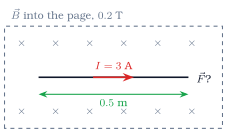
The wire carries \(3\) A to the right in a field into the page.
Find the direction of the force.
Find its magnitude.
Answer(i) up the page (ii) \(0.3\) N
Solution
\(\vec L\) to the right (\(\hat i\)), \(\vec B\) into the page (\(-\hat k\)): \(\hat i \times (-\hat k) = \hat j\). The force is up the page.
\(F = BIL = 0.2 \times 3 \times 0.5 = 0.3\) N.
How did it go?
Q3
The wire of Q1 is turned so that it makes \(30^\circ\) with the field. Find the force. What is the force when the wire is parallel to the field?
Answer\(0.15\) N; zero
Solution
\(F = BIL\sin 30^\circ = 0.3 \times 0.5 = 0.15\) N. Parallel to the field, \(\sin\theta = 0\): no force.
How did it go?
Q4
A wire of cross-section \(A\) has \(n\) free electrons per unit volume drifting at speed \(v_d\). Start from the Lorentz force on one electron. Show that the force on a length \(L\) of the wire is \(BIL\) when \(\vec B\) is perpendicular to it.
Answer\(F = (nAL)ev_dB = BIL\)
Solution
Each electron feels \(ev_dB\). The length \(L\) contains \(nAL\) electrons, so the total force is \(nALev_dB\). The current is \(I = nAev_d\), so \(F = (nAev_d)LB = BIL\). The forces on the electrons are passed to the wire through collisions with the lattice.
How did it go?
Q5
A wire carries \(2\) A along \(\vec L = 0.5\hat j\) m in a field \(\vec B = 0.4\hat i\) T. Find the force vector.
Answer\(-0.4\hat k\) N
Solution
\(\vec F = I\vec L \times \vec B = 2 \times 0.5 \times 0.4\,(\hat j \times \hat i) = 0.4(-\hat k) = -0.4\hat k\) N.
How did it go?
Q6
A horizontal wire of length \(1\) m and mass \(0.1\) kg lies in a horizontal field of \(0.5\) T perpendicular to it. Take \(g = 10\) m/s\(^2\). Find the current that makes the wire float, and state the direction of the force needed.
Answer\(2\) A; force upward
Solution
The magnetic force must balance the weight: \(BIL = mg\), so \(I = \dfrac{mg}{BL} = \dfrac{0.1 \times 10}{0.5 \times 1} = 2\) A. The force must be upward, which fixes the direction of the current by \(\vec L \times \vec B\).
How did it go?
Curved wires
Q7
State the rule for the force on a wire of any shape in a uniform field. What is the net force on a closed loop in a uniform field?
Answer\(\vec F = I\vec L_{\text{eff}} \times \vec B\), \(\vec L_{\text{eff}}\) joins the ends; zero
Solution
In a uniform field, a wire of any shape feels the same force as a straight wire joining its two ends. So \(\vec F = I\vec L_{\text{eff}} \times \vec B\). For a closed loop the ends coincide, \(\vec L_{\text{eff}} = 0\), and the net force is zero.
How did it go?
Q8
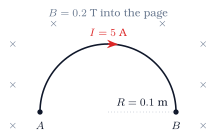
The semicircle carries \(5\) A from \(A\) to \(B\).
Find the effective length of the wire.
Find the force on it.
Answer(i) \(0.2\) m (ii) \(0.2\) N
Solution
The effective length is the diameter \(AB\): \(2R = 0.2\) m.
\(F = BIL_{\text{eff}} = 0.2 \times 5 \times 0.2 = 0.2\) N, perpendicular to \(AB\) in the plane of the page.
How did it go?
Q9
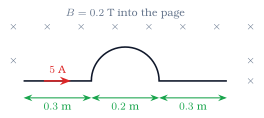
The whole wire carries \(5\) A in the field of \(0.2\) T.
Find the effective length.
Find the total force.
Answer(i) \(0.8\) m (ii) \(0.8\) N
Solution
The ends are \(0.3 + 0.2 + 0.3 = 0.8\) m apart along a straight line, so \(L_{\text{eff}} = 0.8\) m.
\(F = 0.2 \times 5 \times 0.8 = 0.8\) N, perpendicular to the line joining the ends.
How did it go?
Q10
A square loop of side \(0.2\) m carrying \(4\) A lies in a uniform field of \(0.5\) T. The field is in the plane of the loop. Find the net force on the loop. Is there a torque?
Answerzero; yes
Solution
The loop is closed, so the net force is zero. The two sides perpendicular to the field feel equal and opposite forces along different lines, forming a couple. So there is a torque that tends to turn the loop's plane perpendicular to the field.
How did it go?
Q11
The semicircle of Q8 is now placed with the field in its plane, perpendicular to the diameter \(AB\). Find the force on it and its direction. What is the force if the field is instead along \(AB\)?
Answer\(0.2\) N, perpendicular to the plane; zero
Solution
\(\vec L_{\text{eff}}\) is the diameter \(AB\), \(0.2\) m. With \(\vec B\) in the plane and perpendicular to \(AB\): \(F = BIL_{\text{eff}} = 0.2 \times 5 \times 0.2 = 0.2\) N, directed perpendicular to the plane of the semicircle. With \(\vec B\) along \(AB\), \(\vec L_{\text{eff}} \parallel \vec B\) and the force is zero.
How did it go?
Q12
Explain why a uniform field exerts no net force on any closed current loop, using the effective-length rule.
Answer\(\vec L_{\text{eff}} = 0\) for a closed loop
Solution
Split the loop into small elements \(d\vec l\). The total force is \(I\left(\sum d\vec l\right) \times \vec B\). For a closed loop the vector sum of the elements is zero, because the path returns to its start. So the net force is zero whatever the shape.
How did it go?
Parallel wires
Q13
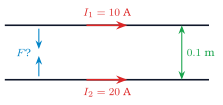
Write the force per unit length between two long parallel wires carrying \(I_1\) and \(I_2\) at separation \(d\). Find it for \(10\) A and \(20\) A, \(0.1\) m apart.
Do the wires attract or repel? Explain with the field of one wire and the force on the other.
Is the force on the \(10\) A wire equal to the force on the \(20\) A wire?
Answer(i) attract (ii) yes, action and reaction
Solution
At the upper wire the field of the lower wire (current to the right) points out of the page. The force \(I\vec L \times \vec B\) on the upper current, to the right, is then downward, towards the lower wire. Likewise the lower wire is pulled up. Same direction: attraction.
Yes. Newton's third law holds: \(\dfrac{\mu_0I_1I_2}{2\pi d}\) per unit length on each, in opposite directions.
How did it go?
Q15
State how the ampere is defined using two parallel wires.
Answer\(1\) A gives \(2 \times 10^{-7}\) N/m at \(1\) m
Solution
Let the same steady current flow in two infinitely long parallel wires one metre apart in vacuum. The current is one ampere when the force between them is \(2 \times 10^{-7}\) newton per metre of length.
How did it go?
Q16
Three long parallel wires lie in a plane, \(0.1\) m apart, each carrying \(10\) A in the same direction. Find the force per unit length on the middle wire and on an outer wire.
Answerzero; \(3 \times 10^{-4}\) N/m inward
Solution
Middle wire: pulled equally towards each neighbour, net zero. Outer wire: attracted by the middle wire, \(\dfrac{2 \times 10^{-7} \times 100}{0.1} = 2 \times 10^{-4}\) N/m, and by the far wire, \(\dfrac{2 \times 10^{-7} \times 100}{0.2} = 10^{-4}\) N/m, both inward: \(3 \times 10^{-4}\) N/m towards the centre.
How did it go?
Q17
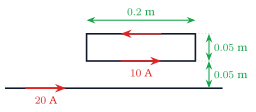
The loop carries \(10\) A and the long wire \(20\) A.
Find the force on the near side and on the far side.
Why do the forces on the two short sides cancel?
Find the net force on the loop and its direction.
Answer(i) \(1.6 \times 10^{-4}\) N towards the wire; \(8 \times 10^{-5}\) N away (ii) equal and opposite by symmetry (iii) \(8 \times 10^{-5}\) N towards the wire
Solution
Near side (\(0.05\) m, currents parallel): \(F = \dfrac{2 \times 10^{-7} \times 20 \times 10 \times 0.2}{0.05} = 1.6 \times 10^{-4}\) N, towards the wire. Far side (\(0.1\) m, currents antiparallel): \(8 \times 10^{-5}\) N, away from the wire.
The short sides carry opposite currents and sit in the same field pattern, so their forces are equal and opposite and cancel.
Net \(= 1.6 \times 10^{-4} - 8 \times 10^{-5} = 8 \times 10^{-5}\) N, towards the wire: the loop is attracted.
How did it go?
Q18
Two long wires \(0.1\) m apart carry \(100\) A each in opposite directions. Find the force per unit length between them and state whether they attract or repel.
A \(0.2\) m wire carrying \(4\) A lies perpendicular to a field of \(0.5\) T. It is moved \(0.1\) m in the direction of the magnetic force. Find the force and the work done by it.
Answer\(0.4\) N; \(0.04\) J
Solution
\(F = BIL = 0.5 \times 4 \times 0.2 = 0.4\) N. \(W = Fs = 0.4 \times 0.1 = 0.04\) J. The energy comes from the source driving the current.
How did it go?
Q20
A \(0.5\) m rod of mass \(0.2\) kg rests on horizontal rails with \(\mu = 0.2\), in a vertical field of \(0.5\) T. Take \(g = 10\) m/s\(^2\). Find the least current that makes the rod start to slide.
Answer\(1.6\) A
Solution
The horizontal magnetic force must reach the limiting friction: \(BIL = \mu mg = 0.2 \times 2 = 0.4\) N. \(I = \dfrac{0.4}{0.5 \times 0.5} = 1.6\) A.
How did it go?
Q21
A wire is placed first parallel and then perpendicular to a uniform field, carrying the same current. Compare the forces.
Answerzero; \(BIL\)
Solution
Parallel: \(\sin 0^\circ = 0\), no force. Perpendicular: the maximum \(BIL\). The perpendicular component of the wire to the field is what counts.
How did it go?
Q22
A \(1\) m rod carries \(10\) A in a field of \(0.1\) T that makes \(37^\circ\) with the rod. Find the force. Take \(\sin 37^\circ = 0.6\).
Two long parallel wires \(1\) m apart carry \(1\) A each. Find the force per metre between them and state why this number is familiar.
Answer\(2 \times 10^{-7}\) N/m; defines the ampere
Solution
\(\dfrac{F}{L} = \dfrac{2 \times 10^{-7} \times 1 \times 1}{1} = 2 \times 10^{-7}\) N/m. This is exactly the force used to define the ampere.
How did it go?
Q24
A semicircular arc of radius \(R\) carries \(I\) in a field \(B\) perpendicular to its plane. By integrating the force on small elements, show that the force is \(2BIR\), directed along the perpendicular bisector of the diameter.
Answer\(F = \int BIR\sin\theta\,d\theta = 2BIR\)
Solution
Take the diameter along \(x\) and the arc above it. An element at angle \(\theta\) from the \(x\) axis has length \(R\,d\theta\) and feels \(dF = BIR\,d\theta\) directed radially outward. The \(x\) components cancel in pairs; the \(y\) components add: \(F_y = \int_0^\pi BIR\sin\theta\,d\theta = 2BIR\). It acts along the perpendicular bisector of the diameter, the same as for a straight wire of length \(2R\).
How did it go?
Magnetic Torque, Dipole Moment and the Galvanometer
24 questions · after Lesson 6, The Moving-Coil Galvanometer
Magnetic moment and torque
Q25
Define the magnetic moment of a current loop and state its direction. Find it for a \(100\)-turn coil of area \(0.02\) m\(^2\) carrying \(0.5\) A.
Answer\(M = NIA\), along the normal by the right-hand rule; \(1\) A m\(^2\)
Solution
\(M = NIA\), directed along the normal to the loop in the sense given by curling the fingers of the right hand along the current. \(M = 100 \times 0.5 \times 0.02 = 1\) A m\(^2\).
How did it go?
Q26
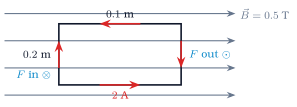
The plane of the loop is parallel to the field.
Find the force on each \(0.2\) m side and explain why they form a couple.
Find the torque on the loop.
Answer(i) \(0.2\) N each, opposite, along different lines (ii) \(0.02\) N m
Solution
Each \(0.2\) m side is perpendicular to \(\vec B\): \(F = BIL = 0.5 \times 2 \times 0.2 = 0.2\) N. The currents in the two sides are opposite, so the forces are opposite, one out of the page and one into it. They act along different lines: a couple.
Torque \(=\) force \(\times\) separation \(= 0.2 \times 0.1 = 0.02\) N m. Check: \(NIAB = 1 \times 2 \times 0.02 \times 0.5 = 0.02\) N m.
How did it go?
Q27
The loop of Q2 is turned so that its plane is perpendicular to the field. Find the torque. Is the loop in stable or unstable equilibrium? Explain.
Answerzero; stable if \(\vec M \parallel \vec B\), unstable if antiparallel
Solution
\(\vec M\) is now along \(\vec B\) (or opposite to it), so \(\tau = MB\sin\theta = 0\). With \(\vec M \parallel \vec B\) the energy is least and a small turn brings a restoring torque: stable. With \(\vec M\) antiparallel the energy is greatest and any turn grows: unstable.
How did it go?
Q28
A loop has \(\vec M = 2\hat i\) A m\(^2\) in a field \(\vec B = 0.3\hat j\) T. Find the torque vector.
Answer\(0.6\hat k\) N m
Solution
\(\vec\tau = \vec M \times \vec B = 2 \times 0.3\,(\hat i \times \hat j) = 0.6\hat k\) N m.
How did it go?
Q29
A rectangular loop of sides \(a\) and \(b\) carries \(I\) with its normal at angle \(\theta\) to \(\vec B\). Using the forces on its sides, show that the torque is \(BIA\sin\theta\) with \(A = ab\).
Answercouple of forces \(BIb\) with arm \(a\sin\theta\)
Solution
Let the sides of length \(b\) be perpendicular to \(\vec B\). Each feels \(F = BIb\), in opposite directions, forming a couple. The perpendicular distance between their lines of action is \(a\sin\theta\), where \(\theta\) is the angle between the normal and \(\vec B\). Torque \(= BIb \times a\sin\theta = BIA\sin\theta\). The other two sides feel forces along the axis that cancel.
How did it go?
Q30
A circular coil of \(50\) turns and radius \(0.1\) m carries \(1\) A in a field of \(0.2\) T. Its magnetic moment makes \(30^\circ\) with the field. Find the torque.
Answer\(0.05\pi \approx 0.16\) N m
Solution
\(M = NIA = 50 \times 1 \times \pi(0.1)^2 = 0.5\pi\) A m\(^2\). \(\tau = MB\sin 30^\circ = 0.5\pi \times 0.2 \times 0.5 = 0.05\pi \approx 0.16\) N m.
How did it go?
Q31
Why does a uniform field exert a torque on a current loop but no net force?
Answerside forces cancel in pairs but act along different lines
Solution
Opposite sides carry opposite currents in the same field, so their forces are equal and opposite and the net force is zero. But the two forces act along different lines, so they form a couple, and a couple has a torque without a net force.
How did it go?
Potential energy
Q32
Write the potential energy of a magnetic dipole in a field. For \(M = 1\) A m\(^2\) and \(B = 0.5\) T, find the energy when \(\vec M\) is parallel and when it is antiparallel to \(\vec B\).
\(U = -\vec M \cdot \vec B = -MB\cos\theta\). Parallel: \(U = -0.5\) J. Antiparallel: \(U = +0.5\) J.
How did it go?
Q33
For the dipole of Q8, find the work needed to turn it (i) from parallel to perpendicular, (ii) from parallel to antiparallel.
Answer(i) \(0.5\) J (ii) \(1\) J
Solution
(i) \(W = U(90^\circ) - U(0) = 0 - (-MB) = MB = 0.5\) J. (ii) \(W = MB - (-MB) = 2MB = 1\) J.
How did it go?
Q34
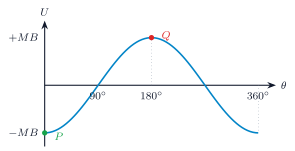
The graph shows \(U = -MB\cos\theta\).
Which point is stable equilibrium and which is unstable? Give the reason.
At which angle is the torque largest?
Answer(i) \(P\) stable, \(U\) minimum; \(Q\) unstable, \(U\) maximum (ii) \(90^\circ\)
Solution
\(P\) (\(\theta = 0\), \(U = -MB\)) is a minimum of energy. A small displacement raises \(U\) and the torque brings the dipole back, so it is stable. \(Q\) (\(\theta = 180^\circ\), \(U = +MB\)) is a maximum: unstable.
\(\tau = MB\sin\theta\) is largest at \(\theta = 90^\circ\), where the slope of the \(U\) curve is steepest.
How did it go?
Q35
A coil is released from rest with its moment at \(90^\circ\) to the field. Describe its motion.
Answeroscillates about \(\theta = 0\)
Solution
At \(90^\circ\) the torque is greatest and turns the coil towards \(\theta = 0\). It overshoots, is turned back, and oscillates about the parallel position, like a compass needle. With no damping the oscillation continues; in practice it dies down and the coil settles with \(\vec M \parallel \vec B\).
How did it go?
Q36
A coil of \(M = 1\) A m\(^2\) and moment of inertia \(2 \times 10^{-4}\) kg m\(^2\) oscillates through small angles in a field of \(0.5\) T. Use \(T = 2\pi\sqrt{\frac{I}{MB}}\) to find its period.
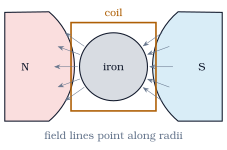
The figure shows the magnet and coil of a moving coil galvanometer.
Why are the pole pieces curved?
What does the radial field do to the angle between the plane of the coil and \(\vec B\) as the coil turns?
Answer(i) to make the field radial (ii) keeps it zero: plane always along \(\vec B\)
Solution
Cylindrical pole faces, together with the iron core, make the field lines in the gap point along radii: a radial field.
Whichever way the coil turns, its plane stays parallel to the local field and its normal stays perpendicular to \(\vec B\). The angle in \(\tau = NIAB\sin\theta\) is always \(90^\circ\).
How did it go?
Q38
Give two purposes of the soft iron cylinder inside the coil.
Answerstrengthens the field; makes it radial
Solution
Being soft iron, it concentrates the field lines through the gap, giving a strong field and so a large torque. Its curved surface, matching the pole pieces, makes the field radial so that the deflection is proportional to the current.
How did it go?
Q39
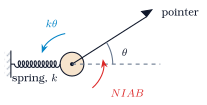
A galvanometer has \(N = 100\), \(A = 2 \times 10^{-4}\) m\(^2\), \(B = 0.5\) T and a spring constant \(k = 10^{-4}\) N m/rad. Write the balance of torques and find the deflection per milliampere.
Answer\(NIAB = k\theta\); \(0.1\) rad per mA
Solution
Deflecting torque \(= \) restoring torque: \(NIAB = k\theta\), so \(\theta = \dfrac{NAB}{k}I = \dfrac{100 \times 2 \times 10^{-4} \times 0.5}{10^{-4}}I = 100I\) rad per ampere. For \(1\) mA: \(0.1\) rad, about \(6^\circ\).
How did it go?
Q40
Write the current sensitivity and the voltage sensitivity of a galvanometer. Why does doubling the number of turns not double the voltage sensitivity?
Answer\(\frac{NAB}{k}\); \(\frac{NAB}{kR}\); \(R\) rises with \(N\)
Solution
Current sensitivity \(\dfrac{\theta}{I} = \dfrac{NAB}{k}\). Voltage sensitivity \(\dfrac{\theta}{V} = \dfrac{NAB}{kR}\). Doubling \(N\) doubles the wire length and so doubles \(R\); the ratio \(\dfrac{N}{R}\) is unchanged and the voltage sensitivity stays the same.
Phosphor bronze has a small torsion constant, so a small torque gives a large deflection. It is elastic and does not take a permanent twist. It is non-magnetic, and it conducts, so it can carry the current into the coil.
How did it go?
Q43
Define the figure of merit of a galvanometer. A galvanometer shows \(30\) divisions at full scale for \(3\) mA. Find its figure of merit.
Answercurrent per division; \(0.1\) mA per division
Solution
The figure of merit is the current needed for a deflection of one division. Here \(\dfrac{3 \text{ mA}}{30} = 0.1\) mA per division.
How did it go?
Q44
Why is the scale of a moving coil galvanometer linear? What would happen to the scale if the field were uniform instead of radial?
Answer\(\theta = \frac{NAB}{k}I\); scale would go as \(\sin\theta\), cramped
Solution
In the radial field \(\theta = \dfrac{NAB}{k}I\), so equal steps of current give equal steps of deflection. In a uniform field the torque would be \(NIAB\cos\theta\) (with \(\theta\) the deflection), giving \(k\theta = NIAB\cos\theta\): a non-linear, cramped scale at large deflections.
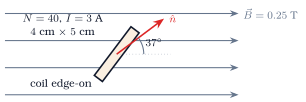
\(\tau = MB\sin 37^\circ = 0.24 \times 0.25 \times 0.6 = 0.036\) N m.
How did it go?
Q46
A coil of moment \(2\) A m\(^2\) is in a field of \(0.1\) T. Find the maximum torque and the difference in energy between the parallel and antiparallel positions.
Answer\(0.2\) N m; \(0.4\) J
Solution
\(\tau_{\max} = MB = 2 \times 0.1 = 0.2\) N m, at \(90^\circ\). Energy difference \(= MB - (-MB) = 2MB = 0.4\) J.
How did it go?
Q47
An electron moves in a circle of radius \(5.3 \times 10^{-11}\) m at \(2.2 \times 10^{6}\) m/s. Treat it as a current loop and find its magnetic moment. Use \(M = \frac{evr}{2}\).
Answer\(9.3 \times 10^{-24}\) A m\(^2\)
Solution
The orbiting electron is a current \(I = \dfrac{ev}{2\pi r}\) round an area \(\pi r^2\), so \(M = \dfrac{evr}{2} = \dfrac{1.6 \times 10^{-19} \times 2.2 \times 10^{6} \times 5.3 \times 10^{-11}}{2} \approx 9.3 \times 10^{-24}\) A m\(^2\), the Bohr magneton.
How did it go?
Q48
For a coil in a radial field, show that the deflection is proportional to the current.
Answer\(NIAB = k\theta\) with \(\sin\theta\) term always \(1\)
Solution
In a radial field the plane of the coil is always parallel to \(\vec B\). The deflecting torque is then \(NIAB\) for every position, with no \(\sin\theta\) factor. The spring supplies \(k\theta\). At rest \(NIAB = k\theta\), so \(\theta = \dfrac{NAB}{k}I \propto I\).