Questions on Sources of the Magnetic Field, the kind your examinations ask. Solve one on paper. Then tell the book how it went. The book believes you, and it uses your answer to plan your revision.
0%
Nothing marked yetMark honestly. Peek at the answer only after your own attempt.
Biot-Savart Law: Wires and Arcs
24 questions · after Lesson 3, Loops and Arcs
Biot-Savart law and straight wires
Q1
State the Biot-Savart law for the field of a current element, in magnitude and direction. Take \(\frac{\mu_0}{4\pi} = 10^{-7}\) SI units throughout this sheet.
Answer\(dB = \frac{\mu_0}{4\pi}\frac{I\,dl\sin\theta}{r^2}\), along \(d\vec l \times \hat r\)
Solution
A current element \(I\,d\vec l\) produces at a point at distance \(r\) a field \(dB = \dfrac{\mu_0}{4\pi}\dfrac{I\,dl\sin\theta}{r^2}\). Here \(\theta\) is the angle between \(d\vec l\) and the line to the point. The direction is that of \(d\vec l \times \hat r\), perpendicular to both.
How did it go?
Q2
Write the field of a long straight wire at distance \(d\). Find it for \(10\) A at \(0.05\) m, and state how its direction is found.
\(B = \dfrac{\mu_0I}{2\pi d} = \dfrac{2 \times 10^{-7} \times 10}{0.05} = 4 \times 10^{-5}\) T. Point the right thumb along the current; the curled fingers give the direction of the circular field lines.
How did it go?
Q3
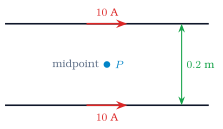
The wires are \(0.2\) m apart and \(P\) is midway.
Find the field at \(P\) for the currents shown.
Find the field at \(P\) if the lower current is reversed.
Answer(i) zero (ii) \(4 \times 10^{-5}\) T
Solution
Each wire gives \(\dfrac{2 \times 10^{-7} \times 10}{0.1} = 2 \times 10^{-5}\) T at \(P\). With parallel currents the two fields at the midpoint are opposite (one into the page, one out), so the net field is zero.
With antiparallel currents the two fields at \(P\) point the same way: \(B = 4 \times 10^{-5}\) T.
How did it go?
Q4
A straight wire of length \(0.6\) m carries \(10\) A. Find the field at a point \(0.4\) m from its midpoint on the perpendicular bisector. Use \(B = \frac{\mu_0I}{4\pi d}(\sin\alpha + \sin\beta)\).
A long wire carries \(10\) A. Find the field at a point \(0.05\) m from one end of the wire, on the perpendicular through that end. Compare it with Q2.
Answer\(2 \times 10^{-5}\) T; half of Q2
Solution
A semi-infinite wire gives \(\dfrac{\mu_0I}{4\pi d}\) at the foot of the perpendicular from its end. Here that is \(\dfrac{10^{-7} \times 10}{0.05} = 2 \times 10^{-5}\) T, exactly half the value for the infinite wire in Q2.
How did it go?
Q6
Why is the field zero at every point on the line of a straight current, beyond its ends?
Answer\(d\vec l \parallel \hat r\), so \(\sin\theta = 0\)
Solution
For a point on the line of the wire, every element \(d\vec l\) is parallel to the vector \(\hat r\) to the point. So \(\sin\theta = 0\) and each \(dB\) is zero.
How did it go?
Loops and arcs
Q7
Write the field at the centre of a circular loop of \(N\) turns. Find it for one turn of radius \(0.1\) m carrying \(5\) A.
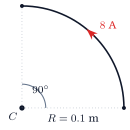
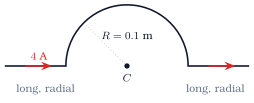
The straight leads point along radii through \(C\).
What do the straight leads contribute at \(C\)? Why?
Find the field at \(C\) and its direction.
Answer(i) zero; \(C\) is on their lines (ii) \(4\pi \times 10^{-6} \approx 1.3 \times 10^{-5}\) T, into the page
Solution
Zero. \(C\) lies on the line of each straight lead, where \(\sin\theta = 0\) for every element.
Only the semicircle counts: \(B = \dfrac{\mu_0I}{4R} = \dfrac{4\pi \times 10^{-7} \times 4}{0.4} = 4\pi \times 10^{-6} \approx 1.3 \times 10^{-5}\) T. The current runs clockwise over the arc as drawn, so the field at \(C\) is into the page.
How did it go?
Q10
Write the field on the axis of a circular loop at distance \(x\) from the centre. For the loop of Q7 find the field at \(x = \sqrt3R\).
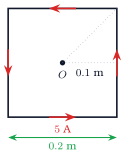
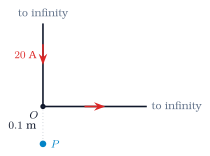
\(P\) lies on the line of the horizontal arm, \(0.1\) m from the corner.
What does the horizontal arm contribute at \(P\)?
Find the field at \(P\) due to the vertical arm, and hence the total.
Answer(i) zero (ii) \(2 \times 10^{-5}\) T; \(2 \times 10^{-5}\) T
Solution
Zero: \(P\) lies on the line of the horizontal arm.
\(P\) is at the foot of the perpendicular from the end \(O\) of the vertical arm, at \(d = 0.1\) m: \(B = \dfrac{\mu_0I}{4\pi d} = \dfrac{10^{-7} \times 20}{0.1} = 2 \times 10^{-5}\) T. That is the whole field at \(P\).
How did it go?
Q15
A regular hexagon of side \(0.1\) m carries \(10\) A. Find the field at its centre.
Answer\(\frac{\sqrt3\mu_0I}{\pi a} \approx 6.9 \times 10^{-5}\) T
Solution
The centre is at \(d = \dfrac{\sqrt3}{2}a\) from each side, and each side subtends \(30^\circ\) on either side of the perpendicular. One side: \(\dfrac{\mu_0I}{4\pi d} \times 2\sin 30^\circ = \dfrac{\mu_0I}{4\pi d}\). Six sides: \(B = \dfrac{6\mu_0I}{4\pi d} = \dfrac{\sqrt3\mu_0I}{\pi a} = \dfrac{1.732 \times 4\pi \times 10^{-7} \times 10}{\pi \times 0.1} \approx 6.9 \times 10^{-5}\) T.
How did it go?
Q16
A long wire carries \(10\) A. A coplanar loop of radius \(0.05\) m carrying \(2\) A has its centre \(0.1\) m from the wire. At the centre the two fields are in opposite directions. Find the net field there.
Answer\(\approx 5 \times 10^{-6}\) T, in the loop's sense
Solution
Wire: \(\dfrac{2 \times 10^{-7} \times 10}{0.1} = 2 \times 10^{-5}\) T. Loop: \(\dfrac{\mu_0I}{2R} = \dfrac{4\pi \times 10^{-7} \times 2}{0.1} \approx 2.5 \times 10^{-5}\) T. Opposite directions: net \(\approx 0.5 \times 10^{-5} = 5 \times 10^{-6}\) T, in the direction of the loop's own field.
How did it go?
Q17
Two identical coaxial loops of radius \(0.1\) m carrying \(5\) A in the same sense are \(0.2\) m apart. Find the field at the midpoint of the axis.
Answer\(\approx 2.2 \times 10^{-5}\) T
Solution
The midpoint is \(x = 0.1\) m \(= R\) from each loop: \(B_1 = \dfrac{\mu_0IR^2}{2(2R^2)^{3/2}} = \dfrac{B_{\text{centre}}}{2\sqrt2} = \dfrac{\pi \times 10^{-5}}{2.83} \approx 1.1 \times 10^{-5}\) T. Both add: \(B \approx 2.2 \times 10^{-5}\) T.
How did it go?
Q18
A loop in the plane of the page carries current anticlockwise. Give the direction of the field at its centre and at a point far along its axis.
Answerout of the page at both
Solution
For an anticlockwise current the right-hand rule gives a field out of the page at the centre. On the axis the field keeps the same direction at every distance, so it points out of the page far away as well, only weaker.
How did it go?
Q19
The field of a long wire falls as \(\frac{1}{r}\) but the axial field of a loop falls as \(\frac{1}{x^3}\) far away. Explain the difference in one or two sentences.
Answerwire is infinite; loop is a dipole
Solution
A long wire has current at every distance along it, and the contributions add up to a slowly falling \(\dfrac{1}{r}\) field. A loop is a closed current whose near and far sides nearly cancel far away. It acts as a magnetic dipole, whose field falls as \(\dfrac{1}{x^3}\).
How did it go?
Small situations
Q20
A power cable carries \(100\) A. Find its field at \(1\) m and compare it with the Earth's field of about \(5 \times 10^{-5}\) T.
Answer\(2 \times 10^{-5}\) T; \(0.4\) of Earth's
Solution
\(B = \dfrac{2 \times 10^{-7} \times 100}{1} = 2 \times 10^{-5}\) T, about \(0.4\) of the Earth's field. A compass near the cable would be noticeably deflected.
How did it go?
Q21
A coil of \(100\) turns and radius \(0.05\) m must produce \(10^{-3}\) T at its centre. Find the current needed.
Answer\(\approx 0.8\) A
Solution
\(B = \dfrac{\mu_0NI}{2R}\), so \(I = \dfrac{2RB}{\mu_0N} = \dfrac{2 \times 0.05 \times 10^{-3}}{4\pi \times 10^{-7} \times 100} \approx 0.8\) A.
How did it go?
Q22
The number of turns and the radius of a coil are both doubled at the same current. What happens to the field at the centre?
Answerunchanged
Solution
\(B \propto \dfrac{N}{R}\) at fixed \(I\). Doubling both leaves the ratio, and so the field, unchanged.
How did it go?
Q23
Find the field at the centre of a \(60^\circ\) arc of radius \(0.1\) m carrying \(6\) A.
Answer\(2\pi \times 10^{-6} \approx 6.3 \times 10^{-6}\) T
Starting from the Biot-Savart law, derive the field at the centre of a circular loop of radius \(R\) carrying \(I\).
Answer\(B = \frac{\mu_0I}{4\pi R^2} \times 2\pi R = \frac{\mu_0I}{2R}\)
Solution
Every element \(d\vec l\) of the loop is perpendicular to the radius to the centre, so \(\sin\theta = 1\) and \(r = R\): \(dB = \dfrac{\mu_0}{4\pi}\dfrac{I\,dl}{R^2}\). All the \(dB\) point the same way, along the axis. Adding round the loop, \(\sum dl = 2\pi R\): \(B = \dfrac{\mu_0}{4\pi}\dfrac{I \times 2\pi R}{R^2} = \dfrac{\mu_0I}{2R}\).
How did it go?
Ampere's Law: Cylinders, Solenoids and Toroids
24 questions · after Lesson 6, The Toroid, and Where Ampere's Law Fails
Ampere's law and cylinders
Q25
State Ampere's circuital law. How is the sign of the enclosed current fixed? Take \(\mu_0 = 4\pi \times 10^{-7}\) SI units throughout.
Answer\(\oint\vec B\cdot d\vec l = \mu_0I_{\text{enc}}\); right-hand rule with the loop's sense
Solution
The line integral of \(\vec B\) round any closed loop equals \(\mu_0\) times the net current threading the loop: \(\oint\vec B\cdot d\vec l = \mu_0I_{\text{enc}}\). Curl the fingers of the right hand in the sense of travel round the loop. Current along the thumb counts positive, current the other way negative.
How did it go?
Q26
Use Ampere's law to derive the field outside a long straight wire carrying \(I\). Which symmetry makes the law easy to apply here?
Answer\(B\,2\pi r = \mu_0I\), \(B = \frac{\mu_0I}{2\pi r}\); cylindrical symmetry
Solution
By symmetry the field lines are circles centred on the wire. \(B\) is the same all round a circle of radius \(r\) and points along the circle. So \(\oint\vec B\cdot d\vec l = B \times 2\pi r = \mu_0I\), giving \(B = \dfrac{\mu_0I}{2\pi r}\). The cylindrical symmetry makes \(B\) constant on the loop, which is what the law needs.
How did it go?
Q27
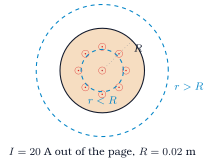
The current is spread uniformly over the cross-section.
Find the current enclosed by a circle of radius \(r < R\), and hence \(B\) at \(r = 0.01\) m.
Find \(B\) at the surface, \(r = R\).
Find \(B\) at \(r = 0.04\) m.
Answer(i) \(I\frac{r^2}{R^2}\); \(10^{-4}\) T (ii) \(2 \times 10^{-4}\) T (iii) \(10^{-4}\) T
A circular loop inside the hollow encloses no current, so \(B \times 2\pi r = 0\) and \(B = 0\) inside. A loop outside encloses the whole current \(I\), so \(B = \dfrac{\mu_0I}{2\pi r}\), the same as for a thin wire on the axis.
How did it go?
Q29
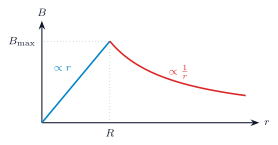
The graph shows \(B\) against \(r\) for the solid cylinder of Q3.
Write \(B(r)\) for \(r < R\) and \(r > R\).
Where is \(B\) largest?
Answer(i) \(\frac{\mu_0Ir}{2\pi R^2}\); \(\frac{\mu_0I}{2\pi r}\) (ii) at the surface
Solution
Inside: \(B = \dfrac{\mu_0Ir}{2\pi R^2}\), rising in proportion to \(r\). Outside: \(B = \dfrac{\mu_0I}{2\pi r}\), falling as \(\dfrac{1}{r}\).
The two expressions meet at \(r = R\), where \(B = \dfrac{\mu_0I}{2\pi R}\) is the largest value.
How did it go?
Non-uniform current and cavities
Q30
A cylinder of radius \(R\) carries a current density \(J = J_0\frac{r}{R}\). Find the current inside radius \(r\) in terms of the total current \(I\), and hence \(B\) inside. Compare \(B\) at \(r = \frac{R}{2}\) with the uniform case.
Answer\(I\frac{r^3}{R^3}\); \(\frac{\mu_0Ir^2}{2\pi R^3}\); half the uniform value
Solution
\(I(r) = \int_0^r J_0\dfrac{r'}{R}2\pi r'\,dr' = \dfrac{2\pi J_0r^3}{3R}\). The total current is \(I = I(R) = \dfrac{2\pi J_0R^2}{3}\), so \(I(r) = I\dfrac{r^3}{R^3}\). Ampere: \(B\,2\pi r = \mu_0I\dfrac{r^3}{R^3}\), so \(B = \dfrac{\mu_0Ir^2}{2\pi R^3}\). At \(r = \dfrac{R}{2}\): \(B = \dfrac{\mu_0I}{8\pi R}\), half of the uniform-current value \(\dfrac{\mu_0I}{4\pi R}\), because less of the current lies near the axis.
How did it go?
Q31
A coaxial cable has an inner wire carrying \(5\) A and an outer shell carrying \(5\) A back. Find the field at \(0.01\) m from the axis, in the gap between them, and the field outside the cable.
Answer\(10^{-4}\) T; zero
Solution
In the gap a loop encloses only the inner \(5\) A: \(B = \dfrac{2 \times 10^{-7} \times 5}{0.01} = 10^{-4}\) T. Outside, the loop encloses \(5 - 5 = 0\): \(B = 0\). That is why coaxial cables do not disturb their surroundings.
How did it go?
Q32
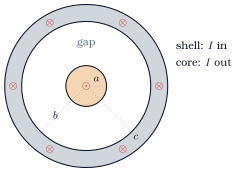
The core carries \(I\) out of the page and the shell carries \(I\) into the page.
Write \(B\) for \(r < a\) (uniform current in the core).
Write \(B\) for \(a < r < b\).
What is \(B\) for \(r > c\)? Why?
Answer(i) \(\frac{\mu_0Ir}{2\pi a^2}\) (ii) \(\frac{\mu_0I}{2\pi r}\) (iii) zero, net enclosed current zero
Solution
Inside the core, as for the solid cylinder: \(B = \dfrac{\mu_0Ir}{2\pi a^2}\).
In the gap the loop encloses the full core current: \(B = \dfrac{\mu_0I}{2\pi r}\).
Outside the shell the enclosed current is \(I - I = 0\), so \(B = 0\).
How did it go?
Q33
A thick hollow cylinder with inner radius \(0.01\) m and outer radius \(0.02\) m carries \(30\) A uniformly. Find \(B\) at \(r = 0.015\) m.
Why can Ampere's law not be used directly to find the field of a finite straight wire or of a single circular loop?
Answerno loop on which \(B\) is constant and along the loop
Solution
Ampere's law is always true, but it gives \(B\) directly only for a loop with symmetry. On that loop \(B\) must have the same magnitude everywhere and point along the loop. A finite wire or a single loop lacks that symmetry, so \(\oint\vec B\cdot d\vec l\) cannot be written as \(B\) times a length. The Biot-Savart law must be used instead.
How did it go?
Solenoids
Q35
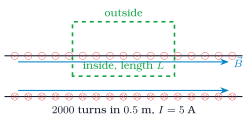
Using a rectangular Amperian loop, derive \(B = \mu_0nI\) inside a long solenoid with \(n\) turns per unit length.
Answer\(BL = \mu_0(nL)I\)
Solution
Take a rectangle with one side of length \(L\) along the axis inside and the opposite side far outside, where \(B \approx 0\). Its two short sides are perpendicular to \(\vec B\). Only the inside side contributes: \(\oint\vec B\cdot d\vec l = BL\). The rectangle is threaded by \(nL\) turns, each carrying \(I\): \(BL = \mu_0nLI\), so \(B = \mu_0nI\).
How did it go?
Q36
A long solenoid has \(1000\) turns per metre and carries \(2\) A. Find the field inside.
Which sides of the loop contribute to \(\oint\vec B\cdot d\vec l\), and why?
Find \(B\) inside.
Answer(i) \(4000\) per metre (ii) only the inside side (iii) \(\approx 2.5 \times 10^{-2}\) T
Solution
\(n = \dfrac{2000}{0.5} = 4000\) turns per metre.
Only the side inside, along the axis: \(\vec B\) is along it. The outside side has \(B \approx 0\), and on the two short sides \(\vec B\) is perpendicular to \(d\vec l\).
Find the field at one end of a long solenoid, on the axis, in terms of the field deep inside. Give the reason.
Answer\(\frac{1}{2}\mu_0nI\); only half the turns lie on one side
Solution
Deep inside, turns on both sides of a point contribute equally to \(\mu_0nI\). At an end, only the turns on one side exist, so the field is \(\dfrac{1}{2}\mu_0nI\). Two half-solenoids placed end to end would restore the full value.
How did it go?
Q39
Why is the field outside an ideal long solenoid zero?
Answera loop wholly outside encloses no net current
Solution
Take a rectangular loop lying wholly outside. It encloses no current, so \(\oint\vec B\cdot d\vec l = 0\) for any such loop, which forces the outside field to be the same everywhere. Far away it is zero, so it is zero everywhere outside an ideal, infinitely long solenoid.
How did it go?
Q40
How can the field of a solenoid be doubled? Does the radius of the solenoid matter?
Answerdouble \(I\) or \(n\); no
Solution
\(B = \mu_0nI\): double the current, or wind twice as many turns per metre. The radius does not appear, so a fatter solenoid with the same \(n\) and \(I\) has the same field inside.
How did it go?
Q41
A soft iron core of relative permeability \(500\) is put into the solenoid of Q12. Find the new field.
Describe how \(B\) varies along the axis of a real solenoid of finite length, from far outside to the centre.
Answerrises from \(\approx 0\), half at the end, uniform \(\mu_0nI\) in the middle
Solution
Far outside on the axis the field is tiny. It grows as the end is approached and reaches \(\dfrac{1}{2}\mu_0nI\) at the end face. Inside it rises quickly and levels off at \(\mu_0nI\) over the middle part, where it is uniform. The pattern is symmetric about the centre.
How did it go?
Toroids
Q43
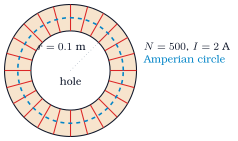
The Amperian circle runs inside the core at \(r = 0.1\) m.
Find the enclosed current.
Find \(B\) on the circle.
Answer(i) \(1000\) A turns (ii) \(2 \times 10^{-3}\) T
Solution
The circle is threaded by all \(N\) turns: \(I_{\text{enc}} = NI = 500 \times 2 = 1000\) A turns.
\(B \times 2\pi r = \mu_0NI\), so \(B = \dfrac{\mu_0NI}{2\pi r} = \dfrac{4\pi \times 10^{-7} \times 1000}{2\pi \times 0.1} = 2 \times 10^{-3}\) T.
How did it go?
Q44
Find the field in the hole of the toroid and outside it. Give the reason from Ampere's law.
Answerzero; zero; no net enclosed current
Solution
A circle in the hole threads no turns, so \(B = 0\) there. A circle outside the toroid is threaded by every turn twice, once going in and once coming out. The net current is zero and \(B = 0\). The field is confined to the core.
How did it go?
Q45
Is the field inside the core of a toroid uniform across its cross-section? Explain.
Answerno; \(B \propto \frac{1}{r}\)
Solution
No. \(B = \dfrac{\mu_0NI}{2\pi r}\) depends on \(r\), so the field is stronger at the inner edge of the core than at the outer edge. For a thin core the variation is small.
How did it go?
Q46
Show that for a toroid whose core is thin compared with its radius, the field reduces to that of a solenoid.
Answer\(n = \frac{N}{2\pi r}\) gives \(\mu_0nI\)
Solution
If the core is thin, \(r\) is nearly the same across it and the turns per unit length along the core are \(n = \dfrac{N}{2\pi r}\). Then \(B = \dfrac{\mu_0NI}{2\pi r} = \mu_0nI\), the solenoid formula: a toroid is a solenoid bent into a ring.
How did it go?
Q47
A solenoid \(0.2\) m long has \(400\) turns. Find the current needed for a field of \(5 \times 10^{-3}\) T inside.
Using Ampere's law, show that the field inside a long hollow cylinder carrying current on its surface is zero.
Answer\(I_{\text{enc}} = 0\) for \(r < R\)
Solution
By symmetry the field, if any, is circular about the axis with constant magnitude on a circle of radius \(r\). For \(r < R\) the circle encloses no current, so \(B \times 2\pi r = 0\) and \(B = 0\) everywhere inside the hollow.