Questions on Magnetism and Matter, the kind your examinations ask. Solve one on paper. Then tell the book how it went. The book believes you, and it uses your answer to plan your revision.
0%
Nothing marked yetMark honestly. Peek at the answer only after your own attempt.
Earth's Magnetism, Magnetic Materials and the Magnetometer
24 questions · after Lesson 5, Magnetic Materials
Bar magnet as a dipole
Q1
A bar magnet has pole strength \(10\) A m and length \(0.1\) m. Find its magnetic moment. Using \(B_{\text{axial}} = \frac{\mu_0}{4\pi}\frac{2M}{r^3}\) and \(B_{\text{eq}} = \frac{\mu_0}{4\pi}\frac{M}{r^3}\), find both fields at \(0.5\) m. Take \(\frac{\mu_0}{4\pi} = 10^{-7}\).
Answer\(1\) A m\(^2\); \(1.6 \times 10^{-6}\) T; \(8 \times 10^{-7}\) T
Solution
\(M = m \times 2l = 10 \times 0.1 = 1\) A m\(^2\). Axial: \(B = 10^{-7} \times \dfrac{2 \times 1}{0.125} = 1.6 \times 10^{-6}\) T. Equatorial: \(B = 10^{-7} \times \dfrac{1}{0.125} = 8 \times 10^{-7}\) T.
How did it go?
Q2
The magnet of Q1 is placed at \(30^\circ\) to a field of \(0.2\) T. Find the torque on it and its potential energy.
Answer\(0.1\) N m; \(-0.17\) J
Solution
\(\tau = MB\sin\theta = 1 \times 0.2 \times 0.5 = 0.1\) N m. \(U = -MB\cos\theta = -0.2 \times 0.866 \approx -0.17\) J.
How did it go?
Q3
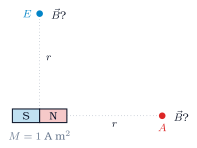
\(A\) and \(E\) are at the same distance from the centre of the magnet.
Give the direction of \(\vec B\) at \(A\) and at \(E\) relative to \(\vec M\).
Find \(\frac{B_A}{B_E}\).
Answer(i) \(A\): along \(\vec M\); \(E\): opposite to \(\vec M\) (ii) \(2\)
Solution
At \(A\), on the axis beyond the N pole, the field points away from the magnet, along \(\vec M\). At \(E\), on the equatorial line, the field runs from the N pole round to the S pole, opposite to \(\vec M\).
\(\dfrac{B_A}{B_E} = \dfrac{2M/r^3}{M/r^3} = 2\).
How did it go?
Q4
A magnet of moment \(1\) A m\(^2\) and moment of inertia \(4 \times 10^{-6}\) kg m\(^2\) oscillates in a horizontal field \(B_H = 4 \times 10^{-5}\) T. Find its period.
A bar magnet of moment \(M\) and pole strength \(m\) is cut into two equal halves (i) across its length, (ii) along its length. Find the moment and pole strength of each piece.
Answer(i) \(\frac{M}{2}\), \(m\) (ii) \(\frac{M}{2}\), \(\frac{m}{2}\)
Solution
(i) Cut across: each piece has the same pole strength \(m\) but half the length, so \(M' = m \times l = \dfrac{M}{2}\). (ii) Cut along: each piece has half the cross-section, so half the pole strength \(\dfrac{m}{2}\), and the full length: \(M' = \dfrac{m}{2} \times 2l = \dfrac{M}{2}\).
How did it go?
Earth's magnetism
Q6
Define the three elements of the Earth's magnetic field at a place.
Answerdeclination, dip, horizontal component
Solution
Declination: the angle between the magnetic meridian and the geographic meridian. Dip (inclination): the angle the total field makes with the horizontal. Horizontal component \(B_H\): the horizontal part of the field, \(B\cos\delta\). The three fix the field completely.
How did it go?
Q7
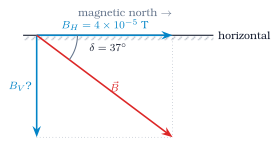
At a place \(B_H = 4 \times 10^{-5}\) T and the dip is \(37^\circ\). Take \(\tan 37^\circ = 0.75\).
Find \(B_V\).
Find the total field \(B\).
Answer(i) \(3 \times 10^{-5}\) T (ii) \(5 \times 10^{-5}\) T
Where on the Earth is the dip \(0^\circ\), and where is it \(90^\circ\)? What does a freely pivoted needle do at each place?
Answermagnetic equator, needle horizontal; magnetic poles, needle vertical
Solution
At the magnetic equator the field is horizontal, so the dip is \(0^\circ\) and a freely pivoted needle stays horizontal. At the magnetic poles the field is vertical, the dip is \(90^\circ\) and the needle stands vertical.
How did it go?
Q9
A dip circle is turned so that its plane makes \(60^\circ\) with the magnetic meridian. If the true dip is \(37^\circ\), find the tangent of the apparent dip, using \(\tan\delta' = \frac{\tan\delta}{\cos\theta}\).
Answer\(1.5\)
Solution
In a plane at angle \(\theta\) to the meridian only \(B_H\cos\theta\) lies in the plane, while \(B_V\) is unchanged: \(\tan\delta' = \dfrac{B_V}{B_H\cos\theta} = \dfrac{\tan\delta}{\cos\theta} = \dfrac{0.75}{0.5} = 1.5\). The apparent dip is larger than the true dip.
How did it go?
Q10
The declination at a place is \(10^\circ\) E. What does a compass needle do there? Which element of the Earth's field is used by a compass?
Answerpoints \(10^\circ\) east of geographic north; \(B_H\)
Solution
The compass needle settles \(10^\circ\) east of geographic north, because it aligns with the magnetic meridian. A compass responds only to the horizontal component \(B_H\); the vertical component only tries to tip it, which the pivot prevents.
How did it go?
Q11
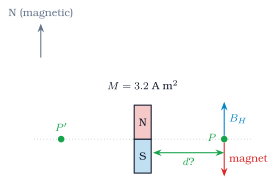
The magnet's N pole points north and \(B_H = 4 \times 10^{-5}\) T.
Why do the neutral points lie on the equatorial line?
Find \(d\).
Answer(i) magnet's field there is opposite to \(B_H\) (ii) \(0.2\) m
Solution
With the N pole pointing north, the magnet's field on its equatorial line points south, opposite to \(B_H\). Where the two are equal in size the net field is zero: a neutral point.
\(\dfrac{\mu_0}{4\pi}\dfrac{M}{d^3} = B_H\): \(d^3 = \dfrac{10^{-7} \times 3.2}{4 \times 10^{-5}} = 8 \times 10^{-3}\), so \(d = 0.2\) m.
How did it go?
Q12
The magnet of Q11 is turned so that its N pole points south. Where are the neutral points now? Find their distance from the centre for \(M = 1.6\) A m\(^2\).
Answeron the axis; \(0.2\) m
Solution
Now the axial field beyond each pole points south, opposite to \(B_H\), so the neutral points lie on the axis. \(\dfrac{\mu_0}{4\pi}\dfrac{2M}{d^3} = B_H\): \(d^3 = \dfrac{10^{-7} \times 3.2}{4 \times 10^{-5}} = 8 \times 10^{-3}\), so \(d = 0.2\) m.
How did it go?
Magnetic materials
Q13
Define magnetisation \(\vec M\), magnetic intensity \(\vec H\) and susceptibility \(\chi\). Write the relation between \(\mu_r\) and \(\chi\).
Magnetisation \(\vec M\) is the magnetic moment per unit volume. \(\vec H = \dfrac{\vec B}{\mu_0} - \vec M\) is the part of the field due to free currents alone. \(\chi = \dfrac{M}{H}\). Since \(B = \mu_0(H + M) = \mu_0(1 + \chi)H\), \(\mu_r = 1 + \chi\).
How did it go?
Q14
Give the sign and rough size of \(\chi\) for diamagnetic, paramagnetic and ferromagnetic materials, with one example of each.
Diamagnetic: \(\chi\) small and negative, about \(-10^{-5}\); bismuth, copper, water. Paramagnetic: small and positive, about \(10^{-4}\) to \(10^{-3}\); aluminium, oxygen. Ferromagnetic: large and positive, \(10^{2}\) to \(10^{3}\) or more; iron, nickel, cobalt.
How did it go?
Q15
A paramagnetic rod with \(\chi = 3 \times 10^{-4}\) is placed in \(H = 10^{4}\) A/m. Find \(M\) and \(B\) inside it. Take \(\mu_0 = 4\pi \times 10^{-7}\).
Answer\(3\) A/m; \(1.26 \times 10^{-2}\) T
Solution
\(M = \chi H = 3 \times 10^{-4} \times 10^{4} = 3\) A/m. \(B = \mu_0(H + M) = 4\pi \times 10^{-7} \times 10003 \approx 1.26 \times 10^{-2}\) T, barely more than in vacuum.
How did it go?
Q16
State Curie's law. The susceptibility of a paramagnetic salt is \(2 \times 10^{-4}\) at \(300\) K. Find it at \(150\) K.
Curie's law: for a paramagnet \(\chi = \dfrac{C}{T}\). Halving \(T\) doubles \(\chi\): \(4 \times 10^{-4}\).
How did it go?
Q17
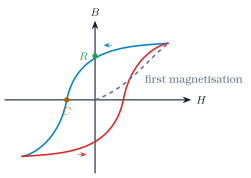
The loop shows \(B\) against \(H\) for a ferromagnetic sample.
What do the points \(R\) and \(C\) measure?
What does the area of the loop represent?
Which kind of loop, thin or fat, suits a permanent magnet?
Answer(i) retentivity, coercivity (ii) energy lost per cycle per unit volume (iii) fat
Solution
\(R\) is the retentivity: the field \(B\) left in the sample when \(H\) is reduced to zero. \(C\) is the coercivity: the reverse \(H\) needed to bring \(B\) to zero.
The area of the loop is the energy dissipated as heat in unit volume of the material in one complete cycle of magnetisation.
A fat loop: high retentivity keeps the magnet strong, and high coercivity makes it hard to demagnetise.
How did it go?
Q18
Why is soft iron used for the core of an electromagnet, and steel for a permanent magnet?
Answersoft iron: low retentivity, low coercivity; steel: high retentivity, high coercivity
Solution
An electromagnet must magnetise strongly and switch off cleanly, and it cycles many times a second. Soft iron has high permeability, low retentivity and low coercivity, so it loses little energy per cycle and keeps no magnetism when the current stops. A permanent magnet must keep its magnetism against stray fields, which needs the high retentivity and coercivity of steel.
How did it go?
Q19
How does a diamagnetic rod behave when it is placed in a non-uniform field? What is special about a superconductor in this respect?
Answermoves towards the weaker field; perfect diamagnet, \(\chi = -1\)
Solution
A diamagnetic rod is weakly repelled: it moves towards the region where the field is weaker. Set along the field, it turns perpendicular to it. A superconductor expels the field completely, with \(\chi = -1\): it is a perfect diamagnet and can float above a magnet.
How did it go?
Magnetometers
Q20
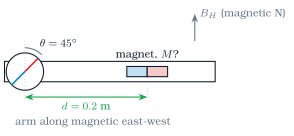
The magnetometer is in the tan A position with \(B_H = 4 \times 10^{-5}\) T.
Write the balance condition of the two fields at the needle.
Find \(M\).
Answer(i) \(\frac{\mu_0}{4\pi}\frac{2M}{d^3} = B_H\tan\theta\) (ii) \(1.6\) A m\(^2\)
Solution
The magnet's axial field at the needle is perpendicular to \(B_H\), and the needle sets along the resultant: \(\dfrac{\mu_0}{4\pi}\dfrac{2M}{d^3} = B_H\tan\theta\).
The same magnet gives \(45^\circ\) at \(0.2\) m in the tan B position of another magnetometer. Find the moment this implies, and explain why it differs from Q20.
Answer\(3.2\) A m\(^2\); equatorial field is half the axial
Solution
In the tan B position the needle sits on the magnet's equatorial line, where the field is \(\dfrac{\mu_0}{4\pi}\dfrac{M}{d^3}\). The same reading then implies \(M = \dfrac{4 \times 10^{-5} \times 8 \times 10^{-3}}{10^{-7}} = 3.2\) A m\(^2\), twice the Q20 value, because the equatorial field is only half the axial field. A given magnet therefore deflects less in tan B.
How did it go?
Q22
Two magnets of the same moment of inertia oscillate in the same \(B_H\) with periods \(2\) s and \(1\) s. Find the ratio of their magnetic moments.
Answer\(1 : 4\)
Solution
\(T \propto \dfrac{1}{\sqrt M}\) for the same \(I\) and \(B_H\): \(\dfrac{M_1}{M_2} = \dfrac{T_2^2}{T_1^2} = \dfrac{1}{4}\).
How did it go?
Q23
Two magnets tied together oscillate with period \(2\) s when like poles point the same way, and \(4\) s when they oppose. Find \(\frac{M_1}{M_2}\).
Show that for a short magnet the axial field at distance \(r\) is twice the equatorial field at the same distance.
Answer\(\frac{2M}{r^3}\) against \(\frac{M}{r^3}\)
Solution
Treat the magnet as two poles \(\pm m\) a distance \(2l\) apart with \(r \gg l\). On the axis the poles give \(\dfrac{\mu_0m}{4\pi}\left[\dfrac{1}{(r - l)^2} - \dfrac{1}{(r + l)^2}\right] \approx \dfrac{\mu_0}{4\pi}\dfrac{2m \times 2l}{r^3} = \dfrac{\mu_0}{4\pi}\dfrac{2M}{r^3}\). On the equatorial line the two pole fields, each \(\dfrac{\mu_0m}{4\pi r^2}\), add only their components along the axis, giving \(\dfrac{\mu_0}{4\pi}\dfrac{m \times 2l}{r^3} = \dfrac{\mu_0}{4\pi}\dfrac{M}{r^3}\). The axial field is twice the equatorial one.