Questions on Faraday's Law, Lenz's Law and Motional EMF, the kind your examinations ask. Solve one on paper. Then tell the book how it went. The book believes you, and it uses your answer to plan your revision.
0%
Nothing marked yetMark honestly. Peek at the answer only after your own attempt.
Faraday's and Lenz's Laws
24 questions · after Lesson 3, Lenz's Law
Magnetic flux
Q1
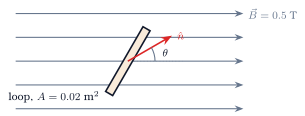
Define magnetic flux through a surface and give its unit. A coil of area \(0.02\) m\(^2\) lies in a field of \(0.5\) T with its normal at \(60^\circ\) to the field. Find the flux.
\(\Phi = \vec B \cdot \vec A = BA\cos\theta\), the number of field lines through the surface; unit weber (T m\(^2\)). \(\Phi = 0.5 \times 0.02 \times \cos 60^\circ = 5 \times 10^{-3}\) Wb.
How did it go?
Q2
The loop is turned in the field.
Find the flux for \(\theta = 0\).
Find the flux for \(\theta = 90^\circ\).
Answer(i) \(10^{-2}\) Wb (ii) zero
Solution
Normal along \(\vec B\): \(\Phi = BA = 0.5 \times 0.02 = 10^{-2}\) Wb, the maximum.
Plane of the loop along \(\vec B\): no lines pass through, \(\Phi = 0\).
How did it go?
Q3
What is flux linkage? Find it for the coil of Q1 if it has \(100\) turns.
Answer\(N\Phi\); \(0.5\) Wb
Solution
Flux linkage is the flux through the coil multiplied by the number of turns, \(N\Phi\), since each turn is threaded by the same flux. \(100 \times 5 \times 10^{-3} = 0.5\) Wb.
How did it go?
Q4
A long solenoid has \(1000\) turns per metre, a cross-section of \(10^{-3}\) m\(^2\) and carries \(2\) A. Find the flux through one turn. Take \(\mu_0 = 4\pi \times 10^{-7}\).
What is the net magnetic flux through any closed surface? What does this say about magnetic field lines?
Answerzero; lines form closed loops, no monopoles
Solution
Zero, always. Every field line that enters a closed surface also leaves it, because magnetic field lines form closed loops. There are no magnetic monopoles from which lines could start or end.
How did it go?
Faraday's law
Q6
State Faraday's law of induction in words and as an equation for a coil of \(N\) turns. What does the minus sign express?
Answer\(\varepsilon = -N\frac{d\Phi}{dt}\); the emf opposes the change (Lenz)
Solution
The emf induced in a circuit equals the rate of change of the flux linked with it: \(\varepsilon = -N\dfrac{d\Phi}{dt}\). The minus sign says that the emf drives a current whose own flux opposes the change, which is Lenz's law.
How did it go?
Q7
A \(200\)-turn coil of area \(0.01\) m\(^2\) is in a field of \(0.2\) T along its axis. The field falls to zero in \(0.1\) s. Find the average induced emf.
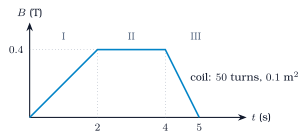
\(B\) is constant, so the flux does not change: \(\varepsilon = 0\).
\(\dfrac{dB}{dt} = \dfrac{0.4}{1} = 0.4\) T/s. \(\varepsilon = 50 \times 0.1 \times 0.4 = 2\) V, in the opposite sense to stage I.
How did it go?
Q9
A \(100\)-turn coil of area \(0.05\) m\(^2\) has its normal along a field of \(0.1\) T. It is turned through \(180^\circ\) in \(0.1\) s. Find the average emf.
Answer\(10\) V
Solution
The flux goes from \(+BA\) to \(-BA\), a change of \(2BA = 2 \times 0.1 \times 0.05 = 0.01\) Wb. \(\varepsilon = N\dfrac{\Delta\Phi}{\Delta t} = 100 \times \dfrac{0.01}{0.1} = 10\) V.
How did it go?
Q10
The coil of Q7 has resistance \(8\) Ω. Find the charge that flows through it while the field collapses. Does it depend on how long the collapse takes?
Answer\(0.05\) C; no
Solution
\(q = \dfrac{N\Delta\Phi}{R} = \dfrac{200 \times 0.002}{8} = 0.05\) C. It does not depend on the time: a slower collapse gives a smaller current for a longer time, and the same total charge.
How did it go?
Q11
A loop of area \(0.5\) m\(^2\) and resistance \(2\) Ω lies in a field increasing at \(0.4\) T/s. Find the emf, the current and the electrical power produced.
Answer\(0.2\) V; \(0.1\) A; \(0.02\) W
Solution
\(\varepsilon = A\dfrac{dB}{dt} = 0.5 \times 0.4 = 0.2\) V. \(I = \dfrac{0.2}{2} = 0.1\) A. \(P = \varepsilon I = 0.02\) W, supplied by whatever agent is increasing the field.
How did it go?
Q12
A flexible loop in a field of \(0.5\) T shrinks from \(0.2\) m\(^2\) to \(0.1\) m\(^2\) in \(0.5\) s. Find the average emf.
Answer\(0.1\) V
Solution
\(\Delta\Phi = B\,\Delta A = 0.5 \times 0.1 = 0.05\) Wb. \(\varepsilon = \dfrac{0.05}{0.5} = 0.1\) V.
How did it go?
Lenz's law
Q13
State Lenz's law. Explain in two sentences how it follows from the conservation of energy.
Answerinduced current opposes the change causing it; work must be done to induce it
Solution
Lenz's law: the induced current flows in the direction that opposes the change of flux producing it. If it helped the change instead, the flux and the current would grow without limit, giving energy from nothing. Opposing the change means an external agent must do work, and that work is what appears as electrical energy.
How did it go?
Q14
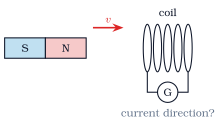
The N pole approaches the coil.
Which pole does the near face of the coil become? Why?
Seen from the magnet, is the induced current clockwise or anticlockwise?
What force does the coil exert on the magnet?
Answer(i) N pole, to repel the approach (ii) anticlockwise (iii) repulsion
Solution
The near face becomes a N pole, so that it repels the approaching N pole and opposes the increase of flux.
A face that is a N pole has anticlockwise current when viewed from outside, so seen from the magnet the current is anticlockwise.
Repulsion: the magnet must be pushed in against this force, and the work done becomes the electrical energy.
How did it go?
Q15
The magnet of Q14 is now pulled away. What changes in the induced current and in the force on the magnet?
Answercurrent reverses, near face becomes S; attraction
Solution
The flux is now decreasing, so the induced current reverses and the near face becomes a S pole, which attracts the departing N pole. The force on the magnet is now an attraction, again opposing its motion.
How did it go?
Q16
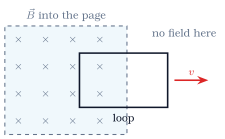
The loop is pulled out of the field region.
Is the flux through the loop increasing or decreasing?
Find the sense of the induced current.
In which direction is the magnetic force on the loop?
Answer(i) decreasing (ii) clockwise (iii) to the left, opposing the pull
Solution
Less and less of the loop is in the field, so the flux (into the page) is decreasing.
The current must make its own flux into the page to replace what is lost: clockwise.
The force on the side still inside the field is to the left, opposing the pull. Work done against it becomes heat in the loop.
How did it go?
Q17
A loop lies in a field into the page that is increasing. Find the sense of the induced current and explain with Lenz's law.
Answeranticlockwise; its field is out of the page, opposing the increase
Solution
The flux into the page is growing, so the induced current makes a field out of the page inside the loop. That needs an anticlockwise current.
How did it go?
Q18
A magnet dropped through a vertical copper tube falls much more slowly than in air. Explain.
Answereddy currents in the tube oppose the motion
Solution
As the magnet falls, the flux through each ring of the tube changes, inducing circulating (eddy) currents in the copper. By Lenz's law these currents oppose the motion: the ring ahead repels the magnet and the ring behind attracts it. The magnet quickly reaches a small terminal speed.
How did it go?
Q19
Two coils lie side by side. The current in the first is switched on. State the direction of the induced current in the second relative to the first, and what happens when the current is switched off.
Answeropposite to the first; then same direction as the first
Solution
Switching on increases the flux through the second coil, so its induced current flows opposite to the current in the first, to oppose the growth. Switching off decreases the flux. The induced current now flows in the same direction as the first coil's current was, trying to keep the flux.
How did it go?
Small situations
Q20
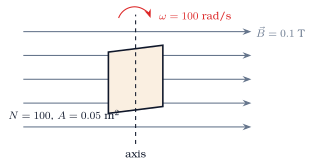
The coil rotates steadily in the field.
Write the flux through the coil as a function of time, starting with the normal along \(\vec B\).
Find the emf as a function of time and its peak value.
Answer(i) \(NBA\cos\omega t\) (ii) \(NBA\omega\sin\omega t\); \(50\) V
Solution
The angle between the normal and \(\vec B\) is \(\omega t\): \(\Phi = NBA\cos\omega t\) per the whole coil, that is \(N\Phi_1\) with \(\Phi_1 = BA\cos\omega t\).
A \(500\)-turn coil of area \(0.1\) m\(^2\) starts with its normal along the Earth's field of \(5 \times 10^{-5}\) T. It is flipped over in \(0.2\) s. Find the average emf.
A coil moves with constant velocity through a uniform field, staying perpendicular to it. Is any emf induced? Explain.
Answerno; flux constant
Solution
No. The field is uniform and the coil's orientation is fixed, so the flux through it stays the same as it moves. Faraday's law needs a changing flux; motion alone is not enough.
How did it go?
Q24
The flux linkage of a coil of resistance \(R\) changes by \(N\Delta\Phi\). Show that the charge that flows is \(q = \frac{N\Delta\Phi}{R}\), whatever the rate of change.
\(I = \dfrac{\varepsilon}{R} = \dfrac{N}{R}\dfrac{d\Phi}{dt}\). The charge is \(q = \int I\,dt = \dfrac{N}{R}\int\dfrac{d\Phi}{dt}dt = \dfrac{N}{R}\int d\Phi = \dfrac{N\Delta\Phi}{R}\). The time cancels: only the total change of flux matters.
How did it go?
Motional EMF and Rail Problems
24 questions · after Lesson 6, Rails: Drag, Terminal Speed and Energy
Motional emf
Q25
A rod of length \(l\) moves at speed \(v\) perpendicular to a field \(B\). Using the magnetic force on the free electrons, show that an emf \(Blv\) appears between its ends.
Each free electron moves with the rod at \(v\) and feels a magnetic force \(evB\) along the rod, pushing electrons to one end. Charge builds up until the electric field \(E\) inside the rod balances it: \(eE = evB\), so \(E = vB\). The potential difference across the length is \(\varepsilon = El = Blv\).
How did it go?
Q26
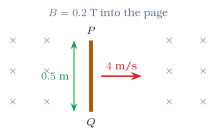
A \(0.5\) m rod moves at \(4\) m/s perpendicular to a field of \(0.2\) T. Find the emf between its ends.
The rod \(PQ\) moves to the right in a field into the page.
Which way are the free electrons pushed? Which end is at the higher potential?
If \(P\) and \(Q\) were joined by an external wire, which way would current flow through the rod?
Answer(i) towards \(Q\); \(P\) (ii) from \(Q\) to \(P\)
Solution
For a positive charge \(\vec v \times \vec B = \hat i \times (-\hat k) = \hat j\), towards \(P\). Electrons feel the opposite force and go to \(Q\), leaving \(P\) positive: \(P\) is at the higher potential.
Inside the rod, which acts as the source, current flows from \(Q\) to \(P\). In the external wire it flows from \(P\) to \(Q\).
How did it go?
Q28
The rod of Q2 moves at \(30^\circ\) to the field instead of perpendicular to it. Find the emf.
Answer\(0.2\) V
Solution
Only the component of \(v\) perpendicular to \(B\) counts: \(\varepsilon = Blv\sin 30^\circ = 0.4 \times 0.5 = 0.2\) V.
How did it go?
Q29
An aircraft with a wingspan of \(40\) m flies horizontally at \(250\) m/s where the vertical component of the Earth's field is \(5 \times 10^{-5}\) T. Find the emf between the wing tips.
An isolated rod moves through a field. There is an emf between its ends, yet no current flows along it. Explain.
Answeropen circuit; charges pile up until \(eE = evB\)
Solution
The rod is an open circuit. The magnetic force moves electrons to one end only until the electric field of the separated charges balances it. After that there is no net force and no further flow. The emf is present as a potential difference, but a current needs a closed path.
How did it go?
Rotational emf
Q31
A rod of length \(L\) rotates at angular speed \(\omega\) about one end, in a plane perpendicular to a field \(B\). Show that the emf between its ends is \(\frac{1}{2}B\omega L^2\).
Answer\(\varepsilon = \int_0^L B\omega r\,dr\)
Solution
An element \(dr\) at distance \(r\) from the pivot moves at \(v = \omega r\) and has emf \(d\varepsilon = B\omega r\,dr\). Adding along the rod: \(\varepsilon = \int_0^L B\omega r\,dr = \dfrac{1}{2}B\omega L^2\). Equivalently, the rod sweeps area at the rate \(\dfrac{1}{2}\omega L^2\).
How did it go?
Q32
A \(1\) m rod rotates at \(10\) rad/s about one end in a field of \(0.5\) T perpendicular to its plane. Find the emf.
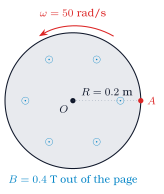
Every radius is a rotating rod: \(\varepsilon = \dfrac{1}{2}B\omega R^2 = \dfrac{1}{2} \times 0.4 \times 50 \times 0.04 = 0.4\) V.
No: all rim points are at the same potential, since every radius gives the same emf.
How did it go?
Q34
A rod of length \(L\) rotates about its midpoint in a field perpendicular to its plane. Find the emf between the centre and one end, and between the two ends.
Answer\(\frac{1}{8}B\omega L^2\); zero
Solution
Each half is a rod of length \(\dfrac{L}{2}\) rotating about its end: emf \(\dfrac{1}{2}B\omega\left(\dfrac{L}{2}\right)^2 = \dfrac{1}{8}B\omega L^2\) between the centre and either end. Both ends are at the same potential relative to the centre, so the emf between the two ends is zero.
How did it go?
Q35
In Q9 the field is out of the page and the disc turns anticlockwise. Which is at the higher potential, the centre or the rim? Explain with the force on a positive charge.
Answerrim; force on \(+q\) is outward
Solution
A positive charge at radius \(r\) moves tangentially at \(\omega r\). With \(\vec v\) tangential (anticlockwise) and \(\vec B\) out of the page, \(\vec v \times \vec B\) points radially outward. Positive charge is pushed to the rim, so the rim is at the higher potential.
How did it go?
Rail problems
Q36
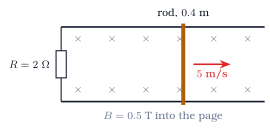
The rod is pulled at a steady \(5\) m/s. Ignore the resistance of the rod and rails.
Find the emf and the current.
Find the force needed to keep the rod moving.
Find the mechanical power supplied and the heat produced per second.
Answer(i) \(1\) V; \(0.5\) A (ii) \(0.1\) N (iii) \(0.5\) W; \(0.5\) W
Solution
\(\varepsilon = Blv = 0.5 \times 0.4 \times 5 = 1\) V. \(I = \dfrac{1}{2} = 0.5\) A.
The current in the field feels \(F = BIl = 0.5 \times 0.5 \times 0.4 = 0.1\) N, opposing the motion; the pull must equal it.
Mechanical: \(Fv = 0.1 \times 5 = 0.5\) W. Heat: \(I^2R = 0.25 \times 2 = 0.5\) W. They match.
How did it go?
Q37
For a rod pulled at constant speed on rails, show in general that the mechanical power supplied equals the electrical power \(I^2R\).
Answer\(Fv = BIlv = I\varepsilon = I^2R\)
Solution
The pull balances the magnetic force \(BIl\), so the power supplied is \(Fv = BIlv = I(Blv) = I\varepsilon\). With \(\varepsilon = IR\) this is \(I^2R\), the rate of heating in the resistor. All the mechanical work becomes heat.
How did it go?
Q38
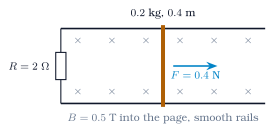
The rod of Q12 has mass \(0.2\) kg. It is given \(5\) m/s and released. Write its equation of motion, describe how its speed changes, and find how far it travels before stopping.
Answer\(m\frac{dv}{dt} = -\frac{B^2l^2}{R}v\); exponential decay; \(50\) m
Solution
Current \(I = \dfrac{Blv}{R}\) gives a retarding force \(BIl = \dfrac{B^2l^2}{R}v\): \(m\dfrac{dv}{dt} = -\dfrac{B^2l^2}{R}v\). The speed decays exponentially, \(v = v_0e^{-t/\tau}\) with \(\tau = \dfrac{mR}{B^2l^2} = \dfrac{0.2 \times 2}{0.25 \times 0.16} = 10\) s. Distance \(= v_0\tau = 5 \times 10 = 50\) m.
How did it go?
Q39
A constant force of \(0.4\) N pulls the rod from rest.
Why does the rod reach a terminal velocity?
Find the terminal velocity and the current then.
Answer(i) magnetic drag grows with \(v\) until it equals \(F\) (ii) \(20\) m/s; \(2\) A
Solution
As the rod speeds up, the induced current and the magnetic drag \(\dfrac{B^2l^2}{R}v\) grow. When the drag equals \(F\) the net force is zero and the speed stays constant.
The rails of Q12 are instead connected to a \(2\) V battery through the \(2\) Ω resistor, and the rod is free to move. Find the initial current and force on the rod, and the speed at which the rod stops accelerating.
Answer\(1\) A; \(0.2\) N; \(10\) m/s
Solution
At rest there is no back emf: \(I = \dfrac{2}{2} = 1\) A and \(F = BIl = 0.5 \times 1 \times 0.4 = 0.2\) N, which starts the rod moving. As it moves the motional emf opposes the battery; the current and force vanish when \(Blv = 2\) V, at \(v = \dfrac{2}{0.5 \times 0.4} = 10\) m/s. The rod then coasts at constant speed: a simple linear motor.
How did it go?
Q41
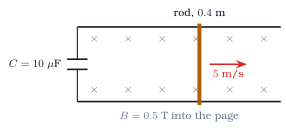
The rails are closed by a capacitor and the rod moves at a steady \(5\) m/s.
Find the final charge on the capacitor.
What force is needed to keep the rod moving once the capacitor is charged?
Answer(i) \(10\) μC (ii) zero
Solution
The capacitor charges to the emf \(\varepsilon = Blv = 1\) V: \(Q = C\varepsilon = 10 \times 10^{-6} \times 1 = 10\) μC.
Once charged, no current flows, so there is no magnetic force on the rod. With smooth rails no force is needed to keep it moving.
How did it go?
Q42
A \(0.5\) m rod slides down rails inclined at \(37^\circ\) at \(2\) m/s in a vertical field of \(0.5\) T. Find the emf. Take \(\cos 37^\circ = 0.8\).
Answer\(0.4\) V
Solution
The rod's velocity along the incline has a horizontal component \(v\cos 37^\circ\) perpendicular to the vertical field; the vertical component is along \(\vec B\) and gives nothing. \(\varepsilon = Blv\cos 37^\circ = 0.5 \times 0.5 \times 2 \times 0.8 = 0.4\) V.
How did it go?
Q43
The rails are closed by a pure inductor and the rod is given a push. Explain in words why the rod oscillates instead of slowing to rest.
Answerenergy swaps between the rod's motion and the inductor's field
Solution
With no resistance, no energy is lost as heat. The moving rod drives a growing current through the inductor, storing energy in its magnetic field and slowing the rod. When the rod stops, the inductor's current is largest; it keeps flowing and pushes the rod back the other way. Energy passes back and forth between the rod's motion and the inductor, so the rod oscillates.
How did it go?
Small situations
Q44
A train's axle is \(1.5\) m long. The train runs at \(20\) m/s where the vertical field is \(5 \times 10^{-5}\) T. Find the emf across the axle.
A closed rectangular loop moves at constant velocity wholly inside a uniform field. Is there a current in it? Explain using the motional emfs of its sides.
Answerno; the emfs of opposite sides cancel
Solution
No. The two sides perpendicular to the velocity each have a motional emf \(Blv\). The two are equal and drive current in opposite senses round the loop, so they cancel. Equivalently, the flux through the loop does not change.
How did it go?
Q46
For the rod of Q12, find the heat produced in \(10\) s and the work done by the pulling force in the same time.
Answer\(5\) J; \(5\) J
Solution
Heat \(= I^2Rt = 0.25 \times 2 \times 10 = 5\) J. Work \(= Fvt = 0.1 \times 5 \times 10 = 5\) J. Equal, as Q13 requires.
How did it go?
Q47
A \(1\) m horizontal rod falls at \(10\) m/s with its length perpendicular to the horizontal field \(B_H = 4 \times 10^{-5}\) T. Find the emf across it.
Answer\(4 \times 10^{-4}\) V
Solution
The rod, its velocity and \(B_H\) are mutually perpendicular: \(\varepsilon = B_Hlv = 4 \times 10^{-5} \times 1 \times 10 = 4 \times 10^{-4}\) V.
How did it go?
Q48
For the rod of Q14, show that the distance travelled before stopping is \(x = \frac{mRv_0}{B^2l^2}\).
Answer\(m\,dv = -\frac{B^2l^2}{R}dx\)
Solution
\(m\dfrac{dv}{dt} = -\dfrac{B^2l^2}{R}v\). Write \(\dfrac{dv}{dt} = v\dfrac{dv}{dx}\): \(mv\dfrac{dv}{dx} = -\dfrac{B^2l^2}{R}v\), so \(m\,dv = -\dfrac{B^2l^2}{R}dx\). Integrating from \(v_0\) to \(0\): \(-mv_0 = -\dfrac{B^2l^2}{R}x\), so \(x = \dfrac{mRv_0}{B^2l^2}\), which is \(v_0\tau\).