Questions on Alternating Current and the LCR Circuit, the kind your examinations ask. Solve one on paper. Then tell the book how it went. The book believes you, and it uses your answer to plan your revision.
0%
Nothing marked yetMark honestly. Peek at the answer only after your own attempt.
RMS and Average Values, Phasors
24 questions · after Lesson 3, The Inductor and the Capacitor
Sinusoidal AC
Q1
Write the general form of a sinusoidal current. For the mains supply of \(220\) V (rms) at \(50\) Hz, find \(\omega\) and the peak voltage.
Answer\(i = i_0\sin\omega t\); \(100\pi \approx 314\) rad/s; \(311\) V
Define the rms value of an alternating current. Why is it the value quoted on meters and appliances? Find it for a peak current of \(2\) A.
AnswerDC value giving the same heating; \(\sqrt2 \approx 1.41\) A
Solution
The rms value is the steady current that would produce the same heating in a resistor as the alternating current: \(I_{\text{rms}} = \sqrt{\langle i^2\rangle}\). Heating depends on \(i^2\), which does not average to zero, so rms measures what the current can do. For a sinusoid \(I_{\text{rms}} = \dfrac{i_0}{\sqrt2} = \dfrac{2}{\sqrt2} \approx 1.41\) A.
How did it go?
Q4
Show that the rms value of \(i = i_0\sin\omega t\) is \(\frac{i_0}{\sqrt2}\).
Answer\(\langle\sin^2\rangle = \frac{1}{2}\)
Solution
\(i^2 = i_0^2\sin^2\omega t\). Over a cycle \(\sin^2\omega t\) averages to \(\dfrac{1}{2}\) (Q24), so \(\langle i^2\rangle = \dfrac{i_0^2}{2}\) and \(I_{\text{rms}} = \sqrt{\dfrac{i_0^2}{2}} = \dfrac{i_0}{\sqrt2}\).
How did it go?
Q5
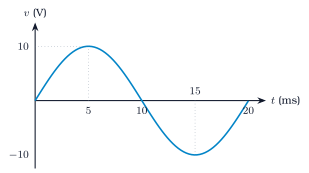
Find the mean value of \(i = i_0\sin\omega t\) over a full cycle and over the positive half cycle.
Answer\(0\); \(\frac{2i_0}{\pi} \approx 0.64i_0\)
Solution
Over a full cycle the positive and negative halves cancel: mean \(= 0\). Over the half cycle \(0\) to \(\dfrac{T}{2}\): \(\bar i = \dfrac{2}{T}\int_0^{T/2}i_0\sin\omega t\,dt = \dfrac{2i_0}{\pi} \approx 0.64i_0\).
How did it go?
Irregular waveforms
Q6
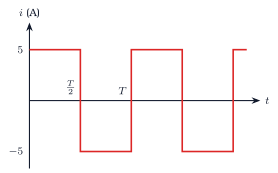
A square-wave current switches between \(+5\) A and \(-5\) A.
Find its rms value.
Find its mean value over a cycle.
Answer(i) \(5\) A (ii) \(0\)
Solution
\(i^2 = 25\) at every instant, so \(\langle i^2\rangle = 25\) and \(I_{\text{rms}} = 5\) A.
The current is \(+5\) for half the time and \(-5\) for the other half: mean \(= 0\).
How did it go?
Q7
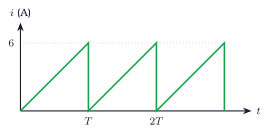
The current rises linearly from \(0\) to \(6\) A in each period.
Find its mean value.
Find its rms value.
Answer(i) \(3\) A (ii) \(2\sqrt3 \approx 3.5\) A
Solution
The current rises uniformly from \(0\) to \(6\) A, so its mean is \(3\) A.
With \(i = \dfrac{6t}{T}\): \(\langle i^2\rangle = \dfrac{1}{T}\int_0^T\dfrac{36t^2}{T^2}dt = 12\), so \(I_{\text{rms}} = \sqrt{12} = 2\sqrt3 \approx 3.5\) A.
How did it go?
Q8
A current is \(i = 3 + 4\sin\omega t\) (in amperes). Find its mean and its rms value.
Answer\(3\) A; \(\sqrt{17} \approx 4.1\) A
Solution
Mean: the sine averages to zero, leaving \(3\) A. \(i^2 = 9 + 24\sin\omega t + 16\sin^2\omega t\), whose average is \(9 + 0 + 8 = 17\). \(I_{\text{rms}} = \sqrt{17} \approx 4.1\) A.
How did it go?
Q9
A current is \(i = 2\sin\omega t + 2\cos\omega t\). Find its peak value and its rms value.
Answer\(2\sqrt2 \approx 2.8\) A; \(2\) A
Solution
\(2\sin\omega t + 2\cos\omega t = 2\sqrt2\sin\left(\omega t + \dfrac{\pi}{4}\right)\): a sinusoid of peak \(2\sqrt2 \approx 2.8\) A. Rms \(= \dfrac{2\sqrt2}{\sqrt2} = 2\) A.
How did it go?
Q10
A half-wave rectifier passes only the positive halves of \(i = 4\sin\omega t\). Find the mean and the rms values of the output over a full cycle.
Answer\(\frac{4}{\pi} \approx 1.3\) A; \(2\) A
Solution
Mean: the positive half contributes \(\dfrac{2i_0}{\pi}\) over its own half, and the other half is zero: \(\bar i = \dfrac{i_0}{\pi} = \dfrac{4}{\pi} \approx 1.3\) A. Rms: \(\langle i^2\rangle\) is half that of the full sine, \(\dfrac{i_0^2}{4}\), so \(I_{\text{rms}} = \dfrac{i_0}{2} = 2\) A.
How did it go?
Q11
A steady \(2\) A and an alternating current of peak \(2\) A flow in turn through the same resistor for equal times. Compare the heat produced.
AnswerAC gives half
Solution
Heat \(\propto I_{\text{rms}}^2\). DC: \(4R\) per unit time. AC of peak \(2\) A has \(I_{\text{rms}} = \sqrt2\) A, giving \(2R\): half as much heat.
How did it go?
Phasors
Q12
What is a phasor? What do its length and its angle represent, and how is the instantaneous value read from it?
Answerrotating vector; length = peak, angle = phase; projection on the vertical
Solution
A phasor is a vector rotating anticlockwise at the angular frequency \(\omega\). Its length is the peak value and its angle at any instant is the phase \(\omega t + \phi\). The instantaneous value is the projection of the phasor on the vertical axis, \(v_0\sin(\omega t + \phi)\).
How did it go?
Q13
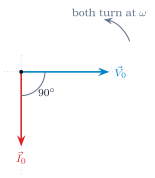
The voltage is \(v = v_0\sin\omega t\).
Write \(i(t)\).
Which circuit element gives this diagram?
Answer(i) \(i_0\sin\left(\omega t - \frac{\pi}{2}\right)\) (ii) pure inductor
Solution
The current phasor is \(90^\circ\) behind: \(i = i_0\sin\left(\omega t - \dfrac{\pi}{2}\right) = -i_0\cos\omega t\).
A pure inductor, in which the current lags the voltage by a quarter cycle.
How did it go?
Q14
A voltage \(v = 20\sin\omega t\) is applied to a \(5\) Ω resistor. Write \(i(t)\) and draw the phasor diagram in words.
Answer\(4\sin\omega t\); \(\vec V\) and \(\vec I\) along the same line
Solution
In a resistor \(i = \dfrac{v}{R} = 4\sin\omega t\) A, in phase with \(v\). The two phasors point along the same line, of lengths \(20\) V and \(4\) A, and rotate together.
How did it go?
Q15
A \(0.1\) H inductor is connected to \(220\) V, \(50\) Hz mains. Find its reactance and the rms current. State the phase of the current relative to the voltage.
Answer\(10\pi \approx 31\) Ω; \(7\) A; lags by \(90^\circ\)
Solution
\(X_L = \omega L = 100\pi \times 0.1 = 10\pi \approx 31\) Ω. \(I_{\text{rms}} = \dfrac{220}{31.4} \approx 7\) A. The current lags the voltage by \(90^\circ\).
How did it go?
Q16
A \(100\) μF capacitor is connected to the same mains. Find its reactance and the rms current, and state the phase of the current.
Answer\(\frac{100}{\pi} \approx 32\) Ω; \(6.9\) A; leads by \(90^\circ\)
Solution
\(X_C = \dfrac{1}{\omega C} = \dfrac{1}{100\pi \times 10^{-4}} = \dfrac{100}{\pi} \approx 32\) Ω. \(I_{\text{rms}} = \dfrac{220}{31.8} \approx 6.9\) A. The current leads the voltage by \(90^\circ\).
How did it go?
Q17
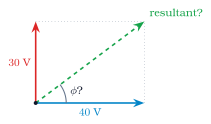
Two voltages of the same frequency, \(30\) V and \(40\) V, differ in phase by \(90^\circ\).
Find the resultant voltage.
Find its phase \(\phi\) relative to the \(40\) V phasor.
Answer(i) \(50\) V (ii) \(37^\circ\)
Solution
Phasors add like vectors: \(V = \sqrt{30^2 + 40^2} = 50\) V.
\(\tan\phi = \dfrac{30}{40} = 0.75\), so \(\phi = 37^\circ\) ahead of the \(40\) V phasor.
How did it go?
Q18
How do \(X_L\) and \(X_C\) change as the frequency rises? What do an inductor and a capacitor do to a steady direct current?
Answer\(X_L\) rises, \(X_C\) falls; inductor passes DC, capacitor blocks it
Solution
\(X_L = \omega L\) grows in proportion to the frequency; \(X_C = \dfrac{1}{\omega C}\) falls as the frequency rises. For direct current \(\omega = 0\): an inductor has zero reactance and passes DC freely, while a capacitor has infinite reactance and blocks it.
How did it go?
Small situations
Q19
A bulb is rated \(100\) W at \(220\) V rms. Find the rms current and the peak current through it.
Answer\(0.45\) A; \(0.64\) A
Solution
\(I_{\text{rms}} = \dfrac{P}{V_{\text{rms}}} = \dfrac{100}{220} \approx 0.45\) A. Peak \(= \sqrt2 \times 0.45 \approx 0.64\) A.
How did it go?
Q20
An AC ammeter reads \(2\) A. What kind of value is this? Find the peak current.
Answerrms; \(2.8\) A
Solution
AC meters read rms values. Peak \(= \sqrt2 \times 2 \approx 2.8\) A.
How did it go?
Q21
A voltage is \(v = 100\sin(314t)\) V. Find the rms value, the frequency and the first time at which \(v\) is at its peak.
Answer\(70.7\) V; \(50\) Hz; \(5\) ms
Solution
\(V_{\text{rms}} = \dfrac{100}{\sqrt2} \approx 70.7\) V. \(\omega = 314 = 2\pi f\), so \(f = 50\) Hz. The first peak is at \(\omega t = \dfrac{\pi}{2}\): \(t = \dfrac{T}{4} = 5\) ms.
How did it go?
Q22
Why does an ordinary moving coil galvanometer read zero when an alternating current of \(50\) Hz passes through it?
Answermean current zero; coil cannot follow \(50\) Hz
Solution
The coil's torque reverses every half cycle. Its inertia is far too large to follow \(50\) reversals a second, so it responds only to the average current, which is zero. A hot-wire or rectifier instrument is needed for AC.
How did it go?
Q23
Two currents \(i_1 = 3\sin\omega t\) and \(i_2 = 4\sin\left(\omega t + \frac{\pi}{2}\right)\) meet at a junction. Find the resultant current using phasors.
Answer\(5\sin(\omega t + 53^\circ)\)
Solution
The phasors are \(3\) along the reference and \(4\) at \(90^\circ\) ahead. Resultant \(\sqrt{9 + 16} = 5\) A, at \(\tan^{-1}\dfrac{4}{3} = 53^\circ\) ahead: \(i = 5\sin(\omega t + 53^\circ)\).
How did it go?
Q24
Show that the average of \(\sin^2\omega t\) over one cycle is \(\frac{1}{2}\).
Answer\(\sin^2 = \frac{1 - \cos 2\omega t}{2}\), cosine averages to zero
Solution
\(\sin^2\omega t = \dfrac{1 - \cos 2\omega t}{2}\). Over a full cycle the cosine term averages to zero, since it spends equal times positive and negative. What remains is \(\dfrac{1}{2}\). Equivalently, \(\sin^2 + \cos^2 = 1\) and the two have equal averages, so each is \(\dfrac{1}{2}\).
How did it go?
Series LCR, Resonance, Power and the Choke Coil
24 questions · after Lesson 6, Power, the Power Factor and the Choke
Impedance
Q25
For a series LCR circuit, write the impedance and the phase angle between the current and the applied voltage. Describe the phasor diagram in words.
\(Z = \sqrt{R^2 + (X_L - X_C)^2}\) and \(\tan\phi = \dfrac{X_L - X_C}{R}\). In the phasor diagram the current phasor is the reference. \(V_R\) lies along it, \(V_L\) is \(90^\circ\) ahead and \(V_C\) is \(90^\circ\) behind. The applied voltage is the vector sum of the three.
How did it go?
Q26
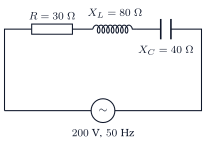
Use the values shown. All voltages are rms.
Find the impedance and the current.
Find the voltages across \(R\), \(L\) and \(C\).
Find the phase angle and state whether the current leads or lags.
Answer(i) \(50\) Ω; \(4\) A (ii) \(120\) V; \(320\) V; \(160\) V (iii) \(53^\circ\); lags
\(\tan\phi = \dfrac{40}{30} = \dfrac{4}{3}\), so \(\phi = 53^\circ\). \(X_L > X_C\), so the current lags the voltage.
How did it go?
Q27
In Q2 the circuit is inductive. What does this mean for the phase of the current? What would make it capacitive?
Answercurrent behind the voltage; \(X_C > X_L\)
Solution
Inductive means \(X_L > X_C\): the inductor dominates and the current reaches its peak after the voltage does. Lowering the frequency, or reducing \(C\) so that \(X_C\) grows past \(X_L\), would make the circuit capacitive with the current leading.
How did it go?
Q28
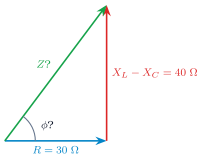
The triangle shows \(R\) and the net reactance of Q2.
Find \(Z\).
Find \(\cos\phi\).
Answer(i) \(50\) Ω (ii) \(0.6\)
Solution
\(Z\) is the hypotenuse: \(\sqrt{30^2 + 40^2} = 50\) Ω.
A coil of resistance \(40\) Ω and reactance \(30\) Ω is put across \(100\) V rms. Find the impedance, the current, the voltage across the resistance and the reactance, and the phase angle. Take \(\tan 37^\circ = 0.75\).
\(Z = \sqrt{40^2 + 30^2} = 50\) Ω. \(I = \dfrac{100}{50} = 2\) A. \(V_R = 80\) V, \(V_L = 60\) V; check \(\sqrt{80^2 + 60^2} = 100\) V. \(\tan\phi = \dfrac{30}{40} = 0.75\), so the current lags by \(37^\circ\).
How did it go?
Q30
A \(60\) Ω resistor and a capacitor of reactance \(80\) Ω are in series. Find the impedance and the phase angle. Does the current lead or lag? Take \(\tan 53^\circ = \frac{4}{3}\).
Answer\(100\) Ω; \(53^\circ\); leads
Solution
\(Z = \sqrt{60^2 + 80^2} = 100\) Ω. \(\tan\phi = \dfrac{80}{60} = \dfrac{4}{3}\), so \(\phi = 53^\circ\). With a capacitor the current leads the voltage.
How did it go?
Q31
In Q2, \(V_R + V_L + V_C\) is much more than \(200\) V. Explain why this is not a contradiction.
Answerphasor sum, not arithmetic sum: \(\sqrt{V_R^2 + (V_L - V_C)^2} = 200\) V
Solution
The three voltages peak at different times: \(V_L\) and \(V_C\) are opposite in phase and partly cancel, and \(V_R\) is \(90^\circ\) from both. Only their phasor sum equals the supply: \(\sqrt{120^2 + (320 - 160)^2} = \sqrt{14400 + 25600} = 200\) V. Adding the numbers directly ignores the phases.
How did it go?
Resonance
Q32
State the resonance condition of a series LCR circuit and derive \(\omega_0 = \frac{1}{\sqrt{LC}}\). Find \(\omega_0\) and \(f_0\) for \(L = 0.1\) H and \(C = 10\) μF.
Resonance: \(X_L = X_C\), that is \(\omega L = \dfrac{1}{\omega C}\), so \(\omega_0 = \dfrac{1}{\sqrt{LC}}\). Here \(\omega_0 = \dfrac{1}{\sqrt{0.1 \times 10^{-5}}} = \dfrac{1}{10^{-3}} = 1000\) rad/s and \(f_0 = \dfrac{1000}{2\pi} \approx 159\) Hz.
How did it go?
Q33
At resonance, what are the impedance, the current and the phase angle of the circuit of Q8 with \(R = 10\) Ω and \(V = 20\) V rms?
Answer\(10\) Ω; \(2\) A; zero
Solution
The reactances cancel, so \(Z = R = 10\) Ω, its smallest value. \(I = \dfrac{20}{10} = 2\) A, the largest possible. \(\phi = 0\): the circuit behaves as a pure resistor.
How did it go?
Q34
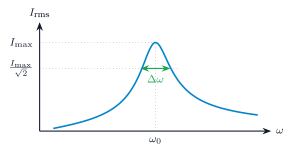
For the circuit of Q9, use \(Q = \frac{\omega_0L}{R}\) and \(\Delta\omega = \frac{\omega_0}{Q}\).
\(\Delta\omega = \dfrac{\omega_0}{Q} = \dfrac{1000}{10} = 100\) rad/s, the width between the points where the current is \(\dfrac{1}{\sqrt2}\) of its peak.
How did it go?
Q35
Find the voltage across the inductor at resonance in Q9. Why can it exceed the source voltage?
Answer\(200\) V; \(V_L\) and \(V_C\) cancel
Solution
\(V_L = IX_L = 2 \times 1000 \times 0.1 = 200\) V, ten times the \(20\) V supply. \(V_C\) is also \(200\) V but opposite in phase, so the two cancel and the supply only has to drive the current through \(R\). The ratio \(\dfrac{V_L}{V} = Q\).
How did it go?
Q36
In tuning a radio, which quantity of the LCR circuit is varied and why is a high \(Q\) wanted?
Answer\(C\); to pick one station sharply
Solution
The capacitance is varied, which moves \(\omega_0\) to the frequency of the wanted station. A high \(Q\) gives a narrow, tall resonance peak, so the circuit responds strongly to that station and hardly at all to neighbouring frequencies.
How did it go?
Q37
Two circuits have the same \(L\) and \(C\) but \(R = 10\) Ω and \(R = 40\) Ω. Compare their \(Q\) factors and the sharpness of their resonance curves.
Answer\(10\) and \(2.5\); the first is four times sharper
Solution
\(Q = \dfrac{\omega_0L}{R}\): \(10\) for \(R = 10\) Ω and \(2.5\) for \(R = 40\) Ω. The bandwidth \(\dfrac{\omega_0}{Q}\) is four times larger for the second, so its resonance is four times broader and its peak current four times smaller.
How did it go?
Power
Q38
Write the average power in an AC circuit and define the power factor. Find the power for the circuit of Q2 and check it against \(I^2R\).
Answer\(P = V_{\text{rms}}I_{\text{rms}}\cos\phi\); \(\cos\phi = \frac{R}{Z}\); \(480\) W
Solution
\(P = V_{\text{rms}}I_{\text{rms}}\cos\phi\), with the power factor \(\cos\phi = \dfrac{R}{Z}\). For Q2: \(P = 200 \times 4 \times 0.6 = 480\) W. Check: \(I^2R = 16 \times 30 = 480\) W. All the power goes into the resistor.
How did it go?
Q39
What is the wattless component of the current? Find it for Q2.
Answer\(I\sin\phi\), no average power; \(3.2\) A
Solution
The current can be split into \(I\cos\phi\) in phase with the voltage and \(I\sin\phi\) at \(90^\circ\) to it. The second part delivers no average power and is called wattless: \(4 \times \sin 53^\circ = 4 \times 0.8 = 3.2\) A.
How did it go?
Q40
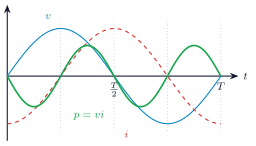
The graph shows \(v\), \(i\) and \(p = vi\) for a pure inductor.
What is the average power over a cycle?
Describe what happens to the energy in each quarter cycle.
Answer(i) zero (ii) energy goes into the field, then back to the source
Solution
\(p\) is positive for half of each cycle and equally negative for the other half, so the average power is zero.
While \(p > 0\) the source feeds energy into the inductor's magnetic field as the current grows. While \(p < 0\) the field collapses and returns the energy to the source. Nothing is dissipated.
How did it go?
Q41
A load draws \(1000\) W at \(200\) V rms. Find the current when the power factor is \(0.5\) and when it is \(1\). Why do power companies want the power factor near \(1\)?
Answer\(10\) A; \(5\) A; less \(I^2R\) loss in the lines
Solution
\(I = \dfrac{P}{V\cos\phi}\): with \(\cos\phi = 0.5\), \(I = \dfrac{1000}{100} = 10\) A; with \(\cos\phi = 1\), \(I = 5\) A. The same useful power needs twice the current at the poorer power factor, and the \(I^2R\) loss in the transmission lines is four times larger.
How did it go?
Q42
For Q2, find the apparent power in VA and the true power in W.
Answer\(800\) VA; \(480\) W
Solution
Apparent power \(= V_{\text{rms}}I_{\text{rms}} = 200 \times 4 = 800\) VA. True power \(= 800 \times 0.6 = 480\) W. The difference is reactive power that shuttles back and forth.
How did it go?
Q43
A factory's load is inductive with a low power factor. What can be added to the circuit to improve it, and why does that work?
Answera capacitor in parallel; its leading current cancels the lagging one
Solution
A capacitor of suitable size is connected in parallel with the load. Its current leads the voltage by \(90^\circ\) and cancels the lagging wattless current of the inductive load. The total current then comes closer to being in phase with the voltage, and the power factor rises towards \(1\).
How did it go?
Choke coil
Q44
What is a choke coil? Why does it reduce the current in the lamp without wasting much power?
Answerhigh-\(L\), low-\(R\) coil; reactance limits current, no \(I^2R\) loss
Solution
A choke is a coil of large inductance and very small resistance. Its reactance \(\omega L\) limits the alternating current just as a resistor would. Since it dissipates almost no \(I^2R\) heat, the power drawn from the supply is nearly all used in the lamp.
How did it go?
Q45
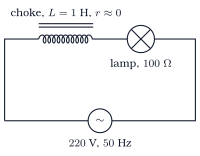
For the circuit of Q20, find the reactance of the choke, the impedance, the current, and the power in the lamp and in the choke.
A resistor is used instead of the choke to give the same current in the lamp. Find its value and the power it wastes.
Answer\(\approx 230\) Ω; \(\approx 103\) W
Solution
The lamp needs the same \(0.67\) A, so the total resistance must be \(\dfrac{220}{0.67} \approx 330\) Ω and the added resistor \(\approx 230\) Ω. It wastes \(I^2R = 0.44 \times 230 \approx 103\) W, more than twice the lamp's own power.
How did it go?
Q47
Why is a choke wound with thick copper wire on a laminated iron core?
Answerthick wire: small \(R\); iron core: large \(L\); laminated: no eddy loss
Solution
Thick wire keeps the resistance, and so the \(I^2R\) loss, small. The iron core multiplies the inductance, giving a large reactance with few turns. Laminating the core cuts the eddy currents that a solid core would carry, so the core itself wastes little energy.
How did it go?
Q48
Show that the average power delivered to a pure inductor over a cycle is zero.
Answer\(p = -\frac{v_0i_0}{2}\sin 2\omega t\), averages to zero
Solution
\(v = v_0\sin\omega t\) and \(i = i_0\sin\left(\omega t - \dfrac{\pi}{2}\right) = -i_0\cos\omega t\). \(p = vi = -v_0i_0\sin\omega t\cos\omega t = -\dfrac{v_0i_0}{2}\sin 2\omega t\). A sine of double frequency averages to zero over a cycle, so \(\bar P = 0\).