Questions on Transformers, LC Oscillations and Electromagnetic Waves, the kind your examinations ask. Solve one on paper. Then tell the book how it went. The book believes you, and it uses your answer to plan your revision.
0%
Nothing marked yetMark honestly. Peek at the answer only after your own attempt.
Transformers and LC Oscillations
24 questions · after Lesson 2, LC Oscillations
Transformer principle
Q1
On what principle does a transformer work? Why does it not work with a steady direct current?
Answermutual induction; DC gives no changing flux
Solution
Mutual induction: the alternating current in the primary makes an alternating flux in the core. This changing flux induces an emf in every turn of the secondary. A steady direct current gives a constant flux, so no emf is induced in the secondary.
How did it go?
Q2
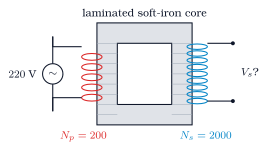
The transformer is ideal.
Find the secondary voltage.
Is it step-up or step-down?
Answer(i) \(2200\) V (ii) step-up
Solution
The same flux threads every turn, so the emf per turn is the same in both coils: \(\dfrac{V_s}{V_p} = \dfrac{N_s}{N_p}\). \(V_s = 220 \times \dfrac{2000}{200} = 2200\) V.
\(N_s > N_p\), so the voltage is raised: step-up.
How did it go?
Q3
The secondary of Q2 supplies \(1\) A. Find the primary current, using conservation of power.
Answer\(10\) A
Solution
Ideal: \(V_pI_p = V_sI_s\), so \(I_p = \dfrac{2200 \times 1}{220} = 10\) A. The voltage goes up ten times and the current comes down ten times.
How did it go?
Q4
A doorbell needs \(12\) V from a \(240\) V supply. Find the turns ratio. If the primary has \(1000\) turns, how many has the secondary?
Why is the core made of soft iron, and why is it laminated? Why are the windings insulated from the core?
Answerhigh permeability; cuts eddy currents; stops short circuits
Solution
Soft iron has a high permeability, so it carries almost all the flux from the primary to the secondary. It also magnetises and demagnetises easily, with little hysteresis loss. Laminating the core breaks up the paths of eddy currents. Insulation stops the windings shorting through the conducting core.
How did it go?
Q6
Name four sources of energy loss in a transformer and say how each is reduced.
Copper loss, \(I^2R\) heating in the windings: thick wire. Eddy current loss in the core: laminations. Hysteresis loss: soft iron or special alloys with a thin loop. Flux leakage, flux that misses the secondary: winding the coils one over the other on a closed core.
How did it go?
Efficiency and transmission
Q7
A transformer takes \(1000\) W and delivers \(900\) W. Find its efficiency and the power lost.
Answer\(90\%\); \(100\) W
Solution
Efficiency \(= \dfrac{900}{1000} = 90\%\). Loss \(= 1000 - 900 = 100\) W, mostly as heat.
How did it go?
Q8
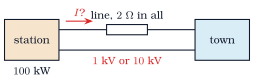
The station sends \(100\) kW to the town through a line of total resistance \(2\) Ω.
Find the line current and the power lost when the line voltage is \(1\) kV.
Repeat for \(10\) kV.
What fraction of the power is lost in each case?
Answer(i) \(100\) A; \(20\) kW (ii) \(10\) A; \(200\) W (iii) \(20\%\); \(0.2\%\)
Solution
\(I = \dfrac{P}{V} = \dfrac{10^{5}}{10^{3}} = 100\) A. Loss \(= I^2R = 10^{4} \times 2 = 20\) kW.
\(I = \dfrac{10^{5}}{10^{4}} = 10\) A. Loss \(= 100 \times 2 = 200\) W.
\(\dfrac{20}{100} = 20\%\) at \(1\) kV but only \(\dfrac{0.2}{100} = 0.2\%\) at \(10\) kV. Ten times the voltage cuts the loss a hundred times.
How did it go?
Q9
Why is electrical power stepped up to a high voltage for transmission and stepped down again near the user?
Answerlow current, low \(I^2R\) loss; safe voltage for users
Solution
For a given power, a higher voltage means a smaller current, and the \(I^2R\) loss in the lines falls as the square of the current. High voltages are dangerous and useless for appliances, so transformers step the voltage down again near homes and factories.
How did it go?
Q10
A transformer of efficiency \(90\%\) draws \(2\) A at \(220\) V. Its secondary delivers \(11\) V. Find the output power and the secondary current.
Answer\(396\) W; \(36\) A
Solution
Input \(= 220 \times 2 = 440\) W. Output \(= 0.9 \times 440 = 396\) W. \(I_s = \dfrac{396}{11} = 36\) A.
How did it go?
Q11
The secondary of a transformer is left open. Why is the primary current then very small, although the primary is connected to the mains?
Answerback emf nearly equals the supply
Solution
With no secondary current, the primary is just a coil of large inductance across the mains. Its back emf almost equals the supply voltage, so only a small magnetising current flows, enough to set up the flux. The primary current grows only when the secondary draws power.
How did it go?
Q12
For an ideal transformer, write the relation between the currents and the numbers of turns. Explain in one sentence why a step-up transformer steps the current down.
Answer\(\frac{I_s}{I_p} = \frac{N_p}{N_s}\); power is conserved
Solution
\(V_pI_p = V_sI_s\) with \(\dfrac{V_s}{V_p} = \dfrac{N_s}{N_p}\) gives \(\dfrac{I_s}{I_p} = \dfrac{N_p}{N_s}\). Power cannot be created, so if the voltage is multiplied by a factor the current must be divided by the same factor.
How did it go?
LC oscillations
Q13
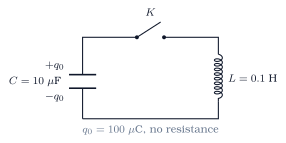
The switch is closed at \(t = 0\).
Find \(\omega\) and \(f\) of the oscillation.
Find the period.
Answer(i) \(1000\) rad/s; \(\approx 159\) Hz (ii) \(\approx 6.3\) ms
Write \(q(t)\) and \(i(t)\) for the circuit of Q13. At what instants is the current largest, and what is the charge then?
Answer\(q = q_0\cos\omega t\); \(i = -q_0\omega\sin\omega t\); at \(\frac{T}{4}\), \(\frac{3T}{4}\), when \(q = 0\)
Solution
\(q = q_0\cos\omega t\) and \(i = \dfrac{dq}{dt} = -q_0\omega\sin\omega t\). The current is largest when \(\sin\omega t = \pm 1\), at \(t = \dfrac{T}{4}, \dfrac{3T}{4}, \dots\); the charge is then zero and all the energy is in the inductor.
How did it go?
Q16
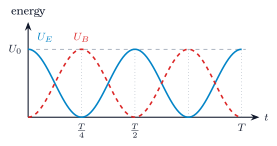
The graph shows \(U_E\) and \(U_B\) for the circuit of Q13.
At what frequency does the energy pass back and forth?
\(U_E = \dfrac{q_0^2}{2C}\cos^2\omega t\) and \(U_B = \dfrac{q_0^2}{2C}\sin^2\omega t\) each complete a cycle in half a period, so the energy shuttles at \(2f \approx 318\) Hz.
\(\cos^2 + \sin^2 = 1\), so the sum is always \(\dfrac{q_0^2}{2C} = 5 \times 10^{-4}\) J.
How did it go?
Q17
Derive the equation of an LC circuit, \(L\frac{d^2q}{dt^2} + \frac{q}{C} = 0\), and compare it with \(m\frac{d^2x}{dt^2} + kx = 0\) for a mass on a spring.
Round the loop the capacitor voltage equals the inductor's emf: \(\dfrac{q}{C} = -L\dfrac{di}{dt}\). With \(i = \dfrac{dq}{dt}\): \(L\dfrac{d^2q}{dt^2} + \dfrac{q}{C} = 0\). This has the same form as \(m\dfrac{d^2x}{dt^2} + kx = 0\). Here \(q\) stands in place of \(x\), \(L\) in place of \(m\) and \(\dfrac{1}{C}\) in place of \(k\). Its solution is simple harmonic, \(q = q_0\cos\omega t\) with \(\omega = \dfrac{1}{\sqrt{LC}}\), just as \(\omega = \sqrt{\dfrac{k}{m}}\).
How did it go?
Q18
Complete the analogy between the LC circuit and the mass-spring system. What corresponds to \(x\), \(v\), \(m\) and \(k\)? What corresponds to \(\frac{1}{2}mv^2\) and \(\frac{1}{2}kx^2\)?
Displacement \(x \leftrightarrow\) charge \(q\); velocity \(v \leftrightarrow\) current \(i\); mass \(m \leftrightarrow\) inductance \(L\). Spring constant \(k \leftrightarrow \dfrac{1}{C}\); kinetic energy \(\dfrac{1}{2}mv^2 \leftrightarrow \dfrac{1}{2}Li^2\); potential energy \(\dfrac{1}{2}kx^2 \leftrightarrow \dfrac{q^2}{2C}\).
How did it go?
Q19
The capacitor of Q13 is replaced by \(40\) μF. Find the new \(\omega\) and period.
Answer\(500\) rad/s; \(\approx 12.6\) ms
Solution
\(C\) is four times larger, so \(\omega = \dfrac{1}{\sqrt{LC}}\) is halved: \(500\) rad/s. \(T = \dfrac{2\pi}{500} \approx 12.6\) ms, twice as long.
How did it go?
Q20
Why do the oscillations of a real LC circuit die away? Where does the energy go?
Answerresistance heats the wires; radiation
Solution
Real coils and wires have resistance, so part of the energy is turned into heat in every cycle and the amplitude decays. An oscillating circuit also radiates a little energy as electromagnetic waves. To keep it going, energy must be fed in, as in a radio transmitter.
How did it go?
Small situations
Q21
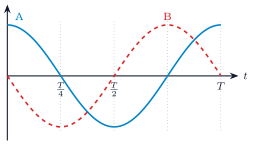
Curves A and B show \(q\) and \(i\) for the circuit of Q13.
Which curve is \(q\) and which is \(i\)?
At what time is the energy first entirely magnetic?
Answer(i) A is \(q\), B is \(i\) (ii) \(\frac{T}{4} \approx 1.6\) ms
Solution
A starts at its maximum, like the charge \(q_0\); B starts at zero, like the current. A is \(q\) and B is \(i\).
All the energy is magnetic when \(q = 0\) and \(i\) is largest, first at \(t = \dfrac{T}{4} \approx 1.6\) ms.
How did it go?
Q22
A tuning circuit has \(L = 1\) mH and must oscillate at \(1\) MHz. Find \(C\).
\(q = q_0\cos\omega t\) and \(i = -q_0\omega\sin\omega t\). \(\dfrac{q^2}{2C} = \dfrac{q_0^2}{2C}\cos^2\omega t\) and \(\dfrac{1}{2}Li^2 = \dfrac{1}{2}Lq_0^2\omega^2\sin^2\omega t = \dfrac{q_0^2}{2C}\sin^2\omega t\), using \(\omega^2 = \dfrac{1}{LC}\). Their sum is \(\dfrac{q_0^2}{2C}(\cos^2\omega t + \sin^2\omega t) = \dfrac{q_0^2}{2C}\), constant.
How did it go?
Displacement Current, EM Waves and the Spectrum
24 questions · after Lesson 6, The Electromagnetic Spectrum
Displacement current
Q25
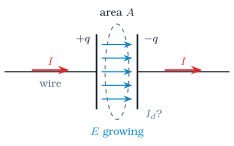
Ampère's law is applied to a loop around the wire of a charging capacitor. Explain why the law gives different answers for two surfaces bounded by the same loop, one cutting the wire and one passing between the plates.
Answer\(I\) through the first surface, \(0\) through the second
Solution
Ampère's law says \(\oint\vec B\cdot d\vec l\) equals \(\mu_0\) times the current through any surface bounded by the loop. A flat surface cut by the wire has current \(I\) through it. A bulging surface passing between the plates has no current through it. The same loop then gives \(\mu_0I\) and \(0\), so the law as it stood cannot be right.
How did it go?
Q26
Define the displacement current. How did Maxwell change Ampère's law to remove the inconsistency of Q1?
The displacement current is \(I_d = \epsilon_0\dfrac{d\Phi_E}{dt}\), where \(\Phi_E\) is the electric flux through the surface. Maxwell added it to the conduction current: \(\oint\vec B\cdot d\vec l = \mu_0(I + I_d)\). Between the plates the growing flux gives an \(I_d\) equal to the wire current, so both surfaces now agree.
How did it go?
Q27
The plates have area \(A = 0.1\) m\(^2\) and the field between them grows at \(10^{12}\) V/m per second. Take \(\epsilon_0 = 8.85 \times 10^{-12}\) SI units.
Find the displacement current between the plates.
What is the conduction current in the wires? Give the reason.
Answer(i) \(0.885\) A (ii) \(0.885\) A; \(I_d = \frac{dq}{dt}\)
Solution
\(\Phi_E = EA\), so \(I_d = \epsilon_0A\dfrac{dE}{dt} = 8.85 \times 10^{-12} \times 0.1 \times 10^{12} = 0.885\) A.
Also \(0.885\) A. The charge on the plates is \(q = \epsilon_0AE\), so the wire current \(\dfrac{dq}{dt}\) is exactly the displacement current. The two together form a continuous current around the circuit.
How did it go?
Q28
For a parallel-plate capacitor show that the displacement current between the plates equals the conduction current \(\frac{dq}{dt}\) in the wires.
Answer\(q = \epsilon_0AE\), so \(\frac{dq}{dt} = \epsilon_0A\frac{dE}{dt}\)
Solution
Between the plates \(E = \dfrac{\sigma}{\epsilon_0} = \dfrac{q}{\epsilon_0A}\), so \(q = \epsilon_0AE = \epsilon_0\Phi_E\). Differentiating: \(\dfrac{dq}{dt} = \epsilon_0\dfrac{d\Phi_E}{dt} = I_d\). The conduction current in the wires equals the displacement current between the plates at every instant.
How did it go?
Q29
The voltage across a \(2\) μF capacitor rises at \(10^{6}\) V/s. Find the displacement current between its plates.
Answer\(2\) A
Solution
\(q = CV\), so \(I_d = \dfrac{dq}{dt} = C\dfrac{dV}{dt} = 2 \times 10^{-6} \times 10^{6} = 2\) A.
How did it go?
Q30
Write Maxwell's four equations in integral form and name the law each one expresses.
Gauss's law for electricity: \(\oint\vec E\cdot d\vec A = \dfrac{q}{\epsilon_0}\). Gauss's law for magnetism: \(\oint\vec B\cdot d\vec A = 0\) (no magnetic monopoles). Faraday's law: \(\oint\vec E\cdot d\vec l = -\dfrac{d\Phi_B}{dt}\). Ampère-Maxwell law: \(\oint\vec B\cdot d\vec l = \mu_0I + \mu_0\epsilon_0\dfrac{d\Phi_E}{dt}\).
How did it go?
Properties of EM waves
Q31
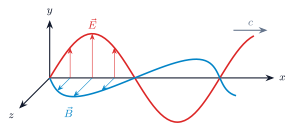
Use the figure to answer.
In which direction does the wave travel? How is it fixed by \(\vec E\) and \(\vec B\)?
What is the phase difference between \(\vec E\) and \(\vec B\)?
Why is the wave called transverse?
Answer(i) \(+x\); along \(\vec E \times \vec B\) (ii) zero (iii) \(\vec E\), \(\vec B\) perpendicular to the travel direction
Solution
Along \(+x\). The direction of travel is that of \(\vec E \times \vec B\): here \(\hat j \times \hat k = \hat i\).
Zero. \(\vec E\) and \(\vec B\) reach their maxima at the same points and vanish together.
Both fields oscillate perpendicular to the direction in which the wave moves, and perpendicular to each other.
How did it go?
Q32
Compute the speed of light from \(c = \frac{1}{\sqrt{\mu_0\epsilon_0}}\) with \(\mu_0 = 4\pi \times 10^{-7}\) and \(\epsilon_0 = 8.85 \times 10^{-12}\) SI units.
The electric field amplitude of a wave is \(300\) V/m. Find the magnetic field amplitude.
Answer\(1\) μT
Solution
\(B_0 = \dfrac{E_0}{c} = \dfrac{300}{3 \times 10^{8}} = 10^{-6}\) T \(= 1\) μT. The magnetic field of light is very weak in tesla, but it carries as much energy as the electric field.
How did it go?
Q34
An EM wave has \(E_y = 60\sin(0.5x - 1.5 \times 10^{8}t)\) V/m, with \(x\) in metres and \(t\) in seconds. Find the wavelength, the frequency, the speed, and the amplitude and direction of \(\vec B\).
Answer\(4\pi \approx 12.6\) m; \(2.4 \times 10^{7}\) Hz; \(3 \times 10^{8}\) m/s; \(2 \times 10^{-7}\) T along \(z\)
Solution
\(k = 0.5\) rad/m, so \(\lambda = \dfrac{2\pi}{k} = 4\pi \approx 12.6\) m. \(\omega = 1.5 \times 10^{8}\) rad/s, so \(f = \dfrac{\omega}{2\pi} \approx 2.4 \times 10^{7}\) Hz. \(v = \dfrac{\omega}{k} = 3 \times 10^{8}\) m/s. \(B_0 = \dfrac{E_0}{c} = 2 \times 10^{-7}\) T. With \(\vec E\) along \(y\) and travel along \(+x\), \(\vec B\) is along \(z\) so that \(\vec E \times \vec B\) points along \(x\).
How did it go?
Q35
In glass \(\epsilon_r = 2.25\) and \(\mu_r = 1\). Find the speed of light in glass and its refractive index.
Write the energy density of an EM wave. Show that the electric and magnetic parts are equal, and find the average energy density for \(E_0 = 300\) V/m.
\(u = \dfrac{1}{2}\epsilon_0E^2 + \dfrac{B^2}{2\mu_0}\). With \(B = \dfrac{E}{c}\) and \(c^2 = \dfrac{1}{\mu_0\epsilon_0}\): \(\dfrac{B^2}{2\mu_0} = \dfrac{E^2}{2\mu_0c^2} = \dfrac{1}{2}\epsilon_0E^2\), equal to the electric part. Over a cycle the average of \(E^2\) is \(\dfrac{E_0^2}{2}\), so \(\bar u = \dfrac{1}{2}\epsilon_0E_0^2 = \dfrac{1}{2} \times 8.85 \times 10^{-12} \times 9 \times 10^{4} \approx 4 \times 10^{-7}\) J/m\(^3\).
How did it go?
Q37
Find the intensity of the wave of Q12. Take \(c = 3 \times 10^{8}\) m/s.
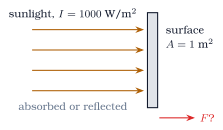
Sunlight of intensity \(1000\) W/m\(^2\) falls normally on the surface.
Find the momentum delivered per second if the light is absorbed.
Find the radiation pressure and the force if it is absorbed.
Find the pressure if it is fully reflected.
Answer(i) \(3.3 \times 10^{-6}\) kg m/s each second (ii) \(3.3 \times 10^{-6}\) Pa; \(3.3 \times 10^{-6}\) N (iii) \(6.7 \times 10^{-6}\) Pa
Solution
Energy per second on \(1\) m\(^2\) is \(1000\) J; its momentum is \(\dfrac{U}{c} = \dfrac{1000}{3 \times 10^{8}} \approx 3.3 \times 10^{-6}\) kg m/s, delivered each second.
Pressure \(= \dfrac{I}{c} = 3.3 \times 10^{-6}\) Pa. Force \(= pA = 3.3 \times 10^{-6}\) N.
Reflection reverses the momentum, so twice as much is transferred: \(p = \dfrac{2I}{c} \approx 6.7 \times 10^{-6}\) Pa.
How did it go?
Sources and intensity
Q39
How are electromagnetic waves produced? What decides the frequency of the wave sent out by an oscillating dipole antenna?
Answeraccelerated charges; the oscillation frequency
Solution
Accelerated charges radiate. In an antenna the charges oscillate up and down. The changing electric field creates a changing magnetic field and so on, sending out a wave. The wave has the same frequency as the oscillation of the charges, set by the driving circuit.
How did it go?
Q40
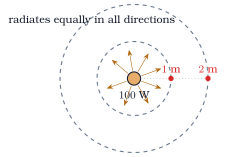
A \(100\) W source radiates uniformly in all directions. Find the intensity at \(1\) m and the electric field amplitude there. Use \(I = \frac{1}{2}\epsilon_0cE_0^2\).
\(I \propto \dfrac{1}{r^2}\): at \(2\) m the intensity is a quarter, \(2\) W/m\(^2\).
\(E_0 \propto \sqrt I \propto \dfrac{1}{r}\): half the value at \(1\) m, about \(39\) V/m.
How did it go?
Q42
Light exerts a pressure on everything it falls on. Why do we never notice it? Compare the sunlight pressure of Q14 with atmospheric pressure.
Answer\(10^{-6}\) Pa against \(10^{5}\) Pa
Solution
Sunlight gives about \(3 \times 10^{-6}\) Pa, while the atmosphere presses with \(10^{5}\) Pa, some \(3 \times 10^{10}\) times more. The force on a hand is well below a micronewton, far too small to feel. Only on huge, light surfaces in space (solar sails) does it matter.
How did it go?
The spectrum
Q43
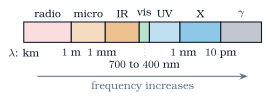
Use the spectrum chart.
List the seven regions in order of increasing frequency.
Which region has photons of the highest energy?
Answer(i) radio, micro, IR, visible, UV, X, \(\gamma\) (ii) gamma
Solution
Radio, microwaves, infrared, visible, ultraviolet, X-rays, gamma rays. Wavelength falls along the same order.
Gamma rays: photon energy \(hf\) grows with frequency, and they have the highest frequency.
How did it go?
Q44
Find (i) the frequency of \(3\) cm microwaves, (ii) the wavelength of \(100\) MHz FM radio, (iii) the frequency of \(1\) nm X-rays.
Answer(i) \(10^{10}\) Hz (ii) \(3\) m (iii) \(3 \times 10^{17}\) Hz
Solution
(i) \(f = \dfrac{c}{\lambda} = \dfrac{3 \times 10^{8}}{0.03} = 10^{10}\) Hz. (ii) \(\lambda = \dfrac{3 \times 10^{8}}{10^{8}} = 3\) m. (iii) \(f = \dfrac{3 \times 10^{8}}{10^{-9}} = 3 \times 10^{17}\) Hz.
How did it go?
Q45
Name one source of each: radio waves, microwaves, infrared, X-rays, gamma rays.
Answerantennas; magnetrons; hot bodies; electrons hitting metal; nuclei
Solution
Radio: oscillating currents in antennas. Microwaves: magnetrons and klystrons. Infrared: hot bodies, vibrating molecules. X-rays: fast electrons stopped by a metal target. Gamma rays: radioactive nuclei.
How did it go?
Q46
Give one use of each: microwaves, infrared, ultraviolet, X-rays, gamma rays.
Answerovens, radar; remotes, night vision; sterilising; imaging; cancer therapy
Solution
Microwaves: cooking (water molecules absorb \(2.45\) GHz), radar. Infrared: remote controls, night-vision cameras. Ultraviolet: sterilising water and instruments. X-rays: medical imaging. Gamma rays: destroying cancer cells.
How did it go?
Q47
To which region does each wavelength belong: (i) \(500\) nm, (ii) \(1\) mm, (iii) \(10\) pm, (iv) \(300\) m?
Answer(i) visible (ii) microwave (iii) gamma or X (iv) radio
Solution
(i) \(500\) nm: visible (green). (ii) \(1\) mm: microwave, at the border with far infrared. (iii) \(10\) pm: gamma rays, overlapping hard X-rays. (iv) \(300\) m: radio (medium wave).
How did it go?
Q48
For a plane wave \(E = E_0\sin(kx - \omega t)\) and \(B = B_0\sin(kx - \omega t)\), Faraday's law gives \(\frac{\partial E}{\partial x} = -\frac{\partial B}{\partial t}\). Show that \(\frac{E_0}{B_0} = c\).