Questions on Reflection: Plane and Spherical Mirrors, the kind your examinations ask. Solve one on paper. Then tell the book how it went. The book believes you, and it uses your answer to plan your revision.
0%
Nothing marked yetMark honestly. Peek at the answer only after your own attempt.
Plane Mirrors, Image Kinematics and Mirror Rotation
24 questions · after Lesson 3, Many Images and Moving Images
Laws of reflection and the plane mirror image
Q1
A ray meets a plane mirror at an angle of incidence of \(30^\circ\).
State the two laws of reflection.
Find the angle between the incident ray and the reflected ray.
Find the angle through which the ray is turned (the deviation).
Answer(i) \(r = i\); incident ray, reflected ray and normal in one plane (ii) \(60^\circ\) (iii) \(120^\circ\)
Solution
First law: the incident ray, the reflected ray and the normal at the point of incidence lie in one plane. Second law: the angle of reflection equals the angle of incidence, \(r = i\).
The incident ray and the reflected ray are each \(30^\circ\) from the normal, on opposite sides. The angle between them is \(i + r = 60^\circ\).
Without the mirror the ray would have gone straight on. Measured from that direction, the turn is \(\delta = 180^\circ - 2i = 180^\circ - 60^\circ = 120^\circ\).
How did it go?
Q2
A person stands \(2\) m in front of a plane mirror. The person walks \(0.5\) m towards the mirror.
Find the distance between the person and the image before and after the walk.
By how much did the image move?
Answer(i) \(4\) m, \(3\) m (ii) \(0.5\) m
Solution
The image is as far behind the mirror as the object is in front. Before: \(2 + 2 = 4\) m. After the walk the person is \(1.5\) m from the mirror, so the distance is \(1.5 + 1.5 = 3\) m.
The image moved from \(2\) m behind the mirror to \(1.5\) m behind it: \(0.5\) m, the same as the person.
How did it go?
Q3
A person is \(180\) cm tall. The eyes are \(10\) cm below the top of the head. A plane mirror hangs on a vertical wall.
Find the least length of mirror in which the person can see the full image.
Find the height of the lower edge and the upper edge of this mirror above the floor.
Answer(i) \(90\) cm (ii) \(85\) cm, \(175\) cm
Solution
The eye \(E\) sees the top of the head \(H\) by a ray that reflects midway between their levels. The eye sees the feet \(F\) by a ray that reflects midway between the levels of \(E\) and \(F\). So the mirror must reach from half of \(EF\) below the eye to half of \(EH\) above the eye.
Length \(= \dfrac{EF}{2} + \dfrac{EH}{2} = \dfrac{170}{2} + \dfrac{10}{2} = 85 + 5 = 90\) cm, half the height of the person.
Eye level is \(170\) cm. Lower edge: \(170 - 85 = 85\) cm above the floor. Upper edge: \(170 + 5 = 175\) cm above the floor.
How did it go?
Q4
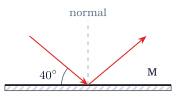
The figure shows a ray that meets a plane mirror M at \(40^\circ\) to the surface of the mirror.
Find the angle of incidence and the angle of reflection.
Find the deviation of the ray.
Answer(i) \(50^\circ\), \(50^\circ\) (ii) \(80^\circ\)
Solution
Angles of incidence and reflection are measured from the normal. The ray is \(40^\circ\) from the mirror, so \(i = 90^\circ - 40^\circ = 50^\circ\), and \(r = i = 50^\circ\).
\(\delta = 180^\circ - 2i = 180^\circ - 100^\circ = 80^\circ\). Check: the ray turns through twice the angle it makes with the mirror, \(2 \times 40^\circ = 80^\circ\).
How did it go?
Q5
The image of a clock in a plane mirror appears to read \(4{:}30\). Find the actual time. Give the reason in one sentence.
Answer\(7{:}30\); the dial is reflected about the \(12\)-\(6\) line
Solution
A plane mirror swaps left and right, so the clock face appears reflected about the \(12\)-\(6\) line. The actual time is \(11{:}60 - 4{:}30 = 7{:}30\).
Reason: the mirror image of the hour hand at \(4\) lies at \(8\), and the minute hand at \(6\) stays at \(6\).
How did it go?
Images by inclined mirrors
Q6
Two plane mirrors are inclined at \(60^\circ\). An object is placed on the bisector of the angle between them. Find the number of images.
Answer\(5\)
Solution
\(\dfrac{360^\circ}{\theta} = \dfrac{360^\circ}{60^\circ} = 6\), an even number. The number of images is \(n = 6 - 1 = 5\) for any position of the object.
How did it go?
Q7
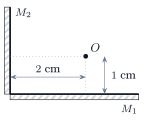
Two plane mirrors \(M_1\) and \(M_2\) meet at right angles, as in the figure. The object \(O\) is \(1\) cm from \(M_1\) and \(2\) cm from \(M_2\).
How many images are formed?
Take the corner as the origin, \(M_1\) along \(x\) and \(M_2\) along \(y\). Write the coordinates of every image, in cm.
Answer(i) \(3\) (ii) \((2, -1)\), \((-2, 1)\), \((-2, -1)\)
Solution
\(\dfrac{360^\circ}{90^\circ} = 4\) is even, so \(n = 4 - 1 = 3\) images.
\(O\) is at \((2, 1)\). The image in \(M_1\) (the \(x\) axis) is at \((2, -1)\). The image in \(M_2\) (the \(y\) axis) is at \((-2, 1)\). Each of these is itself reflected in the other mirror, and both give the same third image at \((-2, -1)\).
How did it go?
Q8
Two plane mirrors are inclined at \(72^\circ\). Find the number of images when the object is
on the bisector,
not on the bisector.
Answer(i) \(4\) (ii) \(5\)
Solution
\(\dfrac{360^\circ}{72^\circ} = 5\), an odd number. For an object on the bisector the last two images coincide, so \(n = 5 - 1 = 4\).
For an object off the bisector the last two images are separate, so \(n = 5\).
How did it go?
Q9
Two plane mirrors are inclined at \(50^\circ\). Find the number of images of an object placed between them.
Answer\(7\)
Solution
\(\dfrac{360^\circ}{50^\circ} = 7.2\), not an integer. The number of images is the integer part, \(n = 7\), for every position of the object.
How did it go?
Q10
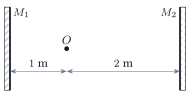
Two parallel mirrors \(M_1\) and \(M_2\) are \(3\) m apart. An object \(O\) is \(1\) m from \(M_1\).
How many images are formed?
Find the distance from \(O\) of the nearest image in \(M_1\) and of the nearest image in \(M_2\).
Find the distance between these two images.
Answer(i) infinite (ii) \(2\) m, \(4\) m (iii) \(6\) m
Solution
Each image in one mirror acts as an object for the other mirror. The chain never ends, so there are infinitely many images (they grow fainter along the chain).
\(O\) is \(1\) m in front of \(M_1\). So the nearest image in \(M_1\) is \(1\) m behind \(M_1\), at \(2\) m from \(O\). \(O\) is \(2\) m in front of \(M_2\). So the nearest image in \(M_2\) is \(2\) m behind \(M_2\), at \(4\) m from \(O\).
The two images lie on opposite sides of \(O\): \(2 + 4 = 6\) m apart.
How did it go?
Image kinematics
Q11
An object moves towards a fixed plane mirror at \(3\) m/s along the normal.
Find the velocity of the image.
Find the speed of the image relative to the object.
Answer(i) \(3\) m/s towards the mirror (ii) \(6\) m/s
Solution
The image is always as far behind the mirror as the object is in front. When the object comes \(1\) m closer, the image also comes \(1\) m closer. So the image moves at \(3\) m/s towards the mirror, from the other side.
Object and image approach each other at \(3 + 3 = 6\) m/s.
How did it go?
Q12
The object is now at rest. The mirror moves towards the object at \(2\) m/s along its normal. Find the velocity of the image relative to the ground.
Answer\(4\) m/s towards the object
Solution
Let the mirror move a distance \(s\) towards the object. The object is now \(s\) nearer the mirror, so the image is also \(s\) nearer the mirror, that is \(2s\) nearer the object. The image moves at twice the mirror speed: \(2 \times 2 = 4\) m/s towards the object.
How did it go?
Q13
An object moves towards a plane mirror at \(5\) m/s. At the same time the mirror moves towards the object at \(2\) m/s. Both velocities are along the normal.
Find the velocity of the image relative to the ground.
Find the speed at which the image approaches the object.
Answer(i) \(9\) m/s towards the object (ii) \(14\) m/s
Solution
Along the normal, \(v_{\text{image}} = 2v_{\text{mirror}} - v_{\text{object}}\) (all with signs). Take the direction from the object towards the mirror as positive: \(v_{\text{object}} = +5\) m/s, \(v_{\text{mirror}} = -2\) m/s.
\(v_{\text{image}} = 2(-2) - 5 = -9\) m/s, that is \(9\) m/s towards the object.
Relative velocity \(= v_{\text{image}} - v_{\text{object}} = -9 - 5 = -14\) m/s. The image approaches the object at \(14\) m/s.
How did it go?
Q14
An object moves parallel to a plane mirror at \(4\) m/s. Find the velocity of the image. Does the answer change if the mirror also moves parallel to itself at \(6\) m/s?
Answer\(4\) m/s, same direction; no
Solution
The distance of the image behind the mirror does not change when the object moves parallel to the mirror. The image copies the motion: \(4\) m/s in the same direction as the object.
No. Motion of the mirror in its own plane does not change where the image is, so the image velocity stays \(4\) m/s.
How did it go?
Q15
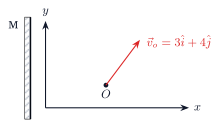
A plane mirror M lies in the \(y\)-\(z\) plane. An object \(O\) moves with velocity \(\vec v_o = (3\hat i + 4\hat j)\) m/s, as in the figure.
Write the velocity of the image and find its speed.
Find the velocity of the image relative to the object.
Answer(i) \((-3\hat i + 4\hat j)\) m/s, \(5\) m/s (ii) \(-6\hat i\) m/s
Solution
The mirror reverses only the component along its normal (\(x\)). The components parallel to the mirror (\(y\), \(z\)) are unchanged. \(\vec v_i = (-3\hat i + 4\hat j)\) m/s, and the speed is \(\sqrt{9 + 16} = 5\) m/s, the same as the object.
\(\vec v_i - \vec v_o = (-3 - 3)\hat i + (4 - 4)\hat j = -6\hat i\) m/s. Object and image approach each other along the normal at \(6\) m/s.
How did it go?
Q16
In Question 15 the mirror also moves with velocity \(2\hat i\) m/s. Find the velocity of the image.
Answer\((\hat i + 4\hat j)\) m/s
Solution
Along the normal: \(v_{ix} = 2v_{mx} - v_{ox} = 2(2) - 3 = 1\) m/s. Parallel to the mirror the image copies the object: \(v_{iy} = 4\) m/s. So \(\vec v_i = (\hat i + 4\hat j)\) m/s.
How did it go?
Mirror rotation and deviation
Q17
A ray falls on a plane mirror. The ray is kept fixed and the mirror is turned by \(10^\circ\) about an axis in its plane, perpendicular to the plane of incidence. Through what angle does the reflected ray turn? Give the reason.
Answer\(20^\circ\); the normal turns by \(10^\circ\), so \(i\) and \(r\) both change by \(10^\circ\)
Solution
When the mirror turns by \(\theta\), the normal also turns by \(\theta\). The angle of incidence changes by \(\theta\), so the reflected ray moves by \(\theta\) relative to the normal. The normal itself has also moved by \(\theta\). Together the reflected ray turns by \(2\theta = 20^\circ\).
How did it go?
Q18
A ray falls on a plane mirror at an angle of incidence of \(30^\circ\). The mirror is turned by \(15^\circ\) so that the angle of incidence becomes \(45^\circ\).
Find the deviation of the ray before and after the turn.
Hence find the angle through which the reflected ray turned.
Answer(i) \(120^\circ\), \(90^\circ\) (ii) \(30^\circ\)
The incident ray did not move, so the change in deviation is the turn of the reflected ray: \(120^\circ - 90^\circ = 30^\circ\). This is twice the \(15^\circ\) turn of the mirror.
How did it go?
Q19
Write the deviation \(\delta = 180^\circ - 2i\) produced by a single plane mirror at each angle of incidence \(i\).
\(i = 0^\circ\),
\(i = 45^\circ\),
\(i = 90^\circ\) (grazing).
Answer(i) \(180^\circ\) (ii) \(90^\circ\) (iii) \(0^\circ\)
Solution
\(i = 0^\circ\): \(\delta = 180^\circ\). The ray goes back along its own path.
\(i = 45^\circ\): \(\delta = 90^\circ\). The ray turns through a right angle.
\(i = 90^\circ\): \(\delta = 0^\circ\). A grazing ray is not turned at all.
How did it go?
Q20
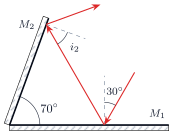
Two plane mirrors \(M_1\) and \(M_2\) are inclined at \(70^\circ\). A ray meets \(M_1\) at an angle of incidence of \(30^\circ\) and then meets \(M_2\).
Find the angle of incidence \(i_2\) at \(M_2\).
Find the deviation at each mirror and the total deviation of the ray.
Answer(i) \(40^\circ\) (ii) \(120^\circ\), \(100^\circ\); \(220^\circ\)
Solution
At \(M_1\) the reflected ray makes \(90^\circ - 30^\circ = 60^\circ\) with the mirror \(M_1\). In the triangle formed by the two mirrors and this ray, the angle at \(M_2\) is \(180^\circ - 70^\circ - 60^\circ = 50^\circ\). This is the angle between the ray and \(M_2\), so \(i_2 = 90^\circ - 50^\circ = 40^\circ\).
At \(M_1\): \(\delta_1 = 180^\circ - 60^\circ = 120^\circ\). At \(M_2\): \(\delta_2 = 180^\circ - 80^\circ = 100^\circ\). Both turns are in the same sense, so the total is \(220^\circ\). Check: \(360^\circ - 2(70^\circ) = 220^\circ\).
How did it go?
Q21
Two plane mirrors are inclined at an angle \(\theta\). A ray is reflected once from each mirror.
Show that the total deviation is \(360^\circ - 2\theta\), whatever the angle of incidence.
Hence show that for \(\theta = 90^\circ\) the final ray is antiparallel to the incident ray.
Let the ray make angle \(\alpha\) with \(M_1\) and angle \(\beta\) with \(M_2\). In the triangle formed by the mirrors and the ray between them, \(\alpha + \beta + \theta = 180^\circ\).
Each reflection turns the ray through twice the angle it makes with that mirror, in the same sense. Total deviation \(= 2\alpha + 2\beta = 2(180^\circ - \theta) = 360^\circ - 2\theta\). The angle of incidence does not appear.
\(\theta = 90^\circ\) gives \(\delta = 360^\circ - 180^\circ = 180^\circ\). A turn of \(180^\circ\) means the final ray is antiparallel to the incident ray, for any angle of incidence.
How did it go?
Q22
A plane mirror turns at \(2\) rad/s about an axis in its plane. A fixed ray falls on the mirror and the reflected ray makes a spot on a screen \(10\) m away.
Find the angular speed of the reflected ray.
Find the speed of the spot at the instant the reflected ray is normal to the screen.
Answer(i) \(4\) rad/s (ii) \(40\) m/s
Solution
The reflected ray turns through twice the angle of the mirror, so its angular speed is \(2\omega = 4\) rad/s.
The spot is at distance \(10\) m along a ray that sweeps at \(4\) rad/s. When the ray is normal to the screen, the spot speed is \(r\,\omega_{\text{ray}} = 10 \times 4 = 40\) m/s.
How did it go?
Q23
A ray falls on a pair of mirrors fixed at right angles to each other. The pair is now turned by \(5^\circ\) about the line where the mirrors meet. Through what angle does the final ray turn? Give the reason.
Answer\(0^\circ\); deviation \(360^\circ - 2(90^\circ) = 180^\circ\) for any angle of incidence
Solution
\(0^\circ\). For two mirrors at \(90^\circ\) the total deviation is \(360^\circ - 2(90^\circ) = 180^\circ\), whatever the angle of incidence. Turning the pair changes the angle of incidence but not the deviation, so the final ray stays antiparallel to the incident ray.
How did it go?
Q24
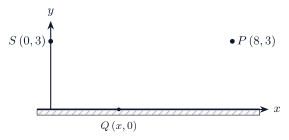
A plane mirror lies along the \(x\) axis. A point source \(S\) is at \((0, 3)\) and a point \(P\) is at \((8, 3)\). Distances are in metres. A ray from \(S\) reaches \(P\) after one reflection at \(Q\,(x, 0)\).
Use the image of \(S\) to find \(x\).
Find the length of the path \(SQP\).
Answer(i) \(4\) m (ii) \(10\) m
Solution
The reflected ray appears to come from the image \(S'\) at \((0, -3)\). So \(S'\), \(Q\) and \(P\) lie on one line. Slope of \(S'P\): \(\dfrac{3 - (-3)}{8 - 0} = \dfrac{3}{4}\). At \(y = 0\): \(0 = -3 + \dfrac{3}{4}x\), so \(x = 4\) m.
Check: \(S\) and \(P\) are at equal heights and \(Q\) is midway. So the ray from \(S\) and the ray to \(P\) make equal angles with the normal at \(Q\).
The path \(SQP\) has the same length as the straight line \(S'P\): \(\sqrt{8^2 + 6^2} = 10\) m.
How did it go?
Spherical Mirrors, Magnification and Image Velocity
24 questions · after Lesson 6, Moving Objects, Moving Images
The mirror formula
Q25
A concave mirror has radius of curvature \(40\) cm. Use the sign convention: distances are measured from the pole, positive along the direction of the incident light. An object is placed \(30\) cm in front of the mirror.
Write the focal length \(f\) with its sign.
Find the image distance \(v\) and the magnification \(m\).
State whether the image is real or virtual, erect or inverted, larger or smaller.
Answer(i) \(-20\) cm (ii) \(-60\) cm, \(-2\) (iii) real, inverted, larger
Solution
\(f = \dfrac{R}{2} = 20\) cm. The focus of a concave mirror is in front of the mirror, against the incident light, so \(f = -20\) cm.
\(u = -30\) cm. \(\dfrac{1}{v} = \dfrac{1}{f} - \dfrac{1}{u} = -\dfrac{1}{20} + \dfrac{1}{30} = -\dfrac{1}{60}\), so \(v = -60\) cm.
\(m = -\dfrac{v}{u} = -\dfrac{-60}{-30} = -2\).
\(v\) is negative: the image is in front of the mirror, so it is real. \(m\) is negative: the image is inverted. \(|m| = 2\): the image is twice the size of the object.
How did it go?
Q26
The object of Question 1 is moved to \(10\) cm from the mirror. Find \(v\) and \(m\), and describe the image.
Answer\(+20\) cm, \(+2\); virtual, erect, larger
Solution
\(u = -10\) cm, \(f = -20\) cm. \(\dfrac{1}{v} = -\dfrac{1}{20} + \dfrac{1}{10} = \dfrac{1}{20}\), so \(v = +20\) cm. \(m = -\dfrac{20}{-10} = +2\).
The image is behind the mirror (virtual), erect and twice the size. An object inside the focus of a concave mirror always gives this kind of image (a shaving mirror).
How did it go?
Q27
A convex mirror has radius of curvature \(40\) cm. An object is placed \(20\) cm in front of it. Find \(v\) and \(m\), and describe the image.
Answer\(+10\) cm, \(+\frac{1}{2}\); virtual, erect, smaller
Solution
For a convex mirror the focus is behind the mirror: \(f = +20\) cm. \(u = -20\) cm. \(\dfrac{1}{v} = \dfrac{1}{20} + \dfrac{1}{20} = \dfrac{1}{10}\), so \(v = +10\) cm. \(m = -\dfrac{10}{-20} = +\dfrac{1}{2}\).
The image is virtual, erect and half the size of the object.
How did it go?
Q28
An object is placed at the centre of curvature of a concave mirror. Show from the mirror formula that the image is formed at the same point, with \(m = -1\).
At the centre of curvature \(u = -R = -2f\) (with \(f\) negative for a concave mirror, \(u = 2f\)). \(\dfrac{1}{v} = \dfrac{1}{f} - \dfrac{1}{2f} = \dfrac{1}{2f}\), so \(v = 2f = u\). The image is at the centre of curvature.
\(m = -\dfrac{v}{u} = -1\): the image is real, inverted and the same size as the object.
How did it go?
Q29
Take \(\frac{1}{v} = \frac{1}{f} - \frac{1}{u}\) with \(f > 0\) and \(u < 0\). Show that a convex mirror always forms a virtual, erect image smaller than the object, whatever the object distance.
With \(f > 0\) and \(u < 0\), \(\dfrac{1}{v} = \dfrac{1}{f} + \dfrac{1}{|u|}\) is a sum of two positive terms. So \(v > 0\): the image is behind the mirror, virtual.
Also \(\dfrac{1}{v} > \dfrac{1}{|u|}\), so \(v < |u|\). Then \(m = -\dfrac{v}{u} = \dfrac{v}{|u|}\) is positive and less than \(1\): erect and smaller. This holds for every object distance.
How did it go?
Magnification
Q30
An object \(2\) cm tall is placed \(15\) cm in front of a concave mirror of focal length \(10\) cm. Find the position, the height and the nature of the image.
Answer\(-30\) cm, \(4\) cm inverted, real
Solution
\(u = -15\) cm, \(f = -10\) cm. \(\dfrac{1}{v} = -\dfrac{1}{10} + \dfrac{1}{15} = -\dfrac{1}{30}\), so \(v = -30\) cm. \(m = -\dfrac{-30}{-15} = -2\).
Height of image \(= m \times 2 = -4\) cm: the image is \(4\) cm tall, inverted, real, \(30\) cm in front of the mirror.
How did it go?
Q31
A concave mirror of focal length \(12\) cm forms a real image three times the size of the object. Find the object distance and the image distance.
Answer\(-16\) cm, \(-48\) cm
Solution
A real image from a concave mirror is inverted, so \(m = -3\). \(m = -\dfrac{v}{u} = -3\) gives \(v = 3u\).
\(\dfrac{1}{3u} + \dfrac{1}{u} = \dfrac{4}{3u} = \dfrac{1}{f} = -\dfrac{1}{12}\), so \(u = -16\) cm and \(v = -48\) cm.
How did it go?
Q32
A convex mirror of focal length \(15\) cm forms an image half the size of the object. Find the object distance and the image distance.
Answer\(-15\) cm, \(+7.5\) cm
Solution
A convex mirror gives an erect image, so \(m = +\dfrac{1}{2}\), and \(v = -\dfrac{u}{2}\).
\(\dfrac{1}{v} + \dfrac{1}{u} = -\dfrac{2}{u} + \dfrac{1}{u} = -\dfrac{1}{u} = \dfrac{1}{15}\), so \(u = -15\) cm and \(v = +7.5\) cm.
How did it go?
Q33
Newton's formula measures distances from the focus: \(xy = f^2\). Here \(x\) is the distance of the object from \(F\) and \(y\) is the distance of the image from \(F\). A concave mirror has \(f = 20\) cm and the object is \(5\) cm beyond \(F\).
Find \(y\).
Find the image distance from the pole and check with the mirror formula.
Answer(i) \(80\) cm (ii) \(-100\) cm
Solution
\(y = \dfrac{f^2}{x} = \dfrac{400}{5} = 80\) cm. The image is \(80\) cm beyond \(F\), on the same side as the object.
Image distance from the pole \(= 20 + 80 = 100\) cm, so \(v = -100\) cm. Check: \(u = -25\) cm, \(\dfrac{1}{v} = -\dfrac{1}{20} + \dfrac{1}{25} = -\dfrac{1}{100}\). Correct.
How did it go?
Q34
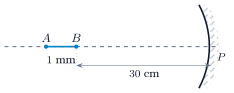
A short rod \(AB\) of length \(1\) mm lies along the axis of a concave mirror of focal length \(20\) cm. The end \(B\) is \(30\) cm from the pole, as in the figure.
Find the transverse magnification \(m\) for an object at \(B\).
The longitudinal magnification is \(m_L = -m^2\). Find the length of the image of the rod.
Answer(i) \(-2\) (ii) \(4\) mm
Solution
\(u = -30\) cm, \(f = -20\) cm give \(v = -60\) cm (Question 1) and \(m = -2\).
\(m_L = -m^2 = -4\). The image of the rod is \(4 \times 1 = 4\) mm long, and it lies along the axis. The minus sign says that the order of the ends is reversed. The image of \(A\), the far end, is nearer the mirror than the image of \(B\).
How did it go?
Q35
A square card of side \(1\) cm is placed \(15\) cm in front of a concave mirror of focal length \(10\) cm. The card is perpendicular to the axis. Find the area of the image.
Answer\(4\) cm\(^2\)
Solution
\(u = -15\) cm, \(f = -10\) cm give \(v = -30\) cm and \(m = -2\). Each side of the square is magnified \(2\) times, so the area is magnified \(m^2 = 4\) times. Area of image \(= 4\) cm\(^2\).
How did it go?
Read a figure
Q36
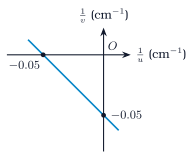
The figure shows the graph of \(\frac{1}{v}\) against \(\frac{1}{u}\) for a spherical mirror. Both intercepts are \(-0.05\) cm\(^{-1}\).
Why is the graph a straight line of slope \(-1\)?
Read the focal length from the graph. Is the mirror concave or convex?
Mark the point on the line at which \(u = v\). What is the object distance there?
Answer(i) \(\frac{1}{v} = -\frac{1}{u} + \frac{1}{f}\) is linear with slope \(-1\) (ii) \(-20\) cm, concave (iii) \(-40\) cm
Solution
The mirror formula is \(\dfrac{1}{v} = -\dfrac{1}{u} + \dfrac{1}{f}\). Plot \(\dfrac{1}{v}\) against \(\dfrac{1}{u}\). This is a straight line with slope \(-1\) and intercept \(\dfrac{1}{f}\) on each axis.
Each intercept equals \(\dfrac{1}{f} = -0.05\) cm\(^{-1}\), so \(f = -20\) cm. A negative focal length means a concave mirror.
\(u = v\) is the point where the line meets the line \(\dfrac{1}{v} = \dfrac{1}{u}\), that is \(\dfrac{1}{u} = \dfrac{1}{v} = -0.025\) cm\(^{-1}\). So \(u = -40\) cm, the centre of curvature.
How did it go?
Q37
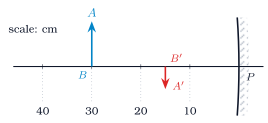
The figure shows an object \(AB\) and its image \(A'B'\) formed by a concave mirror. The scale is in cm from the pole \(P\).
Read \(u\) and \(v\) with their signs.
Find the focal length and the radius of curvature of the mirror.
Find \(m\). Is the image real or virtual?
Answer(i) \(-30\) cm, \(-15\) cm (ii) \(-10\) cm, \(-20\) cm (iii) \(-\frac{1}{2}\), real
Solution
Both the object and the image are in front of the mirror: \(u = -30\) cm, \(v = -15\) cm.
\(\dfrac{1}{f} = \dfrac{1}{v} + \dfrac{1}{u} = -\dfrac{1}{15} - \dfrac{1}{30} = -\dfrac{1}{10}\), so \(f = -10\) cm and \(R = 2f = -20\) cm.
\(m = -\dfrac{v}{u} = -\dfrac{-15}{-30} = -\dfrac{1}{2}\). The image is inverted and half the size, as drawn. \(v < 0\), so the image is real.
How did it go?
Q38
A concave mirror forms on a screen an image of a small lamp three times the size of the lamp. The screen is \(80\) cm from the lamp. Find \(u\), \(v\) and \(f\).
Answer\(-40\) cm, \(-120\) cm, \(-30\) cm
Solution
The image is on a screen, so it is real and inverted: \(m = -3\) and \(v = 3u\). Both are in front of the mirror, and the image is farther: \(|v| - |u| = 80\) cm gives \(2|u| = 80\), \(|u| = 40\) cm.
\(u = -40\) cm, \(v = -120\) cm. \(\dfrac{1}{f} = -\dfrac{1}{120} - \dfrac{1}{40} = -\dfrac{4}{120}\), so \(f = -30\) cm.
How did it go?
Q39
A convex mirror of focal length \(30\) cm forms an image \(20\) cm behind the mirror. Find the object distance and the magnification.
Answer\(-60\) cm, \(+\frac{1}{3}\)
Solution
\(f = +30\) cm, \(v = +20\) cm. \(\dfrac{1}{u} = \dfrac{1}{f} - \dfrac{1}{v} = \dfrac{1}{30} - \dfrac{1}{20} = -\dfrac{1}{60}\), so \(u = -60\) cm. \(m = -\dfrac{20}{-60} = +\dfrac{1}{3}\).
How did it go?
Velocity of the image
Q40
Differentiate the mirror formula \(\frac{1}{v} + \frac{1}{u} = \frac{1}{f}\) with respect to time. Show that for an object moving along the axis, \(v_I = -m^2 v_O\), where \(v_O = \frac{du}{dt}\) and \(v_I = \frac{dv}{dt}\).
\(f\) is constant, so \(\dfrac{d}{dt}\left(\dfrac{1}{v} + \dfrac{1}{u}\right) = 0\): \(-\dfrac{1}{v^2}\dfrac{dv}{dt} - \dfrac{1}{u^2}\dfrac{du}{dt} = 0\).
So \(\dfrac{dv}{dt} = -\dfrac{v^2}{u^2}\dfrac{du}{dt}\), that is \(v_I = -m^2 v_O\), since \(m^2 = \dfrac{v^2}{u^2}\). The image always moves opposite to the object along the axis, with speed \(m^2\) times the object speed.
How did it go?
Q41
An object is \(30\) cm in front of a concave mirror of focal length \(20\) cm. The object moves towards the mirror at \(2\) cm/s.
Find the velocity of the image. In which direction does the image move?
Is the image moving faster or slower than the object? Why?
Answer(i) \(8\) cm/s away from the mirror (ii) faster; \(|m| = 2\), image speed is \(m^2 = 4\) times
Solution
\(u = -30\) cm, \(f = -20\) cm: \(v = -60\) cm, \(m = -2\). The object moves towards the mirror, so \(u\) increases towards zero: \(v_O = +2\) cm/s.
\(v_I = -m^2 v_O = -4 \times 2 = -8\) cm/s. \(v\) becomes more negative: the image moves away from the mirror at \(8\) cm/s.
Faster, because \(|m| = 2 > 1\) and the image speed is \(m^2 = 4\) times the object speed.
How did it go?
Q42
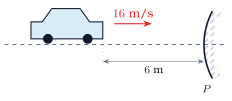
A rear-view mirror is convex with radius of curvature \(4\) m. A car \(6\) m behind it approaches at \(16\) m/s, as in the figure.
Find the position of the image of the car and the magnification.
Find the speed of the image. Does the image move towards or away from the mirror?
Answer(i) \(+1.5\) m, \(+\frac{1}{4}\) (ii) \(1\) m/s, towards
Solution
\(f = +2\) m, \(u = -6\) m. \(\dfrac{1}{v} = \dfrac{1}{2} + \dfrac{1}{6} = \dfrac{2}{3}\), so \(v = +1.5\) m behind the mirror. \(m = -\dfrac{1.5}{-6} = +\dfrac{1}{4}\).
\(v_I = -m^2 v_O = -\dfrac{1}{16} \times 16 = -1\) m/s. \(v\) decreases from \(1.5\) m: the image moves towards the mirror at \(1\) m/s. The car seems slow and small in the mirror.
How did it go?
Q43
An object is \(30\) cm in front of a concave mirror of focal length \(20\) cm. The object moves perpendicular to the axis at \(3\) cm/s. Find the velocity of the image. Give the direction.
Answer\(6\) cm/s, opposite to the object
Solution
For motion perpendicular to the axis, \(h_I = m\,h_O\) with \(m\) fixed (since \(u\) does not change). Differentiating, \(v_{I\perp} = m\,v_{O\perp} = -2 \times 3 = -6\) cm/s.
The image moves at \(6\) cm/s in the direction opposite to the object, because the image is inverted.
How did it go?
Q44
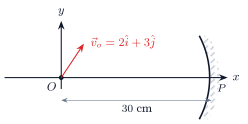
A point object is \(30\) cm in front of a concave mirror of focal length \(20\) cm. The \(x\) axis is along the principal axis, towards the mirror. The object moves with velocity \((2\hat i + 3\hat j)\) cm/s.
Find the \(x\) component and the \(y\) component of the image velocity.
Find the speed of the image.
Answer(i) \(-8\) cm/s, \(-6\) cm/s (ii) \(10\) cm/s
Solution
\(m = -2\) as before. Along the axis: \(v_{Ix} = -m^2 v_{Ox} = -4 \times 2 = -8\) cm/s. Perpendicular: \(v_{Iy} = m\,v_{Oy} = -2 \times 3 = -6\) cm/s.
An object moves along the axis of a concave mirror of focal length \(20\) cm. At what object distance does the image move with the same speed as the object? What is special about this position?
Answer\(40\) cm; centre of curvature
Solution
\(|v_I| = |v_O|\) needs \(m^2 = 1\), so \(|m| = 1\) and \(|v| = |u|\). A real image the same size as the object has \(v = u\). Then \(\dfrac{2}{u} = \dfrac{1}{f}\), \(u = 2f = -40\) cm.
This is the centre of curvature. There the image is the same size as the object, and it moves at the same speed, in the opposite direction.
How did it go?
Q46
An object moves at constant speed along the axis of a concave mirror, from the centre of curvature towards the focus. Does the image move at constant speed? Give the reason.
Answerno; \(v_I = -m^2v_O\) and \(|m|\) grows from \(1\) at \(C\) without limit near \(F\)
Solution
No. The image speed is \(m^2\) times the object speed, and \(m\) changes with position. At \(C\), \(|m| = 1\). As the object nears \(F\), \(|m|\) grows without limit, so the image speeds up and moves off to infinity.
How did it go?
Q47
A plane mirror is a spherical mirror with \(R \to \infty\). Use the result of Question 16 to show that the image of an object moving along the normal has \(v_I = -v_O\).
As \(R \to \infty\), \(f \to \infty\) and \(\dfrac{1}{f} \to 0\), so \(\dfrac{1}{v} = -\dfrac{1}{u}\) and \(v = -u\). Then \(m = -\dfrac{v}{u} = +1\) and \(m^2 = 1\).
\(v_I = -m^2 v_O = -v_O\): the image moves towards the mirror as fast as the object does, from the other side. This agrees with the plane mirror result.
How did it go?
Q48
A candle is \(20\) cm in front of a concave mirror of radius of curvature \(60\) cm.
Find \(v\) and \(m\). Describe the image.
The candle moves towards the mirror at \(1\) cm/s. Find the speed of the image and its direction.
Answer(i) \(+60\) cm, \(+3\); virtual, erect, larger (ii) \(9\) cm/s towards the mirror
Solution
\(f = -30\) cm, \(u = -20\) cm. \(\dfrac{1}{v} = -\dfrac{1}{30} + \dfrac{1}{20} = \dfrac{1}{60}\), so \(v = +60\) cm. \(m = -\dfrac{60}{-20} = +3\). The image is virtual, erect and three times the size.
\(v_O = +1\) cm/s (towards the mirror). \(v_I = -m^2 v_O = -9\) cm/s. \(v\) decreases from \(+60\) cm: the virtual image moves towards the mirror at \(9\) cm/s.