Questions on Refraction, Total Internal Reflection and Prisms, the kind your examinations ask. Solve one on paper. Then tell the book how it went. The book believes you, and it uses your answer to plan your revision.
0%
Nothing marked yetMark honestly. Peek at the answer only after your own attempt.
Snell's Law, Apparent Depth and Slabs
24 questions · after Lesson 2, Apparent Depth and the Glass Slab
Snell's law
Q1
A ray passes from air into glass of refractive index \(\mu = \sqrt{2}\) at an angle of incidence of \(45^\circ\). Take \(c = 3 \times 10^8\) m/s throughout this sheet.
Find the angle of refraction \(r\).
Find the deviation of the ray.
Answer(i) \(30^\circ\) (ii) \(15^\circ\)
Solution
Snell's law: \(\sin i = \mu\sin r\). \(\sin r = \dfrac{\sin 45^\circ}{\sqrt{2}} = \dfrac{1}{2}\), so \(r = 30^\circ\).
The ray bends towards the normal by \(i - r = 45^\circ - 30^\circ = 15^\circ\).
How did it go?
Q2
Light of wavelength \(600\) nm in air enters glass of \(\mu = 1.5\).
Find the speed of light in the glass.
Find the wavelength in the glass.
What happens to the frequency?
Answer(i) \(2 \times 10^8\) m/s (ii) \(400\) nm (iii) unchanged, \(5 \times 10^{14}\) Hz
The frequency is fixed by the source and does not change: \(f = \dfrac{c}{\lambda} = \dfrac{3 \times 10^8}{6 \times 10^{-7}} = 5 \times 10^{14}\) Hz in both media.
How did it go?
Q3
Water has \(\mu_w = \frac{4}{3}\) and glass has \(\mu_g = \frac{3}{2}\).
Find the refractive index of glass with respect to water, \(_w\mu_g\), and of water with respect to glass, \(_g\mu_w\).
A ray in glass meets the water surface with \(\sin i = 0.8\). Find \(\sin r\) in the water. Does the ray bend towards or away from the normal?
Answer(i) \(\frac{9}{8}\), \(\frac{8}{9}\) (ii) \(0.9\); away
\(\mu_g\sin i = \mu_w\sin r\), so \(\sin r = \dfrac{\mu_g}{\mu_w}\sin i = \dfrac{9}{8} \times 0.8 = 0.9\). Water is rarer than glass, so the ray bends away from the normal (\(r > i\)).
How did it go?
Q4
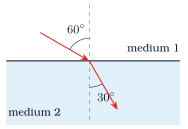
The figure shows a ray crossing from medium 1 into medium 2.
Find \(\frac{\mu_2}{\mu_1}\) from the angles.
Which medium is optically denser? Give the reason.
Find the ratio of the speed of light in medium 1 to that in medium 2.
Answer(i) \(\sqrt{3}\) (ii) medium 2; the ray bends towards the normal (iii) \(\sqrt{3}\)
Medium 2. The ray bends towards the normal on entering it, which happens when light enters a denser medium.
\(\dfrac{v_1}{v_2} = \dfrac{c/\mu_1}{c/\mu_2} = \dfrac{\mu_2}{\mu_1} = \sqrt{3}\). Light is slower in the denser medium.
How did it go?
Q5
A ray enters a parallel-sided glass slab at angle of incidence \(i\) and leaves from the opposite face. Show, using Snell's law at both faces, that the emergent ray is parallel to the incident ray.
Answer\(\sin i = \mu\sin r\) and \(\mu\sin r = \sin e\) (parallel normals), so \(e = i\)
Solution
At the first face, \(\sin i = \mu\sin r\). The two faces are parallel, so the normals are parallel and the angle of incidence at the second face is the same \(r\).
At the second face, \(\mu\sin r = \sin e\). So \(\sin e = \sin i\) and \(e = i\). The emergent ray makes the same angle with the parallel normal, so it is parallel to the incident ray (but shifted sideways).
How did it go?
Q6
Light travels \(3\) cm through glass of \(\mu = 1.5\).
Find the time taken.
Find the optical path, the distance light would travel in air in the same time.
Answer(i) \(1.5 \times 10^{-10}\) s (ii) \(4.5\) cm
Optical path \(= \mu \times\) distance \(= 1.5 \times 3 = 4.5\) cm. Check: in \(1.5 \times 10^{-10}\) s light in air covers \(3 \times 10^8 \times 1.5 \times 10^{-10} = 0.045\) m.
How did it go?
Apparent depth
Q7
A pond is \(4\) m deep. Water has \(\mu = \frac{4}{3}\). A person looks straight down at a stone on the bottom.
Find the apparent depth of the stone.
Find the normal shift.
Answer(i) \(3\) m (ii) \(1\) m
Solution
Apparent depth \(= \dfrac{\text{real depth}}{\mu} = \dfrac{4}{4/3} = 3\) m.
Normal shift \(= 4 - 3 = 1\) m. The stone appears \(1\) m higher than it is.
How did it go?
Q8
A glass slab \(6\) cm thick with \(\mu = 1.5\) is placed on a printed page. Find the apparent depth of the letters below the top face, and the height through which they appear raised.
Answer\(4\) cm; \(2\) cm
Solution
Apparent depth \(= \dfrac{t}{\mu} = \dfrac{6}{1.5} = 4\) cm. The letters appear raised by \(t - \dfrac{t}{\mu} = t\left(1 - \dfrac{1}{\mu}\right) = 6 \times \dfrac{1}{3} = 2\) cm.
How did it go?
Q9
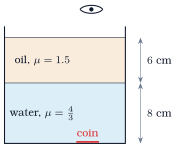
A coin lies at the bottom of a beaker under \(8\) cm of water (\(\mu = \frac{4}{3}\)). Above the water is \(6\) cm of oil (\(\mu = 1.5\)). The coin is viewed from above, as in the figure.
Find the apparent depth of the coin below the top surface of the oil.
Find the total normal shift.
Answer(i) \(10\) cm (ii) \(4\) cm
Solution
Each layer contributes its own apparent depth: \(\dfrac{8}{4/3} + \dfrac{6}{1.5} = 6 + 4 = 10\) cm.
Real depth \(= 8 + 6 = 14\) cm. Shift \(= 14 - 10 = 4\) cm. Check: \(8 \times \dfrac{1}{4} + 6 \times \dfrac{1}{3} = 2 + 2 = 4\) cm.
How did it go?
Q10
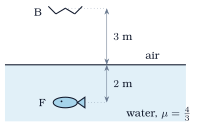
A fish \(F\) is \(2\) m below the surface of a lake. A bird \(B\) is \(3\) m above the surface, on the same vertical line. Water has \(\mu = \frac{4}{3}\).
How far above the surface does the bird appear to the fish? Hence find the apparent distance of the bird from the fish.
How far below the surface does the fish appear to the bird? Hence find the apparent distance of the fish from the bird.
Answer(i) \(4\) m; \(6\) m (ii) \(1.5\) m; \(4.5\) m
Solution
The bird is in the rarer medium, viewed from the denser one. Apparent height \(= \mu \times 3 = 4\) m above the surface. Distance from the fish \(= 2 + 4 = 6\) m.
The fish is in the denser medium, viewed from the rarer one. Apparent depth \(= \dfrac{2}{\mu} = 1.5\) m below the surface. Distance from the bird \(= 3 + 1.5 = 4.5\) m.
How did it go?
Q11
In Question 10 the fish rises at \(4\) m/s and the bird dives at \(3\) m/s at the same instant.
Find the speed at which the bird sees the fish approach.
Find the speed at which the fish sees the bird approach.
Answer(i) \(6\) m/s (ii) \(8\) m/s
Solution
The apparent depth of the fish is \(\dfrac{d}{\mu}\), so it changes at \(\dfrac{4}{4/3} = 3\) m/s. The bird itself dives at \(3\) m/s. The bird sees the fish approach at \(3 + 3 = 6\) m/s.
The apparent height of the bird is \(\mu h\), so it changes at \(\dfrac{4}{3} \times 3 = 4\) m/s. The fish itself rises at \(4\) m/s. The fish sees the bird approach at \(4 + 4 = 8\) m/s.
How did it go?
Q12
A microscope is focused on a dot on a table. A glass slab \(3\) cm thick with \(\mu = 1.5\) is placed over the dot. Through what distance, and in which direction, must the microscope be moved to focus on the dot again?
Answer\(1\) cm upwards
Solution
The slab raises the image of the dot by \(t\left(1 - \dfrac{1}{\mu}\right) = 3 \times \dfrac{1}{3} = 1\) cm. The microscope must be raised by \(1\) cm.
How did it go?
Lateral shift and slabs
Q13
A ray falls at \(45^\circ\) on a slab of thickness \(10\) cm and \(\mu = \sqrt{2}\). The lateral shift is \(d = \frac{t\sin(i - r)}{\cos r}\).
Derive the lateral shift formula \(d = \frac{t\sin(i - r)}{\cos r}\) for a slab of thickness \(t\), angle of incidence \(i\) and angle of refraction \(r\).
Let the ray enter at \(A\) and leave at \(B\). Inside the slab the path \(AB\) makes angle \(r\) with the normal, so \(AB = \dfrac{t}{\cos r}\).
The emergent ray is parallel to the incident ray. The lateral shift \(d\) is the perpendicular distance from \(B\) to the line of the incident ray. The angle between \(AB\) and that line is \(i - r\), so \(d = AB\sin(i - r) = \dfrac{t\sin(i - r)}{\cos r}\).
How did it go?
Q15
For small angles \(\sin\theta \approx \theta\) and \(\cos\theta \approx 1\).
Show that the lateral shift becomes \(d \approx t\,i\left(1 - \frac{1}{\mu}\right)\), with \(i\) in radians.
Find \(d\) for \(i = 0.1\) rad, \(t = 6\) cm and \(\mu = 1.5\).
Answer(i) \(d \approx t(i - r)\) with \(r = \frac{i}{\mu}\) (ii) \(0.2\) cm
Solution
For small angles \(\sin(i - r) \approx i - r\) and \(\cos r \approx 1\), so \(d \approx t(i - r)\). Snell's law becomes \(i = \mu r\), so \(r = \dfrac{i}{\mu}\) and \(d \approx t\,i\left(1 - \dfrac{1}{\mu}\right)\).
A ray falls at grazing incidence (\(i = 90^\circ\)) on a slab of thickness \(10\) cm and \(\mu = \sqrt{2}\). Find \(r\) and the lateral shift.
Answer\(45^\circ\); \(10\) cm
Solution
\(\sin r = \dfrac{\sin 90^\circ}{\sqrt{2}} = \dfrac{1}{\sqrt{2}}\), so \(r = 45^\circ\). \(d = \dfrac{t\sin(90^\circ - 45^\circ)}{\cos 45^\circ} = t = 10\) cm. At grazing incidence the shift is largest.
How did it go?
Q17
An object is viewed through a glass slab placed between the object and the eye. Show that the normal shift \(t\left(1 - \frac{1}{\mu}\right)\) does not depend on where the slab is placed between them.
Answerthe shift is fixed by \(t\) and \(\mu\) alone; the air paths do not bend the ray
Solution
Let the object be at distance \(x\) in front of the slab and the eye beyond it. Rays from the object cross the slab and are shifted by \(t\left(1 - \dfrac{1}{\mu}\right)\) towards the eye, whatever the value of \(x\).
Reason: the shift is fixed by the refraction at the two faces, which depends only on \(t\) and \(\mu\). The air paths before and after the slab do not bend the ray. So the image position does not depend on where the slab sits.
How did it go?
Q18
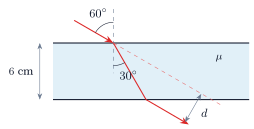
The figure shows a ray through a slab \(6\) cm thick. The angles are \(60^\circ\) in air and \(30^\circ\) inside the slab.
Find the refractive index \(\mu\) of the slab.
Find the lateral shift \(d\). Take \(\sqrt{3} = 1.73\).
At what angle does the ray leave the slab?
Answer(i) \(\sqrt{3}\) (ii) \(2\sqrt{3} \approx 3.46\) cm (iii) \(60^\circ\)
The faces are parallel, so the ray leaves at the angle of incidence, \(60^\circ\) to the normal.
How did it go?
Q19
A ray from air passes through three parallel slabs of refractive indices \(\mu_1\), \(\mu_2\) and \(\mu_3\) in turn, and comes out into air.
Show that the emergent ray is parallel to the incident ray.
The angle of incidence is \(45^\circ\) and \(\mu_2 = \sqrt{2}\). Find the angle of the ray inside the second slab. Does \(\mu_1\) matter?
Answer(i) \(\sin i = \mu_1\sin r_1 = \mu_2\sin r_2 = \mu_3\sin r_3 = \sin e\) (ii) \(30^\circ\); no
Solution
All the faces are parallel, so the angle of refraction at one face equals the angle of incidence at the next. Snell's law at each face gives \(\sin i = \mu_1\sin r_1 = \mu_2\sin r_2 = \mu_3\sin r_3 = \sin e\). So \(e = i\) and the emergent ray is parallel to the incident ray.
From the chain, \(\sin r_2 = \dfrac{\sin i}{\mu_2} = \dfrac{\sin 45^\circ}{\sqrt{2}} = \dfrac{1}{2}\), so \(r_2 = 30^\circ\). \(\mu_1\) drops out: the angle in any slab depends only on that slab's index and the angle in air.
How did it go?
Small situations
Q20
A beaker is filled with a liquid to a depth of \(12\) cm. A mark at the bottom now appears raised by \(3\) cm. Find the refractive index of the liquid.
Answer\(\frac{4}{3}\)
Solution
Shift \(= t\left(1 - \dfrac{1}{\mu}\right)\): \(3 = 12\left(1 - \dfrac{1}{\mu}\right)\), so \(1 - \dfrac{1}{\mu} = \dfrac{1}{4}\) and \(\mu = \dfrac{4}{3}\).
How did it go?
Q21
A glass slab (\(\mu_g = 1.5\)) \(9\) cm thick rests on an object.
Find the normal shift when viewed from air.
Find the normal shift when the slab and object are under water (\(\mu_w = \frac{4}{3}\)).
Under water the index that matters is the relative one, \(_w\mu_g = \dfrac{1.5}{4/3} = \dfrac{9}{8}\). Shift \(= 9\left(1 - \dfrac{8}{9}\right) = 1\) cm. The slab does less in water because it is only slightly denser than water.
How did it go?
Q22
The slab of Question 8 is lifted slowly at \(2\) cm/s, staying between the page and the eye. Find the velocity of the image of the letters. Give the reason.
Answerzero; the shift \(t(1 - \frac{1}{\mu})\) does not depend on where the slab is
Solution
Zero. The image of the letters is raised by \(t\left(1 - \dfrac{1}{\mu}\right) = 2\) cm, and this shift does not depend on the position of the slab (Question 17). The image stays \(2\) cm above the page while the slab moves.
How did it go?
Q23
A ray falls on a glass surface at \(60^\circ\). The reflected ray and the refracted ray are found to be perpendicular to each other. Find the angle of refraction and the refractive index of the glass.
Answer\(30^\circ\); \(\sqrt{3}\)
Solution
The reflected ray makes \(60^\circ\) with the normal. If the refracted ray is perpendicular to it, then \(60^\circ + 90^\circ + r = 180^\circ\), so \(r = 30^\circ\).
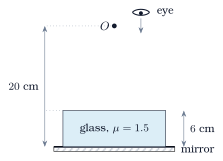
A glass slab \(6\) cm thick (\(\mu = 1.5\)) lies on a plane mirror. A point object \(O\) is \(20\) cm above the mirror. An eye above looks down at the image of \(O\).
By how much does the slab appear to raise the mirror?
Find the distance of the final image below \(O\).
Answer(i) \(2\) cm (ii) \(36\) cm
Solution
Light crosses the slab once on the way down and once on the way up. Seen through the slab, the mirror appears raised by the normal shift \(t\left(1 - \dfrac{1}{\mu}\right) = 6 \times \dfrac{1}{3} = 2\) cm.
Replace the real mirror by an effective mirror \(2\) cm higher, \(18\) cm below \(O\). The plane mirror forms the image \(18\) cm behind it, that is \(18 + 18 = 36\) cm below \(O\).
Check by steps: \(O\) is \(14\) cm above the glass. From inside the glass it appears \(14 \times 1.5 = 21\) cm above the top face, or \(27\) cm above the mirror. The mirror image is \(27\) cm below the mirror, \(33\) cm below the top face in glass. From air it appears at \(\dfrac{33}{1.5} = 22\) cm below the top face, that is \(14 + 22 = 36\) cm below \(O\).
How did it go?
Total Internal Reflection and Variable Refractive Index
24 questions · after Lesson 4, "Bending in Layers: Mirages and Graded Media"
Critical angle
Q25
The critical angle \(C\) for a medium in air is given by \(\sin C = \frac{1}{\mu}\). Find \(C\) for
Answer(i) \(45^\circ\) (ii) \(30^\circ\) (iii) \(\approx 42^\circ\)
Solution
\(\sin C = \dfrac{1}{\sqrt{2}}\), so \(C = 45^\circ\).
\(\sin C = \dfrac{1}{2}\), so \(C = 30^\circ\). A denser medium has a smaller critical angle.
\(\sin C = \dfrac{2}{3}\), so \(C \approx 42^\circ\).
How did it go?
Q26
State the two conditions for total internal reflection. Why can a ray going from air into glass never be totally reflected?
Answerdenser to rarer; \(i > C\); air to glass is rarer to denser, the ray always refracts
Solution
First, the ray must travel from a denser medium towards a rarer one. Second, the angle of incidence must be larger than the critical angle, \(i > C\).
From air into glass the ray goes towards the denser medium. It bends towards the normal and always finds an angle of refraction, so it is never totally reflected.
How did it go?
Q27
Glass has \(\mu_g = \frac{3}{2}\) and water has \(\mu_w = \frac{4}{3}\). Find \(\sin C\) for a glass-water surface. Is this critical angle larger or smaller than that of glass in air? Why?
Answer\(\frac{8}{9}\); larger, since \(\sin C = \frac{\mu_w}{\mu_g} > \frac{1}{\mu_g}\)
Solution
At the critical angle the refracted ray grazes the surface: \(\mu_g\sin C = \mu_w\sin 90^\circ\), so \(\sin C = \dfrac{\mu_w}{\mu_g} = \dfrac{4/3}{3/2} = \dfrac{8}{9}\).
\(\dfrac{8}{9} > \dfrac{2}{3}\), so \(C\) is larger than for glass in air. Water is closer to glass in optical density, so the ray needs a larger angle before it is totally reflected.
How did it go?
Q28
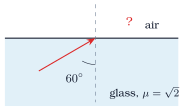
The figure shows a ray inside glass (\(\mu = \sqrt{2}\)) meeting the surface at \(60^\circ\) to the normal.
Find the critical angle. Does the ray emerge into the air?
The angle of incidence is changed to \(30^\circ\). Find the angle of refraction in air.
At what angle of incidence does the refracted ray just graze the surface?
Answer(i) \(45^\circ\); no (ii) \(45^\circ\) (iii) \(45^\circ\)
Solution
\(\sin C = \dfrac{1}{\sqrt{2}}\), \(C = 45^\circ\). The angle of incidence \(60^\circ > C\), so the ray is totally reflected and does not emerge.
\(\sqrt{2}\sin 30^\circ = \sin r\) gives \(\sin r = \dfrac{\sqrt{2}}{2} = \dfrac{1}{\sqrt{2}}\), so \(r = 45^\circ\).
Grazing means \(r = 90^\circ\), which happens at \(i = C = 45^\circ\).
How did it go?
Q29
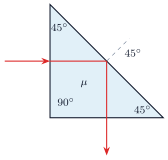
A ray enters a right-angled isosceles prism normally through one short face, as in the figure, and meets the hypotenuse at \(45^\circ\).
Find the least refractive index for which the ray is totally reflected at the hypotenuse.
The prism is made of glass with \(\mu = 1.5\). Through what angle is the ray turned?
Answer(i) \(\sqrt{2}\) (ii) \(90^\circ\)
Solution
Total reflection needs \(45^\circ \ge C\), that is \(\sin 45^\circ \ge \dfrac{1}{\mu}\), so \(\mu \ge \sqrt{2} \approx 1.41\).
For \(\mu = 1.5\), \(C \approx 42^\circ < 45^\circ\), so the ray is totally reflected. It was moving horizontally and leaves vertically: it is turned through \(90^\circ\). It meets the bottom face normally and passes out without bending.
How did it go?
Q30
An optical fibre has a core of \(\mu = 1.5\) and a cladding of \(\mu = 1.2\).
Find \(\sin C\) at the core-cladding surface. Take \(C \approx 53^\circ\).
Find the largest angle a ray inside the core may make with the axis and still be guided.
Find the sine of the largest angle of incidence in air, at the flat end, for which the ray is guided.
Answer(i) \(0.8\) (ii) \(37^\circ\) (iii) \(0.9\)
Solution
\(\sin C = \dfrac{\mu_{\text{clad}}}{\mu_{\text{core}}} = \dfrac{1.2}{1.5} = 0.8\), so \(C \approx 53^\circ\).
The angle of incidence at the wall is \(90^\circ\) minus the angle with the axis. Guiding needs \(i \ge 53^\circ\), so the angle with the axis is at most \(90^\circ - 53^\circ = 37^\circ\).
At the flat end the ray refracts from air into the core: \(\sin i_{\max} = 1.5\sin 37^\circ = 1.5 \times 0.6 = 0.9\). Any ray entering at less than about \(64^\circ\) to the axis is guided.
How did it go?
Circle of illuminance
Q31
A small lamp is \(3\) m below the surface of a liquid of \(\mu = \frac{5}{4}\). Light comes out of the surface only inside a circle of radius \(r = h\tan C\).
Find \(\tan C\).
Find \(r\) and the area of the lit circle.
Answer(i) \(\frac{4}{3}\) (ii) \(4\) m; \(16\pi \approx 50\) m\(^2\)
Solution
\(\sin C = \dfrac{4}{5}\), so \(\cos C = \dfrac{3}{5}\) and \(\tan C = \dfrac{4}{3}\).
\(r = h\tan C = 3 \times \dfrac{4}{3} = 4\) m. Area \(= \pi r^2 = 16\pi \approx 50\) m\(^2\).
How did it go?
Q32
A lamp is at depth \(\sqrt{7}\) m in water (\(\mu = \frac{4}{3}\)). Find the radius of the circle through which its light leaves the water.
Answer\(3\) m
Solution
\(r = \dfrac{h}{\sqrt{\mu^2 - 1}}\). \(\mu^2 - 1 = \dfrac{16}{9} - 1 = \dfrac{7}{9}\), so \(\sqrt{\mu^2 - 1} = \dfrac{\sqrt{7}}{3}\) and \(r = \sqrt{7} \times \dfrac{3}{\sqrt{7}} = 3\) m.
How did it go?
Q33
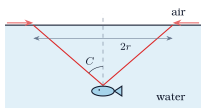
A fish looks up at the surface, as in the figure. Water has \(\mu = \frac{4}{3}\); take \(C \approx 49^\circ\).
Find the vertex angle of the cone inside which the fish sees everything above the water.
What does the fish see on the surface outside this cone? Give the reason.
Answer(i) \(98^\circ\) (ii) reflection of the bottom; rays at \(i > C\) are totally reflected
Solution
Rays from every direction above the water enter the eye of the fish within angle \(C\) of the vertical. The cone has vertex angle \(2C \approx 98^\circ\).
Rays from the bottom that meet the surface at more than \(C\) are totally reflected. Outside the cone the surface acts as a mirror, and the fish sees the reflection of the bottom of the lake.
How did it go?
Q34
A coin lies \(12\) cm below the surface of the liquid of Question 7 (\(\mu = \frac{5}{4}\)). Find the least diameter of a flat opaque disc floating on the surface that hides the coin from every viewer above the surface.
Answer\(32\) cm
Solution
Rays from the coin that reach the surface within radius \(r = h\tan C\) leave the liquid; the rest are totally reflected. The disc must cover that circle: \(r = 12 \times \dfrac{4}{3} = 16\) cm, so the diameter is \(32\) cm.
How did it go?
Q35
Show that the radius of the circle of illuminance is \(r = \frac{h}{\sqrt{\mu^2 - 1}}\), where \(h\) is the depth of the source.
Answer\(r = h\tan C\) and \(\tan C = \frac{1}{\sqrt{\mu^2 - 1}}\)
Solution
A ray from the source at depth \(h\) reaches the surface at distance \(r\) from the point directly above the source with \(\tan i = \dfrac{r}{h}\). Light escapes only while \(i \le C\), so the edge of the lit circle has \(r = h\tan C\).
\(\sin C = \dfrac{1}{\mu}\) gives \(\cos C = \dfrac{\sqrt{\mu^2 - 1}}{\mu}\) and \(\tan C = \dfrac{1}{\sqrt{\mu^2 - 1}}\). So \(r = \dfrac{h}{\sqrt{\mu^2 - 1}}\).
How did it go?
Uses of TIR
Q36
Diamond has \(\mu = 2.4\). Find \(\sin C\) and explain in one or two sentences why a cut diamond sparkles.
Answer\(\frac{5}{12}\); small \(C\), so light is totally reflected many times inside and leaves in flashes
Solution
\(\sin C = \dfrac{1}{2.4} = \dfrac{5}{12} \approx 0.42\), so \(C \approx 25^\circ\). Light that enters a cut diamond meets most of the inside faces at more than \(25^\circ\) and is totally reflected many times. It comes out through a few faces only, in bright flashes.
How did it go?
Q37
A ray travels in glass (\(\mu = \frac{3}{2}\)) towards a flat surface with water (\(\mu = \frac{4}{3}\)) on the other side. Find \(\sin i\) for the largest angle of incidence at which the ray still enters the water.
Answer\(\frac{8}{9}\)
Solution
The ray enters the water as long as \(i \le C\), where \(\sin C = \dfrac{\mu_w}{\mu_g} = \dfrac{8}{9}\). So the largest \(\sin i\) is \(\dfrac{8}{9}\) (about \(63^\circ\)).
How did it go?
Q38
A ray enters glass from air at grazing incidence (\(i = 90^\circ\)). Show that the angle of refraction equals the critical angle of the glass. Hence explain why no ray inside the glass can reach the surface from air at an angle larger than \(C\).
Answer\(\sin r = \frac{1}{\mu} = \sin C\); every ray from air has \(i \le 90^\circ\), so \(r \le C\)
Solution
\(\sin 90^\circ = \mu\sin r\) gives \(\sin r = \dfrac{1}{\mu} = \sin C\), so \(r = C\).
Every ray from air has \(i \le 90^\circ\), so its angle of refraction is at most \(C\). A ray inside the glass at an angle larger than \(C\) cannot have come from the air. Reversing the path, such a ray cannot get out into the air either: it is totally reflected.
How did it go?
Q39
Explain a mirage on a hot road in three sentences. Say what happens to the refractive index of the air, how a ray from the sky bends, and why the road looks wet.
Answer\(\mu\) is lower near the road; a ray from the sky bends away from the vertical and turns up; the eye sees the sky on the road
Solution
The air near the hot road is hotter and less dense, so its refractive index is lower than that of the cooler air above. A ray from the sky coming down at a small angle passes into rarer and rarer air and bends away from the vertical. Near the road it is turned back upward. The eye traces the ray back to the road, so it sees an image of the sky there, which looks like a pool of water.
How did it go?
Variable refractive index
Q40
A medium is made of thin horizontal layers with refractive indices \(\mu_1, \mu_2, \mu_3, \ldots\). A ray makes angle \(\theta_1\) with the vertical in the first layer.
Show that \(\mu\sin\theta\) has the same value in every layer.
The ray enters from air at \(60^\circ\) to the vertical. Find \(\theta\) in a layer where \(\mu = \sqrt{3}\).
Answer(i) Snell's law at parallel boundaries: \(\mu_1\sin\theta_1 = \mu_2\sin\theta_2 = \ldots\) (ii) \(30^\circ\)
Solution
The boundaries are parallel, so the angle of refraction at one boundary is the angle of incidence at the next. Snell's law at each boundary gives \(\mu_1\sin\theta_1 = \mu_2\sin\theta_2 = \mu_3\sin\theta_3 = \ldots\)
\(1 \times \sin 60^\circ = \sqrt{3}\sin\theta\), so \(\sin\theta = \dfrac{\sqrt{3}/2}{\sqrt{3}} = \dfrac{1}{2}\) and \(\theta = 30^\circ\).
How did it go?
Q41
A ray starts in a layer of \(\mu_0 = \sqrt{2}\) at \(45^\circ\) to the vertical and moves upward into layers of smaller and smaller \(\mu\). In the layer of what refractive index does the ray become horizontal? What happens to the ray after that?
Answer\(\mu = 1\); turns back
Solution
\(\mu\sin\theta = \sqrt{2}\sin 45^\circ = 1\). The ray is horizontal when \(\theta = 90^\circ\), that is \(\mu \times 1 = 1\), so \(\mu = 1\).
Beyond that layer \(\mu\sin\theta\) would have to exceed \(\mu\), which is impossible. The ray is totally reflected at that level and comes back down, retracing the same angles in reverse.
How did it go?
Q42
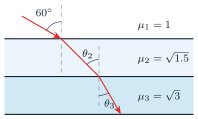
The figure shows a ray entering three layers of refractive index \(1\), \(\sqrt{1.5}\) and \(\sqrt{3}\) at \(60^\circ\) to the vertical.
Find \(\theta_2\) and \(\theta_3\).
Does the ray bend towards or away from the vertical as it goes down?
Towards the vertical. Each layer is denser than the one above, so the angle with the normal keeps decreasing.
How did it go?
Q43
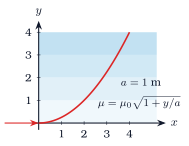
A medium fills the region \(y > 0\) and its refractive index grows with \(y\): \(\mu(y) = \mu_0\sqrt{1 + \frac{y}{a}}\). A ray enters at the origin along the \(x\) axis, that is, at \(90^\circ\) to the \(y\) direction.
Write the value of \(\mu\sin\theta\) along the path, where \(\theta\) is the angle with the \(y\) axis.
Show that \(\tan\theta = \sqrt{\frac{a}{y}}\) at height \(y\).
Continue Question 19. Along the path \(\frac{dx}{dy} = \tan\theta\).
Integrate to show that the path is \(y = \frac{x^2}{4a}\).
For \(a = 1\) m, find \(y\) at \(x = 4\) m and compare with the figure.
Answer(i) \(dx = \sqrt{\frac{a}{y}}\,dy\), so \(x = 2\sqrt{ay}\) (ii) \(4\) m
Solution
\(\dfrac{dx}{dy} = \sqrt{\dfrac{a}{y}}\), so \(dx = \sqrt{a}\,y^{-1/2}\,dy\). Integrating from the origin: \(x = \sqrt{a} \times 2\sqrt{y} = 2\sqrt{ay}\). Squaring, \(x^2 = 4ay\), that is \(y = \dfrac{x^2}{4a}\), a parabola.
\(y = \dfrac{16}{4} = 4\) m at \(x = 4\) m, which is where the curve in the figure reaches \(y = 4\).
How did it go?
Q45
For the path of Question 20 with \(a = 1\) m, find the angle the ray makes with the \(x\) axis at \(x = 2\) m.
Answer\(45^\circ\)
Solution
Slope \(\dfrac{dy}{dx} = \dfrac{x}{2a} = \dfrac{2}{2} = 1\) at \(x = 2\) m. The ray makes \(45^\circ\) with the \(x\) axis (and \(45^\circ\) with the \(y\) axis).
Check: \(y = 1\) m there, and \(\tan\theta = \sqrt{a/y} = 1\), so \(\theta = 45^\circ\) with the \(y\) axis.
How did it go?
Q46
Start from \(\mu(y)\sin\theta(y) = \) constant and differentiate with respect to \(y\). Show that \(\frac{d\theta}{dy} = -\frac{\tan\theta}{\mu}\frac{d\mu}{dy}\). In which direction does the ray turn when \(\mu\) increases with \(y\)?
When \(\dfrac{d\mu}{dy} > 0\), \(\dfrac{d\theta}{dy} < 0\): the angle with the \(y\) axis decreases, so the ray turns towards the \(y\) axis (towards the denser region).
How did it go?
Q47
A ray moves in a medium with \(\mu(y) = \mu_0\sqrt{1 - \frac{y}{a}}\) for \(0 \le y < a\). It starts at \(y = 0\) at \(30^\circ\) to the \(y\) axis. At what height \(y\) does the ray become horizontal and turn back?
Answer\(\frac{3a}{4}\)
Solution
\(\mu\sin\theta = \mu_0\sin 30^\circ = \dfrac{\mu_0}{2}\). The ray is horizontal when \(\sin\theta = 1\), that is \(\mu(y) = \dfrac{\mu_0}{2}\).
\(\sqrt{1 - \dfrac{y}{a}} = \dfrac{1}{2}\) gives \(1 - \dfrac{y}{a} = \dfrac{1}{4}\), so \(y = \dfrac{3a}{4}\). Above this height the ray cannot go; it turns back down.
How did it go?
Q48
Near a hot road the refractive index of air is \(\mu_g = 1.0000\) at the ground and \(\mu_e = 1.0003\) at eye level. A ray from the eye goes down at a small angle \(\alpha\) below the horizontal. For small angles \(\cos\alpha \approx 1 - \frac{\alpha^2}{2}\).
Show that the ray just grazes the ground when \(\cos\alpha = \frac{\mu_g}{\mu_e}\).
Find \(\alpha\) in radians. Rays steeper than this reach the road; flatter rays turn back and show the sky.
Answer(i) \(\mu_e\cos\alpha = \mu_g\sin 90^\circ\) (ii) \(0.024\) rad (\(\approx 1.4^\circ\))
Solution
The angle with the vertical at the eye is \(90^\circ - \alpha\), so \(\mu_e\sin(90^\circ - \alpha) = \mu_e\cos\alpha\). Grazing the ground means \(\theta = 90^\circ\) there: \(\mu_e\cos\alpha = \mu_g\sin 90^\circ\), so \(\cos\alpha = \dfrac{\mu_g}{\mu_e}\).
\(1 - \dfrac{\alpha^2}{2} = \dfrac{1}{1.0003} \approx 1 - 0.0003\), so \(\alpha^2 = 0.0006\) and \(\alpha \approx 0.024\) rad \(\approx 1.4^\circ\). Only rays within about \(1.4^\circ\) of the horizontal turn back, which is why the mirage is seen far down the road.
How did it go?
Prisms: Deviation and Dispersion
24 questions · after Lesson 6, Dispersion and the Rainbow
The prism formula
Q49
A prism has angle \(A = 60^\circ\) and \(\mu = \sqrt{2}\). A ray passes through it at minimum deviation. Inside the prism \(r_1 + r_2 = A\).
Find \(r_1\) and \(r_2\).
Find the angle of incidence \(i\).
Find \(\delta_{\min} = i + e - A\).
Answer(i) \(30^\circ\), \(30^\circ\) (ii) \(45^\circ\) (iii) \(30^\circ\)
Solution
At minimum deviation the ray passes symmetrically, so \(r_1 = r_2 = \dfrac{A}{2} = 30^\circ\).
\(\sin i = \mu\sin r_1 = \sqrt{2} \times \dfrac{1}{2} = \dfrac{1}{\sqrt{2}}\), so \(i = 45^\circ\) (and \(e = 45^\circ\)).
\(\sin r_1 = \dfrac{\sin 60^\circ}{\sqrt{3}} = \dfrac{1}{2}\), so \(r_1 = 30^\circ\). \(r_2 = A - r_1 = 30^\circ\). \(\sin e = \sqrt{3}\sin 30^\circ = \dfrac{\sqrt{3}}{2}\), so \(e = 60^\circ\).
\(\delta = i + e - A = 60^\circ + 60^\circ - 60^\circ = 60^\circ\).
Yes. \(i = e\) (and \(r_1 = r_2\)), which is the condition for minimum deviation.
How did it go?
Q51
The minimum deviation of a \(60^\circ\) prism is measured to be \(30^\circ\). Use \(\mu\sin\frac{A}{2} = \sin\frac{A + \delta_{\min}}{2}\) to find the refractive index.
A ray falls at grazing incidence (\(i = 90^\circ\)) on a prism with \(A = 90^\circ\) and \(\mu = \sqrt{2}\).
Find \(r_1\) and \(r_2\).
Find \(e\) and the deviation.
Answer(i) \(45^\circ\), \(45^\circ\) (ii) \(90^\circ\); \(90^\circ\)
Solution
\(\sin r_1 = \dfrac{\sin 90^\circ}{\sqrt{2}}\), so \(r_1 = 45^\circ\) (the critical angle). \(r_2 = 90^\circ - 45^\circ = 45^\circ\).
\(\sin e = \sqrt{2}\sin 45^\circ = 1\), so \(e = 90^\circ\): the ray leaves grazing the second face. \(\delta = 90^\circ + 90^\circ - 90^\circ = 90^\circ\).
How did it go?
Q54
A prism is made of a material with \(\mu = 2\).
Find the critical angle \(C\).
Light passes through a prism only if \(A \le 2C\). Find the largest prism angle that lets any ray through. What happens for a larger angle?
Answer(i) \(30^\circ\) (ii) \(60^\circ\)
Solution
\(\sin C = \dfrac{1}{2}\), so \(C = 30^\circ\).
\(A \le 2C = 60^\circ\). For \(A = 60^\circ\) only the grazing ray gets through, leaving grazing. For \(A > 60^\circ\), \(r_2 = A - r_1 > C\) for every ray, since \(r_1 \le C\); every ray is totally reflected at the second face.
How did it go?
Q55
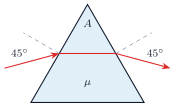
The figure shows a ray through an equilateral prism (\(A = 60^\circ\)). The ray enters and leaves at \(45^\circ\) to the normals.
Find the deviation \(\delta\).
Why must this be the minimum deviation for this prism?
Find \(\mu\).
Answer(i) \(30^\circ\) (ii) \(i = e\) (iii) \(\sqrt{2}\)
Solution
\(\delta = i + e - A = 45^\circ + 45^\circ - 60^\circ = 30^\circ\).
The ray passes symmetrically, \(i = e\). Deviation is least exactly when the path is symmetric, so this is \(\delta_{\min}\).
For a thin prism \(\delta = (\mu - 1)A\). Find the deviation produced by a prism of angle \(4^\circ\) and \(\mu = 1.5\).
Answer\(2^\circ\)
Solution
\(\delta = (1.5 - 1) \times 4^\circ = 2^\circ\).
How did it go?
Q57
Two thin prisms are placed in contact: \(A_1 = 6^\circ\) with \(\mu_1 = 1.5\), and \(A_2 = 4^\circ\) with \(\mu_2 = 1.6\). Find the net deviation when the prisms are
the same way round,
opposite ways round.
Answer(i) \(5.4^\circ\) (ii) \(0.6^\circ\)
Solution
\(\delta_1 = 0.5 \times 6^\circ = 3^\circ\), \(\delta_2 = 0.6 \times 4^\circ = 2.4^\circ\). Same way round, the deviations add: \(5.4^\circ\).
Opposite ways round, they subtract: \(3^\circ - 2.4^\circ = 0.6^\circ\), towards the base of the first prism.
How did it go?
Q58
Derive \(\delta = (\mu - 1)A\) for a thin prism. Start from \(\delta = i + e - A\), \(r_1 + r_2 = A\) and Snell's law with small angles.
For small angles \(\sin\theta \approx \theta\), so Snell's law gives \(i = \mu r_1\) and \(e = \mu r_2\).
\(\delta = i + e - A = \mu(r_1 + r_2) - A = \mu A - A = (\mu - 1)A\). The result does not depend on \(i\): a thin prism deviates every ray by the same small angle.
How did it go?
Q59
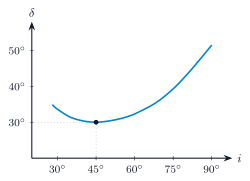
The figure shows the deviation \(\delta\) against the angle of incidence \(i\) for a prism.
Read \(\delta_{\min}\) and the angle of incidence at which it occurs.
Find the prism angle \(A\), using \(i = e\) at minimum deviation.
Find \(\mu\).
The graph ends at \(i = 90^\circ\). Why does it not start at \(i = 0\)?
Answer(i) \(30^\circ\) at \(45^\circ\) (ii) \(60^\circ\) (iii) \(\sqrt{2}\) (iv) at small \(i\), \(r_2 > C\): total internal reflection, no emergent ray
Solution
The lowest point of the curve is \(\delta_{\min} = 30^\circ\) at \(i = 45^\circ\).
At minimum deviation \(e = i = 45^\circ\), so \(A = i + e - \delta_{\min} = 90^\circ - 30^\circ = 60^\circ\).
At small \(i\), \(r_1\) is small and \(r_2 = A - r_1\) is large. Below about \(28^\circ\), \(r_2\) exceeds the critical angle (\(45^\circ\)) and the ray is totally reflected inside. No ray emerges, so there is no deviation to plot.
How did it go?
Dispersion
Q60
A glass has \(\mu_v = 1.52\) for violet, \(\mu_r = 1.48\) for red and \(\mu_y = 1.50\) for yellow. Find the dispersive power \(\omega = \frac{\mu_v - \mu_r}{\mu_y - 1}\).
\(\dfrac{0.2}{2.5} = 0.08 = \omega\). Dispersive power is angular dispersion per unit mean deviation.
How did it go?
Q62
A crown prism (\(\mu = 1.5\), \(\omega = 0.08\)) of angle \(6^\circ\) is combined with a flint prism (\(\mu = 1.6\), \(\omega = 0.1\)). The flint prism is the opposite way round, and the mean deviation of the pair is zero.
Find the angle of the flint prism.
Find the net angular dispersion. This is dispersion without deviation.
Answer(i) \(5^\circ\) (ii) \(0.06^\circ\)
Solution
Zero mean deviation: \((\mu_1 - 1)A_1 = (\mu_2 - 1)A_2\), so \(0.5 \times 6^\circ = 0.6 \times A_2\) and \(A_2 = 5^\circ\).
Each prism has mean deviation \(3^\circ\). Angular dispersion of each is \(\omega\delta\): crown \(0.08 \times 3^\circ = 0.24^\circ\), flint \(0.1 \times 3^\circ = 0.3^\circ\), in opposite senses. Net dispersion \(= 0.3^\circ - 0.24^\circ = 0.06^\circ\), with no mean deviation.
How did it go?
Q63
The same two glasses are used to make an achromatic pair (deviation without dispersion). The flint prism has angle \(4^\circ\).
Write the condition \(\omega_1\delta_1 = \omega_2\delta_2\) and find the angle of the crown prism.
Find the net deviation of the pair.
Answer(i) \(6^\circ\) (ii) \(0.6^\circ\)
Solution
\(\omega_1\delta_1 = \omega_2\delta_2\): \(0.08 \times 0.5A_1 = 0.1 \times 0.6 \times 4^\circ\), so \(0.04A_1 = 0.24^\circ\) and \(A_1 = 6^\circ\).
\(\delta_1 = 3^\circ\) and \(\delta_2 = 2.4^\circ\) in opposite senses. Net deviation \(= 0.6^\circ\), and the colours stay together.
How did it go?
Q64
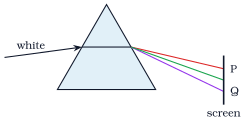
White light passes through a prism and spreads into a band on a screen, as in the figure.
Which colour reaches \(P\) and which reaches \(Q\)? Give the reason.
Which colour travels fastest inside the glass?
Why does a parallel-sided slab not produce such a band?
Answer(i) \(P\) red, \(Q\) violet; violet has the larger \(\mu\) (ii) red (iii) all colours leave a slab parallel and overlap again
Solution
\(P\) is red and \(Q\) is violet. Violet has the larger refractive index, so it is bent more at each face and deviates most, towards the base of the prism.
Red. \(v = \dfrac{c}{\mu}\) and red has the smallest \(\mu\).
In a slab every colour comes out parallel to the incident ray (only shifted sideways), so the colours overlap again and the beam stays white.
How did it go?
Q65
Cauchy's relation \(\mu = a + \frac{b}{\lambda^2}\) describes glass. Red light has \(\lambda = 700\) nm and violet has \(\lambda = 400\) nm. Which colour has the larger \(\mu\)? Which colour is deviated more by a prism?
Answerviolet; violet
Solution
\(\dfrac{b}{\lambda^2}\) is larger for the smaller wavelength, so violet has the larger \(\mu\). A larger \(\mu\) means a larger deviation, so violet is deviated more.
How did it go?
Q66
A material has \(\mu_r = \sqrt{2}\) and \(\mu_v = \sqrt{3}\) (an exaggeration, to keep the numbers simple). A \(60^\circ\) prism of this material is set at minimum deviation for each colour in turn.
Find \(\delta_{\min}\) for red and for violet.
Find the angular dispersion.
Answer(i) \(30^\circ\), \(60^\circ\) (ii) \(30^\circ\)
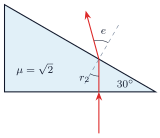
A ray enters a \(30^\circ\) prism (\(\mu = \sqrt{2}\)) normally through one face, as in the figure.
Write \(r_1\) and hence \(r_2\).
Find the angle of emergence \(e\) and the deviation.
Answer(i) \(0\), \(30^\circ\) (ii) \(45^\circ\); \(15^\circ\)
Solution
Normal incidence means \(i = 0\) and \(r_1 = 0\). Then \(r_2 = A - r_1 = 30^\circ\).
\(\sin e = \sqrt{2}\sin 30^\circ = \dfrac{1}{\sqrt{2}}\), so \(e = 45^\circ\). \(\delta = i + e - A = 0 + 45^\circ - 30^\circ = 15^\circ\).
How did it go?
Q68
The prism of Question 19 is replaced by one with \(A = 30^\circ\) and \(\mu = 2\), still at normal incidence. Find the critical angle. What happens at the second face?
Answer\(30^\circ\); grazing emergence
Solution
\(\sin C = \dfrac{1}{2}\), so \(C = 30^\circ\). At the second face \(r_2 = 30^\circ = C\), so the emergent ray grazes the face (\(e = 90^\circ\)). Any larger prism angle would give total internal reflection there.
How did it go?
Q69
A thin prism of angle \(8^\circ\) and \(\mu = 1.5\) gives a deviation of \(4^\circ\) in air. Find the deviation when the prism is under water (\(\mu_w = \frac{4}{3}\)).
Answer\(1^\circ\)
Solution
Under water the relative index is \(\dfrac{1.5}{4/3} = \dfrac{9}{8}\). \(\delta = \left(\dfrac{9}{8} - 1\right) \times 8^\circ = 1^\circ\). The prism deviates four times less because glass is only slightly denser than water.
How did it go?
Q70
Explain in two or three sentences why the deviation of a prism is least when the ray passes symmetrically (\(i = e\)). Use the fact that a ray path can be reversed.
Answerreversing the ray swaps \(i\) and \(e\) with the same \(\delta\); one minimum forces \(i = e\)
Solution
Suppose the deviation were least at some angle of incidence \(i_0\) with \(e_0 \ne i_0\). Reversing the ray gives a path with angle of incidence \(e_0\) and the same deviation. So the same minimum would occur at two different angles of incidence.
A smooth curve of \(\delta\) against \(i\) with one minimum cannot do this. So the minimum must be at the one path that is its own reverse: \(i = e\).
How did it go?
Q71
A ray falls at \(i = 45^\circ\) on a \(60^\circ\) prism of \(\mu = \sqrt{3}\). Take \(\sin^{-1}(0.41) \approx 24^\circ\) and \(\sin^{-1}\frac{1}{\sqrt{3}} \approx 35^\circ\).
Find \(r_1\) and \(r_2\).
Find the critical angle.
Does the ray emerge from the second face?
Answer(i) \(24^\circ\), \(36^\circ\) (ii) \(35^\circ\) (iii) no
\(\sin C = \dfrac{1}{\sqrt{3}}\), so \(C \approx 35^\circ\).
\(r_2 = 36^\circ > C\), so the ray is totally reflected at the second face and does not emerge. Compare Question 2: at \(i = 60^\circ\) the same prism let the ray through.
How did it go?
Q72
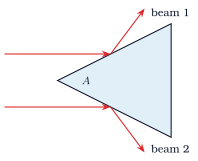
A parallel beam falls on the apex of a prism of angle \(A\) and is reflected from both faces, as in the figure. Show that the angle between the two reflected beams is \(2A\). This is how a spectrometer measures \(A\).
Answer\(\theta_1 + \theta_2 = A\); the beams turn by \(2\theta_1\) and \(2\theta_2\) on opposite sides
Solution
Each face acts as a plane mirror. The two faces are inclined at \(A\), so their normals are also inclined at \(A\). The incident direction lies between the two normals, making angles \(\theta_1\) and \(\theta_2\) with them, so \(\theta_1 + \theta_2 = A\).
A mirror turns a ray away from the normal by twice the angle of incidence. Beam 1 is turned by \(2\theta_1\) to one side of the incident direction, and beam 2 by \(2\theta_2\) to the other side. The angle between them is \(2\theta_1 + 2\theta_2 = 2A\).