Questions on Spherical Surfaces and Lenses, the kind your examinations ask. Solve one on paper. Then tell the book how it went. The book believes you, and it uses your answer to plan your revision.
0%
Nothing marked yetMark honestly. Peek at the answer only after your own attempt.
Refraction at Spherical Surfaces
24 questions · after Lesson 2, Spheres, Bubbles and Fish Bowls
The formula
Q1
Write the refraction formula for a single spherical surface and state the sign convention. Distances are measured from the pole, positive along the incident light. Which medium is \(\mu_1\)?
Answer\(\frac{\mu_2}{v} - \frac{\mu_1}{u} = \frac{\mu_2 - \mu_1}{R}\); medium of the incident light
Solution
\(\dfrac{\mu_2}{v} - \dfrac{\mu_1}{u} = \dfrac{\mu_2 - \mu_1}{R}\). \(u\), \(v\) and \(R\) are measured from the pole, positive in the direction of the incident light. \(\mu_1\) is the index of the medium the light comes from and \(\mu_2\) that of the medium it enters. \(R\) is the distance to the centre of curvature, with its sign.
How did it go?
Q2
Let \(R \to \infty\) in the formula. What does it reduce to? A coin lies \(12\) cm below the surface of water (\(\mu = \frac{4}{3}\)). Find its apparent depth.
Answer\(\frac{\mu_2}{v} = \frac{\mu_1}{u}\); \(9\) cm
Solution
With \(R \to \infty\) the right side is zero: \(\dfrac{\mu_2}{v} = \dfrac{\mu_1}{u}\), so \(v = \dfrac{\mu_2}{\mu_1}u\). Coin: \(\mu_1 = \dfrac{4}{3}\), \(\mu_2 = 1\), \(u = -12\): \(v = \dfrac{1}{4/3}(-12) = -9\) cm. It appears \(9\) cm deep.
How did it go?
Q3
A convex glass surface of radius \(10\) cm separates air from glass (\(\mu = 1.5\)). A point object in air is \(30\) cm from the pole. Find the image.
Answer\(90\) cm inside the glass, real
Solution
\(\mu_1 = 1\), \(\mu_2 = 1.5\), \(u = -30\) cm, \(R = +10\) cm. \(\dfrac{1.5}{v} + \dfrac{1}{30} = \dfrac{0.5}{10} = 0.05\), so \(\dfrac{1.5}{v} = 0.05 - 0.0333 = 0.0167\) and \(v = 90\) cm. A real image \(90\) cm inside the glass.
How did it go?
Q4
The object of Q3 is moved to \(10\) cm from the pole. Find the image and state its nature.
Answer\(30\) cm in front, virtual
Solution
\(\dfrac{1.5}{v} + \dfrac{1}{10} = 0.05\), so \(\dfrac{1.5}{v} = -0.05\) and \(v = -30\) cm. The image is virtual, \(30\) cm in front of the surface on the object's side.
How did it go?
Q5
For the surface of Q3 find the first focal length, the object position that gives an image at infinity. Find also the second focal length, the image position of a distant object. Why are they different?
Answer\(20\) cm; \(30\) cm; different media on the two sides
Solution
Image at infinity: \(-\dfrac{\mu_1}{u} = \dfrac{\mu_2 - \mu_1}{R}\), so \(f_1 = \dfrac{\mu_1R}{\mu_2 - \mu_1} = \dfrac{1 \times 10}{0.5} = 20\) cm. Object at infinity: \(f_2 = \dfrac{\mu_2R}{\mu_2 - \mu_1} = \dfrac{1.5 \times 10}{0.5} = 30\) cm. Light bends by the same amount, but it travels in different media on the two sides. So the two focal lengths are in the ratio \(\mu_1 : \mu_2\).
How did it go?
Q6
The lateral magnification for a spherical surface is \(m = \frac{\mu_1v}{\mu_2u}\). Find \(m\) for Q3 and describe the image.
Answer\(-2\); real, inverted, twice the size
Solution
\(m = \dfrac{\mu_1v}{\mu_2u} = \dfrac{1 \times 90}{1.5 \times (-30)} = -2\). The image is real, inverted and twice the size of the object.
How did it go?
Figures
Q7
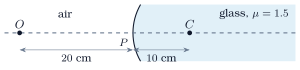
The object is \(20\) cm from the pole \(P\).
Find the image position.
Explain the result.
Answer(i) at infinity (ii) object at the first focus
Solution
\(\dfrac{1.5}{v} + \dfrac{1}{20} = 0.05\), so \(\dfrac{1.5}{v} = 0\): \(v = \infty\). The refracted rays are parallel.
\(20\) cm is the first focal length of this surface (Q5). An object at the first focus gives a parallel beam inside the glass.
How did it go?
Q8
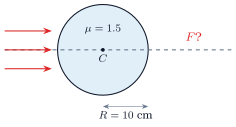
A parallel beam enters the glass sphere (\(\mu = 1.5\)).
Find the image formed by the first surface.
Treat that image as the object for the second surface and find the final image.
Answer(i) \(30\) cm from the first pole, inside (ii) \(5\) cm beyond the far surface
Solution
First surface, \(u = -\infty\), \(R = +10\): \(\dfrac{1.5}{v} = \dfrac{0.5}{10}\), so \(v = 30\) cm from the first pole, that is \(10\) cm beyond the far surface.
For the second surface this image is a virtual object at \(u = +10\) cm. Now \(\mu_1 = 1.5\), \(\mu_2 = 1\), \(R = -10\): \(\dfrac{1}{v} - \dfrac{1.5}{10} = \dfrac{-0.5}{-10} = 0.05\), so \(\dfrac{1}{v} = 0.2\) and \(v = 5\) cm. The beam focuses \(5\) cm beyond the sphere.
How did it go?
Q9
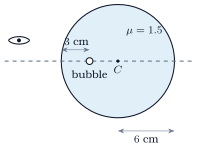
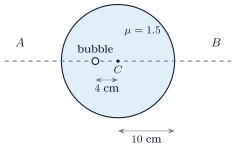
The bubble is viewed from the left along the diameter.
Write \(u\), \(R\), \(\mu_1\) and \(\mu_2\) with signs.
Find the apparent depth of the bubble.
Answer(i) \(u = -3\), \(R = -6\), \(\mu_1 = 1.5\), \(\mu_2 = 1\) (ii) \(2.4\) cm
Solution
Light goes from the bubble leftwards to the eye: \(\mu_1 = 1.5\), \(\mu_2 = 1\). \(u = -3\) cm. The centre \(C\) lies on the far side from the light's direction: \(R = -6\) cm.
\(\dfrac{1}{v} + \dfrac{1.5}{3} = \dfrac{1 - 1.5}{-6} = 0.083\), so \(\dfrac{1}{v} = 0.083 - 0.5 = -0.417\) and \(v = -2.4\) cm. The bubble appears \(2.4\) cm below the surface.
How did it go?
Q10
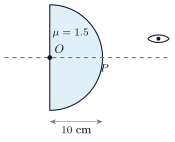
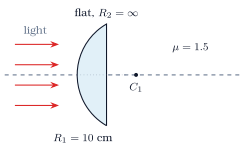
The object \(O\) sits at the centre of the flat face.
Where is its image?
Why is there no shift?
Answer(i) at \(O\) (ii) rays leave along radii, undeviated
Solution
\(u = -10\), \(R = -10\), \(\mu_1 = 1.5\), \(\mu_2 = 1\): \(\dfrac{1}{v} + \dfrac{1.5}{10} = \dfrac{-0.5}{-10} = 0.05\), so \(\dfrac{1}{v} = -0.1\) and \(v = -10\) cm: the image is at \(O\) itself.
\(O\) is the centre of curvature of the curved face. Every ray from \(O\) meets the surface along a radius, at normal incidence, and passes through undeviated.
How did it go?
More situations
Q11
A concave glass surface (\(\mu = 1.5\)) of radius \(20\) cm faces the air. A point object in air is \(20\) cm from the pole. Find the image and its magnification.
Answer\(20\) cm in front, virtual; \(m = \frac{2}{3}\)
Solution
\(\mu_1 = 1\), \(\mu_2 = 1.5\), \(u = -20\), \(R = -20\): \(\dfrac{1.5}{v} + \dfrac{1}{20} = \dfrac{0.5}{-20} = -0.025\), so \(\dfrac{1.5}{v} = -0.075\) and \(v = -20\) cm. Virtual image \(20\) cm in front. \(m = \dfrac{\mu_1v}{\mu_2u} = \dfrac{-20}{1.5 \times (-20)} = \dfrac{2}{3}\): upright and smaller.
How did it go?
Q12
A point object inside glass (\(\mu = 1.5\)) is \(15\) cm from a surface of radius \(10\) cm that bulges out into the air. Find the image seen from the air.
Answer\(20\) cm inside, virtual
Solution
Light goes from glass to air: \(\mu_1 = 1.5\), \(\mu_2 = 1\), \(u = -15\). The surface bulges towards the air, so its centre is inside the glass, on the incoming side: \(R = -10\). \(\dfrac{1}{v} + \dfrac{1.5}{15} = \dfrac{-0.5}{-10} = 0.05\), so \(\dfrac{1}{v} = -0.05\) and \(v = -20\) cm. A virtual image \(20\) cm inside the glass.
How did it go?
Q13
A point object is at the centre of a solid glass sphere. Where is its image as seen from outside? Give the reason.
Answerat the centre; rays meet the surface normally
Solution
At the centre. Every ray from the centre travels along a radius and strikes the surface at normal incidence, so it is not bent. The rays appear to come from the centre, exactly where the object is.
How did it go?
Q14
A long glass rod (\(\mu = 1.5\)) has a hemispherical end of radius \(5\) cm. A point object in air is \(20\) cm from the end. Find the image inside the rod.
Answer\(30\) cm inside
Solution
\(\mu_1 = 1\), \(\mu_2 = 1.5\), \(u = -20\), \(R = +5\): \(\dfrac{1.5}{v} + \dfrac{1}{20} = \dfrac{0.5}{5} = 0.1\), so \(\dfrac{1.5}{v} = 0.05\) and \(v = 30\) cm inside the rod.
How did it go?
Q15
A fish in a round bowl looks larger than it is. Explain with the spherical surface formula and the magnification.
Answervirtual image with \(m > 1\)
Solution
The fish is inside water behind a surface that is convex towards the viewer. For an object inside such a surface the image is virtual. Here \(m = \dfrac{\mu_1v}{\mu_2u}\) with \(\mu_1 > \mu_2\) and \(|v|\) close to \(|u|\), so \(m\) comes out larger than \(1\). The bowl acts as a weak magnifier.
How did it go?
Q16
A small fish is at the centre of a spherical bowl of water (\(\mu = \frac{4}{3}\)) of radius \(15\) cm. Ignore the glass. Find where it appears to be and how many times larger it looks.
Answerat the centre; \(\frac{4}{3}\) times
Solution
Rays from the centre leave along radii, so the fish appears at the centre: \(v = u = -15\) cm. \(m = \dfrac{\mu_1v}{\mu_2u} = \dfrac{(4/3)(-15)}{1 \times (-15)} = \dfrac{4}{3}\): it looks \(1.33\) times larger.
How did it go?
Q17
The bubble is \(4\) cm from the centre of the sphere (\(\mu = 1.5\)).
Find its apparent depth from \(A\).
Find its apparent depth from \(B\).
Answer(i) \(5\) cm (ii) \(17.5\) cm
Solution
From \(A\) the bubble is \(6\) cm inside: \(u = -6\), \(R = -10\). \(\dfrac{1}{v} + \dfrac{1.5}{6} = 0.05\), so \(\dfrac{1}{v} = -0.2\) and \(v = -5\) cm: apparent depth \(5\) cm.
From \(B\) it is \(14\) cm inside: \(\dfrac{1}{v} + \dfrac{1.5}{14} = 0.05\), so \(\dfrac{1}{v} = -0.057\) and \(v = -17.5\) cm: apparent depth \(17.5\) cm.
How did it go?
Q18
A bubble is at the centre of a glass sphere of radius \(10\) cm. Find where it appears from outside and its magnification.
Answerat the centre; \(1.5\)
Solution
\(u = -10\), \(R = -10\): \(\dfrac{1}{v} + 0.15 = 0.05\), so \(v = -10\) cm: it appears at the centre, where it is. \(m = \dfrac{1.5 \times (-10)}{1 \times (-10)} = 1.5\): it looks one and a half times its size.
How did it go?
Small situations
Q19
A fish is \(2\) m below the surface of a lake and a bird \(3\) m above it. Find the apparent depth of the fish for the bird and the apparent height of the bird for the fish. Take \(\mu = \frac{4}{3}\).
Answer\(1.5\) m; \(4\) m
Solution
Plane surface: \(v = \dfrac{\mu_2}{\mu_1}u\). Fish seen from air: \(\dfrac{1}{4/3} \times 2 = 1.5\) m deep. Bird seen from water: \(\dfrac{4/3}{1} \times 3 = 4\) m high.
How did it go?
Q20
Light travels left to right. State the sign of \(R\) for a surface that is convex towards the incoming light, and for one that is concave towards it.
Answerconvex: \(R > 0\); concave: \(R < 0\)
Solution
With light going left to right, a surface convex towards the incoming light has its centre of curvature to the right. That is the positive direction: \(R > 0\). A surface concave towards the incoming light has its centre on the left: \(R < 0\).
How did it go?
Q21
The power of a refracting surface is \(\frac{\mu_2 - \mu_1}{R}\) with \(R\) in metres. Find the power of a glass surface of radius \(0.1\) m in air.
Show that for a plane surface the formula gives apparent depth \(= \) real depth \(\times \frac{\mu_2}{\mu_1}\).
Answer\(v = \frac{\mu_2}{\mu_1}u\)
Solution
With \(R = \infty\): \(\dfrac{\mu_2}{v} = \dfrac{\mu_1}{u}\), so \(v = \dfrac{\mu_2}{\mu_1}u\). The image distance, the apparent depth, is the real depth \(|u|\) multiplied by \(\dfrac{\mu_2}{\mu_1}\), and it lies on the same side as the object.
How did it go?
Q23
State the two focal lengths of the surface of Q3 and say which object positions they correspond to.
Answer\(f_1 = 20\) cm: image at infinity; \(f_2 = 30\) cm: object at infinity
Solution
\(f_1 = 20\) cm: an object here gives an image at infinity. \(f_2 = 30\) cm: an object at infinity gives an image here, inside the glass.
How did it go?
Q24
Show that for any spherical refracting surface \(\frac{f_2}{f_1} = \frac{\mu_2}{\mu_1}\).
Set \(v = \infty\): \(f_1 = -u = \dfrac{\mu_1R}{\mu_2 - \mu_1}\). Set \(u = -\infty\): \(f_2 = v = \dfrac{\mu_2R}{\mu_2 - \mu_1}\). Dividing, \(\dfrac{f_2}{f_1} = \dfrac{\mu_2}{\mu_1}\): the focal length on each side is proportional to the refractive index on that side.
How did it go?
Lens Maker's Formula, Lenses in Media and Aberrations
24 questions · after Lesson 6, Finding f, and the Faults of Lenses
Lens maker's formula
Q25
Write the lens maker's formula and the sign rule for \(R_1\) and \(R_2\). Find \(f\) for an equiconvex lens of radii \(20\) cm made of glass with \(\mu = 1.5\).
Answer\(\frac{1}{f} = (\mu - 1)\left(\frac{1}{R_1} - \frac{1}{R_2}\right)\), radii signed along the light; \(20\) cm
Solution
\(\dfrac{1}{f} = (\mu - 1)\left(\dfrac{1}{R_1} - \dfrac{1}{R_2}\right)\). \(R_1\) is the radius of the first face met by the light and \(R_2\) that of the second. Each is positive if its centre lies on the far side of the lens along the light. Equiconvex: \(R_1 = +20\), \(R_2 = -20\): \(\dfrac{1}{f} = 0.5\left(\dfrac{1}{20} + \dfrac{1}{20}\right) = 0.05\), so \(f = 20\) cm.
How did it go?
Q26
The lens is plano-convex with \(\mu = 1.5\).
Find its focal length.
Does \(f\) change if the lens is turned round?
Answer(i) \(20\) cm (ii) no
Solution
\(R_1 = +10\) cm, \(R_2 = \infty\): \(\dfrac{1}{f} = 0.5 \times \dfrac{1}{10} = 0.05\), so \(f = 20\) cm.
No. Turned round, \(R_1 = \infty\) and \(R_2 = -10\): \(\dfrac{1}{f} = 0.5\left(0 + \dfrac{1}{10}\right)\), the same \(20\) cm. A thin lens has the same focal length from either side.
How did it go?
Q27
A biconcave lens has both radii \(15\) cm and \(\mu = 1.5\). Find its focal length.
A meniscus lens has \(R_1 = +10\) cm and \(R_2 = +20\) cm, with \(\mu = 1.5\). Find its focal length. Is it converging or diverging?
Answer\(40\) cm; converging
Solution
\(\dfrac{1}{f} = 0.5\left(\dfrac{1}{10} - \dfrac{1}{20}\right) = 0.5 \times 0.05 = 0.025\), so \(f = 40\) cm. Positive: converging, because the more strongly curved face is the convex one.
How did it go?
Q29
Derive the lens maker's formula by applying the spherical surface formula to the two faces of a thin lens in air.
First face, air to glass, object at \(u\): \(\dfrac{\mu}{v_1} - \dfrac{1}{u} = \dfrac{\mu - 1}{R_1}\). Second face, glass to air, with the first image as object (the lens is thin, so distances are unchanged): \(\dfrac{1}{v} - \dfrac{\mu}{v_1} = \dfrac{1 - \mu}{R_2}\). Adding: \(\dfrac{1}{v} - \dfrac{1}{u} = (\mu - 1)\left(\dfrac{1}{R_1} - \dfrac{1}{R_2}\right)\). With \(u = -\infty\), \(v = f\): the lens maker's formula.
How did it go?
Q30
An equiconvex lens of radii \(30\) cm has a focal length of \(30\) cm in air. Find the refractive index of its glass.
The lens of Q1 is immersed in water (\(\mu = \frac{4}{3}\)). Find its new focal length.
Answer\(80\) cm
Solution
In water the relative index is \(\dfrac{1.5}{4/3} = 1.125\). \(\dfrac{1}{f'} = 0.125 \times 0.1 = 0.0125\), so \(f' = 80\) cm: four times the air value.
How did it go?
Q32
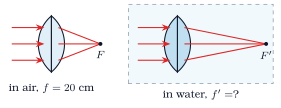
The same lens is shown in air and in water.
Why do the rays converge less in water?
Find \(f'\) for \(f = 20\) cm.
Answer(i) smaller relative index, less bending (ii) \(80\) cm
Solution
Refraction depends on the ratio of the indices of glass and its surroundings. In water that ratio is \(1.125\) instead of \(1.5\), so each face bends the light much less and the focus moves further away.
\(\dfrac{f'}{f} = \dfrac{\mu_g - 1}{\mu_g/\mu_m - 1} = \dfrac{0.5}{0.125} = 4\), so \(f' = 80\) cm.
How did it go?
Q33
The glass lens of Q1 is placed in a liquid of refractive index \(1.5\). What happens to its focal length? What would the lens look like?
Answer\(f \to \infty\); the lens disappears
Solution
The relative index is \(1\), so \(\mu_{\text{rel}} - 1 = 0\) and \(\dfrac{1}{f} = 0\): \(f \to \infty\). Light passes without bending, and since there is no refraction or reflection at its faces the lens becomes invisible in the liquid.
How did it go?
Q34
The lens of Q1 is placed in a liquid of refractive index \(1.6\). Find its focal length and state its nature.
Answer\(-160\) cm; diverging
Solution
\(\mu_{\text{rel}} = \dfrac{1.5}{1.6} = 0.9375\). \(\dfrac{1}{f} = (0.9375 - 1) \times 0.1 = -0.00625\), so \(f = -160\) cm. The convex lens now diverges light, because it is optically thinner than its surroundings.
How did it go?
Q35
An air bubble in water has the shape of an equiconvex lens with radii \(10\) cm. Does it converge or diverge light? Find its focal length.
Answerdiverges; \(-20\) cm
Solution
\(\mu_{\text{rel}} = \dfrac{1}{4/3} = 0.75\). \(\dfrac{1}{f} = (0.75 - 1)\left(\dfrac{1}{10} + \dfrac{1}{10}\right) = -0.05\), so \(f = -20\) cm. A convex bubble of air in water diverges light, the opposite of a glass lens in air.
How did it go?
Q36
Define the power of a lens and give its unit. Find the power of the lens of Q1 in air and in water.
Answer\(P = \frac{1}{f}\) in metres; dioptre; \(5\) D; \(1.25\) D
Solution
Power \(P = \dfrac{1}{f}\) with \(f\) in metres, measured in dioptres (D). In air: \(\dfrac{1}{0.2} = 5\) D. In water: \(\dfrac{1}{0.8} = 1.25\) D.
How did it go?
Q37
Show that a glass lens of focal length \(f\) in air has focal length \(f' = f\frac{\mu_g - 1}{\mu_g/\mu_m - 1}\) in a medium of index \(\mu_m\).
Answerratio of the \((\mu_{\text{rel}} - 1)\) factors
Solution
In air \(\dfrac{1}{f} = (\mu_g - 1)K\) where \(K = \dfrac{1}{R_1} - \dfrac{1}{R_2}\). In the medium \(\dfrac{1}{f'} = \left(\dfrac{\mu_g}{\mu_m} - 1\right)K\). Dividing, \(\dfrac{f'}{f} = \dfrac{\mu_g - 1}{\mu_g/\mu_m - 1}\), so \(f' = f\dfrac{\mu_g - 1}{\mu_g/\mu_m - 1}\).
How did it go?
Aberrations
Q38
What is spherical aberration? Why does it occur, and give two ways of reducing it.
Answermarginal and paraxial rays focus apart; a sphere is not the ideal focusing shape; stops, plano-convex with curved face to the parallel beam
Solution
Spherical aberration is the failure of a lens with spherical faces to bring all parallel rays to one focus. Rays through the edge focus nearer than rays near the axis, so a point object gives a blurred spot. It occurs because a sphere is not the ideal shape for focusing. It is reduced by a stop that admits only paraxial rays. It is also reduced by a plano-convex lens with its curved face towards the parallel beam, or by combining lenses so that their aberrations cancel.
How did it go?
Q39
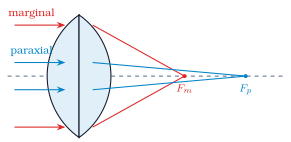
The figure shows marginal and paraxial rays through a convex lens.
Which rays focus nearer the lens? Why?
What does a stop in front of the lens do?
Answer(i) marginal; bent more at the edges (ii) removes the marginal rays
Solution
The marginal rays, at \(F_m\). They meet the faces at larger angles and are bent more than the thin-lens formula allows.
A stop blocks the marginal rays, leaving only the paraxial ones, so the image becomes sharper, at the cost of brightness.
How did it go?
Q40
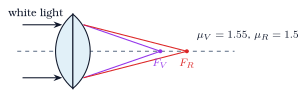
An equiconvex lens of radii \(20\) cm has \(\mu = 1.55\) for violet and \(1.5\) for red. Find the focal lengths for the two colours and the longitudinal chromatic aberration.
\(\omega = \dfrac{\mu_V - \mu_R}{\mu_Y - 1}\), the ratio of the spread of the index to its mean deviation. \(\omega = \dfrac{1.55 - 1.5}{1.525 - 1} = \dfrac{0.05}{0.525} \approx 0.095\).
How did it go?
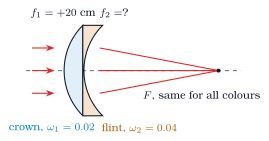
Q42
The doublet is to be achromatic: \(\frac{\omega_1}{f_1} + \frac{\omega_2}{f_2} = 0\).
Find \(f_2\).
Find the focal length of the combination.
Answer(i) \(-40\) cm (ii) \(40\) cm
Solution
\(\dfrac{0.02}{20} + \dfrac{0.04}{f_2} = 0\), so \(f_2 = -40\) cm: a diverging flint lens.
\(\dfrac{1}{F} = \dfrac{1}{20} - \dfrac{1}{40} = \dfrac{1}{40}\), so \(F = 40\) cm, converging and the same for all colours.
How did it go?
Q43
Why must the two lenses of an achromatic doublet be made of different glasses?
Answersame glass gives \(f_1 = -f_2\), zero power
Solution
The condition \(\dfrac{\omega_1}{f_1} = -\dfrac{\omega_2}{f_2}\) with \(\omega_1 = \omega_2\) would need \(f_2 = -f_1\), and then \(\dfrac{1}{F} = \dfrac{1}{f_1} + \dfrac{1}{f_2} = 0\): no lens at all. With a flint of higher dispersive power, a weaker concave lens cancels the colour spread while leaving net converging power.
How did it go?
Q44
For a single lens the longitudinal chromatic aberration is about \(\omega f\). Find it for \(f = 20\) cm and \(\omega = 0.02\).
Answer\(0.4\) cm
Solution
\(f_R - f_V \approx \omega f = 0.02 \times 20 = 0.4\) cm.
How did it go?
Small situations
Q45
White light passes through the lens.
Which colour focuses nearer the lens, and why?
What is seen on a screen at \(F_R\)?
Answer(i) violet; larger \(\mu\) (ii) red point with a violet-blue fringe
Solution
Violet. Its refractive index is larger, so it is bent more and \(f_V < f_R\).
At \(F_R\) the red light is a point but the violet has already crossed and spread out. One sees a red centre with a bluish-violet ring around it.
How did it go?
Q46
A glass lens (\(\mu = 1.5\)) has \(f = 20\) cm in air. Find its focal length in a liquid of refractive index \(1.25\).
Answer\(50\) cm
Solution
\(\dfrac{f'}{f} = \dfrac{\mu_g - 1}{\mu_g/\mu_m - 1} = \dfrac{0.5}{1.2 - 1} = 2.5\), so \(f' = 50\) cm.
How did it go?
Q47
A thin plano-convex glass lens (\(\mu = 1.5\)) has focal length \(30\) cm. Find the radius of its curved face.
Answer\(15\) cm
Solution
\(\dfrac{1}{30} = 0.5 \times \dfrac{1}{R}\), so \(R = 15\) cm.
How did it go?
Q48
Show that an equiconvex lens made of glass with \(\mu = 1.5\) has a focal length equal to its radius of curvature.
Silvered and Cut Lenses, Combinations and the Displacement Method
24 questions · after Lesson 6, Finding f, and the Faults of Lenses
Combinations
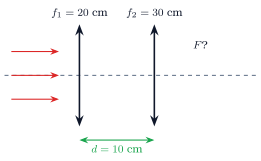
Q49
Write the focal length and the power of two thin lenses in contact. A convex lens of \(20\) cm and a concave lens of \(30\) cm are put together. Find the combined focal length and power.
Use \(\frac{1}{F} = \frac{1}{f_1} + \frac{1}{f_2} - \frac{d}{f_1f_2}\).
Find \(F\).
Find \(F\) if the lenses are put in contact.
Answer(i) \(15\) cm (ii) \(12\) cm
Solution
\(\dfrac{1}{F} = \dfrac{1}{20} + \dfrac{1}{30} - \dfrac{10}{600} = 0.05 + 0.0333 - 0.0167 = 0.0667\), so \(F = 15\) cm.
\(d = 0\): \(\dfrac{1}{F} = \dfrac{1}{20} + \dfrac{1}{30} = \dfrac{1}{12}\), \(F = 12\) cm. Separating the lenses weakens the combination.
How did it go?
Q51
Write the power of the combination of Q2 in dioptres using \(P = P_1 + P_2 - dP_1P_2\), and check it against \(F\).
Answer\(6.67\) D; \(F = 15\) cm
Solution
\(P_1 = 5\) D, \(P_2 = 3.33\) D, \(d = 0.1\) m: \(P = 5 + 3.33 - 0.1 \times 16.67 = 6.67\) D. \(F = \dfrac{1}{6.67} = 0.15\) m \(= 15\) cm, as in Q2.
How did it go?
Q52
A convex lens of \(20\) cm and a concave lens of \(20\) cm are placed in contact. What does the pair do to light? Find its power.
Answerlike a plane glass plate; \(0\)
Solution
\(P = \dfrac{1}{0.2} - \dfrac{1}{0.2} = 0\): the pair has no focusing power. Light passes through as through a flat slab of glass, with \(F = \infty\).
How did it go?
Q53
An object is placed \(30\) cm from the contact pair of Q1. Find the image.
Answer\(60\) cm on the object side, virtual
Solution
\(\dfrac{1}{v} - \dfrac{1}{u} = \dfrac{1}{F}\) with \(u = -30\), \(F = 60\): \(\dfrac{1}{v} = \dfrac{1}{60} - \dfrac{1}{30} = -\dfrac{1}{60}\), so \(v = -60\) cm: a virtual, upright image on the object's side, twice the size.
How did it go?
Q54
Two thin lenses in contact have a combined focal length of \(12\) cm. One of them has \(f = 20\) cm. Find the other.
Answer\(30\) cm
Solution
\(\dfrac{1}{12} = \dfrac{1}{20} + \dfrac{1}{f_2}\), so \(\dfrac{1}{f_2} = \dfrac{5 - 3}{60} = \dfrac{1}{30}\) and \(f_2 = 30\) cm.
How did it go?
Cut lenses
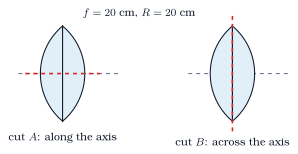
Q55
The equiconvex lens has \(f = 20\) cm.
Find the focal length of each piece after cut \(A\).
Find the focal length of each piece after cut \(B\).
Answer(i) \(20\) cm (ii) \(40\) cm
Solution
Each half still has both curved faces with the same radii, so the lens maker's formula gives the same \(f = 20\) cm. Only the aperture is halved.
Each piece is plano-convex with one face of radius \(20\) cm: \(\dfrac{1}{f} = 0.5 \times \dfrac{1}{20}\), so \(f = 40\) cm, double the original.
How did it go?
Q56
Why does cut \(B\) change the focal length while cut \(A\) does not?
Answer\(B\) removes one curved face; \(A\) keeps both
Solution
The focal length depends only on the curvatures of the two faces. Cut \(A\) leaves each piece with both original faces, so nothing in the formula changes. Cut \(B\) replaces one curved face by a flat one, removing half the bending power.
How did it go?
Q57
The two pieces from cut \(B\) are placed in contact again with their curved faces outward. Find the focal length. What if their flat faces are outward?
Answer\(20\) cm; \(20\) cm
Solution
Two lenses of \(40\) cm in contact: \(\dfrac{1}{F} = \dfrac{1}{40} + \dfrac{1}{40}\), \(F = 20\) cm, the original lens. With the flat faces outward the two curved faces meet in the middle. For thin lenses in contact only the two powers add, so the result is again \(20\) cm.
How did it go?
Q58
The two halves from cut \(A\) are separated a little along the cut. How many images of a point object does the pair form? Why?
Answertwo; two optical axes
Solution
Two images. Each half is a complete lens with its own optical centre and principal axis, and the two axes are now slightly displaced. A single point object gives one image from each half (Billet's split lens).
How did it go?
Q59
After cut \(A\), what happens to the brightness of the image formed by one half? Explain.
Answerhalves; half the aperture
Solution
The image is only half as bright. Half of the lens area is gone, so half the light from the object is gathered. The image is still complete, because every part of a lens forms the whole image.
How did it go?
Silvered lenses
Q60
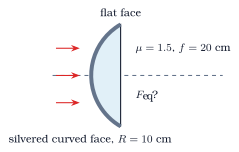
Write the equivalent power of a silvered lens. A plano-convex lens of \(f = 20\) cm is silvered on its flat face. Find its equivalent focal length and state what it behaves as.
\(P_{\text{eq}} = 2P_L + P_M\). A silvered flat face is a plane mirror with \(P_M = 0\): \(P_{\text{eq}} = \dfrac{2}{20} = \dfrac{1}{10}\) per cm, so \(F_{\text{eq}} = 10\) cm. The system behaves as a concave mirror of focal length \(10\) cm.
How did it go?
Q61
The curved face is silvered.
Find \(P_L\) and \(P_M\).
Find \(F_{\text{eq}}\).
Answer(i) \(\frac{1}{20}\) cm\(^{-1}\); \(\frac{1}{5}\) cm\(^{-1}\) (ii) \(\frac{10}{3} \approx 3.3\) cm
Solution
\(P_L = \dfrac{1}{f} = \dfrac{1}{20}\) cm\(^{-1}\). The silvered curved face is a concave mirror of radius \(10\) cm, focal length \(5\) cm: \(P_M = \dfrac{1}{5}\) cm\(^{-1}\).
\(P_{\text{eq}} = \dfrac{2}{20} + \dfrac{1}{5} = \dfrac{3}{10}\) cm\(^{-1}\), so \(F_{\text{eq}} = \dfrac{10}{3} \approx 3.3\) cm, a concave mirror.
How did it go?
Q62
An equiconvex lens of \(f = 20\) cm and radii \(20\) cm is silvered on one face. Find its equivalent focal length.
Answer\(5\) cm
Solution
\(P_L = \dfrac{1}{20}\); the silvered face has radius \(20\) cm, so \(P_M = \dfrac{2}{20} = \dfrac{1}{10}\). \(P_{\text{eq}} = \dfrac{2}{20} + \dfrac{1}{10} = \dfrac{1}{5}\) cm\(^{-1}\), so \(F_{\text{eq}} = 5\) cm.
How did it go?
Q63
A plano-concave lens of \(f = -20\) cm is silvered on its flat face. Find the equivalent focal length and the kind of mirror it behaves as.
Answer\(-10\) cm; convex mirror
Solution
\(P_L = -\dfrac{1}{20}\), \(P_M = 0\): \(P_{\text{eq}} = -\dfrac{2}{20} = -\dfrac{1}{10}\) cm\(^{-1}\), so \(F_{\text{eq}} = -10\) cm. It behaves as a convex mirror of focal length \(10\) cm.
How did it go?
Q64
An object is placed \(15\) cm in front of the silvered lens of Q12. Find the image, treating the system as a mirror.
Answer\(30\) cm in front, real, inverted
Solution
Concave mirror, \(f = -10\) cm in the mirror convention, \(u = -15\): \(\dfrac{1}{v} = \dfrac{1}{f} - \dfrac{1}{u} = -\dfrac{1}{10} + \dfrac{1}{15} = -\dfrac{1}{30}\), so \(v = -30\) cm. A real, inverted image \(30\) cm in front, twice the size.
How did it go?
Q65
Explain why the lens counts twice in \(P_{\text{eq}} = 2P_L + P_M\).
Answerlight passes through it before and after reflection
Solution
The light is refracted by the lens on its way in and reflected by the silvered surface. It is then refracted by the lens again on its way out. Each passage through the lens adds its power \(P_L\), and the mirror adds \(P_M\), so the total is \(2P_L + P_M\).
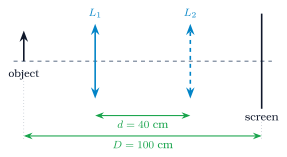
\(u + v = 100\) and \(v - u = 40\): \(u = 30\) cm at \(L_1\), and by symmetry \(u = 70\) cm at \(L_2\).
How did it go?
Q67
In another displacement experiment the two images are \(4\) cm and \(1\) cm tall. Find the size of the object and the two magnifications.
Answer\(2\) cm; \(2\) and \(\frac{1}{2}\)
Solution
\(O = \sqrt{I_1I_2} = \sqrt{4 \times 1} = 2\) cm. \(m_1 = \dfrac{4}{2} = 2\) and \(m_2 = \dfrac{1}{2}\). Their product is \(1\), as it must be for the two conjugate positions.
How did it go?
Q68
What is the least distance between object and screen for which a real image can be formed with the lens of Q18? Explain.
Answer\(84\) cm; \(D \ge 4f\)
Solution
\(D \ge 4f\), so \(D_{\min} = 84\) cm. With \(u + v = D\) and \(\dfrac{1}{u} + \dfrac{1}{v} = \dfrac{1}{f}\), the sum \(u + v\) is least when \(u = v = 2f\), giving \(D = 4f\). For smaller \(D\) no real image can fall on the screen and \(d^2 = D^2 - 4fD\) would be negative.
How did it go?
Q69
Derive \(f = \frac{D^2 - d^2}{4D}\) for the displacement method.
Answer\(u + v = D\), \(v - u = d\)
Solution
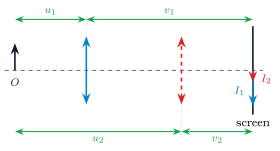
For a real image, \(u + v = D\) (magnitudes). The two lens positions are \(d\) apart, so \(v - u = d\) at the first position: \(u = \dfrac{D - d}{2}\), \(v = \dfrac{D + d}{2}\). Then \(\dfrac{1}{f} = \dfrac{1}{u} + \dfrac{1}{v} = \dfrac{2}{D - d} + \dfrac{2}{D + d} = \dfrac{4D}{D^2 - d^2}\), so \(f = \dfrac{D^2 - d^2}{4D}\).
How did it go?
Q70
For \(D = 100\) cm and \(d = 40\) cm:
Write \(u_1\), \(v_1\), \(u_2\), \(v_2\).
Why are the two positions conjugate?
Answer(i) \(30\), \(70\), \(70\), \(30\) cm (ii) \(u\) and \(v\) swap
Solution
\(u_1 = 30\) cm, \(v_1 = 70\) cm; \(u_2 = 70\) cm, \(v_2 = 30\) cm.
The lens formula is symmetric in \(u\) and \(v\). If an object at \(30\) cm images at \(70\) cm, an object at \(70\) cm images at \(30\) cm. The second position simply swaps the roles of the two distances.
How did it go?
Q71
Give one advantage of the displacement method over measuring \(u\) and \(v\) directly.
Answerno need to locate the optical centre
Solution
Only the displacement \(d\) of the lens and the fixed distance \(D\) need be measured. Neither requires knowing where the optical centre of the lens lies, which is hard to locate for a thick lens in a mount.
How did it go?
Q72
Show that in the displacement method the object size is \(O = \sqrt{I_1I_2}\).
Answer\(m_1m_2 = 1\)
Solution
At the first position \(m_1 = \dfrac{I_1}{O} = \dfrac{v}{u}\) and at the second \(m_2 = \dfrac{I_2}{O} = \dfrac{u}{v}\). Multiplying, \(\dfrac{I_1I_2}{O^2} = 1\), so \(O = \sqrt{I_1I_2}\).