Questions on Optical Instruments and the Eye, the kind your examinations ask. Solve one on paper. Then tell the book how it went. The book believes you, and it uses your answer to plan your revision.
0%
Nothing marked yetMark honestly. Peek at the answer only after your own attempt.
Microscopes, Telescopes and Defects of Vision
24 questions · after Lesson 5, Telescopes
Simple microscope
Q1
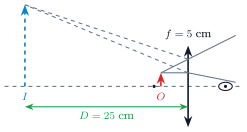
Define the magnifying power of a microscope. Why is it defined with angles rather than sizes? Take \(D = 25\) cm throughout.
Answer\(M = \frac{\beta}{\alpha}\), angle with instrument to angle at \(D\) without it; apparent size depends on the angle
Solution
\(M = \dfrac{\beta}{\alpha}\). Here \(\beta\) is the angle the final image subtends at the eye. \(\alpha\) is the angle the object subtends when placed at the least distance of distinct vision \(D\). The size of the image on the retina depends on the angle the object subtends, not on its actual size. That angle decides how large a thing looks.
How did it go?
Q2
A simple microscope has \(f = 5\) cm. Find its magnifying power when the image is at \(D\) and when it is at infinity.
Only an object inside the focal length gives a virtual, erect and enlarged image on the same side, which the eye can view directly.
How did it go?
Q4
Why does a shorter focal length give a larger magnifying power? Why can the magnification of a simple microscope not be made very large?
Answer\(M = 1 + \frac{D}{f}\); aberrations grow with strong curvature
Solution
\(M = 1 + \dfrac{D}{f}\) grows as \(f\) shrinks. But a very short \(f\) needs strongly curved faces of small radius, which brings large spherical and chromatic aberration and a tiny lens. In practice a single lens is limited to about \(10\) times.
How did it go?
Q5
A watchmaker's eyepiece has \(f = 2.5\) cm. Find its magnifying power for the image at \(D\) and for the relaxed eye.
Eyepiece with image at \(D\): \(M_e = 1 + \dfrac{25}{5} = 6\). Total \(M = m_oM_e = -60\).
For the eyepiece, \(v_e = -25\): \(\dfrac{1}{u_e} = -\dfrac{1}{25} - \dfrac{1}{5}\), so \(u_e = -\dfrac{25}{6} \approx -4.2\) cm. \(L = v_o + |u_e| = 11 + 4.2 \approx 15.2\) cm.
How did it go?
Q7
Why is the objective of a compound microscope given a very short focal length, and the eyepiece a moderate one?
Answerlarge \(m_o = \frac{v_o}{u_o}\) needs small \(u_o \approx f_o\); eyepiece must give a comfortable virtual image
Solution
The objective's magnification \(\dfrac{v_o}{u_o}\) is large only when the object is placed just outside a very short focal length, which also keeps the tube short. The eyepiece works as a simple microscope; a moderate focal length gives a comfortable, aberration-free virtual image for the eye.
How did it go?
Q8
The objective of a microscope magnifies \(20\) times and the eyepiece acts as a simple microscope of power \(6\). Find the total magnification.
Answer\(-120\)
Solution
\(M = m_o \times M_e = (-20) \times 6 = -120\); the minus sign records the inversion.
How did it go?
Q9
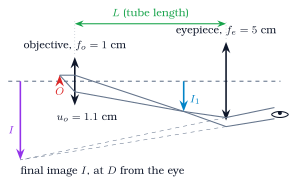
A microscope has \(f_o = 1\) cm and \(f_e = 4\) cm, with the lenses \(15\) cm apart and the final image at infinity. Find the object distance and the magnifying power.
Answer\(1.1\) cm; \(-62.5\)
Solution
Final image at infinity, so \(I_1\) is at the focus of the eyepiece: \(v_o = 15 - 4 = 11\) cm. \(\dfrac{1}{u_o} = \dfrac{1}{11} - \dfrac{1}{1} = -\dfrac{10}{11}\), so \(u_o = -1.1\) cm. \(m_o = \dfrac{11}{-1.1} = -10\); \(M_e = \dfrac{25}{4} = 6.25\); \(M = -62.5\).
How did it go?
Q10
In a compound microscope, why is the intermediate image real while the final image is virtual?
The object lies just outside the objective's focus, so the objective forms a real, inverted, enlarged image inside the tube. That image falls inside the focal length of the eyepiece. The eyepiece therefore acts as a magnifying glass and gives a virtual final image for the eye to view.
How did it go?
Q11
For the microscope of Q6, find the magnifying power when the final image is at infinity, and the new tube length.
Answer\(-50\); \(16\) cm
Solution
\(M_e = \dfrac{D}{f_e} = 5\), so \(M = -10 \times 5 = -50\). \(I_1\) now sits at the eyepiece focus: \(L = v_o + f_e = 11 + 5 = 16\) cm.
How did it go?
Telescopes
Q12
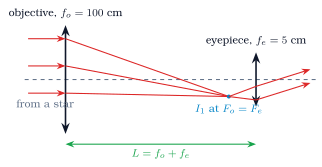
Write the magnifying power and the length of an astronomical telescope in normal adjustment. Find both for \(f_o = 100\) cm and \(f_e = 5\) cm.
Normal adjustment: \(M = \dfrac{f_o}{f_e} = \dfrac{100}{5} = 20\) and \(L = f_o + f_e = 105\) cm.
How did it go?
Q13
The telescope is in normal adjustment.
Why do the foci of the two lenses coincide?
Why is the objective made with a large aperture?
Answer(i) \(I_1\) at \(F_o\) must be at \(F_e\) for parallel emergent rays (ii) more light, better resolution
Solution
Parallel rays from a distant star form \(I_1\) at the objective's focus. For the eyepiece to send out parallel rays, which the relaxed eye focuses, \(I_1\) must lie at the eyepiece's focus too. So \(F_o\) and \(F_e\) coincide.
A large objective gathers more light, so faint objects become visible, and its larger aperture gives finer resolution of detail.
How did it go?
Q14
The telescope of Q12 is adjusted so that the final image is at \(D\). Find the magnifying power and the length now.
Answer\(24\); \(\approx 104.2\) cm
Solution
\(M = \dfrac{f_o}{f_e}\left(1 + \dfrac{f_e}{D}\right) = 20 \times 1.2 = 24\). Eyepiece: \(v_e = -25\), so \(\dfrac{1}{u_e} = -\dfrac{1}{25} - \dfrac{1}{5}\) and \(u_e = -\dfrac{25}{6} \approx -4.2\) cm. \(L = 100 + 4.2 \approx 104.2\) cm.
How did it go?
Q15
A terrestrial telescope uses an erecting lens of \(f = 5\) cm between the objective and eyepiece of Q12. Find its length in normal adjustment. Why is the erecting lens needed?
Answer\(125\) cm; to make the image erect
Solution
The erecting lens is placed so that \(I_1\) is at \(2f\) on one side and its erect image at \(2f\) on the other. This adds \(4f = 20\) cm: \(L = 105 + 20 = 125\) cm. Without it the astronomical telescope shows everything upside down, which is harmless for stars but useless on land.
How did it go?
Q16
Give three advantages of a reflecting telescope over a refracting one.
A mirror focuses all colours alike, so there is no chromatic aberration. A large mirror can be supported over its whole back. A large lens sags under its own weight and must be held by its rim. A parabolic mirror is free of spherical aberration, and light does not pass through glass, so absorption is avoided.
How did it go?
Q17
The Moon subtends \(0.5^\circ\) at the eye. What angle does its image subtend through the telescope of Q12? Is the image erect or inverted?
Answer\(10^\circ\); inverted
Solution
The telescope multiplies the angle by \(M = 20\): \(0.5^\circ \times 20 = 10^\circ\). An astronomical telescope gives an inverted image.
How did it go?
Q18
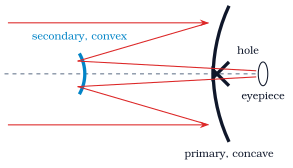
Trace the path of light in the Cassegrain telescope and name the parts.
Light from the star enters and strikes the large concave primary mirror, which reflects it towards its focus. Before reaching the focus it meets the small convex secondary mirror. That mirror sends it back through a hole in the centre of the primary to the eyepiece behind. The folded path makes the instrument short.
How did it go?
Defects of vision
Q19
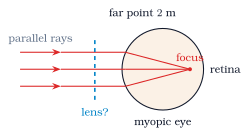
The far point of the eye is \(2\) m.
Where do parallel rays focus, and why can the eye not see distant objects clearly?
Find the focal length and power of the correcting lens.
Answer(i) in front of the retina; eye lens too strong (ii) \(-2\) m; \(-0.5\) D
Solution
They focus in front of the retina: the eye's lens is too strong, or the eyeball too long. Only objects nearer than \(2\) m form sharp images on the retina.
The lens must make distant objects appear at the far point: a virtual image at \(2\) m for an object at infinity. So \(f = -2\) m, a concave lens of power \(P = \dfrac{1}{-2} = -0.5\) D.
How did it go?
Q20
A person cannot see clearly nearer than \(50\) cm. Find the focal length and power of the lens that lets them read at \(25\) cm. Name the defect.
Answer\(+50\) cm; \(+2\) D; hypermetropia
Solution
Hypermetropia (long sight). The lens must form a virtual image at the near point, \(50\) cm, of an object at \(25\) cm. \(\dfrac{1}{f} = \dfrac{1}{-50} - \dfrac{1}{-25} = \dfrac{1}{50}\), so \(f = +50\) cm, a convex lens of \(+2\) D.
How did it go?
Q21
What is presbyopia? Why does it develop with age, and how is it corrected?
Answerloss of accommodation; stiffening lens, weak ciliary muscles; bifocals
Solution
Presbyopia is the loss of the eye's power of accommodation with age: the near point recedes, and often distant vision weakens too. The eye lens stiffens and the ciliary muscles weaken, so the lens can no longer bulge enough. It is corrected with bifocal spectacles: a convex part for reading and, if needed, another part for distance.
How did it go?
Q22
What is astigmatism? What kind of lens corrects it?
Answercornea curved unequally in different planes; cylindrical lens
Solution
In astigmatism the cornea (or lens) is curved differently in different planes. Lines in one direction focus sharply while lines at right angles are blurred. A cylindrical lens, which has power in one plane only, is used to make the total curvature the same in all planes.
How did it go?
Q23
A myopic person has far point \(50\) cm and near point \(12\) cm. Find the power of the lens for distant vision. With this lens, what is the nearest distance of clear vision?
Answer\(-2\) D; \(\approx 15.8\) cm
Solution
Distant vision: \(f = -50\) cm, \(P = \dfrac{1}{-0.5} = -2\) D. With this lens, the nearest object is one whose virtual image falls at the near point \(12\) cm: \(\dfrac{1}{u} = \dfrac{1}{-12} - \dfrac{1}{-50} = -\dfrac{38}{600}\), so \(u \approx -15.8\) cm. Reading is slightly harder with the lens on.
How did it go?
Q24
A hypermetropic eye has its near point at \(N\) (in cm). Show that a lens of focal length \(f = \frac{25N}{N - 25}\) brings the near point to \(25\) cm.
The lens must image an object at \(25\) cm as a virtual image at the near point \(N\): \(u = -25\), \(v = -N\). \(\dfrac{1}{f} = \dfrac{1}{v} - \dfrac{1}{u} = -\dfrac{1}{N} + \dfrac{1}{25} = \dfrac{N - 25}{25N}\), so \(f = \dfrac{25N}{N - 25}\), positive for \(N > 25\): a convex lens.