Questions on Interference and Young's Double Slit, the kind your examinations ask. Solve one on paper. Then tell the book how it went. The book believes you, and it uses your answer to plan your revision.
0%
Nothing marked yetMark honestly. Peek at the answer only after your own attempt.
Huygens' Principle, Superposition and Interference Conditions
24 questions · after Lesson 3, Coherent Sources and the Intensity of Two Waves
Huygens' principle
Q1
State Huygens' principle. How is the new wavefront found from the old one?
Answerevery point on a wavefront is a source of secondary wavelets; new wavefront = forward envelope
Solution
Every point on a wavefront acts as a fresh source of secondary wavelets. These spread out in all directions with the speed of the wave in that medium. The new wavefront at a later time is the surface that touches all these wavelets on their forward side, their common envelope.
How did it go?
Q2
Give the shape of the wavefront in each case. (i) A point source. (ii) A long straight line source. (iii) A very distant source such as a star.
Answer(i) spherical (ii) cylindrical (iii) plane
Solution
(i) Spheres centred on the source. (ii) Cylinders with the line as axis. (iii) Planes: a small part of a sphere of enormous radius is flat.
How did it go?
Q3
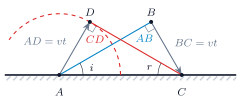
\(AB\) is the incident wavefront and \(CD\) the reflected one.
Why is \(AD = BC\)?
Show that the angle of reflection equals the angle of incidence.
Answer(i) both \(= vt\) (ii) triangles \(ABC\) and \(ADC\) congruent
Solution
In the time \(t\) that the wave takes to travel from \(B\) to \(C\), the wavelet from \(A\) spreads a distance \(vt\). So \(AD = BC = vt\).
Triangles \(ABC\) and \(ADC\) have the common side \(AC\), \(AD = BC\), and right angles at \(B\) and \(D\). They are congruent, so \(\angle BAC = \angle DCA\). These angles equal the angles of incidence and reflection, so \(i = r\).
How did it go?
Q4
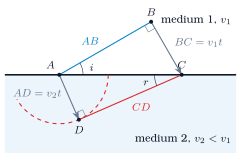
The wavefront \(AB\) enters the slower medium.
Write \(\sin i\) and \(\sin r\) in terms of \(BC\), \(AD\) and \(AC\).
Hence obtain Snell's law and the meaning of \(\mu\) as a ratio of speeds.
Answer(i) \(\sin i = \frac{BC}{AC}\), \(\sin r = \frac{AD}{AC}\) (ii) \(\frac{\sin i}{\sin r} = \frac{v_1}{v_2} = \mu\)
Solution
In triangle \(ABC\), \(\sin i = \dfrac{BC}{AC} = \dfrac{v_1t}{AC}\). In triangle \(ADC\), \(\sin r = \dfrac{AD}{AC} = \dfrac{v_2t}{AC}\).
Dividing, \(\dfrac{\sin i}{\sin r} = \dfrac{v_1}{v_2}\), a constant for the pair of media. This is Snell's law, and it identifies the refractive index as \(\mu = \dfrac{v_1}{v_2}\), the ratio of the wave speeds.
How did it go?
Q5
A plane wavefront passes through a convex lens. What is the shape of the emerging wavefront? Explain in terms of the speed of light in glass.
Answerspherical, converging to the focus; light is slower through the thick centre
Solution
The emerging wavefront is spherical and converges on the focus. Light travels more slowly in glass, and the centre of the lens is thickest, so the middle of the wavefront is delayed most. The edges get ahead and the plane wavefront bends into a sphere curving in towards the axis.
How did it go?
Q6
Light of wavelength \(600\) nm in air enters glass of \(\mu = 1.5\). Find its speed, wavelength and frequency in the glass. Take \(c = 3 \times 10^{8}\) m/s.
\(v = \dfrac{c}{\mu} = 2 \times 10^{8}\) m/s. \(\lambda' = \dfrac{\lambda}{\mu} = 400\) nm. The frequency is fixed by the source: \(f = \dfrac{c}{\lambda} = \dfrac{3 \times 10^{8}}{6 \times 10^{-7}} = 5 \times 10^{14}\) Hz, the same in both media.
How did it go?
Coherence, phase and path
Q7
What are coherent sources? Why do two separate bulbs not produce interference fringes?
Answersame frequency, constant phase difference; independent bulbs change phase at random
Solution
Coherent sources have the same frequency and a phase difference that stays constant in time. In a bulb, atoms emit short wave trains independently, so the phase changes at random about \(10^{8}\) times a second. The interference pattern from two bulbs shifts just as fast and only a uniform average is seen.
How did it go?
Q8
Write the relation between phase difference and path difference. Find the phase difference for a path difference of \(150\) nm with light of \(600\) nm.
Two waves from coherent sources arrive at a point with a path difference of (i) \(\frac{\lambda}{2}\), (ii) \(\lambda\), (iii) \(\frac{3\lambda}{2}\). State the phase difference and the kind of interference in each case.
Answer(i) \(\pi\), destructive (ii) \(2\pi\), constructive (iii) \(3\pi\), destructive
Solution
(i) \(\Delta\phi = \pi\): crest meets trough, destructive. (ii) \(\Delta\phi = 2\pi\): in step, constructive. (iii) \(\Delta\phi = 3\pi\): destructive again. Odd multiples of \(\dfrac{\lambda}{2}\) give darkness, whole wavelengths give brightness.
How did it go?
Q10
Two waves \(y_1 = a\sin\omega t\) and \(y_2 = a\sin(\omega t + \phi)\) superpose. Find the resultant amplitude, and evaluate it and the intensity for \(\phi = 60^\circ\) in terms of the single-wave intensity \(I_0\).
\(y = a\sin\omega t + a\sin(\omega t + \phi) = 2a\cos\dfrac{\phi}{2}\sin\left(\omega t + \dfrac{\phi}{2}\right)\), amplitude \(A = 2a\cos\dfrac{\phi}{2}\). For \(\phi = 60^\circ\): \(A = 2a\cos 30^\circ = \sqrt3a\), and \(I \propto A^2 = 3a^2\), so \(I = 3I_0\).
How did it go?
Q11
Define optical path. A glass slab (\(\mu = 1.5\)) of thickness \(1\) mm is placed in the path of a beam. Find the optical path through it and the extra path introduced, in wavelengths of \(600\) nm light.
Answer\(\mu t\); \(1.5\) mm; \(0.5\) mm \(\approx 833\lambda\)
Solution
Optical path is the distance light would travel in vacuum in the same time: \(\mu t\). Through the slab: \(1.5 \times 1 = 1.5\) mm. Extra path \((\mu - 1)t = 0.5\) mm \(= 5 \times 10^{-4}\) m, which is \(\dfrac{5 \times 10^{-4}}{6 \times 10^{-7}} \approx 833\) wavelengths.
How did it go?
Q12
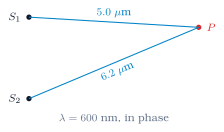
The sources oscillate in phase with \(\lambda = 600\) nm.
A whole number of wavelengths: the waves arrive in phase and \(P\) is bright.
How did it go?
Resultant intensity
Q13
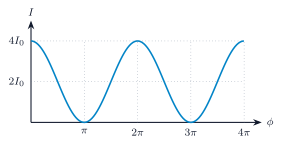
Write the resultant intensity of two coherent waves of intensities \(I_1\) and \(I_2\) with phase difference \(\phi\). For \(I_1 = I_2 = I_0\), find \(I\) at \(\phi = 0\), \(\frac{\pi}{2}\) and \(\pi\).
Interference makes some points four times brighter and others dark. Show that energy is still conserved on average.
Answer\(\langle I\rangle = I_1 + I_2\)
Solution
\(I = I_1 + I_2 + 2\sqrt{I_1I_2}\cos\phi\). Over the pattern \(\phi\) takes all values equally and \(\cos\phi\) averages to zero, so \(\langle I\rangle = I_1 + I_2\), exactly the sum of the two separate intensities. Interference only redistributes the energy from the dark places to the bright ones.
How did it go?
Q19
Two coherent sources have intensities \(4I_0\) and \(I_0\). Find \(I_{\max}\) and \(I_{\min}\) of the pattern.
Answer\(9I_0\); \(I_0\)
Solution
\(I_{\max} = \left(\sqrt{4I_0} + \sqrt{I_0}\right)^2 = (2 + 1)^2I_0 = 9I_0\). \(I_{\min} = (2 - 1)^2I_0 = I_0\). The dark fringes are not fully dark because the amplitudes are unequal.
How did it go?
Doppler effect for light
Q20
Write the Doppler shift for light for \(v \ll c\). A galaxy recedes at \(3 \times 10^{6}\) m/s. Find the observed wavelength of its \(500\) nm line.
\(\dfrac{\Delta\lambda}{\lambda} = \dfrac{v}{c} = \dfrac{3 \times 10^{6}}{3 \times 10^{8}} = 0.01\). \(\Delta\lambda = 5\) nm, towards longer wavelengths for a receding source: the line is seen at \(505\) nm, a red shift.
How did it go?
Q21
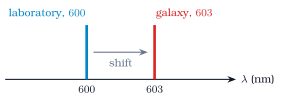
The laboratory line at \(600\) nm is seen at \(603\) nm.
Is the galaxy approaching or receding?
Find its speed.
Answer(i) receding (ii) \(1.5 \times 10^{6}\) m/s
Solution
The wavelength is longer, a red shift, so the galaxy is receding.
A star approaches the Earth at \(6 \times 10^{5}\) m/s. Find the shift of its \(500\) nm line and name the kind of shift.
Answer\(-1\) nm; blue shift
Solution
\(\Delta\lambda = \lambda\dfrac{v}{c} = 500 \times \dfrac{6 \times 10^{5}}{3 \times 10^{8}} = 1\) nm. The source approaches, so the wavelength shortens to \(499\) nm: a blue shift of \(1\) nm.
How did it go?
Q23
Why is \(\frac{\Delta\lambda}{\lambda} = \frac{v}{c}\) used only for speeds much smaller than \(c\)?
Answerrelativistic effects and second-order terms ignored
Solution
The exact formula involves relativistic time dilation and terms in \(\dfrac{v^2}{c^2}\). For \(v \ll c\) these are negligible and the simple first-order result \(\dfrac{\Delta\lambda}{\lambda} = \dfrac{v}{c}\) holds. For speeds comparable with \(c\) it would be badly wrong.
How did it go?
Q24
Two waves of amplitudes \(a_1\) and \(a_2\) interfere. Show that \(\frac{I_{\max}}{I_{\min}} = \left(\frac{a_1 + a_2}{a_1 - a_2}\right)^2\).
Answer\(I \propto (a_1 \pm a_2)^2\)
Solution
Intensity is proportional to the square of the resultant amplitude. In phase the amplitudes add, \(A_{\max} = a_1 + a_2\); in antiphase they subtract, \(A_{\min} = a_1 - a_2\). So \(\dfrac{I_{\max}}{I_{\min}} = \dfrac{(a_1 + a_2)^2}{(a_1 - a_2)^2}\).
How did it go?
YDSE: Fringe Width and Positions of Fringes
24 questions · after Lesson 5, Reading the Fringe Pattern
Q25
Describe Young's double slit experiment in two or three sentences. What is seen on the screen?
Answertwo coherent slits lit by one slit; equally spaced bright and dark fringes on the screen
Solution
Light from a narrow slit \(S\) falls on two close, parallel slits \(S_1\) and \(S_2\). The two slits act as coherent sources and their light overlaps on a distant screen. The screen shows alternate bright and dark bands, called fringes, parallel to the slits and equally spaced.
How did it go?
Q26
Why is a single slit \(S\) placed before the two slits \(S_1\) and \(S_2\)? What would happen if \(S_1\) and \(S_2\) were lit by two separate lamps?
Answerto make \(S_1\), \(S_2\) coherent; separate lamps give no steady fringes
Solution
Both \(S_1\) and \(S_2\) receive light from the same wavefront from \(S\). So any random change of phase in the source appears at both slits together. The phase difference between them stays constant: they are coherent. Two separate lamps change phase independently and at random. The fringes then shift millions of times a second and the screen looks uniformly lit.
How did it go?
Q27
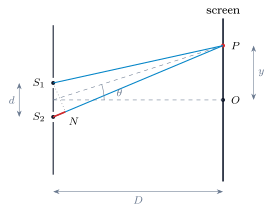
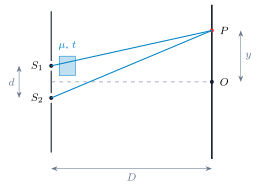
The figure shows the two slits, \(d\) apart, and a screen at distance \(D\). The point \(P\) is at height \(y\) above the centre \(O\).
Write the path difference \(S_2P - S_1P\) in terms of \(d\) and \(\theta\).
Show that for small \(\theta\) the path difference is \(\frac{yd}{D}\).
Answer(i) \(d\sin\theta\) (ii) \(\sin\theta \approx \tan\theta = \frac{y}{D}\)
Solution
Drop the perpendicular \(S_1N\) on \(S_2P\). For a distant screen \(S_1P \approx NP\), so the path difference is \(S_2N = d\sin\theta\).
For small \(\theta\), \(\sin\theta \approx \tan\theta = \dfrac{y}{D}\). So \(\Delta x = d\sin\theta = \dfrac{yd}{D}\).
How did it go?
Q28
Write the condition on the path difference for a bright fringe and for a dark fringe at \(P\). Use \(n = 1, 2, 3, \ldots\) and the wavelength \(\lambda\).
Answerbright: \(\Delta x = n\lambda\); dark: \(\Delta x = (2n - 1)\frac{\lambda}{2}\)
Solution
Bright: the waves arrive in phase, \(\Delta x = n\lambda\) with \(n = 0, 1, 2, \ldots\). Dark: they arrive in antiphase, \(\Delta x = (2n - 1)\dfrac{\lambda}{2}\) with \(n = 1, 2, 3, \ldots\).
How did it go?
Q29
Why is the fringe at the centre \(O\) always bright? What is its order?
Answer\(S_1O = S_2O\), path difference zero; zero order
Solution
\(O\) is equidistant from the two slits, so the path difference there is zero for every wavelength. The waves arrive in phase and the fringe is bright. It is the zero-order fringe, \(n = 0\).
How did it go?
Q30
In a double slit experiment \(\lambda = 600\) nm, \(d = 1\) mm and \(D = 1\) m. Find the fringe width \(\beta\).
Answer\(0.6\) mm
Solution
\(\beta = \dfrac{\lambda D}{d} = \dfrac{600 \times 10^{-9} \times 1}{10^{-3}} = 6 \times 10^{-4}\) m \(= 0.6\) mm.
How did it go?
Q31
Start from the set-up of Q6. Find the new fringe width when
\(d\) is doubled,
\(D\) is doubled instead.
Answer(i) \(0.3\) mm (ii) \(1.2\) mm
Solution
\(\beta \propto \dfrac{1}{d}\), so doubling \(d\) halves \(\beta\): \(0.3\) mm.
\(\beta \propto D\), so doubling \(D\) doubles \(\beta\): \(1.2\) mm.
How did it go?
Q32
The fringe width is \(0.6\) mm with light of \(600\) nm. The lamp is replaced by one of \(450\) nm. Find the new fringe width. Do the fringes come closer or move apart?
Answer\(0.45\) mm; closer
Solution
\(\beta \propto \lambda\) for the same \(d\) and \(D\). \(\beta' = 0.6 \times \dfrac{450}{600} = 0.45\) mm. A shorter wavelength gives narrower fringes, so they come closer.
How did it go?
Q33
Define the angular fringe width. Find it for \(\lambda = 600\) nm and \(d = 1\) mm. Does it change when the screen is moved farther away?
Answer\(\frac{\beta}{D} = \frac{\lambda}{d}\); \(6 \times 10^{-4}\) rad; no
Solution
The angular fringe width is the angle that one fringe subtends at the slits, \(\theta_0 = \dfrac{\beta}{D} = \dfrac{\lambda}{d}\). Here \(\theta_0 = \dfrac{600 \times 10^{-9}}{10^{-3}} = 6 \times 10^{-4}\) rad. It does not contain \(D\), so moving the screen leaves it unchanged.
How did it go?
Q34
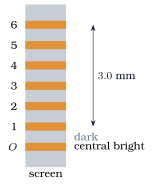
The figure shows part of the pattern on the screen. The first and the sixth bright fringes are \(3.0\) mm apart.
Find the fringe width.
Find the distance of the fourth dark fringe from \(O\).
Answer(i) \(0.6\) mm (ii) \(2.1\) mm
Solution
From the first to the sixth bright fringe there are \(5\) fringe widths. \(\beta = \dfrac{3.0}{5} = 0.6\) mm.
The \(n\)th dark fringe is at \((2n - 1)\dfrac{\beta}{2}\). For \(n = 4\): \(\dfrac{7}{2} \times 0.6 = 2.1\) mm.
How did it go?
Q35
With \(d = 1.5\) mm and \(D = 1\) m the fringe width is measured to be \(0.4\) mm. Find the wavelength of the light.
The fringe width is \(0.6\) mm. Take the third bright fringe and the second dark fringe. Find the distance between them when they lie
on the same side of \(O\),
on opposite sides of \(O\).
Answer(i) \(0.9\) mm (ii) \(2.7\) mm
Solution
Third bright at \(3\beta = 1.8\) mm; second dark at \(\dfrac{3}{2}\beta = 0.9\) mm. Same side: \(1.8 - 0.9 = 0.9\) mm.
Opposite sides: \(1.8 + 0.9 = 2.7\) mm.
How did it go?
Q38
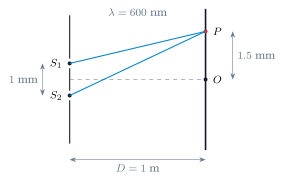
In the figure \(d = 1\) mm, \(D = 1\) m and \(\lambda = 600\) nm. The point \(P\) is \(1.5\) mm above \(O\).
Find the path difference at \(P\).
Express it in wavelengths. Is \(P\) bright or dark, and which fringe is it?
Answer(i) \(1.5\) μm (ii) \(2.5\lambda\); dark, third dark fringe
Solution
\(\Delta x = \dfrac{yd}{D} = \dfrac{1.5 \times 10^{-3} \times 10^{-3}}{1} = 1.5 \times 10^{-6}\) m \(= 1.5\) μm.
\(\dfrac{\Delta x}{\lambda} = \dfrac{1.5}{0.6} = 2.5\), so \(\Delta x = \dfrac{5\lambda}{2} = (2 \times 3 - 1)\dfrac{\lambda}{2}\). \(P\) is dark; it lies on the third dark fringe.
How did it go?
Q39
A double slit is lit by two wavelengths, \(600\) nm and \(400\) nm, together. Take \(d = 1\) mm and \(D = 1\) m. Find the least distance from \(O\) where a bright fringe of one colour falls on one of the other.
Answer\(1.2\) mm
Solution
The fringe widths are \(0.6\) mm and \(0.4\) mm. Bright fringes coincide where \(0.6\,n_1 = 0.4\,n_2\), that is \(3n_1 = 2n_2\). The smallest solution is \(n_1 = 2\), \(n_2 = 3\). Both give \(y = 1.2\) mm.
How did it go?
Q40
Light of \(480\) nm and \(600\) nm falls on the same double slit. The \(n\)th bright fringe of \(600\) nm coincides with the \((n + 1)\)th bright fringe of \(480\) nm. Find \(n\).
Answer\(n = 4\)
Solution
\(y_n(600) = y_{n+1}(480)\) gives \(600n = 480(n + 1)\), so \(120n = 480\) and \(n = 4\). The fourth bright fringe of \(600\) nm falls on the fifth of \(480\) nm.
How did it go?
Q41
The fringe width is \(0.6\) mm. How many bright fringes lie within \(6\) mm on either side of the centre, counting the central fringe?
Answer\(21\)
Solution
Bright fringes are at \(y = 0, \pm\beta, \pm 2\beta, \ldots\). Within \(6\) mm on one side there are \(\dfrac{6}{0.6} = 10\) fringes beyond the centre. Total: \(10 + 10 + 1 = 21\).
How did it go?
Q42
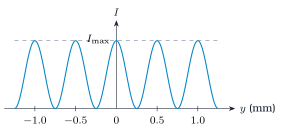
Write the intensity at a point on the screen as a function of its distance \(y\) from the centre. Take \(I_{\max}\) as the intensity at the centre and \(\beta\) as the fringe width.
Answer\(I = I_{\max}\cos^2\frac{\pi y}{\beta}\)
Solution
\(I = I_{\max}\cos^2\dfrac{\phi}{2}\) with \(\phi = \dfrac{2\pi}{\lambda}\dfrac{yd}{D} = \dfrac{2\pi y}{\beta}\). So \(I = I_{\max}\cos^2\dfrac{\pi y}{\beta}\). It is \(I_{\max}\) at \(y = 0, \pm\beta, \ldots\) and zero midway between.
How did it go?
Q43
The fringe width is \(0.6\) mm. Find the intensity, as a fraction of \(I_{\max}\), at a point
\(0.15\) mm from the centre,
\(0.2\) mm from the centre.
Answer(i) \(\frac{1}{2}I_{\max}\) (ii) \(\frac{1}{4}I_{\max}\)
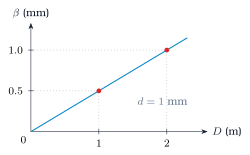
\(\beta = \dfrac{\lambda}{d}D\), so the slope is \(\dfrac{\lambda}{d}\). \(\lambda = 5 \times 10^{-4} \times 10^{-3} = 5 \times 10^{-7}\) m \(= 500\) nm.
How did it go?
Q48
The fringes near the centre are equally spaced. Explain why this is only approximately true far from the centre, and say how the spacing changes there.
The exact condition for the \(n\)th bright fringe is \(d\sin\theta = n\lambda\) and its position is \(y = D\tan\theta\). Near the centre \(\sin\theta \approx \tan\theta\), so \(y \propto n\) and the fringes are equally spaced. Far from the centre \(\tan\theta\) grows faster than \(\sin\theta\). Equal steps in \(\sin\theta\) then give increasing steps in \(y\), so the fringes become wider.
How did it go?
YDSE with a Slab, Modifications and White Light
24 questions · after Lesson 6, A Slab in One Beam, and White Light
Q49
Define the optical path of light through a medium. Find the optical path through a glass slab of thickness \(2\) mm and refractive index \(1.5\).
Answer\(\mu x\), the air distance covered in the same time; \(3\) mm
Solution
The optical path is the distance light would cover in air (or vacuum) in the time it takes to cross the medium. For a geometric path \(x\) in a medium of index \(\mu\) the optical path is \(\mu x\). Here it is \(1.5 \times 2 = 3\) mm.
How did it go?
Q50
Light of wavelength \(600\) nm in air enters the slab of Q1.
Number of waves \(= \dfrac{t}{\lambda_g} = \dfrac{2 \times 10^{-3}}{400 \times 10^{-9}} = 5000\). The same length of air holds only \(3333\) waves.
How did it go?
Q51
Two rays start in phase. One crosses \(2\) mm of glass (\(\mu = 1.5\)) and the other crosses \(2\) mm of air. Find the path difference between them after the slab.
Answer\((\mu - 1)t = 1\) mm
Solution
Optical paths: glass \(\mu t = 3\) mm, air \(t = 2\) mm. Path difference \(= \mu t - t = (\mu - 1)t = 1\) mm.
How did it go?
Q52
Find the time light takes to cross the slab of Q1. Take \(c = 3 \times 10^{8}\) m/s.
Answer\(10^{-11}\) s
Solution
Speed in glass \(v = \dfrac{c}{\mu} = 2 \times 10^{8}\) m/s. Time \(= \dfrac{t}{v} = \dfrac{2 \times 10^{-3}}{2 \times 10^{8}} = 10^{-11}\) s. This equals the optical path divided by \(c\).
How did it go?
Q53
A slab is placed in the path of one of two interfering beams. Which of the speed, wavelength and frequency of the light change inside the slab? Write the extra phase the slab adds.
Answerspeed and wavelength fall; frequency same; \(\frac{2\pi}{\lambda}(\mu - 1)t\)
Solution
The frequency is fixed by the source and cannot change at a boundary. The speed falls to \(\dfrac{c}{\mu}\) and the wavelength to \(\dfrac{\lambda}{\mu}\). The beam through the slab gains an extra optical path \((\mu - 1)t\), that is an extra phase \(\dfrac{2\pi}{\lambda}(\mu - 1)t\).
How did it go?
Q54
A slab of thickness \(t\) and refractive index \(\mu\) is placed in front of \(S_1\). The point \(P\) is at height \(y\) above \(O\).
Write the path difference at \(P\), counting the slab.
Show that the central fringe moves to \(y_0 = \frac{D(\mu - 1)t}{d}\).
Answer(i) \(\frac{yd}{D} - (\mu - 1)t\) (ii) put \(\Delta x = 0\)
Solution
The geometric path difference is \(S_2P - S_1P = \dfrac{yd}{D}\). The slab adds \((\mu - 1)t\) to the path from \(S_1\). Net path difference \(\Delta x = \dfrac{yd}{D} - (\mu - 1)t\).
The central fringe is where \(\Delta x = 0\): \(\dfrac{y_0 d}{D} = (\mu - 1)t\), so \(y_0 = \dfrac{D(\mu - 1)t}{d}\). It moves towards \(S_1\), the slab side.
How did it go?
Q55
Take \(t = 6\) μm, \(\mu = 1.5\), \(d = 1\) mm, \(D = 1\) m and \(\lambda = 600\) nm. Find the shift of the pattern in mm and in fringe widths.
Answer\(3\) mm; \(5\) fringe widths
Solution
Shift \(= \dfrac{D(\mu - 1)t}{d} = \dfrac{1 \times 0.5 \times 6 \times 10^{-6}}{10^{-3}} = 3 \times 10^{-3}\) m \(= 3\) mm. The fringe width is \(\beta = \dfrac{\lambda D}{d} = 0.6\) mm, so the shift is \(\dfrac{3}{0.6} = 5\) fringe widths. Equivalently \(\dfrac{(\mu - 1)t}{\lambda} = \dfrac{3 \times 10^{-6}}{600 \times 10^{-9}} = 5\).
How did it go?
Q56
In Q7, towards which slit does the pattern move? Does the fringe width change? Give a reason for each answer.
Answertowards \(S_1\); no, \(\beta = \frac{\lambda D}{d}\) has no \(t\)
Solution
The slab lengthens the optical path from \(S_1\). To restore zero path difference the point must move closer to \(S_1\), so the whole pattern shifts towards \(S_1\). The fringe width \(\beta = \dfrac{\lambda D}{d}\) does not contain \(t\) or \(\mu\), so it stays the same.
How did it go?
Q57
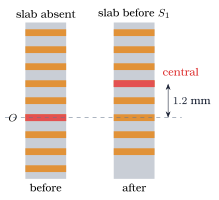
The figure shows the pattern before and after a slab of \(\mu = 1.6\) is placed before \(S_1\). The central fringe moves by \(1.2\) mm. Take \(d = 1\) mm and \(D = 1\) m. Find the thickness of the slab.
With \(\lambda = 600\) nm, what thickness of a slab of \(\mu = 1.5\) before \(S_1\) brings the central fringe to the old position of the fourth bright fringe?
Answer\(4.8\) μm
Solution
The fourth bright fringe is \(4\beta\) from the centre. The shift is \(4\beta\) when \((\mu - 1)t = 4\lambda\). \(t = \dfrac{4 \times 600 \times 10^{-9}}{0.5} = 4.8 \times 10^{-6}\) m \(= 4.8\) μm.
How did it go?
Q59
A slab of \(\mu = 1.5\) and \(t = 1.8\) μm is placed before \(S_1\). The light has \(\lambda = 600\) nm. Is the point \(O\) now bright or dark? Which fringe of the new pattern lies at \(O\)?
Answerdark; second dark fringe
Solution
At \(O\) the geometric paths are equal, so the path difference is just the slab's contribution, \((\mu - 1)t = 0.5 \times 1.8 = 0.9\) μm \(= 1.5\lambda\). An odd multiple of \(\dfrac{\lambda}{2}\) gives a dark point. \(1.5\lambda = (2 \times 2 - 1)\dfrac{\lambda}{2}\), so \(O\) lies on the second dark fringe of the shifted pattern.
How did it go?
Q60
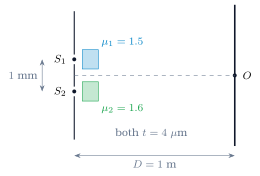
Slabs of equal thickness \(4\) μm are placed before both slits, \(\mu_1 = 1.5\) before \(S_1\) and \(\mu_2 = 1.6\) before \(S_2\).
Find the net path difference the slabs introduce.
Find the shift of the central fringe and its direction.
Answer(i) \(0.4\) μm, more on the \(S_2\) side (ii) \(0.4\) mm towards \(S_2\)
Solution
Extra optical paths: \(S_1\) side \((\mu_1 - 1)t = 2\) μm; \(S_2\) side \((\mu_2 - 1)t = 2.4\) μm. Net extra path \(= 0.4\) μm on the \(S_2\) side.
Shift \(= \dfrac{D \times 0.4 \times 10^{-6}}{10^{-3}} = 0.4 \times 10^{-3}\) m \(= 0.4\) mm. The thicker optical path is on the \(S_2\) side, so the pattern moves towards \(S_2\).
How did it go?
Q61
The whole apparatus is immersed in water, \(\mu = \frac{4}{3}\). How do the wavelength and the fringe width change? The fringe width in air was \(0.6\) mm; find it in water.
Answerboth divided by \(\mu\); \(0.45\) mm
Solution
In water the wavelength becomes \(\lambda' = \dfrac{\lambda}{\mu}\), so the fringe width becomes \(\beta' = \dfrac{\lambda' D}{d} = \dfrac{\beta}{\mu}\). \(\beta' = \dfrac{0.6}{4/3} = 0.45\) mm. The fringes come closer; the pattern does not shift.
How did it go?
Q62
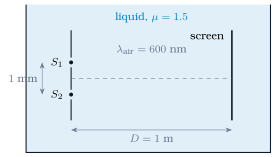
The apparatus in the figure is inside a liquid of \(\mu = 1.5\). The light has \(\lambda = 600\) nm in air.
Find the fringe width.
Find the angular fringe width.
Answer(i) \(0.4\) mm (ii) \(4 \times 10^{-4}\) rad
The apparatus of Q13 is in water. A glass slab of \(\mu = 1.5\) and \(t = 6\) μm is placed before \(S_1\). Take \(d = 1\) mm and \(D = 1\) m. Find the shift of the central fringe. Compare it with the shift in air.
Answer\(0.75\) mm; one quarter of the \(3\) mm in air
Solution
In water the slab replaces \(t\) of water by \(t\) of glass. The extra optical path is \((\mu_g - \mu_w)t = \mu_w\left(\dfrac{\mu_g}{\mu_w} - 1\right)t\). Measured in the water wavelength, the shift is \(\dfrac{D}{d}\left(\dfrac{\mu_g}{\mu_w} - 1\right)t = \dfrac{1}{10^{-3}}(1.125 - 1) \times 6 \times 10^{-6} = 0.75\) mm. In air the same slab shifted the pattern by \(3\) mm, so the shift is one quarter of that.
How did it go?
Q65
The sodium lamp is replaced by white light. Why is the central fringe white while the fringes on either side are coloured?
Answer\(\Delta x = 0\) at \(O\) for every \(\lambda\); elsewhere \(\beta \propto \lambda\)
Solution
At \(O\) the two paths are equal, so every wavelength has zero path difference and every colour is bright there. Together they make white. Away from \(O\) the fringe width \(\beta = \dfrac{\lambda D}{d}\) is different for each colour. The bright fringes of the colours no longer fall together and the fringes appear coloured.
How did it go?
Q66
In the first coloured fringe on either side of the white centre, which colour is nearer the centre, red or violet? Give the reason.
Violet has the shortest wavelength, so its first bright fringe is at the smallest distance \(\beta = \dfrac{\lambda D}{d}\) from the centre. Violet lies on the inner edge and red on the outer edge of each coloured fringe.
How did it go?
Q67
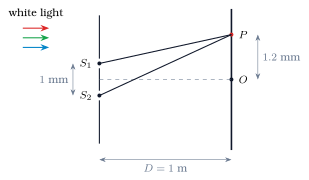
White light falls on the slits. The point \(P\) is \(1.2\) mm above \(O\), with \(d = 1\) mm and \(D = 1\) m.
Find the path difference at \(P\).
Which visible wavelengths (\(400\) to \(700\) nm) are bright at \(P\)?
Answer(i) \(1.2\) μm (ii) \(600\) nm, \(400\) nm
Solution
\(\Delta x = \dfrac{yd}{D} = \dfrac{1.2 \times 10^{-3} \times 10^{-3}}{1} = 1.2 \times 10^{-6}\) m \(= 1.2\) μm.
Bright when \(\Delta x = n\lambda\), so \(\lambda = \dfrac{1.2}{n}\) μm \(= 1200, 600, 400, 300, \ldots\) nm. In the visible range: \(600\) nm (\(n = 2\)) and \(400\) nm (\(n = 3\)).
How did it go?
Q68
In the set-up of Q19, find the visible wavelengths that are missing (dark) at a point where the path difference is \(1.05\) μm.
Answer\(700\) nm, \(420\) nm
Solution
Dark when \(\Delta x = (2n - 1)\dfrac{\lambda}{2}\), so \(\lambda = \dfrac{2 \times 1.05}{2n - 1}\) μm \(= 2100, 700, 420, 300, \ldots\) nm. The visible wavelengths missing at that point are \(700\) nm (\(n = 2\)) and \(420\) nm (\(n = 3\)).
How did it go?
Q69
A slab of \(\mu = 1.5\) and \(t = 6\) μm is placed before \(S_1\) with white light on the slits. Take \(d = 1\) mm and \(D = 1\) m. Where does the white fringe now lie?
Answer\(3\) mm towards \(S_1\)
Solution
The white fringe is the fringe of zero path difference. It moves to \(y_0 = \dfrac{D(\mu - 1)t}{d} = \dfrac{1 \times 0.5 \times 6 \times 10^{-6}}{10^{-3}} = 3\) mm, on the \(S_1\) side of \(O\). The coloured fringes move with it.
How did it go?
Q70
Why is the shift produced by a thin slab easier to measure with white light than with monochromatic light?
Answerwhite fringe is unique; monochromatic fringes all alike
Solution
With monochromatic light all bright fringes look the same. When the pattern shifts by several fringe widths the eye cannot tell the new central fringe from any other. With white light only the central fringe is white, so its new position is seen at once and the shift can be measured directly.
How did it go?
Q71
A filter placed over \(S_2\) reduces the intensity of light from that slit to one quarter of its earlier value. Find the ratio \(\frac{I_{\max}}{I_{\min}}\) in the new pattern.
Answer\(9 : 1\)
Solution
Intensity is proportional to amplitude squared. If the amplitude from \(S_1\) is \(a\), that from \(S_2\) becomes \(\dfrac{a}{2}\). \(\dfrac{I_{\max}}{I_{\min}} = \dfrac{(a + a/2)^2}{(a - a/2)^2} = \dfrac{(3/2)^2}{(1/2)^2} = 9\). The dark fringes are no longer fully dark.
How did it go?
Q72
The slit \(S_2\) is closed completely. What happens to the fringes? The intensity at \(O\) was \(4I_0\) before; what is it now?
Answerfringes vanish, uniform light; \(I_0\)
Solution
With one slit there is no second wave to interfere with, so the fringes disappear. The screen is lit almost uniformly; only the broad single-slit diffraction pattern remains. Each slit alone gives \(I_0\) at \(O\); with both slits in phase the amplitude doubled and gave \(4I_0\). Now the intensity at \(O\) is \(I_0\), one quarter of before.