Questions on Diffraction and Polarisation, the kind your examinations ask. Solve one on paper. Then tell the book how it went. The book believes you, and it uses your answer to plan your revision.
0%
Nothing marked yetMark honestly. Peek at the answer only after your own attempt.
Diffraction and Resolving Power
24 questions · after Lesson 3, Resolving Power
Q1
What is diffraction of light? Why is it not noticed with an open window but is clearly seen with a slit \(0.1\) mm wide?
Answerbending of light round an edge; noticeable only when the opening is comparable with \(\lambda\)
Solution
Diffraction is the bending of light round the edge of an obstacle or opening into the region of the geometric shadow. The bending angle is about \(\dfrac{\lambda}{a}\). For a window a metre wide this is about \(10^{-6}\) rad, far too small to see. For a slit \(0.1\) mm wide it is about \(5 \times 10^{-3}\) rad, which gives a pattern millimetres wide on a screen a metre away.
How did it go?
Q2
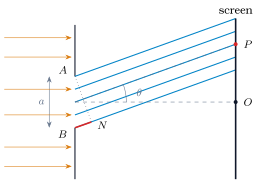
Parallel light falls on a slit \(AB\) of width \(a\). Rays leaving at angle \(\theta\) meet at \(P\).
Write the path difference \(BN\) between the rays from the two edges.
Explain why \(P\) is dark when \(a\sin\theta = \lambda\). Use the idea of pairing points in the two halves of the slit.
Answer(i) \(a\sin\theta\) (ii) each point pairs with one \(\frac{a}{2}\) away, path difference \(\frac{\lambda}{2}\), all pairs cancel
Solution
Drop the perpendicular \(AN\) on the ray from \(B\). The ray from \(B\) travels the extra distance \(BN = a\sin\theta\).
Let \(a\sin\theta = \lambda\). Divide the slit into two halves. A point in the upper half and the point \(\dfrac{a}{2}\) below it send rays to \(P\) with path difference \(\dfrac{a}{2}\sin\theta = \dfrac{\lambda}{2}\). Such a pair cancels. Every point in the upper half has a partner in the lower half, so the whole slit cancels and \(P\) is dark.
How did it go?
Q3
Write the condition for the \(n\)th minimum of a single slit pattern. Write the approximate condition for the secondary maxima.
Minima: \(a\sin\theta = n\lambda\) with \(n = 1, 2, 3, \ldots\) (not \(n = 0\), which is the central maximum). Secondary maxima lie roughly midway between minima, \(a\sin\theta \approx (2n + 1)\dfrac{\lambda}{2}\).
How did it go?
Q4
A slit of width \(0.2\) mm is lit by light of \(500\) nm and the screen is \(2\) m away.
Find the angle of the first minimum.
Find its distance from the centre.
Find the width of the central maximum.
Answer(i) \(2.5 \times 10^{-3}\) rad (ii) \(5\) mm (iii) \(10\) mm
\(y = D\theta = 2 \times 2.5 \times 10^{-3} = 5 \times 10^{-3}\) m \(= 5\) mm.
The central maximum runs from the first minimum on one side to the first on the other: width \(= 2y = 10\) mm.
How did it go?
Q5
Write the width of the central maximum in terms of \(\lambda\), \(D\) and \(a\). What happens to it when
\(a\) is doubled,
\(\lambda\) is doubled,
red light replaces blue?
Answer\(\frac{2\lambda D}{a}\); (i) halves (ii) doubles (iii) wider
Solution
Width \(= \dfrac{2\lambda D}{a}\). (i) Doubling \(a\) halves the width: a wider slit gives a narrower pattern. (ii) Doubling \(\lambda\) doubles the width. (iii) Red light has the longer wavelength, so its central maximum is wider than that of blue.
How did it go?
Q6
Light of \(500\) nm falls on a slit of width \(1\) μm. Find the angle of the first minimum. What happens to the pattern if the slit is narrowed to \(0.4\) μm?
Answer\(30^\circ\); no minimum, light spreads over the whole half space
Solution
\(\sin\theta = \dfrac{\lambda}{a} = \dfrac{500}{1000} = 0.5\), so \(\theta = 30^\circ\). With \(a = 0.4\) μm, \(\dfrac{\lambda}{a} = 1.25 > 1\) and no angle satisfies \(a\sin\theta = \lambda\). There is no minimum at all. The slit acts almost like a line source and light spreads over the whole half space in front of it.
How did it go?
Q7
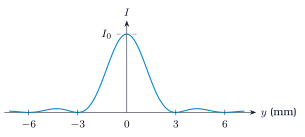
The graph shows a single slit pattern on a screen \(1.5\) m from the slit. The light has \(\lambda = 600\) nm.
Read the width of the central maximum.
Find the slit width.
Answer(i) \(6\) mm (ii) \(0.3\) mm
Solution
The first minima are at \(\pm 3\) mm, so the central maximum is \(6\) mm wide.
\(y_1 = \dfrac{\lambda D}{a}\), so \(a = \dfrac{\lambda D}{y_1} = \dfrac{600 \times 10^{-9} \times 1.5}{3 \times 10^{-3}} = 3 \times 10^{-4}\) m \(= 0.3\) mm.
How did it go?
Q8
For the slit of Q7, find the distance from the centre of
the second minimum,
the first secondary maximum.
Answer(i) \(6\) mm (ii) \(4.5\) mm
Solution
\(y_n = \dfrac{n\lambda D}{a}\), so \(y_2 = 2 \times 3 = 6\) mm.
The first secondary maximum is at \(a\sin\theta \approx \dfrac{3\lambda}{2}\), that is \(y \approx \dfrac{3}{2} \times 3 = 4.5\) mm.
How did it go?
Q9
The first secondary maximum is much fainter than the central one. Roughly what fraction of the central intensity does it have? Explain the fall using the pairing idea of Q2.
Answerabout \(\frac{1}{22}\), \(4.5\%\); only one third of the slit is left unpaired
Solution
At the first secondary maximum \(a\sin\theta = \dfrac{3\lambda}{2}\). Divide the slit into three parts, each with an edge-to-edge path difference of \(\dfrac{\lambda}{2}\). Two of the parts cancel each other pair by pair; only the third part sends light to the screen. Its amplitude is about one third of the full slit's, so the intensity is roughly one ninth. The exact calculation gives about \(\dfrac{1}{22}\), or \(4.5\%\), of the central intensity.
How did it go?
Q10
Compare the width of the central maximum with the width of a secondary maximum in a single slit pattern.
Answercentral is twice as wide
Solution
The central maximum extends from \(\sin\theta = -\dfrac{\lambda}{a}\) to \(+\dfrac{\lambda}{a}\), an angular width of \(\dfrac{2\lambda}{a}\). Each secondary maximum lies between consecutive minima, a width of \(\dfrac{\lambda}{a}\). The central maximum is twice as wide as any secondary maximum.
How did it go?
Q11
The central maximum of Q4 is \(10\) mm wide in air. The whole apparatus is immersed in water, \(\mu = \frac{4}{3}\). Find the new width.
Answer\(7.5\) mm
Solution
In water the wavelength becomes \(\dfrac{\lambda}{\mu}\), so the width \(\dfrac{2\lambda D}{a}\) becomes \(\dfrac{10}{4/3} = 7.5\) mm.
How did it go?
Q12
With light of \(500\) nm the first minimum of a single slit falls \(2\) mm from the centre on a screen \(1\) m away. Find the slit width.
Answer\(0.25\) mm
Solution
\(a = \dfrac{\lambda D}{y_1} = \dfrac{500 \times 10^{-9} \times 1}{2 \times 10^{-3}} = 2.5 \times 10^{-4}\) m \(= 0.25\) mm.
How did it go?
Q13
Give three differences between the interference pattern of two slits and the diffraction pattern of one slit.
Answerequal vs falling maxima; equal widths vs central twice as wide; two sources vs one wavefront
Solution
(1) Interference fringes have equal intensity; diffraction maxima fall off quickly away from the centre. (2) Interference fringes are all of equal width; in diffraction the central maximum is twice as wide as the others. (3) Interference is the superposition of waves from two (or more) separate coherent sources. Diffraction is the superposition of wavelets from different parts of one wavefront.
How did it go?
Q14
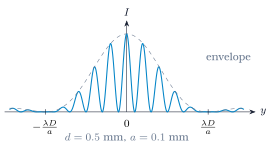
The graph shows a double slit pattern with \(d = 0.5\) mm and slit width \(a = 0.1\) mm.
How many bright interference fringes lie inside the central diffraction maximum?
Which interference orders are missing?
Answer(i) \(9\) (ii) \(5\)th, \(10\)th, \(\ldots\)
Solution
Interference maxima are at \(d\sin\theta = n\lambda\) and the first diffraction minimum at \(a\sin\theta = \lambda\). The order that falls on the diffraction minimum is \(n = \dfrac{d}{a} = 5\). Orders \(0, \pm 1, \pm 2, \pm 3, \pm 4\) lie inside, so \(9\) bright fringes.
Whenever \(\dfrac{d}{a}\) is an integer, the orders \(n = \dfrac{d}{a}, \dfrac{2d}{a}, \ldots\) coincide with diffraction minima and are missing: the \(5\)th, \(10\)th, \(15\)th, and so on.
How did it go?
Q15
In a real double slit experiment the fringes far from the centre are fainter than the central ones. Why?
Answereach slit's own diffraction envelope
Solution
Each slit has a finite width and produces its own single slit diffraction pattern. The interference fringes are formed inside that pattern, so their intensity follows the diffraction envelope. The envelope is greatest at the centre and falls off on both sides.
How did it go?
Q16
For the slits of Q14 take \(\lambda = 500\) nm and \(D = 1\) m. Find the interference fringe width and the width of the central diffraction maximum.
Answer\(1\) mm; \(10\) mm
Solution
Fringe width \(\beta = \dfrac{\lambda D}{d} = \dfrac{500 \times 10^{-9} \times 1}{0.5 \times 10^{-3}} = 1\) mm. Central diffraction maximum \(= \dfrac{2\lambda D}{a} = \dfrac{2 \times 500 \times 10^{-9} \times 1}{0.1 \times 10^{-3}} = 10\) mm. Ten fringe widths fit into it, in agreement with the \(9\) bright fringes of Q14.
How did it go?
Q17
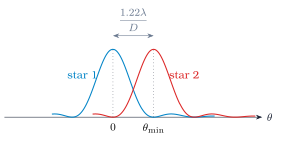
State Rayleigh's criterion for two point sources to be just resolved. The figure shows the two patterns from a circular objective of diameter \(D\). Write the least angular separation.
Answercentral maximum of one on the first minimum of the other; \(\theta_{\min} = \frac{1.22\lambda}{D}\)
Solution
Two point sources are just resolved when their diffraction patterns overlap in a set way. The central maximum of one must fall on the first minimum of the other. For a circular aperture of diameter \(D\) the first minimum is at \(\sin\theta = \dfrac{1.22\lambda}{D}\), so the least angular separation is \(\theta_{\min} = \dfrac{1.22\lambda}{D}\).
How did it go?
Q18
A telescope objective has diameter \(12.2\) cm. For \(\lambda = 500\) nm find its limit of resolution and its resolving power.
First, a large objective collects more light, in proportion to its area, so faint stars become visible. Second, the limit of resolution \(\dfrac{1.22\lambda}{D}\) falls as \(D\) grows, so close stars can be seen as separate and finer detail is visible.
How did it go?
Q21
Write the limit of resolution of a microscope. An objective of numerical aperture \(\mu\sin\theta = 1.22\) is used with light of \(500\) nm. Find the smallest distance it can resolve, and the resolving power.
The smallest distance two points can be apart and still be seen separately is \(d_{\min} = \dfrac{1.22\lambda}{2\mu\sin\theta}\). Here \(d_{\min} = \dfrac{1.22 \times 500}{2 \times 1.22} = 250\) nm. Resolving power \(= \dfrac{1}{d_{\min}} = \dfrac{1}{250 \times 10^{-9}} = 4 \times 10^{6}\) m\(^{-1}\).
How did it go?
Q22
State three ways of raising the resolving power of a microscope. Why does an electron microscope resolve far finer detail than a light microscope?
Answershorter \(\lambda\), oil immersion, wider cone; electron \(\lambda\) is thousands of times smaller
Solution
Resolving power \(= \dfrac{2\mu\sin\theta}{1.22\lambda}\). It rises with a shorter wavelength (blue or ultraviolet light). It also rises with a larger refractive index between object and objective (oil immersion). A larger cone angle \(\theta\) (wide objective close to the object) helps too. Electrons of a few kilovolts have a de Broglie wavelength of about \(0.01\) nm, tens of thousands of times shorter than visible light. So the electron microscope resolves far finer detail.
How did it go?
Q23
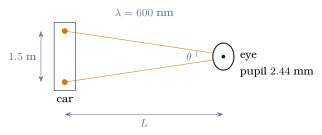
The headlights of a car are \(1.5\) m apart. The pupil of the eye is \(2.44\) mm across and \(\lambda = 600\) nm.
Find the limit of resolution of the eye.
Find the greatest distance \(L\) at which the two headlights appear separate.
The headlights subtend \(\dfrac{1.5}{L}\) at the eye. They are just resolved when \(\dfrac{1.5}{L} = 3 \times 10^{-4}\), so \(L = 5000\) m \(= 5\) km.
How did it go?
Q24
A radio telescope has a dish \(100\) m across and works at \(\lambda = 1\) m. Find its limit of resolution. Compare it with an optical telescope of diameter \(10\) cm at \(500\) nm.
Answer\(1.22 \times 10^{-2}\) rad; \(2000\) times coarser than \(6.1 \times 10^{-6}\) rad
Solution
Radio: \(\theta_{\min} = \dfrac{1.22 \times 1}{100} = 1.22 \times 10^{-2}\) rad, about \(0.7^\circ\). Optical: \(\theta_{\min} = \dfrac{1.22 \times 500 \times 10^{-9}}{0.1} = 6.1 \times 10^{-6}\) rad. The ratio is \(2000\). Even a huge dish resolves far more coarsely than a small optical telescope, because its wavelength is a million times longer.
How did it go?
Polarization: Malus's and Brewster's Laws
24 questions · after Lesson 5, Polarisation by Reflection and Scattering
Q25
What is polarization of a wave? Why can light be polarized but sound in air cannot?
Answervibrations restricted to one direction across the ray; sound is longitudinal
Solution
A wave is polarized when its vibrations are confined to one direction in the plane at right angles to the direction of travel. Only a transverse wave has vibrations across the ray, so only a transverse wave can be polarized. Light is transverse, with \(\vec E\) perpendicular to the ray. Sound in air is longitudinal; its vibrations are along the ray and there is no direction across the ray to select.
How did it go?
Q26
Describe unpolarized light and plane polarized light in terms of the electric field vector \(\vec E\). Which of the two comes from an ordinary lamp?
Answer\(\vec E\) in all directions across the ray, changing at random; \(\vec E\) in one fixed plane; the lamp gives unpolarized
Solution
In unpolarized light \(\vec E\) is always perpendicular to the ray, but its direction in that plane changes at random many million times a second. On average every direction is equally present. In plane polarized light \(\vec E\) vibrates in one fixed plane containing the ray. An ordinary lamp has countless atoms emitting independently, so its light is unpolarized.
How did it go?
Q27
Unpolarized light of intensity \(I_0\) passes through one polaroid. Show that the transmitted intensity is \(\frac{I_0}{2}\).
Answeraverage of \(\cos^2\theta\) over all \(\theta\) is \(\frac12\)
Solution
Let the incident \(\vec E\) make angle \(\theta\) with the polaroid axis. Only the component \(E\cos\theta\) passes, so the transmitted intensity is \(I_0\cos^2\theta\). In unpolarized light \(\theta\) takes all values equally, and the average of \(\cos^2\theta\) over a full turn is \(\dfrac12\). So the transmitted intensity is \(\dfrac{I_0}{2}\).
How did it go?
Q28
The polaroid of Q3 is rotated slowly about the beam. Does the transmitted intensity change? What does this show about the incident light?
Answerno; the incident light is unpolarized
Solution
No. Whatever the orientation of the polaroid, the incident light has equal amounts of \(\vec E\) along every direction, so the transmitted intensity stays \(\dfrac{I_0}{2}\). A constant intensity on rotating the polaroid shows that the incident light is unpolarized.
How did it go?
Q29
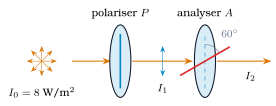
Unpolarized light of intensity \(8\) W/m\(^2\) passes through the polariser \(P\) and then the analyser \(A\). The axis of \(A\) is at \(60^\circ\) to that of \(P\).
Find \(I_1\).
Find \(I_2\).
Answer(i) \(4\) W/m\(^2\) (ii) \(1\) W/m\(^2\)
Solution
The polariser passes half of unpolarized light: \(I_1 = \dfrac{8}{2} = 4\) W/m\(^2\), now plane polarized along the axis of \(P\).
A beam may be unpolarized, plane polarized or partially polarized. How would you tell the three apart with a single polaroid?
Answerrotate it: constant, unpolarized; zero twice per turn, plane; varies but never zero, partial
Solution
Rotate the polaroid through a full turn and watch the transmitted intensity. If it stays constant the light is unpolarized. If it falls to zero twice in a turn, the light is plane polarized. If it rises and falls but never reaches zero, the light is partially polarized.
How did it go?
Q31
State Malus's law. For what angle between the polariser and the analyser is the transmitted intensity greatest, and for what angle is it zero?
Answer\(I = I_0\cos^2\theta\); greatest at \(0^\circ\); zero at \(90^\circ\)
Solution
Malus's law: let plane polarized light of intensity \(I_0\) fall on an analyser whose axis makes angle \(\theta\) with the plane of polarization. The transmitted intensity is \(I = I_0\cos^2\theta\). It is greatest, \(I_0\), at \(\theta = 0\) (axes parallel) and zero at \(\theta = 90^\circ\) (crossed).
How did it go?
Q32
Plane polarized light of intensity \(I_0\) falls on an analyser. Find the transmitted intensity when the angle between the plane of polarization and the analyser axis is
An analyser is set so that the transmitted amplitude is half the incident amplitude. Find the angle and the transmitted intensity as a fraction of \(I_0\).
Answer\(60^\circ\); \(\frac14 I_0\)
Solution
The transmitted amplitude is \(E_0\cos\theta\). For half the amplitude \(\cos\theta = \dfrac12\), so \(\theta = 60^\circ\). The intensity is proportional to the square of the amplitude, so it is \(\dfrac14 I_0\).
How did it go?
Q35
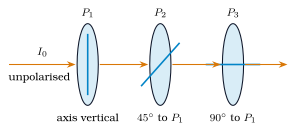
Unpolarized light of intensity \(I_0\) passes through the three polaroids shown. \(P_2\) is at \(45^\circ\) to \(P_1\) and \(P_3\) is at \(90^\circ\) to \(P_1\).
Find the intensity after each polaroid.
What comes out if \(P_2\) is removed?
Answer(i) \(\frac{I_0}{2}\), \(\frac{I_0}{4}\), \(\frac{I_0}{8}\) (ii) nothing, zero
Solution
After \(P_1\): \(\dfrac{I_0}{2}\), polarized vertically. After \(P_2\) at \(45^\circ\): \(\dfrac{I_0}{2}\cos^2 45^\circ = \dfrac{I_0}{4}\), polarized along \(P_2\). After \(P_3\), which is \(45^\circ\) from \(P_2\): \(\dfrac{I_0}{4}\cos^2 45^\circ = \dfrac{I_0}{8}\).
Without \(P_2\) the light polarized by \(P_1\) meets \(P_3\) at \(90^\circ\) and \(\cos^2 90^\circ = 0\). Nothing comes out.
How did it go?
Q36
Two polaroids are crossed. A third polaroid is inserted between them with its axis at \(\theta\) to the first. Write the final intensity for unpolarized incident light \(I_0\), and find the angle that makes it greatest.
After the first polaroid: \(\dfrac{I_0}{2}\). After the middle one at \(\theta\): \(\dfrac{I_0}{2}\cos^2\theta\). The last is at \(90^\circ - \theta\) to the middle one: \(I = \dfrac{I_0}{2}\cos^2\theta\sin^2\theta = \dfrac{I_0}{8}\sin^2 2\theta\). This is greatest when \(\sin 2\theta = 1\), that is \(\theta = 45^\circ\), giving \(\dfrac{I_0}{8}\).
How did it go?
Q37
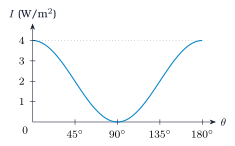
The graph shows the intensity through an analyser as its angle \(\theta\) is changed.
Write the equation of the curve.
Read the intensity at \(\theta = 60^\circ\) and the angle at which \(I = 2\) W/m\(^2\).
Answer(i) \(I = 4\cos^2\theta\) (ii) \(1\) W/m\(^2\); \(45^\circ\)
Solution
The curve is Malus's law with \(I_{\max} = 4\) W/m\(^2\) at \(\theta = 0\): \(I = 4\cos^2\theta\).
At \(60^\circ\): \(4 \times \dfrac14 = 1\) W/m\(^2\). \(I = 2\) when \(\cos^2\theta = \dfrac12\), at \(\theta = 45^\circ\) (and again at \(135^\circ\)).
How did it go?
Q38
An analyser is rotated at a steady \(5\) turns per second in a beam of plane polarized light. How many times per second does the transmitted intensity reach its maximum? Explain.
Answer\(10\) times; maxima at \(\theta = 0\) and \(180^\circ\)
Solution
\(I = I_0\cos^2\theta\) is greatest at \(\theta = 0\) and again at \(\theta = 180^\circ\), since \(\cos^2\theta\) repeats every half turn. So there are two maxima in each rotation. At \(5\) turns per second the intensity reaches its maximum \(10\) times a second.
How did it go?
Q39
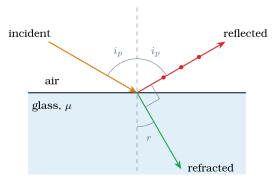
State Brewster's law. Find the polarizing angle for glass of \(\mu = \sqrt3\).
Answer\(\tan i_p = \mu\); \(60^\circ\)
Solution
Brewster's law: the reflected light is completely plane polarized when the tangent of the angle of incidence equals the refractive index, \(\tan i_p = \mu\). For \(\mu = \sqrt3\): \(\tan i_p = \sqrt3\), so \(i_p = 60^\circ\).
How did it go?
Q40
Light falls on glass at the polarizing angle \(i_p\). Use Snell's law and \(\tan i_p = \mu\) to show that the reflected and refracted rays are at right angles.
Answer\(\sin r = \cos i_p\), so \(r = 90^\circ - i_p\)
Solution
Snell's law: \(\sin i_p = \mu\sin r\). Brewster's law: \(\mu = \tan i_p = \dfrac{\sin i_p}{\cos i_p}\). Substituting, \(\sin i_p = \dfrac{\sin i_p}{\cos i_p}\sin r\), so \(\sin r = \cos i_p\) and \(r = 90^\circ - i_p\). The reflected ray makes angle \(i_p\) with the normal and the refracted ray makes \(r\) on the other side. The angle between them is \(180^\circ - i_p - r = 90^\circ\).
How did it go?
Q41
Light reflected from the surface of a liquid is completely plane polarized at an angle of incidence of \(53^\circ\). Take \(\tan 53^\circ = \frac{4}{3}\). Find the refractive index of the liquid and the angle of refraction.
At the polarizing angle, describe the state of polarization of the reflected light and of the refracted light. In which direction does \(\vec E\) vibrate in the reflected light?
Answerreflected: fully plane polarized, \(\vec E\) perpendicular to the plane of incidence; refracted: partial
Solution
At the polarizing angle the reflected light is completely plane polarized. Its \(\vec E\) is perpendicular to the plane of incidence (the plane containing the incident ray and the normal), that is parallel to the surface. The refracted light is only partially polarized. It contains all of the component with \(\vec E\) in the plane of incidence and part of the other component.
How did it go?
Q43
Find the polarizing angle for light going from glass (\(\mu = \sqrt3\)) into air. How is it related to the polarizing angle for air to glass?
Answer\(30^\circ\); the two add to \(90^\circ\)
Solution
For glass to air the relative index is \(\dfrac{1}{\sqrt3}\), so \(\tan i_p' = \dfrac{1}{\sqrt3}\) and \(i_p' = 30^\circ\). For air to glass \(i_p = 60^\circ\). The two polarizing angles add to \(90^\circ\): each is the angle of refraction for the other.
How did it go?
Q44
For a material the critical angle is \(45^\circ\). Find the polarizing angle. Write the general relation between the two angles.
\(\sin C = \dfrac{1}{\mu}\) gives \(\mu = \dfrac{1}{\sin 45^\circ} = \sqrt2\). Then \(\tan i_p = \sqrt2\), so \(i_p = \tan^{-1}\sqrt2 \approx 54.7^\circ\). In general \(\tan i_p = \mu = \dfrac{1}{\sin C}\).
How did it go?
Q45
Why is the sky blue? Why is light from the clear sky partly polarized?
Answerscattering \(\propto \frac{1}{\lambda^4}\), blue scatters most; scattered light is polarized, fully at \(90^\circ\)
Solution
Air molecules are much smaller than the wavelength, and for such scatterers the scattered intensity is proportional to \(\dfrac{1}{\lambda^4}\). Blue light, of shorter wavelength, is scattered several times more strongly than red, so the scattered light of the sky is blue. The molecule scatters by acting as an oscillating electric dipole driven by the incident \(\vec E\). A dipole sends no radiation along its own axis. So light scattered at \(90^\circ\) can only carry the \(\vec E\) component perpendicular to the plane of scattering, and it is plane polarized. At other angles it is partly polarized.
How did it go?
Q46
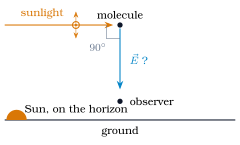
The Sun is on the horizon and an observer looks straight up at a molecule overhead. The light is scattered through \(90^\circ\).
What is the state of polarization of the light reaching the observer?
In which direction does its \(\vec E\) vibrate?
Answer(i) completely plane polarized (ii) horizontal, at right angles to the Sun's direction
Solution
The light reaches the observer after scattering through exactly \(90^\circ\), so it is completely plane polarized.
The incident \(\vec E\) is perpendicular to the sunlight, that is in the vertical plane at right angles to the Sun's direction. Only the component perpendicular to the scattering plane (the vertical plane containing the Sun, the molecule and the observer) is radiated downward. So \(\vec E\) is horizontal and at right angles to the direction of the Sun.
How did it go?
Q47
Sunlight reflected from a road or a lake is partly polarized. In which direction does its \(\vec E\) mainly vibrate? How should the axis of polaroid sunglasses be set to cut this glare?
Answerhorizontal; transmission axis vertical
Solution
Reflection near the polarizing angle favours the component of \(\vec E\) perpendicular to the plane of incidence. For a horizontal road or lake that component is horizontal. Polaroid sunglasses are made with a vertical transmission axis, which blocks the horizontal \(\vec E\) of the glare while passing most of the ordinary light.
How did it go?
Q48
A beam is a mixture of unpolarized light of intensity \(4\) W/m\(^2\) and plane polarized light of intensity \(2\) W/m\(^2\). A polaroid in the beam is rotated slowly. Find the greatest and the least transmitted intensity.
Answer\(4\) W/m\(^2\); \(2\) W/m\(^2\)
Solution
The polaroid always passes half of the unpolarized part, \(2\) W/m\(^2\). The polarized part passes \(2\cos^2\theta\), between \(2\) and \(0\). Greatest: \(2 + 2 = 4\) W/m\(^2\), when the axis is along the polarization. Least: \(2 + 0 = 2\) W/m\(^2\), when the axis is across it.