Questions on Photons and the Photoelectric Effect, the kind your examinations ask. Solve one on paper. Then tell the book how it went. The book believes you, and it uses your answer to plan your revision.
0%
Nothing marked yetMark honestly. Peek at the answer only after your own attempt.
Photoelectric Effect
24 questions · after Lesson 5, The Photon as a Particle
The photon
Q1
Take \(h = 6.6 \times 10^{-34}\) J s, \(c = 3 \times 10^{8}\) m/s, \(e = 1.6 \times 10^{-19}\) C and \(hc = 1240\) eV nm throughout. A photon has wavelength \(620\) nm.
Find the energy of the photon in eV and in joule.
Find the momentum of the photon.
Answer(i) \(2\) eV, \(3.2 \times 10^{-19}\) J (ii) \(1.07 \times 10^{-27}\) kg m/s
A laser pointer emits \(3.2\) mW of light of wavelength \(620\) nm.
How many photons leave the laser each second?
The wavelength is changed to \(1240\) nm at the same power. How many photons leave each second?
Answer(i) \(10^{16}\)/s (ii) \(2 \times 10^{16}\)/s
Solution
Energy of one photon: \(E = 1240/620 = 2\) eV \(= 3.2 \times 10^{-19}\) J.
Number per second \(n = \dfrac{P}{E} = \dfrac{3.2 \times 10^{-3}}{3.2 \times 10^{-19}} = 10^{16}\).
At \(1240\) nm each photon carries \(1\) eV, half as much. The same power needs twice as many photons: \(n = 2 \times 10^{16}\) per second.
How did it go?
Q4
A small lamp emits \(3.2\) W of light of wavelength \(620\) nm equally in all directions.
Find the number of photons emitted per second.
Find the number of photons that cross \(1\) m\(^2\) each second at a distance of \(10\) m.
Answer(i) \(10^{19}\)/s (ii) \(\approx 8 \times 10^{15}\)/s
Solution
\(E = 2\) eV \(= 3.2 \times 10^{-19}\) J per photon. \(n = \dfrac{3.2}{3.2 \times 10^{-19}} = 10^{19}\) per second.
At \(10\) m the photons are spread over a sphere of area \(4\pi r^2 = 4\pi \times 100 = 400\pi\) m\(^2\).
Number crossing \(1\) m\(^2\) per second \(= \dfrac{10^{19}}{400\pi} \approx 8 \times 10^{15}\).
How did it go?
Q5
A parallel beam of light of intensity \(600\) W/m\(^2\) falls normally on a surface of area \(0.5\) m\(^2\).
The surface is perfectly black. Find the radiation pressure and the force on the surface.
The surface is a perfect mirror. Find the pressure and the force now. Why are they doubled?
Answer(i) \(2\ \mu\)Pa, \(1\ \mu\)N (ii) \(4\ \mu\)Pa, \(2\ \mu\)N
Solution
Each photon absorbed gives its momentum \(E/c\) to the surface. The pressure is \(p = \dfrac{I}{c} = \dfrac{600}{3 \times 10^{8}} = 2 \times 10^{-6}\) Pa.
Force \(F = pA = 2 \times 10^{-6} \times 0.5 = 10^{-6}\) N.
A reflected photon reverses its momentum, so the surface receives \(2E/c\) from each photon. The pressure is \(\dfrac{2I}{c} = 4 \times 10^{-6}\) Pa and the force is \(2 \times 10^{-6}\) N.
How did it go?
Einstein's equation
Q6
The work function of a metal is \(3.3\) eV.
What does the work function mean?
Find the threshold frequency \(\nu_0\) and the threshold wavelength \(\lambda_0\) of the metal.
Answer(i) least energy to free an electron (ii) \(8 \times 10^{14}\) Hz, \(375\) nm
Solution
The work function is the minimum energy needed to remove an electron from the surface of the metal.
\(\Phi = h\nu_0\), so \(\nu_0 = \dfrac{3.3 \times 1.6 \times 10^{-19}}{6.6 \times 10^{-34}} = 8 \times 10^{14}\) Hz.
Light of \(500\) nm carries \(1240/500 = 2.48\) eV per photon.
\(2.48\) eV is more than the work functions of Cs and Na, so they emit. It is less than \(4.0\) eV, so copper does not emit.
How did it go?
Q9
Light of wavelength \(248\) nm gives a stopping potential of \(3\) V for a metal. Light of \(310\) nm gives \(2\) V for the same metal. Find the work function and the threshold wavelength of the metal.
Answer\(2\) eV, \(620\) nm
Solution
Photon energies: \(1240/248 = 5\) eV and \(1240/310 = 4\) eV.
Einstein's equation twice: \(5 - \Phi = 3\) and \(4 - \Phi = 2\). Both give \(\Phi = 2\) eV.
Light of a fixed frequency above the threshold falls on a metal. The intensity of the light is doubled. State what happens to
the number of photoelectrons per second,
\(K_{\max}\),
the stopping potential.
Give the reason in each case.
Answer(i) doubles (ii), (iii) unchanged
Solution
Doubling the intensity doubles the number of photons per second. Each photon releases at most one electron, so the number of photoelectrons per second doubles.
\(K_{\max} = h\nu - \Phi\) depends only on the frequency and the metal. \(K_{\max}\) does not change.
\(V_s = K_{\max}/e\), so the stopping potential does not change.
How did it go?
Q12
The work function of a metal is \(2\) eV. Light of wavelength \(310\) nm gives photoelectrons of maximum energy \(K_1\). Light of wavelength \(155\) nm gives \(K_2\).
Find \(K_1\) and \(K_2\) and the ratio \(K_1 : K_2\).
The wavelength is halved. Why is \(K_{\max}\) not simply doubled?
Answer(i) \(2\) eV, \(6\) eV; \(1:3\) (ii) \(\Phi\) is subtracted first
Halving the wavelength doubles the photon energy, not the kinetic energy. The work function is subtracted first, so \(K_{\max}\) grows by more than a factor of two.
How did it go?
Graphs
Q13
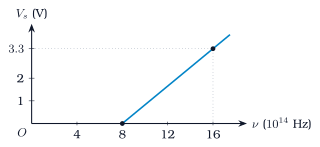
The figure shows the stopping potential \(V_s\) against the frequency \(\nu\) of the light for one metal.
Read the threshold frequency from the graph.
Find Planck's constant from the slope of the line.
Find the work function of the metal in eV.
Answer(i) \(8 \times 10^{14}\) Hz (ii) \(6.6 \times 10^{-34}\) J s (iii) \(3.3\) eV
Solution
The line meets the \(\nu\) axis at \(8 \times 10^{14}\) Hz. Below this frequency there are no photoelectrons, so \(\nu_0 = 8 \times 10^{14}\) Hz.
\(V_s = \dfrac{h}{e}(\nu - \nu_0)\), so the slope is \(\dfrac{h}{e}\).
Slope \(= \dfrac{3.3}{(16 - 8) \times 10^{14}} = 4.125 \times 10^{-15}\) V s.
\(h = e \times \text{slope} = 1.6 \times 10^{-19} \times 4.125 \times 10^{-15} = 6.6 \times 10^{-34}\) J s.
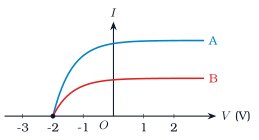
The figure shows the photocurrent \(I\) against the collector potential \(V\) for light of wavelength \(310\) nm at two intensities.
Read the stopping potential. Find \(K_{\max}\) of the photoelectrons.
Which curve, A or B, is for the higher intensity? Give the reason.
Find the work function of the metal.
Answer(i) \(2\) V, \(2\) eV (ii) A (iii) \(2\) eV
Solution
The current becomes zero at \(V = -2\) V for both curves, so \(V_s = 2\) V and \(K_{\max} = 2\) eV.
A has the larger saturation current. A higher intensity means more photons per second, so more photoelectrons per second. Curve A is for the higher intensity.
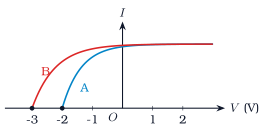
The figure shows \(I\) against \(V\) for two beams, A and B, that send the same number of photons per second to the metal.
Which beam has the higher frequency? Give the reason.
Beam A has wavelength \(310\) nm. Find the work function of the metal.
Find the wavelength of beam B.
Why is the saturation current the same for both?
Answer(i) B, larger \(V_s\) (ii) \(2\) eV (iii) \(248\) nm (iv) same photon rate
Solution
B has the larger stopping potential (\(3\) V against \(2\) V), so its photoelectrons have more energy. A higher \(K_{\max}\) means a higher frequency. Beam B has the higher frequency.
For A: \(E = 1240/310 = 4\) eV and \(K_{\max} = 2\) eV. \(\Phi = 4 - 2 = 2\) eV.
The saturation current counts the photoelectrons per second. Both beams deliver the same number of photons per second, so they release the same number of electrons per second.
How did it go?
Q16
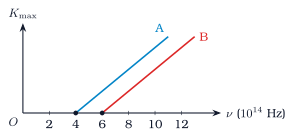
The figure shows \(K_{\max}\) against \(\nu\) for two metals A and B.
Which metal has the larger work function? Give the reason.
Find the work function of each metal in joule, and the ratio \(\Phi_A : \Phi_B\).
Why are the two lines parallel?
Answer(i) B, higher \(\nu_0\) (ii) \(2.64\), \(3.96\) (\(\times 10^{-19}\) J); \(2:3\) (iii) slope \(h\) for all
Solution
B needs a higher frequency (\(6 \times 10^{14}\) Hz) before any electron comes out. \(\Phi = h\nu_0\), so B has the larger work function.
\(K_{\max} = h\nu - \Phi\). The slope is \(h\) for every metal; only the intercept \(\Phi\) changes. So the lines are parallel.
How did it go?
Q17
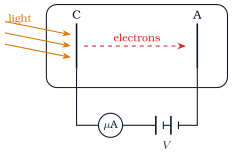
The figure shows a photoelectric tube. Light falls on the emitter C. A is the collector.
Which plate is at the lower potential when the stopping potential is measured? Why?
A is made more and more positive. Why does the current stop increasing?
The lamp is moved to twice its distance. What happens to the saturation current and to \(V_s\)?
Answer(i) A (ii) all electrons reach A (iii) \(I/4\); \(V_s\) same
Solution
The collector A must be at the lower potential. Then A repels the electrons, and only electrons with enough kinetic energy reach it. The potential that stops even the fastest electrons is the stopping potential.
When A is positive enough, every photoelectron emitted by C is collected. The current cannot rise above the number of electrons emitted per second. This is the saturation current.
At twice the distance the intensity falls to one quarter, so the saturation current falls to one quarter. The frequency is unchanged, so \(K_{\max}\) and the stopping potential are unchanged.
How did it go?
Small situations
Q18
A beam sends \(10^{16}\) photons per second to a metal plate. One photon in every \(100\) releases a photoelectron. All photoelectrons reach the collector.
Find the saturation current.
Find the saturation current when the intensity of the beam is doubled.
Answer(i) \(16\ \mu\)A (ii) \(32\ \mu\)A
Solution
Electrons per second \(= 10^{16}/100 = 10^{14}\).
\(I = ne = 10^{14} \times 1.6 \times 10^{-19} = 1.6 \times 10^{-5}\) A \(= 16\ \mu\)A.
Twice the intensity means \(2 \times 10^{16}\) photons per second and \(2 \times 10^{14}\) electrons per second. \(I = 32\ \mu\)A.
How did it go?
Q19
Use the photon picture. Explain each fact in one or two sentences.
Very intense red light may give no photoelectrons, while faint violet light does.
The emission starts as soon as the light falls, with no time delay.
Answer(i) red photon \(< \Phi\) (ii) one photon frees one electron at once
Solution
An electron takes energy from one photon at a time. A red photon carries less than the work function, so no red photon can free an electron, however many there are. One violet photon carries more than the work function, so it frees an electron.
The energy arrives in one packet, not slowly over the whole surface. The first photons that arrive can free electrons at once.
How did it go?
Q20
A metal has work function \(3.3\) eV. Sketch \(K_{\max}\) against the frequency \(\nu\). Mark, with values, where the line meets the \(\nu\) axis and where its extension meets the \(K_{\max}\) axis.
Answer\(8 \times 10^{14}\) Hz; \(-3.3\) eV
Solution
\(K_{\max} = h\nu - \Phi\) is a straight line of slope \(h\).
It meets the \(\nu\) axis where \(K_{\max} = 0\): \(\nu_0 = \dfrac{\Phi}{h} = \dfrac{3.3 \times 1.6 \times 10^{-19}}{6.6 \times 10^{-34}} = 8 \times 10^{14}\) Hz.
Its extension meets the \(K_{\max}\) axis at \(\nu = 0\): \(K_{\max} = -\Phi = -3.3\) eV. The dashed part below the axis is not physical; no electrons come out there.
How did it go?
Q21
Start from Einstein's equation \(K_{\max} = h\nu - \Phi\) and \(K_{\max} = eV_s\).
Show that \(V_s = \frac{h}{e}\nu - \frac{\Phi}{e}\).
Why is the slope of the \(V_s\) against \(\nu\) line the same for every metal?
Answer(i) divide \(eV_s = h\nu - \Phi\) by \(e\) (ii) \(h/e\) is universal