Questions on Matter Waves and Special Relativity, the kind your examinations ask. Solve one on paper. Then tell the book how it went. The book believes you, and it uses your answer to plan your revision.
0%
Nothing marked yetMark honestly. Peek at the answer only after your own attempt.
Radiation Pressure and Matter Waves
21 questions · after Lesson 2, Electrons Diffract: Davisson and Germer
Force of a light beam
Q1
Take \(h = 6.6 \times 10^{-34}\) J s, \(c = 3 \times 10^{8}\) m/s, \(e = 1.6 \times 10^{-19}\) C; \(1\) nN \(= 10^{-9}\) N. A \(6\) W beam falls normally on a surface.
The surface absorbs all the light. Find the force on the surface.
The surface is a perfect mirror. Find the force now.
Answer(i) \(20\) nN (ii) \(40\) nN
Solution
Light of energy \(E\) carries momentum \(E/c\). A beam of power \(P\) delivers momentum \(P/c\) each second.
The photon goes back with the same momentum. Change \(= p - (-p) = 2p = 2 \times 10^{-27}\) kg m/s.
Force \(=\) momentum change per second \(= 10^{20} \times 2 \times 10^{-27} = 2 \times 10^{-7}\) N.
How did it go?
Q3
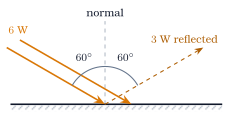
A beam of power \(3\) W falls on a perfectly absorbing plate. The beam makes \(60^\circ\) with the normal to the plate.
Find the momentum delivered per second, and the direction of the force.
Find the components of the force normal to the plate and along the plate.
Answer(i) \(10\) nN, along beam (ii) \(5\), \(8.7\) nN
Solution
Momentum per second \(= \dfrac{P}{c} = \dfrac{3}{3 \times 10^{8}} = 10^{-8}\) N. The beam is fully absorbed, so the plate receives all this momentum. The force acts along the beam.
Normal component: \(F\cos 60^\circ = 10^{-8} \times \dfrac{1}{2} = 5 \times 10^{-9}\) N.
Along the plate: \(F\sin 60^\circ = 10^{-8} \times \dfrac{\sqrt{3}}{2} = 5\sqrt{3} \times 10^{-9} \approx 8.7 \times 10^{-9}\) N.
How did it go?
Q4
The plate of Question 3 is replaced by a perfect mirror. The beam still makes \(60^\circ\) with the normal. Find the force on the mirror and state its direction. Why is there no force along the mirror?
Answer\(10\) nN along normal; no tangential \(\Delta p\)
Solution
On reflection the normal component of the light's momentum reverses. The component along the mirror does not change.
Force \(= 2 \times \dfrac{P}{c}\cos 60^\circ = 2 \times 10^{-8} \times \dfrac{1}{2} = 10^{-8}\) N, along the normal, into the mirror.
The tangential momentum of the light is the same before and after, so no tangential momentum is given to the mirror.
How did it go?
Q5
A \(3\) W beam falls normally on a plate that reflects \(60\%\) and absorbs the rest. Find the force on the plate.
Answer\(16\) nN
Solution
Absorbed part (\(40\%\)): force \(= 0.4\dfrac{P}{c}\). Reflected part (\(60\%\)): force \(= 2 \times 0.6\dfrac{P}{c} = 1.2\dfrac{P}{c}\).
Total \(F = 1.6\dfrac{P}{c} = 1.6 \times 10^{-8}\) N. In general \(F = (1 + r)\dfrac{P}{c}\) with \(r\) the fraction reflected.
How did it go?
Q6
A wide parallel beam of intensity \(300\) W/m\(^2\) falls on a large black surface at \(60^\circ\) to the normal.
Show that the pressure on the surface is \(\frac{I}{c}\cos^2\theta\). Where does each \(\cos\theta\) come from?
Find the pressure.
Answer(i) slant area, normal component (ii) \(2.5 \times 10^{-7}\) Pa
Solution
A beam of cross-section \(A_0\) that meets the surface at angle \(\theta\) covers an area \(A = A_0/\cos\theta\). So a surface of area \(A\) intercepts power \(IA\cos\theta\). This is the first \(\cos\theta\).
The momentum per second is \(\dfrac{IA\cos\theta}{c}\) along the beam. Its normal component has another \(\cos\theta\): \(F_n = \dfrac{IA\cos^2\theta}{c}\).
Wave effects such as diffraction need an opening of about the size of \(\lambda\). Nothing is \(10^{-34}\) m across; the wavelength is far smaller than any object or gap. So the ball behaves as a particle.
How did it go?
Q9
An electron at rest is accelerated through \(V\) volt. Its de Broglie wavelength is \(\lambda = \frac{12.27}{\sqrt{V}}\) Å.
\(\dfrac{h}{\sqrt{2me}} = \dfrac{6.63 \times 10^{-34}}{5.4 \times 10^{-25}} = 1.23 \times 10^{-9}\) m V\(^{1/2}\) \(= 12.3\) Å V\(^{1/2}\). With more exact constants this is \(12.27\).
How did it go?
Q11
Find the de Broglie wavelength of an electron of kinetic energy
\(150\) eV,
\(600\) eV.
Answer(i) \(1.0\) Å (ii) \(0.5\) Å
Solution
For an electron \(K = eV\) means \(V\) in volt equals \(K\) in eV. So \(\lambda = \dfrac{12.27}{\sqrt{K}}\) Å with \(K\) in eV.
\(\lambda = 12.27/\sqrt{600} = 12.27/24.5 \approx 0.5\) Å. Four times the energy gives half the wavelength.
How did it go?
Q12
A proton is \(1836\) times heavier than an electron. Find the ratio \(\lambda_e : \lambda_p\) of their de Broglie wavelengths when the two particles have
The photon carries about \(12400/150 \approx 80\) times more energy. For the same wavelength the momenta are equal, but the photon's energy is \(pc\) while the electron's is only \(p^2/2m\).
How did it go?
Q14
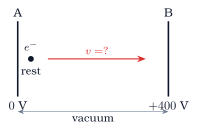
An electron starts from rest at A and reaches B, as shown. Its mass is \(9.1 \times 10^{-31}\) kg.
Find the kinetic energy of the electron at B in eV and in joule.
Find its speed at B.
Find its de Broglie wavelength at B.
Answer\(400\) eV; \(1.2 \times 10^{7}\) m/s; \(0.61\) Å
Solution
\(K = eV = 400\) eV \(= 400 \times 1.6 \times 10^{-19} = 6.4 \times 10^{-17}\) J.
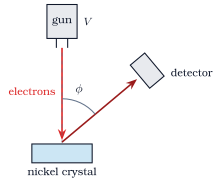
In the Davisson and Germer experiment, accelerated electrons fall on a nickel crystal.
What quantity is measured, and against what is it plotted?
What did the experiment show about electrons?
Answer(i) count vs angle (ii) waves
Solution
The number of electrons scattered per second into the detector is measured. It is plotted against the scattering angle, for several accelerating voltages.
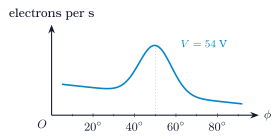
At \(54\) V the count showed a strong peak at one angle, \(50^\circ\). Particles bouncing off a surface would not pick out one angle. Waves diffracted by the regular rows of atoms do. So electrons behave as waves, with the wavelength de Broglie predicted.
How did it go?
Q16
In the experiment a strong peak appeared at an accelerating voltage of \(54\) V. For the nickel planes used, the crystal spacing is \(d = 0.91\) Å and the glancing angle of the peak is \(\theta = 65^\circ\). Take \(\sin 65^\circ = 0.906\).
Find the de Broglie wavelength of the electrons from \(\lambda = \frac{12.27}{\sqrt{V}}\) Å.
Find the wavelength from Bragg's rule \(2d\sin\theta = \lambda\) for the first order.
What does the agreement between (i) and (ii) show?
Answer(i) \(1.67\) (ii) \(1.65\) Å (iii) \(\lambda = h/p\) holds
The wavelength found from the diffraction pattern matches the wavelength predicted by \(\lambda = h/p\). This confirms de Broglie's formula for electrons.
How did it go?
Q17
The figure shows the number of scattered electrons per second against the scattering angle \(\phi\) at \(54\) V.
Read the angle \(\phi\) of the peak.
The glancing angle is \(\theta = 90^\circ - \phi/2\). Find \(\theta\).
The voltage is raised to \(64\) V. Does the peak move to a smaller or a larger \(\phi\)? Why?
Answer(i) \(50^\circ\) (ii) \(65^\circ\) (iii) larger, \(\lambda\) falls
Solution
The peak is at \(\phi = 50^\circ\).
\(\theta = 90^\circ - 25^\circ = 65^\circ\).
A higher voltage gives a higher momentum and a smaller \(\lambda\). From \(2d\sin\theta = \lambda\), a smaller \(\lambda\) needs a smaller glancing angle \(\theta\). Since \(\phi = 180^\circ - 2\theta\), the peak moves to a larger \(\phi\).
How did it go?
Q18
Electrons of kinetic energy \(150\) eV fall on a crystal whose planes are \(d = 1.0\) Å apart.
Find the glancing angle \(\theta\) of the first-order maximum from \(2d\sin\theta = \lambda\).
The energy is raised to \(600\) eV. Find the new first-order angle. Take \(\sin 14.5^\circ = 0.25\).
What does the voltage \(V\) on the gun decide about the electrons?
What does the detector measure, and how is it moved?
Why must the whole apparatus be in a vacuum?
Why is a peak at one angle a sign of wave behaviour?
Answer(i) \(\lambda\) (ii) count, on arc (iii) no air (iv) interference
Solution
\(V\) fixes the kinetic energy \(eV\) of the electrons, and so their momentum and their de Broglie wavelength \(\lambda = 12.27/\sqrt{V}\) Å.
The detector counts the electrons scattered per second in its direction. It moves along a circular arc around the crystal, so the angle \(\phi\) can be varied.
Air molecules would scatter and absorb the slow electrons before they reached the crystal or the detector.
Waves scattered from regular rows of atoms add up only in directions where the path difference is a whole number of wavelengths. Only a wave gives such a sharp maximum at one angle.
How did it go?
Small situations
Q20
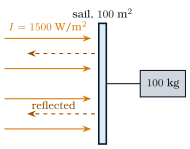
A perfectly reflecting solar sail of area \(100\) m\(^2\) faces the Sun, as shown. Sunlight of intensity \(1500\) W/m\(^2\) falls normally on it. Sail and load have mass \(100\) kg.
Find the force of the sunlight on the sail.
Find the acceleration of the sail.
Find the speed gained in one day (\(86400\) s), starting from rest.
Answer(i) \(1\) mN (ii) \(10^{-5}\) m/s\(^2\) (iii) \(0.86\) m/s
Solution
Power on the sail \(P = IA = 1500 \times 100 = 1.5 \times 10^{5}\) W. Perfect reflection gives \(F = \dfrac{2P}{c} = \dfrac{3 \times 10^{5}}{3 \times 10^{8}} = 10^{-3}\) N.
Electron: \(1\) nm \(= 10\) Å, so \(\sqrt{K} = \dfrac{12.27}{10}\) and \(K = 1.227^2 \approx 1.5\) eV. The same momentum, but the electron carries far less energy.
How did it go?
Special Relativity
24 questions · after Lesson 5, Mass, Momentum and Energy
Frames and postulates
Q22
Take \(c = 3 \times 10^{8}\) m/s throughout. What is an inertial frame of reference? Which of these frames are inertial?
A train at a steady \(30\) m/s on a straight track.
A car that is braking.
A rotating merry-go-round.
Answer(i) inertial (ii), (iii) not inertial
Solution
An inertial frame is one in which Newton's first law holds: a body with no force on it keeps a constant velocity. Any frame moving at constant velocity relative to an inertial frame is also inertial.
Steady speed on a straight track: no acceleration. Inertial.
Braking means acceleration. Not inertial. A loose object slides forward with no force on it.
Rotation means acceleration towards the centre. Not inertial.
How did it go?
Q23
State the two postulates of special relativity in your own words.
Answer(i) same laws in all inertial frames (ii) \(c\) same for all
Solution
First postulate (principle of relativity): the laws of physics are the same in every inertial frame. No experiment inside a closed box can tell whether the box is at rest or moving uniformly.
Second postulate (constancy of \(c\)): the speed of light in vacuum is the same, \(c\), for every observer in every inertial frame. It does not depend on the motion of the source or of the observer.
How did it go?
Q24
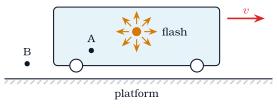
A lamp in a train flashes. A rides in the train and B stands on the platform. The train moves at speed \(v\).
What speed does A measure for the light that moves forward?
What speed does B measure for the same light? Which postulate decides this?
A throws a ball forward at \(10\) m/s while the train moves at \(20\) m/s. What speed does B measure for the ball, approximately?
Answer(i) \(c\) (ii) \(c\); second (iii) \(30\) m/s
Solution
A measures \(c\). In A's frame the lamp is at rest and light always moves at \(c\).
B also measures \(c\), not \(c + v\). This is the second postulate: the speed of light does not depend on the motion of the source.
For slow objects the ordinary rule works: \(20 + 10 = 30\) m/s. (The exact relativistic answer differs from \(30\) m/s by less than \(10^{-13}\) m/s.)
How did it go?
Q25
The rule "speeds simply add" works for the ball in Question 3 but fails for light. Why do we never notice this failure in daily life?
Answer\(v \ll c\)
Solution
The relativistic effects depend on \(v^2/c^2\). For everyday speeds, even \(300\) m/s, this ratio is about \(10^{-12}\). The correction to "speeds add" is far too small to measure with ordinary instruments. Only for speeds near \(c\), or for light itself, does the difference show.
How did it go?
The Lorentz factor
Q26
The Lorentz factor is \(\gamma = \frac{1}{\sqrt{1 - v^2/c^2}}\). Find \(\gamma\) for
\(v = 0.6c\),
\(v = 0.8c\),
\(v = 0.96c\).
Answer(i) \(\frac{5}{4}\) (ii) \(\frac{5}{3}\) (iii) \(\frac{25}{7} \approx 3.6\)
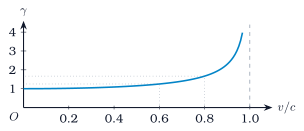
Read \(\gamma\) at \(v = 0.6c\) and at \(v = 0.8c\) from the dotted lines.
Read the speed at which \(\gamma = 2\), roughly.
Why does the curve rise without limit as \(v\) approaches \(c\)?
For \(v\) below \(0.2c\), \(\gamma\) is almost exactly \(1\). What does this mean for everyday motion?
Answer(i) \(1.25\), \(1.67\) (ii) \(\approx 0.87c\) (iii) \(\gamma \to \infty\) (iv) Newton is enough
Solution
The dotted lines give \(\gamma = 1.25\) at \(0.6c\) and \(\gamma \approx 1.67\) at \(0.8c\).
The curve reaches \(\gamma = 2\) at about \(v/c = 0.87\).
As \(v \to c\), \(1 - v^2/c^2 \to 0\), so \(\gamma = 1/\sqrt{1 - v^2/c^2} \to \infty\). The dashed line at \(v = c\) is never reached.
For \(v < 0.2c\), \(\gamma < 1.021\). Time dilation and length contraction are then under \(2\%\). For cars, planes and rockets (\(v/c < 10^{-4}\)) they are completely negligible, and Newton's mechanics is exact enough.
How did it go?
Time dilation
Q29
A muon at rest lives for \(2.2\ \mu\)s on average. Muons made high in the atmosphere move at \(0.96c\).
Find the average lifetime of these muons as measured from the ground.
Find the distance a muon travels in this time.
How far would it travel if there were no time dilation?
Answer(i) \(7.9\ \mu\)s (ii) \(2.26\) km (iii) \(634\) m
Solution
\(\gamma = 25/7\) at \(0.96c\). \(\Delta t = \gamma\,\Delta t_0 = \dfrac{25}{7} \times 2.2 \approx 7.9\ \mu\)s.
Distance \(= v\,\Delta t = 0.96 \times 3 \times 10^{8} \times 7.86 \times 10^{-6} \approx 2263\) m \(\approx 2.26\) km.
Without dilation: \(0.96 \times 3 \times 10^{8} \times 2.2 \times 10^{-6} \approx 634\) m. Most muons would decay before reaching the ground. In fact many do reach it, which confirms time dilation.
How did it go?
Q30
A clock on a spaceship moving at \(0.6c\) shows that \(1\) hour has passed. How much time has passed for observers on Earth?
Answer\(1.25\) h \(= 75\) min
Solution
The ship's clock measures the proper time \(\Delta t_0 = 1\) h between two ticks at the same place on the ship.
Earth measures \(\Delta t = \gamma\,\Delta t_0 = 1.25 \times 1\) h \(= 1.25\) h \(= 75\) min. Moving clocks run slow.
How did it go?
Q31
An astronaut's heart beats \(60\) times per minute, as measured by the astronaut. The spaceship passes Earth at \(0.8c\). How many beats per minute does an observer on Earth count?
Answer\(36\) per min
Solution
The astronaut measures the proper time between beats: \(\Delta t_0 = 1\) s. Earth measures \(\Delta t = \gamma\,\Delta t_0 = \dfrac{5}{3}\) s per beat.
Beats per minute \(= \dfrac{60}{5/3} = 36\).
How did it go?
Q32
Two events happen at the same place in a frame S. A clock at rest in S measures the time between them as \(\Delta t_0\), the proper time.
Is the time between the same two events measured in any other frame longer or shorter than \(\Delta t_0\)?
A muon is created and later decays. In which frame is the time between these two events the proper time?
Answer(i) longer (ii) the muon's frame
Solution
Longer. \(\Delta t = \gamma\,\Delta t_0\) and \(\gamma \ge 1\). The proper time is the shortest time any observer can measure between the two events.
In the muon's own rest frame the creation and the decay happen at the same place (where the muon is). So the muon's frame measures the proper time, \(2.2\ \mu\)s.
How did it go?
Q33
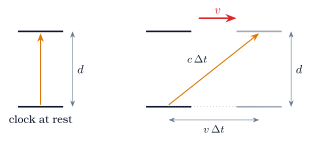
A light clock has two mirrors a distance \(d\) apart. One tick is the flash going from the lower mirror to the upper one.
For the clock at rest, write the time \(\Delta t_0\) of one tick.
In a frame where the clock moves at \(v\), the flash travels along the slant. Use Pythagoras to show that \(\Delta t = \gamma\,\Delta t_0\).
Answer(i) \(d/c\) (ii) \((c\Delta t)^2 = d^2 + (v\Delta t)^2\)
Solution
The flash covers the distance \(d\) at speed \(c\): \(\Delta t_0 = \dfrac{d}{c}\).
In the moving frame the clock shifts by \(v\,\Delta t\) during one tick. The flash travels the slant distance \(c\,\Delta t\) (second postulate: still speed \(c\)).
A rod has proper length \(5\) m. It moves along its length at \(0.8c\). Find its length as measured by an observer at rest.
Answer\(3\) m
Solution
\(L = \dfrac{L_0}{\gamma}\). At \(0.8c\), \(\gamma = \dfrac{5}{3}\), so \(L = 5 \times \dfrac{3}{5} = 3\) m.
How did it go?
Q35
A spaceship is \(100\) m long and \(20\) m wide when at rest. It passes Earth at \(0.6c\), moving along its length.
Find the length and the width measured from Earth.
Which dimension changes, and why not the other?
Answer(i) \(80\) m, \(20\) m (ii) length only
Solution
\(\gamma = 1.25\) at \(0.6c\). Length \(= \dfrac{100}{1.25} = 80\) m. Width \(= 20\) m, unchanged.
Only lengths along the direction of motion contract. The width is perpendicular to the motion, so both frames agree on it.
How did it go?
Q36
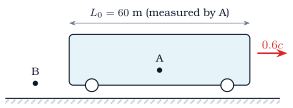
A rides in a train car and measures its length as \(60\) m. The car passes B, who stands on the ground, at \(0.6c\).
Who measures the proper length of the car? Why?
Find the length of the car measured by B.
B holds a metre stick along the track. Find its length as measured by A.
Answer(i) A (ii) \(48\) m (iii) \(0.8\) m
Solution
A. The proper length is measured in the frame in which the object is at rest. The car is at rest for A.
\(L = \dfrac{L_0}{\gamma} = \dfrac{60}{1.25} = 48\) m.
For A, the ground and B's stick move at \(0.6c\). A measures the stick as \(\dfrac{1}{1.25} = 0.8\) m. Each observer sees the other's lengths contracted.
How did it go?
Q37
Return to the muon of Question 8. In the muon's own frame it lives for only \(2.2\ \mu\)s.
The ground is \(2263\) m below the muon in the ground frame. Find this distance in the muon's frame.
Show that in its own frame the muon can still reach the ground.
Answer(i) \(634\) m (ii) \(634/(0.96c) = 2.2\ \mu\)s
Solution
In the muon's frame the atmosphere rushes past at \(0.96c\), so the \(2263\) m is contracted: \(\dfrac{2263}{25/7} = 2263 \times \dfrac{7}{25} \approx 634\) m.
Time to cover \(634\) m at \(0.96c\): \(\dfrac{634}{0.96 \times 3 \times 10^{8}} \approx 2.2\ \mu\)s, exactly the muon's lifetime. Both frames agree that the muon reaches the ground; one calls it time dilation, the other length contraction.
How did it go?
Mass, momentum and energy
Q38
The rest mass of an electron is \(9.1 \times 10^{-31}\) kg. Find its rest energy \(m_0c^2\) in joule and in MeV. Take \(1\) eV \(= 1.6 \times 10^{-19}\) J.
In eV: \(\dfrac{8.19 \times 10^{-14}}{1.6 \times 10^{-19}} = 5.1 \times 10^{5}\) eV \(= 0.51\) MeV.
How did it go?
Q39
Find the energy released if \(1\) g of matter is fully converted into energy. Express the answer in joule and in kilowatt hours (\(1\) kWh \(= 3.6 \times 10^{6}\) J).
Classical: \(\dfrac{1}{2}m_0 v^2 = \dfrac{1}{2}(0.6)^2 m_0c^2 = 0.18\,m_0c^2 = 0.09\) MeV. The true kinetic energy, \(0.25\,m_0c^2\), is larger. The classical formula undercounts at high speed.
How did it go?
Q42
A particle has rest energy \(m_0c^2 = 3\) MeV and momentum \(p\) such that \(pc = 4\) MeV.
Use \(E^2 = (pc)^2 + (m_0c^2)^2\) to find the total energy \(E\).
Find the kinetic energy.
Find \(\gamma\) and hence the speed of the particle.
Answer(i) \(5\) MeV (ii) \(2\) MeV (iii) \(\frac{5}{3}\), \(0.8c\)
Solution
\(E^2 = 4^2 + 3^2 = 25\), so \(E = 5\) MeV.
\(K = E - m_0c^2 = 5 - 3 = 2\) MeV.
\(E = \gamma m_0c^2\), so \(\gamma = \dfrac{5}{3}\). From Question 5, \(\gamma = 5/3\) means \(v = 0.8c\). Check: \(pc = \gamma m_0 v c = \dfrac{5}{3} \times 3 \times 0.8 = 4\) MeV.
How did it go?
Q43
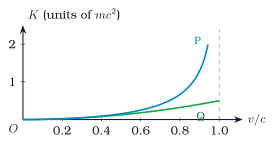
The figure shows kinetic energy against \(v/c\) for a particle, in units of \(mc^2\). One curve is the classical \(\frac{1}{2}mv^2\), the other the relativistic \((\gamma - 1)mc^2\).
Which curve, P or Q, is relativistic? Give the reason.
Find the value of each curve at \(v = 0.8c\) by calculation.
Why does curve P rise without limit near \(v = c\)?
Answer(i) P, diverges at \(c\) (ii) P: \(\frac{2}{3}\), Q: \(0.32\) (iii) \(\gamma \to \infty\)
Solution
P. The relativistic kinetic energy grows faster than \(v^2\) and becomes infinite at \(v = c\). The classical curve is a simple parabola that stays finite.
\(K = (\gamma - 1)mc^2\) and \(\gamma \to \infty\) as \(v \to c\). It would take infinite energy to reach \(c\).
How did it go?
Q44
A photon has zero rest mass. Use \(E^2 = (pc)^2 + (m_0c^2)^2\) to show that its momentum is \(p = E/c\). Find \(p\) for a photon of energy \(2\) eV.
Answer\(m_0 = 0 \Rightarrow E = pc\); \(1.07 \times 10^{-27}\) kg m/s
Solution
Put \(m_0 = 0\): \(E^2 = (pc)^2\), so \(E = pc\) and \(p = \dfrac{E}{c}\).
\(E = 2\) eV \(= 3.2 \times 10^{-19}\) J. \(p = \dfrac{3.2 \times 10^{-19}}{3 \times 10^{8}} \approx 1.07 \times 10^{-27}\) kg m/s. This agrees with \(p = h/\lambda\) for a \(620\) nm photon.
How did it go?
Q45
Use the formulas for \(\gamma\), \(p\) and \(E\) to explain why no object with rest mass can be accelerated to the speed of light.
Answer\(\gamma \to \infty\): infinite energy
Solution
As \(v \to c\), \(\gamma = 1/\sqrt{1 - v^2/c^2} \to \infty\). The momentum \(p = \gamma m_0 v\) and the energy \(E = \gamma m_0 c^2\) both grow without limit.
To reach \(v = c\) a body with \(m_0 \ne 0\) would need infinite energy, which no source can supply. Each extra push adds less speed and more energy. Only massless particles, such as photons, move at \(c\).