Questions on The Bohr Atom and Spectra, the kind your examinations ask. Solve one on paper. Then tell the book how it went. The book believes you, and it uses your answer to plan your revision.
0%
Nothing marked yetMark honestly. Peek at the answer only after your own attempt.
Bohr Model: Orbits, Energy Levels and Spectra
24 questions · after Lesson 5, The Hydrogen Spectrum
Postulates and orbits
Q1
State Bohr's three postulates for the hydrogen atom. Throughout this sheet use \(r_n = 0.53\frac{n^2}{Z}\) Å, \(v_n = 2.2 \times 10^{6}\frac{Z}{n}\) m/s, \(E_n = -13.6\frac{Z^2}{n^2}\) eV, \(R = 1.097 \times 10^{7}\) m\(^{-1}\) and \(hc = 1240\) eV nm.
1. The electron moves around the nucleus only in certain allowed circular orbits. In these orbits it does not radiate energy, even though it accelerates.
2. The allowed orbits are those in which the angular momentum is a whole multiple of \(\dfrac{h}{2\pi}\): \(mvr = \dfrac{nh}{2\pi}\).
3. The atom radiates only when the electron jumps from a higher orbit to a lower one. The photon carries the energy difference: \(h\nu = E_i - E_f\).
How did it go?
Q2
Take \(\frac{h}{2\pi} = 1.05 \times 10^{-34}\) J s. Find the angular momentum of the electron in the orbits \(n = 1\) and \(n = 3\) of hydrogen.
Answer\(1.05 \times 10^{-34}\), \(3.15 \times 10^{-34}\) J s
Solution
\(L = \dfrac{nh}{2\pi}\). For \(n = 1\): \(L = 1.05 \times 10^{-34}\) J s. For \(n = 3\): \(L = 3 \times 1.05 \times 10^{-34} = 3.15 \times 10^{-34}\) J s.
How did it go?
Q3
Find the radius of the orbit.
Hydrogen, \(n = 1\), \(2\) and \(3\).
He\(^+\) (\(Z = 2\)), \(n = 2\).
Li\(^{2+}\) (\(Z = 3\)), \(n = 3\).
Answer(i) \(0.53\), \(2.12\), \(4.77\) Å (ii) \(1.06\) Å (iii) \(1.59\) Å
Ground state of hydrogen: \(\dfrac{v_1}{c} = \dfrac{2.2 \times 10^{6}}{3 \times 10^{8}} = 0.0073 \approx \dfrac{1}{137}\). The speed is far below \(c\), so Newton's mechanics is good enough here.
How did it go?
Q5
An electron of mass \(m\) moves in a circle of radius \(r\) around a nucleus of charge \(Ze\). Start from \(\frac{mv^2}{r} = \frac{kZe^2}{r^2}\) and \(mvr = \frac{nh}{2\pi}\).
Show that \(v = \frac{2\pi kZe^2}{nh}\), so \(v \propto \frac{Z}{n}\).
Show that \(r = \frac{n^2h^2}{4\pi^2 mkZe^2}\), so \(r \propto \frac{n^2}{Z}\).
Answer(i) \(v = 2\pi kZe^2/nh\) (ii) \(r = n^2h^2/4\pi^2 mkZe^2\)
Solution
From \(mvr = \dfrac{nh}{2\pi}\): \(r = \dfrac{nh}{2\pi mv}\). Put this in \(mv^2 = \dfrac{kZe^2}{r}\):
\(mv^2 = kZe^2 \times \dfrac{2\pi mv}{nh}\), so \(v = \dfrac{2\pi kZe^2}{nh}\). Everything except \(Z\) and \(n\) is constant: \(v \propto \dfrac{Z}{n}\).
In a Bohr orbit \(K = -E\) and \(U = 2E\). For \(n = 2\): \(K = 3.4\) eV and \(U = -6.8\) eV. Check: \(K + U = -3.4\) eV \(= E_2\).
How did it go?
Q8
Find the ionization energy of hydrogen, of He\(^+\) and of Li\(^{2+}\), each in the ground state. What is the ionization potential of hydrogen in volt?
Answer\(13.6\), \(54.4\), \(122.4\) eV; \(13.6\) V
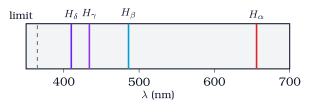
\(H_\alpha\) is at \(656\) nm and \(H_\beta\) at \(486\) nm.
All Balmer lines end on \(n = 2\). \(H_\alpha\): \(3 \to 2\). \(H_\beta\): \(4 \to 2\). \(H_\gamma\): \(5 \to 2\). \(H_\delta\): \(6 \to 2\).
The limit is \(\infty \to 2\), an electron falling from the edge of the atom. The upper levels \(E_n = -13.6/n^2\) get closer and closer together as \(n\) grows, so the photon energies, and the lines, crowd together.
How did it go?
Rydberg formula
Q14
Use \(\frac{1}{\lambda} = R\left(\frac{1}{n_1^2} - \frac{1}{n_2^2}\right)\) to find the shortest wavelength (the series limit) of
the Lyman series,
the Balmer series,
the Paschen series.
Answer(i) \(91.2\) nm (ii) \(365\) nm (iii) \(820\) nm
Solution
The shortest wavelength has \(n_2 = \infty\): \(\dfrac{1}{\lambda} = \dfrac{R}{n_1^2}\), so \(\lambda = \dfrac{n_1^2}{R}\) with \(\dfrac{1}{R} = 91.2\) nm.
Lyman, \(n_1 = 1\): \(91.2\) nm.
Balmer, \(n_1 = 2\): \(4 \times 91.2 = 365\) nm.
Paschen, \(n_1 = 3\): \(9 \times 91.2 = 820\) nm.
How did it go?
Q15
Find the longest wavelength of the Paschen series of hydrogen. In which region of the spectrum does it lie?
Answer\(1875\) nm, infrared
Solution
The longest wavelength is the smallest jump, \(4 \to 3\): \(\dfrac{1}{\lambda} = R\left(\dfrac{1}{9} - \dfrac{1}{16}\right) = \dfrac{7R}{144}\).
\(\lambda = \dfrac{144}{7R} = \dfrac{144}{7} \times 91.2 \approx 1875\) nm. This is in the infrared.
How did it go?
Q16
Show that the ratio of the longest wavelengths of the Lyman and the Balmer series is \(5 : 27\).
The first Balmer line of hydrogen is at \(656\) nm. Find the wavelength of the same transition (\(3 \to 2\)) in He\(^+\).
Answer\(164\) nm
Solution
For a hydrogen-like ion \(\dfrac{1}{\lambda} = RZ^2\left(\dfrac{1}{n_1^2} - \dfrac{1}{n_2^2}\right)\), so \(\lambda \propto \dfrac{1}{Z^2}\) for the same transition.
Balmer lines end on \(n = 2\). From \(n = 4\) these are \(4 \to 2\) and \(3 \to 2\): two lines. The other four are \(4 \to 3\) (Paschen) and \(4 \to 1\), \(3 \to 1\), \(2 \to 1\) (Lyman).
How did it go?
Q19
A hydrogen atom in \(n = 3\) emits a photon of \(1.89\) eV and then a second photon. Find the level the atom reaches after the first photon, and the energy of the second photon.
Answer\(n = 2\); \(10.2\) eV
Solution
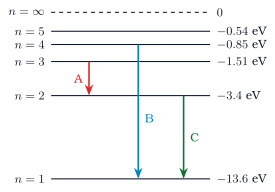
\(1.89\) eV is \(E_3 - E_2\), so the atom drops to \(n = 2\).
The second photon takes it to the ground state: \(E_2 - E_1 = 10.2\) eV. Check: \(1.89 + 10.2 = 12.09\) eV \(= E_3 - E_1\).
How did it go?
Small situations
Q20
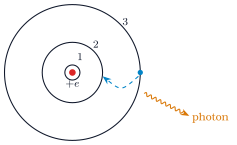
The figure shows the first three Bohr orbits of hydrogen. An electron jumps from orbit \(3\) to orbit \(2\).
Find the radii of orbits \(2\) and \(3\), and their ratio.
Find the ratio of the electron speeds \(v_3 : v_2\).
Find the energy and the wavelength of the emitted photon.
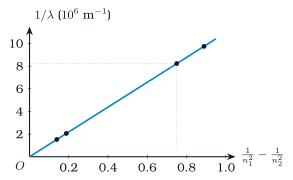
\(H_\alpha\): \(\dfrac{1}{4} - \dfrac{1}{9} = 0.139\), the first point. Lyman \(\alpha\): \(1 - \dfrac{1}{4} = 0.75\), the dotted point.
Slope \(= \dfrac{8.23 \times 10^{6}}{0.75} \approx 1.1 \times 10^{7}\) m\(^{-1}\). This is the Rydberg constant \(R\); the graph is the Rydberg formula drawn as a straight line.
Bracket \(= 1\) means \(n_1 = 1\), \(n_2 = \infty\): \(\dfrac{1}{\lambda} = R\), \(\lambda = 91\) nm. This is the Lyman series limit.
How did it go?
Q22
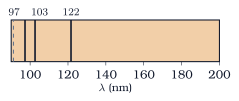
White light of all wavelengths passes through cold hydrogen gas. The figure shows the dark lines seen.
Which series do these lines belong to? Write the transition for each.
Why are no Balmer lines (\(656\) nm, \(486\) nm, ...) absorbed by cold hydrogen?
Answer(i) Lyman: \(2, 3, 4 \to 1\) (ii) ground state
Solution
\(122\), \(103\) and \(97\) nm are Lyman lines. The atom absorbs upward from the ground state: \(1 \to 2\) (\(10.2\) eV), \(1 \to 3\) (\(12.09\) eV) and \(1 \to 4\) (\(12.75\) eV).
A Balmer line is absorbed only by an atom already in \(n = 2\). In cold gas almost every atom is in the ground state \(n = 1\), so only jumps starting from \(n = 1\) (Lyman) are absorbed.
How did it go?
Q23
A hydrogen atom in the ground state absorbs a photon of energy \(15\) eV. What happens to the electron? Find its kinetic energy after the event.
Answerfreed; \(1.4\) eV
Solution
\(15\) eV is more than the ionization energy \(13.6\) eV. The electron is freed from the atom.
Its kinetic energy is the surplus: \(K = 15 - 13.6 = 1.4\) eV.
How did it go?
Q24
The de Broglie wavelength of the electron in orbit \(n\) fits the orbit: \(2\pi r_n = n\lambda\).
Show that this condition is the same as Bohr's rule \(mvr = \frac{nh}{2\pi}\).
Find \(\lambda\) for \(n = 1\) from \(2\pi r_1\). Check it with \(\lambda = \frac{12.27}{\sqrt{K}}\) Å, where \(K = 13.6\) eV.
Answer(i) put \(\lambda = h/mv\) (ii) \(3.33\) Å
Solution
Put \(\lambda = \dfrac{h}{mv}\) in \(2\pi r = n\lambda\): \(2\pi r = \dfrac{nh}{mv}\), so \(mvr = \dfrac{nh}{2\pi}\). Bohr's rule says the orbit holds a whole number of de Broglie waves.
Check: \(K = 13.6\) eV, \(\lambda = \dfrac{12.27}{\sqrt{13.6}} = \dfrac{12.27}{3.69} = 3.33\) Å. The two agree.
How did it go?
Recoil, Finite Nuclear Mass and Atomic Collisions
22 questions · after Lesson 6, Recoil, Reduced Mass and Atomic Collisions
Reduced mass
Q25
Two bodies of masses \(m\) and \(M\) attract each other. Their motion about the centre of mass is that of one body of reduced mass \(\mu = \frac{mM}{m + M}\).
Find \(\mu\) when \(m = M\).
Show that \(\mu \approx m\) when \(M\) is much larger than \(m\). What does this mean for the hydrogen atom?
Answer(i) \(m/2\) (ii) \(\mu \approx m\); fixed proton is fine
\(\mu = \dfrac{m}{1 + m/M}\). When \(M \gg m\), \(m/M \to 0\) and \(\mu \to m\). In hydrogen the proton is \(1836\) times heavier. Treating the proton as fixed and using \(m\) is correct to about one part in \(1836\).
How did it go?
Q26
In a real hydrogen atom the proton is not fixed. Both particles circle the centre of mass. The proton is \(1836\) times heavier than the electron. Find the ratio of the radius of the electron's circle to that of the proton's circle.
Answer\(1836 : 1\)
Solution
The centre of mass stays at rest, so \(m\,r_e = M\,r_p\). Then \(\dfrac{r_e}{r_p} = \dfrac{M}{m} = 1836\). The proton moves in a circle \(1836\) times smaller than the electron's.
How did it go?
Q27
Positronium is an electron and a positron (same mass, opposite charge) bound together. The Bohr formulas hold with \(m\) replaced by \(\mu\). Take \(E_1 = -13.6\) eV and \(r_1 = 0.53\) Å for hydrogen with a fixed nucleus.
Find \(\mu\) in terms of the electron mass \(m\).
Find the ground-state energy and the ionization energy of positronium.
Find the radius of the ground-state orbit.
Answer(i) \(m/2\) (ii) \(-6.8\) eV, \(6.8\) eV (iii) \(1.06\) Å
Solution
Both masses are \(m\): \(\mu = \dfrac{m}{2}\).
\(E_n \propto \mu\), so every energy is halved: \(E_1 = -6.8\) eV. The ionization energy is \(6.8\) eV.
\(r_n \propto \dfrac{1}{\mu}\), so every radius is doubled: \(r_1 = 1.06\) Å.
How did it go?
Q28
Take \(hc = 1240\) eV nm. For positronium, find the wavelength of the \(2 \to 1\) line and of the \(3 \to 2\) line. Compare each with the hydrogen line (\(122\) nm and \(656\) nm).
Answer\(243\) nm, \(1312\) nm; both doubled
Solution
Every level is halved, so every photon energy is halved and every wavelength is doubled.
\(E_1 = -13.6 \times 186 \approx -2530\) eV \(= -2.53\) keV. The muon is bound about \(186\) times more tightly.
\(r_1 = \dfrac{0.53}{186} \approx 2.85 \times 10^{-3}\) Å \(= 2.85 \times 10^{-13}\) m. The muon orbits about \(200\) times closer to the proton than the electron does.
How did it go?
Q30
The Rydberg constant for a fixed nucleus is \(R_\infty = 1.09737 \times 10^{7}\) m\(^{-1}\). For a real atom it is multiplied by \(\frac{\mu}{m} = \frac{M}{M + m}\).
Find \(R_H\) for hydrogen (\(M = 1836\,m\)).
By what percentage does the finite proton mass change the Rydberg constant?
Answer(i) \(1.09677 \times 10^{7}\) m\(^{-1}\) (ii) \(0.054\%\)
Fractional change \(= \dfrac{1}{1837} = 5.4 \times 10^{-4}\), that is \(0.054\%\). Small, but spectrometers measure wavelengths far more precisely than this.
How did it go?
Q31
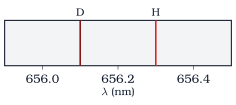
The figure shows the \(H_\alpha\) line (\(656.3\) nm) of ordinary hydrogen and of deuterium, whose nucleus has mass \(3672\,m\).
Why is the deuterium line at a slightly shorter wavelength? Use \(E \propto \mu\).
Show that \(\frac{\lambda_H}{\lambda_D} = \frac{\mu_D}{\mu_H} = \frac{3672 \times 1837}{3673 \times 1836} \approx 1.00027\).
Find the separation of the two lines in nm.
Answer(i) larger \(\mu\), larger \(E\) (ii) \(\lambda \propto 1/\mu\) (iii) \(0.18\) nm; D at \(656.1\) nm
Solution
Deuterium's nucleus is heavier, so its reduced mass is a little larger. The level energies, and the photon energies, are larger in proportion to \(\mu\). A larger photon energy means a shorter wavelength.
\(\lambda \propto \dfrac{1}{E} \propto \dfrac{1}{\mu}\), so \(\dfrac{\lambda_H}{\lambda_D} = \dfrac{\mu_D}{\mu_H}\).
\(\mu_H = \dfrac{1836}{1837}m\) and \(\mu_D = \dfrac{3672}{3673}m\). The ratio is \(\dfrac{3672 \times 1837}{3673 \times 1836} = 1.000272\).
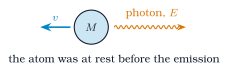
The total momentum was zero before, so it is zero after. The atom has momentum \(5.44 \times 10^{-27}\) kg m/s in the direction opposite to the photon. This is conservation of momentum.
How did it go?
Q33
The mass of the hydrogen atom is \(1.67 \times 10^{-27}\) kg. Find the recoil speed of the atom in Question 8.
Fraction of the photon energy: \(\dfrac{5.5 \times 10^{-8}}{10.2} \approx 5 \times 10^{-9}\). The recoil takes a negligible share.
How did it go?
Q35
The figure shows an atom just after it has emitted a photon. Before the emission the atom was at rest and its energy was \(\Delta E\) above the final level.
Why does the atom move to the left?
Is the photon energy \(E\) equal to, more than, or less than \(\Delta E\)? Write the energy equation.
Answer(i) momentum (ii) less; \(\Delta E = E + K\)
Solution
Momentum is conserved. The photon carries momentum to the right, so the atom must carry an equal momentum to the left.
Less. The energy \(\Delta E\) released by the atom is shared: \(\Delta E = E + K\), where \(K\) is the recoil kinetic energy. So \(E = \Delta E - K\), slightly less than \(\Delta E\).
How did it go?
Q36
Let the recoil momentum be \(p = E/c\) and the recoil kinetic energy be \(K = \frac{p^2}{2M}\).
Show that \(K = \frac{E^2}{2Mc^2}\).
For hydrogen, \(Mc^2 \approx 939\) MeV. Find \(K\) for \(E = 10.2\) eV and check it against Question 10.
Hence show that the photon energy is \(E \approx \Delta E\left(1 - \frac{\Delta E}{2Mc^2}\right)\).
Answer(i) \(p = E/c\) (ii) \(5.5 \times 10^{-8}\) eV (iii) \(E = \Delta E - K\)
\(K = \dfrac{(10.2)^2}{2 \times 939 \times 10^{6}} = \dfrac{104}{1.88 \times 10^{9}} \approx 5.5 \times 10^{-8}\) eV, the same as Question 10.
\(E = \Delta E - K\). Since \(K\) is tiny, put \(E \approx \Delta E\) inside \(K\): \(E \approx \Delta E - \dfrac{\Delta E^2}{2Mc^2} = \Delta E\left(1 - \dfrac{\Delta E}{2Mc^2}\right)\).
How did it go?
Q37
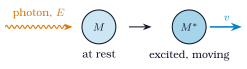
A photon is absorbed by a hydrogen atom at rest, raising it from \(n = 1\) to \(n = 2\) (\(\Delta E = 10.2\) eV).
In which direction does the atom move after the absorption, and why?
Must the photon energy be slightly more or slightly less than \(\Delta E\)? Give the reason.
Find the recoil speed of the atom.
Answer(i) right (ii) more (iii) \(3.3\) m/s
Solution
To the right, the direction of the photon. The photon's momentum \(E/c\) is transferred to the atom.
Slightly more. The photon must supply \(\Delta E\) for the excitation and also the recoil kinetic energy: \(E = \Delta E + K\).
\(p = E/c \approx 5.44 \times 10^{-27}\) kg m/s as before, so \(v = p/M \approx 3.3\) m/s.
How did it go?
Collisions
Q38
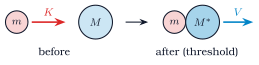
A particle of mass \(m\) and kinetic energy \(K\) hits an atom of mass \(M\) at rest, head on. The atom needs energy \(\Delta E\) to be excited. At the threshold the two move together after the collision.
Why is the kinetic energy after the collision not zero?
Use momentum conservation to show that the kinetic energy after the collision is \(\frac{m}{m + M}K\).
Hence show that \(K_{\min} = \Delta E\,\frac{m + M}{M}\).
Answer(i) momentum must remain (ii) \(K' = \frac{m}{m+M}K\) (iii) \(K_{\min} = \Delta E\frac{m+M}{M}\)
Solution
Momentum must be conserved. The particle brought momentum, so something must carry it after the collision. Moving bodies have kinetic energy, so not all of \(K\) can go into excitation.
Before: momentum \(p = mv\), \(K = \dfrac{p^2}{2m}\). After: the pair of mass \((m + M)\) has the same \(p\), so \(K' = \dfrac{p^2}{2(m + M)}\).
An electron hits a hydrogen atom at rest. Find the least kinetic energy of the electron that can excite the atom to \(n = 2\). Why is the answer so close to \(10.2\) eV?
Answer\(10.2\) eV; \(m \ll M\), atom barely recoils
The electron is so light that the atom hardly moves after the collision. Almost all the electron's kinetic energy is available, so the threshold is nearly \(\Delta E\) itself.
How did it go?
Q42
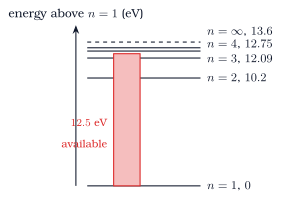
A hydrogen atom with kinetic energy \(25\) eV hits a hydrogen atom at rest, head on. The figure shows the excitation energies of hydrogen.
Find the maximum energy that can go into excitation.
Which levels can the struck atom reach?
Which spectral lines can it then emit? Give their wavelengths (\(hc = 1240\) eV nm).
Answer(i) \(12.5\) eV (ii) \(n = 2, 3\) (iii) \(656\), \(103\), \(122\) nm
Solution
With \(m = M\), the available energy is \(\dfrac{M}{m + M}K = \dfrac{25}{2} = 12.5\) eV, the bar in the figure.
\(12.5\) eV is above \(10.2\) eV (\(n = 2\)) and \(12.09\) eV (\(n = 3\)) but below \(12.75\) eV (\(n = 4\)). The atom can reach \(n = 2\) or \(n = 3\).
From \(n = 3\): \(3 \to 2\) (\(1.89\) eV, \(656\) nm), \(3 \to 1\) (\(12.09\) eV, \(103\) nm) and then \(2 \to 1\) (\(10.2\) eV, \(122\) nm). Three lines in all.
How did it go?
Q43
Two hydrogen atoms move towards each other with equal speeds and collide head on. Find the least kinetic energy of each atom for which one of them can be excited to \(n = 2\). Why is the answer smaller than in Question 15?
Answer\(5.1\) eV each; total momentum zero
Solution
The total momentum is zero, so the atoms can stop dead and all their kinetic energy can go into excitation.
\(2K = 10.2\) eV, so \(K = 5.1\) eV each. In Question 15 the pair had to keep moving to conserve momentum, which wasted half the energy.
How did it go?
Q44
A photon can excite a hydrogen atom from \(n = 1\) to \(n = 2\) only if its energy is \(10.2\) eV. A moving particle can do it with any energy above the threshold. Explain the difference.
Answerphoton absorbed whole; particle keeps the surplus
Solution
A photon is absorbed whole or not at all, and it disappears. Its whole energy must fit the gap \(\Delta E\) exactly (apart from the tiny recoil correction).
A particle survives the collision. It can give the atom exactly \(\Delta E\) and carry away the rest as its own kinetic energy. So any energy above the threshold will do.
How did it go?
Q45
Find the threshold kinetic energy in each case.
A helium atom (mass \(4\) u) hits a hydrogen atom (\(1\) u) at rest and excites it to \(n = 2\).
A hydrogen atom hits a He\(^+\) ion (\(4\) u) at rest and excites it to \(n = 2\) (\(\Delta E = 40.8\) eV).
Answer(i) \(51\) eV (ii) \(51\) eV
Solution
\(m = 4\), \(M = 1\): \(K_{\min} = 10.2 \times \dfrac{4 + 1}{1} = 51\) eV. A heavy projectile on a light target wastes most of its energy in motion.
A hydrogen atom with kinetic energy \(20.4\) eV hits a hydrogen atom at rest, head on, and excites it to \(n = 2\).
Find the total kinetic energy after the collision, and the kinetic energy of each atom.
The excited atom later emits a photon. What is the photon's energy, ignoring recoil?
Answer(i) \(10.2\) eV; \(5.1\) eV each (ii) \(10.2\) eV
Solution
\(20.4\) eV is exactly the threshold, so the atoms move together after the collision. Kinetic energy left \(= \dfrac{m}{m + M}K = \dfrac{20.4}{2} = 10.2\) eV.
The two atoms have the same mass and the same speed, so each has \(5.1\) eV.
The excited atom returns to \(n = 1\) and emits a \(10.2\) eV photon (Lyman \(\alpha\)).