Questions on X-Rays, the kind your examinations ask. Solve one on paper. Then tell the book how it went. The book believes you, and it uses your answer to plan your revision.
0%
Nothing marked yetMark honestly. Peek at the answer only after your own attempt.
X-Rays: Coolidge Tube, Moseley's Law and Bragg's Law
24 questions · after Lesson 5, Bragg's Law: X-Rays Meet a Crystal
Coolidge tube and continuous X-rays
Q1
In a Coolidge tube, electrons from a hot filament are accelerated by a high voltage and strike a metal target.
What produces the X-rays when the electrons hit the target?
Why is the target made of a heavy metal such as tungsten or molybdenum?
Why must the target be cooled?
Answer(i) electrons stopped suddenly (ii) heavy nucleus, high melting point (iii) \(99\%\) is heat
Solution
The electrons are stopped suddenly by the target atoms. A charge that decelerates radiates, and the radiation here is X-rays. Some electrons also knock inner electrons out of target atoms, which then emit characteristic X-rays.
A heavy nucleus decelerates the electrons more strongly, so more of their energy becomes X-rays. A heavy metal also has a high melting point.
About \(99\%\) of the electrons' energy becomes heat in the target. Without cooling the target would melt.
How did it go?
Q2
The shortest wavelength from a tube is \(\lambda_{\min} = \frac{hc}{eV}\). Take \(hc = 12400\) eV Å throughout. Find \(\lambda_{\min}\) for
\(V = 12.4\) kV,
\(V = 31\) kV.
Answer(i) \(1\) Å (ii) \(0.4\) Å
Solution
\(\lambda_{\min} = \dfrac{hc}{eV} = \dfrac{12400}{V}\) Å with \(V\) in volt.
\(\dfrac{12400}{12400} = 1\) Å.
\(\dfrac{12400}{31000} = 0.4\) Å.
How did it go?
Q3
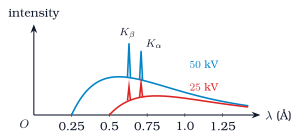
The figure shows the X-ray spectrum of a molybdenum target at two tube voltages.
Read the cut-off wavelength for each voltage. Check both against \(\lambda_{\min} = \frac{hc}{eV}\).
The two sharp peaks are at the same wavelengths for both voltages. Why?
Which part of the spectrum is called continuous, and which characteristic?
Answer(i) \(0.5\) Å, \(0.25\) Å (ii) fixed by target levels (iii) hump; peaks
Solution
The \(25\) kV curve starts at \(0.5\) Å and the \(50\) kV curve at \(0.25\) Å. Check: \(12400/25000 = 0.5\) Å and \(12400/50000 = 0.25\) Å.
The peaks are the characteristic lines of molybdenum. Their wavelengths depend on the energy levels of the target atom, not on the tube voltage.
The smooth hump is the continuous spectrum (bremsstrahlung). The two sharp peaks are the characteristic spectrum.
How did it go?
Q4
Electrons reach the target of a \(25\) kV tube.
Find the kinetic energy of one electron in keV.
Find the maximum energy of an X-ray photon from this tube.
Why do most photons have less than this energy? What gives the continuous spectrum?
Answer(i) \(25\) keV (ii) \(25\) keV (iii) energy lost in steps
Solution
\(K = eV = 25\) keV.
The most energetic photon is made when an electron loses all its energy in one collision: \(25\) keV, which is \(\lambda_{\min} = 0.5\) Å.
Most electrons lose their energy in several steps, and each step gives a photon of only part of the energy. All values from zero to \(25\) keV occur, which makes the spectrum continuous.
How did it go?
Q5
State what happens to the cut-off wavelength and to the intensity of the X-rays in each case.
The tube voltage is doubled.
The filament current is increased at the same voltage.
Answer(i) halves; up (ii) same; up
Solution
\(\lambda_{\min} \propto \dfrac{1}{V}\), so it halves. The electrons are more energetic, so the intensity also rises.
More electrons per second hit the target, so the intensity rises. Their energy is unchanged, so \(\lambda_{\min}\) stays the same.
How did it go?
Q6
A tube runs at \(10\) kV. Take \(e = 1.6 \times 10^{-19}\) C and the electron mass as \(9.1 \times 10^{-31}\) kg.
Find the kinetic energy of an electron at the target in joule and its speed.
Find \(\lambda_{\min}\).
Answer(i) \(1.6 \times 10^{-15}\) J, \(5.9 \times 10^{7}\) m/s (ii) \(1.24\) Å
Solution
\(K = eV = 1.6 \times 10^{-19} \times 10^{4} = 1.6 \times 10^{-15}\) J.
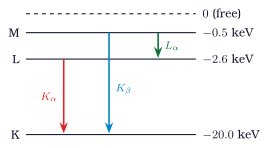
To make a K vacancy the incoming electron must supply \(20\) keV, the binding energy of the K shell. So the tube voltage must be at least \(20\) kV.
How did it go?
Q10
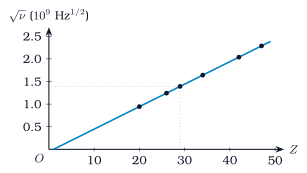
Moseley's law for \(K_\alpha\) lines is \(\sqrt{\nu} = a(Z - 1)\). Copper (\(Z = 29\)) has its \(K_\alpha\) line at \(1.54\) Å. Find the \(K_\alpha\) wavelength of molybdenum (\(Z = 42\)).
Answer\(0.72\) Å
Solution
\(\nu \propto (Z - 1)^2\), so \(\lambda \propto \dfrac{1}{(Z - 1)^2}\).
The line meets the axis at \(Z = 1\). The inner electron feels the nuclear charge reduced by the one remaining K electron, an effective charge \((Z - 1)e\). A hypothetical element with \(Z = 1\) would give zero frequency.
In the Bohr picture, the \(K_\alpha\) photon is a \(2 \to 1\) jump in a field of effective charge \((Z - 1)e\). Take \(Rc = 3.29 \times 10^{15}\) Hz.
Show that \(\nu = \frac{3}{4}Rc\,(Z - 1)^2\).
Hence find the Moseley constant \(a = \sqrt{\frac{3Rc}{4}}\).
Answer(i) \(2 \to 1\) with \(Z - 1\) (ii) \(4.97 \times 10^{7}\) Hz\(^{1/2}\)
Solution
For a hydrogen-like atom \(\nu = Rc\,Z_{eff}^2\left(\dfrac{1}{1^2} - \dfrac{1}{2^2}\right) = \dfrac{3}{4}Rc\,Z_{eff}^2\). With \(Z_{eff} = Z - 1\): \(\nu = \dfrac{3}{4}Rc\,(Z - 1)^2\).
\(\sqrt{\nu} = \sqrt{\dfrac{3Rc}{4}}\,(Z - 1)\), so \(a = \sqrt{0.75 \times 3.29 \times 10^{15}} = \sqrt{2.47 \times 10^{15}} \approx 4.97 \times 10^{7}\) Hz\(^{1/2}\). This matches the graph.
How did it go?
Q13
From Question 12 the \(K_\alpha\) energy is about \(10.2(Z - 1)^2\) eV. Find the \(K_\alpha\) energy in keV and the wavelength for
copper, \(Z = 29\),
molybdenum, \(Z = 42\).
Answer(i) \(8.0\) keV, \(1.55\) Å (ii) \(17.1\) keV, \(0.72\) Å
Why does Moseley's law use \((Z - 1)\) and not \(Z\)?
Why do the characteristic lines not shift when the tube voltage is raised?
Answer(i) screening (ii) fixed levels
Solution
When one K electron is knocked out, one K electron remains. It screens the nucleus, so the electron that jumps in feels a charge of about \((Z - 1)e\), not \(Ze\).
The characteristic photon energy is the difference between two shell energies of the target atom. These energies are fixed by the atom. The tube voltage only decides whether the electrons have enough energy to create the vacancy.
How did it go?
Q15
The \(K_\alpha\) line of an unknown target is at \(0.76\) Å. Use \(E = 10.2(Z - 1)^2\) eV to find its atomic number.
Answer\(Z = 41\)
Solution
\(E = \dfrac{12400}{0.76} \approx 16300\) eV. Then \((Z - 1)^2 = \dfrac{16300}{10.2} \approx 1600\), so \(Z - 1 = 40\) and \(Z = 41\) (niobium).
How did it go?
Bragg's law
Q16
State Bragg's law \(2d\sin\theta = n\lambda\). Explain what \(d\), \(\theta\) and \(n\) stand for.
Answer\(d\) plane spacing, \(\theta\) glancing angle, \(n\) order
Solution
X-rays reflected from successive parallel planes of atoms reinforce when \(2d\sin\theta = n\lambda\).
\(d\) is the distance between neighbouring planes. \(\theta\) is the glancing angle, measured between the ray and the plane (not the normal). \(n = 1, 2, 3, \ldots\) is the order of the maximum.
How did it go?
Q17
X-rays of wavelength \(1.0\) Å fall on a crystal whose planes are \(2.0\) Å apart. Take \(\sin 14.5^\circ = 0.25\).
Find the glancing angles of the first-order and the second-order maxima.
\(\sin\theta \le 1\) needs \(0.25n \le 1\), so \(n \le 4\). The fourth order is at \(\theta = 90^\circ\), the highest possible.
How did it go?
Q18
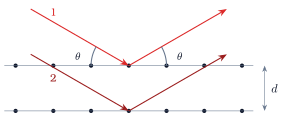
Rays 1 and 2 reflect from two neighbouring planes, a distance \(d\) apart, at glancing angle \(\theta\).
Show that ray 2 travels an extra distance \(2d\sin\theta\).
For what values of this extra distance do the two rays reinforce each other?
Answer(i) \(d\sin\theta\) each way (ii) \(n\lambda\)
Solution
Drop perpendiculars from the reflection point of ray 1 onto ray 2, before and after reflection. Each perpendicular cuts off an extra length \(d\sin\theta\) on ray 2. The total extra path is \(2d\sin\theta\).
The rays reinforce when the extra path is a whole number of wavelengths: \(2d\sin\theta = n\lambda\). That is Bragg's law.
How did it go?
Q19
The first-order maximum for \(1.54\) Å X-rays is at \(\theta = 30^\circ\). Find the spacing \(d\) of the planes.
In rock salt the planes are \(2.82\) Å apart. Find the first-order angle for \(1.41\) Å X-rays.
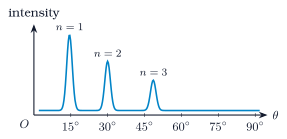
The figure shows the reflected intensity from one set of planes as the glancing angle is varied.
Read the angle of the first-order peak. Find \(\frac{\lambda}{2d}\).
Check that the second peak is at \(30^\circ\).
Is a fourth-order peak possible? At what angle?
Answer(i) \(14.5^\circ\), \(0.25\) (ii) \(\sin\theta = 0.5\) (iii) yes, \(90^\circ\)
Solution
The first peak is at \(14.5^\circ\). \(\sin 14.5^\circ = 0.25 = \dfrac{\lambda}{2d}\).
\(n = 2\): \(\sin\theta = 2 \times 0.25 = 0.5\), \(\theta = 30^\circ\), where the second peak is drawn.
\(n = 4\): \(\sin\theta = 4 \times 0.25 = 1\), \(\theta = 90^\circ\). It is just possible, with the rays perpendicular to the planes.
How did it go?
Q21
Show that the highest order visible is the largest whole number \(n \le \frac{2d}{\lambda}\). Why can no maximum be seen for \(\lambda > 2d\)?
Answer\(\sin\theta \le 1\)
Solution
\(\sin\theta = \dfrac{n\lambda}{2d} \le 1\), so \(n \le \dfrac{2d}{\lambda}\). The highest order is the largest whole number that fits.
If \(\lambda > 2d\), even \(n = 1\) would need \(\sin\theta > 1\), which is impossible. Long waves cannot be diffracted by the crystal; this is why visible light shows no Bragg reflection.
How did it go?
Q22
A crystal with \(d = 1.0\) Å gives a first-order maximum at \(30^\circ\).
Find the wavelength of the X-rays.
What is the least tube voltage that can produce this wavelength?
Only at \(40\) kV. The \(K_\alpha\) line needs a K-shell vacancy, which needs \(20\) keV electrons. At \(15\) kV the electrons cannot remove a K electron, so only the continuous spectrum appears, and it stops at \(0.83\) Å anyway.