Questions on The Nucleus, Binding Energy and Nuclear Reactions, the kind your examinations ask. Solve one on paper. Then tell the book how it went. The book believes you, and it uses your answer to plan your revision.
0%
Nothing marked yetMark honestly. Peek at the answer only after your own attempt.
Nuclear Size, Mass Defect and Binding Energy
24 questions · after Lesson 3, The Binding Energy Curve
Size and density
Q1
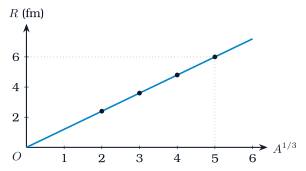
The radius of a nucleus of mass number \(A\) is \(R = R_0 A^{1/3}\) with \(R_0 = 1.2\) fm (\(1\) fm \(= 10^{-15}\) m). Find \(R\) for
\(A = 8\),
\(A = 27\),
\(A = 64\),
\(A = 125\).
Answer(i) \(2.4\) (ii) \(3.6\) (iii) \(4.8\) (iv) \(6.0\) fm
Solution
\(R = 1.2\,A^{1/3}\) fm. The cube roots are \(2\), \(3\), \(4\) and \(5\).
Find the ratio of the radii of the nuclei with \(A = 216\) and \(A = 27\).
Find the ratio of the volumes of the nuclei with \(A = 8\) and \(A = 64\). What does this show about nuclear volume?
Answer(i) \(2:1\) (ii) \(1:8\); \(V \propto A\)
Solution
\(\dfrac{R_{216}}{R_{27}} = \left(\dfrac{216}{27}\right)^{1/3} = 8^{1/3} = 2\). Eight times the nucleons, twice the radius.
\(V \propto R^3 \propto A\). \(\dfrac{V_8}{V_{64}} = \dfrac{8}{64} = \dfrac{1}{8}\). The volume is proportional to the number of nucleons: each nucleon takes the same room, like marbles in a bag.
How did it go?
Q3
Take the mass of one nucleon as \(1.67 \times 10^{-27}\) kg.
Show that the density of a nucleus, \(\rho = \frac{A m}{\frac{4}{3}\pi R^3}\), does not depend on \(A\).
Find this density. Compare it with the density of water, \(10^{3}\) kg/m\(^3\).
Answer(i) \(A\) cancels (ii) \(2.3 \times 10^{17}\) kg/m\(^3\); \(2 \times 10^{14}\) times
Solution
\(\rho = \dfrac{Am}{\frac{4}{3}\pi R_0^3 A} = \dfrac{3m}{4\pi R_0^3}\). The \(A\) cancels, so every nucleus has the same density.
Mass \(\approx 125 \times 1.67 \times 10^{-27} = 2.1 \times 10^{-25}\) kg.
How did it go?
Q6
The Sun has mass \(2 \times 10^{30}\) kg. If it were squeezed to nuclear density, \(2.3 \times 10^{17}\) kg/m\(^3\), what would its radius be? (This is roughly the size of a neutron star.)
\(R = (2.1 \times 10^{12})^{1/3} \approx 1.3 \times 10^{4}\) m \(= 13\) km. The Sun, \(7 \times 10^{5}\) km across, would shrink to the size of a city.
How did it go?
Mass defect and binding energy
Q7
One atomic mass unit is \(1\) u \(= 1.6605 \times 10^{-27}\) kg. Take \(c = 2.998 \times 10^{8}\) m/s and \(1\) eV \(= 1.602 \times 10^{-19}\) J. Show that the energy equivalent of \(1\) u is about \(931.5\) MeV.
In eV: \(\dfrac{1.492 \times 10^{-10}}{1.602 \times 10^{-19}} = 9.316 \times 10^{8}\) eV \(= 931.6\) MeV, which rounds to the usual \(931.5\) MeV.
How did it go?
Q8
The masses are: proton \(1.00728\) u, neutron \(1.00866\) u, deuteron \(2.01355\) u. Take \(1\) u \(= 931.5\) MeV.
Find the mass defect of the deuteron.
Find its binding energy and the binding energy per nucleon.
Answer(i) \(0.00239\) u (ii) \(2.23\) MeV, \(1.11\) MeV
Solution
\(\Delta m = (1.00728 + 1.00866) - 2.01355 = 2.01594 - 2.01355 = 0.00239\) u.
\(B = 0.00239 \times 931.5 \approx 2.23\) MeV. Per nucleon: \(\dfrac{2.23}{2} \approx 1.11\) MeV. The deuteron is loosely bound.
How did it go?
Q9
The mass of the helium-4 nucleus is \(4.00151\) u. Use the proton and neutron masses of Question 8.
Find the mass defect and the binding energy of helium-4.
Find the binding energy per nucleon.
Answer(i) \(0.03037\) u, \(28.3\) MeV (ii) \(7.07\) MeV
Solution
Sum of parts: \(2 \times 1.00728 + 2 \times 1.00866 = 4.03188\) u.
\(\Delta m = 4.03188 - 4.00151 = 0.03037\) u. \(B = 0.03037 \times 931.5 \approx 28.3\) MeV.
\(\dfrac{B}{A} = \dfrac{28.3}{4} \approx 7.07\) MeV, far more than the deuteron's \(1.1\) MeV. Helium-4 is very tightly bound.
How did it go?
Q10
The binding energy per nucleon of iron-56 is \(8.8\) MeV. Find its total binding energy and its mass defect in u.
Answer\(493\) MeV, \(0.529\) u
Solution
\(B = 8.8 \times 56 \approx 493\) MeV.
\(\Delta m = \dfrac{493}{931.5} \approx 0.529\) u, about half a nucleon mass.
How did it go?
Q11
The binding energies of helium-4 and helium-3 are \(28.3\) MeV and \(7.7\) MeV. Find the energy needed to remove one neutron from helium-4. Why is this more than the average binding energy per nucleon?
Answer\(20.6\) MeV; \(^4\)He is a closed, tight core
Solution
Removing one neutron turns \(^4\)He into \(^3\)He. Energy needed \(= B(^4\text{He}) - B(^3\text{He}) = 28.3 - 7.7 = 20.6\) MeV.
The average \(B/A\) is \(7.1\) MeV, but the last nucleon is held by all three others in a closed, very stable arrangement. Breaking it costs much more than the average.
How did it go?
Q12
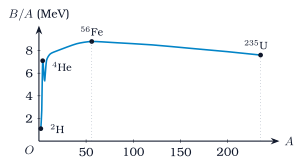
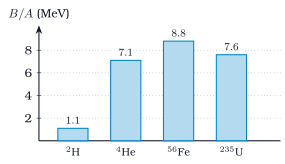
The figure shows the binding energy per nucleon \(B/A\) against the mass number \(A\).
Read \(B/A\) for \(^2\)H, \(^4\)He, \(^{56}\)Fe and \(^{235}\)U.
Which nucleus is the most tightly bound?
In which region of \(A\) does fission release energy, and in which does fusion?
\(^{56}\)Fe, at the peak of the curve. Its nucleons are the hardest to pull apart.
Fission releases energy when a heavy nucleus (\(A > 170\), on the falling part of the curve) splits into pieces with higher \(B/A\). Fusion releases energy when light nuclei (\(A < 30\), on the rising part) join into a nucleus with higher \(B/A\).
How did it go?
Q13
A \(^{235}\)U nucleus (\(B/A = 7.6\) MeV) splits into two fragments of about \(A = 118\) each (\(B/A = 8.5\) MeV). Use the binding energies to estimate the energy released.
The nucleons are bound more tightly by about \(1998 - 1786 \approx 210\) MeV. This energy is released, mostly as kinetic energy of the fragments. The usual figure is \(200\) MeV.
How did it go?
Q14
Two deuterons (\(B/A = 1.1\) MeV) fuse into one helium-4 nucleus (\(B/A = 7.1\) MeV). Estimate the energy released.
Energy released \(= 28.4 - 4.4 = 24\) MeV. Per nucleon this is far more than fission gives, which is why fusion powers the stars.
How did it go?
The curve
Q15
Give the reason in each case.
Why is \(B/A\) almost constant, about \(8\) MeV, for \(A\) from \(30\) to \(170\)?
Why does \(B/A\) fall slowly for heavy nuclei?
Why is \(B/A\) small for very light nuclei?
Answer(i) short range, saturation (ii) Coulomb repulsion (iii) surface nucleons
Solution
The nuclear force has a very short range. Each nucleon binds only to its nearest neighbours, so adding more nucleons adds binding in proportion to \(A\). The force is saturated, and \(B/A\) stays nearly constant.
Every proton repels every other proton electrically, and this force has a long range. In a heavy nucleus the repulsion grows faster than the short-range attraction, so \(B/A\) falls.
In a small nucleus most nucleons are on the surface and have few neighbours to bind to. So the binding per nucleon is low.
How did it go?
Q16
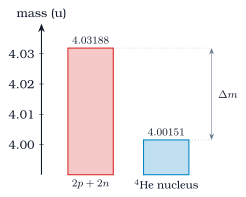
The figure compares the mass of two free protons and two free neutrons with the mass of a helium-4 nucleus.
Read the two masses and find \(\Delta m\).
Find the energy released when the four nucleons come together to form the nucleus.
Where does this energy go?
Answer(i) \(0.03037\) u (ii) \(28.3\) MeV (iii) radiated
Solution
\(2p + 2n\): \(4.03188\) u. \(^4\)He: \(4.00151\) u. \(\Delta m = 0.03037\) u.
\(E = 0.03037 \times 931.5 \approx 28.3\) MeV.
The energy is carried away as gamma-ray photons and as kinetic energy of the products. The nucleus is left lighter by exactly this energy.
How did it go?
Q17
Nucleus X has total binding energy \(500\) MeV and \(A = 60\). Nucleus Y has total binding energy \(1800\) MeV and \(A = 240\). Which nucleus is more stable? Why is \(B/A\), not \(B\), the measure of stability?
AnswerX (\(8.3\) vs \(7.5\) MeV); \(B/A\) is energy per nucleon
Solution
X: \(\dfrac{B}{A} = \dfrac{500}{60} \approx 8.3\) MeV. Y: \(\dfrac{B}{A} = \dfrac{1800}{240} = 7.5\) MeV. X is more stable, although its total \(B\) is smaller.
To break up a nucleus you must free each nucleon. The energy needed per nucleon, \(B/A\), tells how firmly the average nucleon is held. A big nucleus has a large \(B\) only because it has many nucleons.
How did it go?
Q18
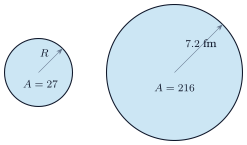
The figure shows two nuclei drawn to scale. The larger has \(A = 216\) and radius \(7.2\) fm.
Find \(R_0\) from the larger nucleus.
Find the radius \(R\) of the smaller nucleus. Check the ratio against the drawing.
Which nucleus has the greater density?
Answer(i) \(1.2\) fm (ii) \(3.6\) fm; \(1:2\) (iii) equal
Solution
\(216^{1/3} = 6\), so \(R_0 = \dfrac{7.2}{6} = 1.2\) fm.
\(27^{1/3} = 3\), so \(R = 1.2 \times 3 = 3.6\) fm. The ratio \(3.6 : 7.2 = 1 : 2\) matches the drawing.
Neither. Nuclear density is the same for every nucleus, about \(2.3 \times 10^{17}\) kg/m\(^3\).
How did it go?
Q19
The binding energy of helium-4 is \(28.3\) MeV.
Express this in joule.
Find the energy needed to break up one mole (\(6.02 \times 10^{23}\)) of helium-4 nuclei into free nucleons.
Answer(i) \(4.5 \times 10^{-12}\) J (ii) \(2.7 \times 10^{12}\) J
\(6.02 \times 10^{23} \times 4.5 \times 10^{-12} \approx 2.7 \times 10^{12}\) J, for only \(4\) g of helium. Nuclear energies are millions of times chemical energies.
How did it go?
Small situations
Q20
State three properties of the nuclear force that make it different from the electric force.
Answershort range, charge independent, saturates
Solution
1. It is very short-ranged: strong up to about \(1\) fm, and practically zero beyond a few fm. The electric force falls off slowly as \(1/r^2\).
2. It is the same for proton-proton, proton-neutron and neutron-neutron pairs: it does not depend on charge.
3. It saturates: a nucleon binds only to its nearest neighbours. It is also about \(100\) times stronger than the electric force at \(1\) fm.
How did it go?
Q21
Each fission of \(^{235}\)U releases about \(200\) MeV. One mole of \(^{235}\)U has mass \(235\) g and contains \(6.02 \times 10^{23}\) nuclei.
Find the number of nuclei in \(1\) kg of \(^{235}\)U.
Find the energy released when all of them undergo fission, in joule.
Answer(i) \(2.56 \times 10^{24}\) (ii) \(8.2 \times 10^{13}\) J
\(200\) MeV \(= 200 \times 1.6 \times 10^{-13} = 3.2 \times 10^{-11}\) J. \(E = 2.56 \times 10^{24} \times 3.2 \times 10^{-11} \approx 8.2 \times 10^{13}\) J. Burning coal gives about \(3 \times 10^{7}\) J per kg, nearly three million times less.
How did it go?
Q22
The figure shows \(B/A\) for four nuclei.
Arrange the four nuclei in order of stability.
Which of them would release energy if split? Which if fused?
An iron-56 nucleus is split into two nuclei of \(A = 28\) with \(B/A = 8.4\) MeV. Is energy released or needed? How much?
Answer(i) Fe, U, He, H (ii) U; H, He (iii) needed, \(22\) MeV
Solution
The order follows \(B/A\). Most stable first: \(^{56}\)Fe, \(^{235}\)U, \(^4\)He, \(^2\)H.
Splitting releases energy only if the pieces have higher \(B/A\): uranium. Fusing releases energy if the product has higher \(B/A\): deuterium and helium.
Before: \(56 \times 8.8 = 492.8\) MeV. After: \(56 \times 8.4 = 470.4\) MeV. The products are less bound, so \(22\) MeV must be supplied. Iron cannot be a nuclear fuel either way.
How did it go?
Q23
Masses are often given in MeV/\(c^2\): proton \(938.3\), neutron \(939.6\). The binding energy of the deuteron is \(2.2\) MeV. Find the mass of the deuteron in MeV/\(c^2\).
Answer\(1875.7\) MeV/\(c^2\)
Solution
Mass of parts \(= 938.3 + 939.6 = 1877.9\) MeV/\(c^2\). The binding energy is missing from the mass: \(m_d = 1877.9 - 2.2 = 1875.7\) MeV/\(c^2\).
How did it go?
Q24
Why is the mass of a nucleus less than the sum of the masses of its nucleons? Where has the missing mass gone?
Answer\(\Delta m = B/c^2\); left as radiation
Solution
To pull the nucleons apart you must do work \(B\) against the nuclear force. So the separated nucleons have energy \(B\) more than the nucleus, and by \(E = mc^2\) they have mass \(B/c^2\) more.
The "missing" mass did not vanish. When the nucleus formed, this energy left as radiation and kinetic energy. Mass and energy together are conserved.
How did it go?
Fission, Chain Reactions and Fusion
22 questions · after Lesson 6, Fusion: the Energy of the Stars
Fission
Q25
Complete each fission equation by finding the number of neutrons released. Check \(Z\) on both sides.
Masses: \(^{235}\)U \(235.0439\) u, \(n\) \(1.0087\) u, \(^{141}\)Ba \(140.9144\) u, \(^{92}\)Kr \(91.9262\) u. Take \(1\) u \(= 931.5\) MeV. Find the energy released in the fission of Question 1(i).
Answer\(0.1859\) u, \(173\) MeV
Solution
Before: \(235.0439 + 1.0087 = 236.0526\) u. After: \(140.9144 + 91.9262 + 3 \times 1.0087 = 235.8667\) u.
\(\Delta m = 0.1859\) u. \(E = 0.1859 \times 931.5 \approx 173\) MeV. The fragments are also radioactive, and their later decays bring the total to about \(200\) MeV.
How did it go?
Q27
The binding energy per nucleon is about \(7.6\) MeV for uranium and about \(8.5\) MeV for nuclei near \(A = 118\). Use these to explain why fission releases roughly \(200\) MeV.
Answer\(\approx 0.9 \times 235\) MeV
Solution
Each of the \(235\) nucleons is bound by about \(7.6\) MeV in uranium and about \(8.5\) MeV in the fragments. Every nucleon becomes more tightly bound by about \(0.9\) MeV.
Energy released \(\approx 0.9 \times 235 \approx 210\) MeV, close to \(200\) MeV. The energy comes from the fall in mass as binding increases.
How did it go?
Q28
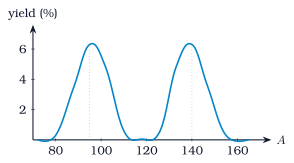
The figure shows how often each fragment mass appears when \(^{235}\)U fissions.
Read the two most common fragment masses.
Add them. Why is the sum a little less than \(236\)?
Is the nucleus more likely to split into equal halves or unequal parts?
Answer(i) \(95\), \(140\) (ii) \(235\); neutrons (iii) unequal
Solution
The humps are at \(A \approx 95\) and \(A \approx 140\).
\(95 + 140 = 235\). The compound nucleus has \(A = 236\), but two or three neutrons are set free, so the two fragments share only about \(233\) to \(234\). (The humps are broad; the sum of the most common pair is roughly this.)
Unequal parts. Equal halves (\(A = 118\)) are near the dip in the middle: they are rare.
How did it go?
Q29
A reactor produces \(1000\) MW of heat. Each fission gives \(200\) MeV \(= 3.2 \times 10^{-11}\) J.
Find the number of fissions per second.
Find the mass of \(^{235}\)U used in one day. (\(6.02 \times 10^{23}\) nuclei have mass \(235\) g.)
Answer(i) \(3.1 \times 10^{19}\) s\(^{-1}\) (ii) \(1.05\) kg
Mass \(= \dfrac{2.7 \times 10^{24}}{6.02 \times 10^{23}} \times 235 \approx 1050\) g \(\approx 1.05\) kg. About one kilogram of uranium a day for a large power station.
How did it go?
Q30
Fission neutrons leave with energies of about \(2\) MeV.
Why must they be slowed down before they can keep a chain reaction going in \(^{235}\)U?
What is a moderator? Name two.
Why are light nuclei better moderators than heavy ones?
Answer(i) slow \(n\) fission \(^{235}\)U (ii) slows \(n\); water, graphite (iii) equal masses share energy
Solution
\(^{235}\)U captures slow (thermal) neutrons far more readily than fast ones. Fast neutrons mostly escape or are caught by \(^{238}\)U without fission.
A moderator is a material in which neutrons lose energy by elastic collisions until they are thermal. Ordinary water, heavy water and graphite are used.
In an elastic collision the energy transferred is greatest when the two masses are equal. A neutron bouncing off a proton can lose all its energy; bouncing off a heavy nucleus it loses almost none.
How did it go?
Q31
A neutron (mass \(1\)) hits a nucleus of mass number \(A\) at rest, head on and elastically. It loses the fraction \(\frac{4A}{(1 + A)^2}\) of its kinetic energy. Find this fraction for
hydrogen, \(A = 1\),
carbon, \(A = 12\),
uranium, \(A = 238\).
Answer(i) \(1\) (ii) \(0.28\) (iii) \(0.017\)
Solution
\(\dfrac{4 \times 1}{2^2} = 1\). All of it, in one head-on collision.
\(\dfrac{48}{169} \approx 0.28\).
\(\dfrac{952}{239^2} = \dfrac{952}{57121} \approx 0.017\). Only \(1.7\%\); uranium itself is useless as a moderator.
How did it go?
Chain reaction
Q32
Define the multiplication factor \(k\) of a chain reaction. What happens when \(k < 1\), \(k = 1\) and \(k > 1\)? Which value does a working reactor keep?
Answerratio of fissions per generation; dies, steady, grows; \(k = 1\)
Solution
\(k\) is the ratio of the number of fissions in one generation to the number in the previous generation.
\(k < 1\): subcritical, the reaction dies out. \(k = 1\): critical, a steady rate. \(k > 1\): supercritical, the rate grows without limit (a bomb). A working reactor is held at \(k = 1\) by its control rods.
How did it go?
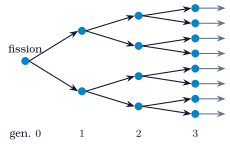
Q33
The figure shows a chain reaction. Each fission leads to two more.
What is \(k\) here? How many fissions occur in generation \(3\)?
How many fissions occur in generation \(10\)?
Find the total energy released in generation \(10\) if each fission gives \(200\) MeV.
Each fission leads to two more, so \(k = 2\). Generation \(3\) has \(2^3 = 8\) fissions (the eight dots on the right).
Generation \(10\): \(2^{10} = 1024\) fissions.
\(1024 \times 200 = 2.05 \times 10^{5}\) MeV \(= 2.05 \times 10^{5} \times 1.6 \times 10^{-13}\) J \(\approx 3.3 \times 10^{-8}\) J. Still tiny; the danger is that generations take only about a microsecond each.
How did it go?
Q34
In a reactor \(k = 1.01\) for a short time. The number of fissions per generation grows as \(N = N_0 k^n\). Take \((1.01)^{100} \approx 2.7\), \(\ln 1000 = 6.9\) and \(\ln 1.01 = 0.01\).
By what factor does the fission rate grow in \(100\) generations?
After how many generations is the rate \(1000\) times larger?
Answer(i) \(2.7\) (ii) \(690\)
Solution
\(\dfrac{N}{N_0} = (1.01)^{100} \approx 2.7\). Even \(1\%\) above critical, the rate nearly triples in \(100\) generations.
Why does a very small lump of \(^{235}\)U not sustain a chain reaction?
Why does a sphere need less mass than a thin sheet of the same material?
Answer(i) neutrons escape the surface (ii) least surface for its volume
Solution
Neutrons are born throughout the volume but escape through the surface. In a small lump the surface is large compared with the volume, so most neutrons leave before they meet a \(^{235}\)U nucleus. \(k\) stays below \(1\).
For a given mass a sphere has the smallest surface area, so the fewest neutrons escape. A thin sheet lets nearly every neutron out through its two faces. The critical mass is the least mass for which \(k\) reaches \(1\).
How did it go?
Q36
State the job of each part of a thermal reactor: fuel rods, moderator, control rods, coolant, shielding. Name one material used for each.
AnswerU fuel, water moderator, Cd rods, water coolant, concrete shield
Solution
Fuel rods: hold the fissile material (enriched uranium oxide) where neutrons can reach it.
Moderator: slows the neutrons to thermal speeds (water, heavy water, graphite).
Control rods: absorb neutrons to hold \(k\) at \(1\) or shut the reactor down (cadmium, boron steel).
Coolant: carries heat from the core to the heat exchanger and boiler (water, liquid sodium, CO\(_2\)).
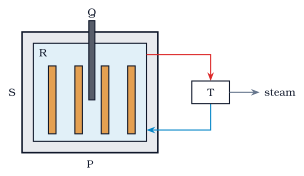
The figure is a schematic of a reactor. Identify the parts P (outer wall), Q (rod from above), R (liquid in the core), S (the block) and T (box in the loop). State what each does.
AnswerP shield, Q control rod, R moderator, S core, T heat exchanger
Solution
P: the thick outer wall is the shielding (concrete), stopping radiation.
Q: the dark rod that can be pushed into the core is a control rod (cadmium or boron); it absorbs neutrons.
R: the liquid around the fuel rods is the moderator, and here also the coolant (water).
S: the whole block is the reactor core, fuel rods in the moderator.
T: the box in the loop is the heat exchanger. Hot coolant (red) gives its heat to water, making steam for the turbine, and returns cold (blue).
How did it go?
Fusion
Q38
In the Sun, four protons end up as one helium-4 nucleus: \(4\,{}^1\)H \(\to {}^4\)He \(+ 2e^+ + 2\nu\). Atomic masses: \(^1\)H \(1.00783\) u, \(^4\)He \(4.00260\) u. Find the energy released per helium nucleus formed. (Using atomic masses takes care of the positrons.)
Answer\(0.02872\) u, \(26.7\) MeV
Solution
\(\Delta m = 4 \times 1.00783 - 4.00260 = 4.03132 - 4.00260 = 0.02872\) u.
\(E = 0.02872 \times 931.5 \approx 26.7\) MeV per helium nucleus, of which the neutrinos carry away a little.
How did it go?
Q39
Write the three steps of the proton-proton chain. In the carbon-nitrogen cycle, what is the role of the carbon nucleus?
In the carbon-nitrogen cycle a \(^{12}\)C nucleus captures protons one by one and passes through nitrogen and oxygen isotopes. At the end it gives back a \(^{12}\)C and a \(^4\)He. The carbon is not used up; it is a catalyst.
How did it go?
Q40
The Sun radiates \(3.9 \times 10^{26}\) W. Take \(c = 3 \times 10^{8}\) m/s.
How many helium nuclei are formed per second, if each gives \(26.7\) MeV \(= 4.27 \times 10^{-12}\) J?
Find the mass the Sun loses each second.
Answer(i) \(9.1 \times 10^{37}\) (ii) \(4.3 \times 10^{9}\) kg
\(E = mc^2\), so \(\dfrac{dm}{dt} = \dfrac{P}{c^2} = \dfrac{3.9 \times 10^{26}}{9 \times 10^{16}} \approx 4.3 \times 10^{9}\) kg/s. Four million tonnes a second, yet the Sun can go on for billions of years.
How did it go?
Q41
Two protons must come within about \(2\) fm for the nuclear force to act. Take \(k = 9 \times 10^{9}\) N m\(^2\)/C\(^2\) and \(e = 1.6 \times 10^{-19}\) C. Find their electric potential energy at this separation in joule and in MeV. This is the Coulomb barrier.
First, \(\frac32 kT\) is only the average; a small fraction of protons in the high-energy tail have far more. Second, quantum tunnelling lets protons pass through the barrier even when \(K\) is below its top. Both together make fusion slow but steady at \(1.5 \times 10^{7}\) K.
How did it go?
Q43
The reaction \(^2\)H \(+ {}^3\)H \(\to {}^4\)He \(+ n\) releases \(17.6\) MeV. The fuel for one reaction has mass \(5\) u \(= 8.3 \times 10^{-27}\) kg.
Find the energy released per kilogram of fuel.
Fission of \(1\) kg of \(^{235}\)U gives \(8.2 \times 10^{13}\) J. How many times better is the fusion fuel per kilogram?
Answer(i) \(3.4 \times 10^{14}\) J (ii) \(\approx 4\)
Solution
Reactions per kg \(= \dfrac{1}{8.3 \times 10^{-27}} = 1.2 \times 10^{26}\).
Energy \(= 1.2 \times 10^{26} \times 17.6 \times 1.6 \times 10^{-13} \approx 3.4 \times 10^{14}\) J.
\(\dfrac{3.4 \times 10^{14}}{8.2 \times 10^{13}} \approx 4\). Fusion fuel gives about four times more energy per kilogram than fission fuel.
How did it go?
Q44
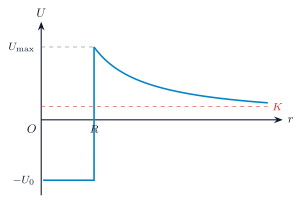
The figure shows the potential energy of two protons against their separation \(r\). The dashed red line is their kinetic energy \(K\).
Which part of the curve is the electric repulsion, and which is the nuclear attraction?
In classical physics, can protons with this \(K\) reach \(r < R\)? Why?
What does quantum mechanics allow that makes fusion possible at \(K < U_{\max}\)?
Answer(i) hill; well (ii) no (iii) tunnelling
Solution
The hill outside \(r = R\), falling as \(1/r\), is the electric repulsion. The deep flat well inside \(R\) is the strong nuclear attraction.
No. Classically a particle cannot enter a region where \(U > K\); its kinetic energy would be negative. The protons would stop and turn back at the point where the red line meets the curve.
Tunnelling. The proton's wave has a small but non-zero amplitude beyond the barrier, so there is a small probability of appearing inside the well. With enormous numbers of protons, this small probability gives a steady fusion rate.
How did it go?
Q45
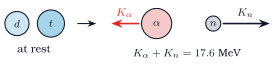
A deuteron and a triton, both nearly at rest, fuse as shown and release \(17.6\) MeV.
Why do the \(\alpha\) particle and the neutron fly apart in opposite directions with equal momenta?
Show that \(\frac{K_n}{K_\alpha} = 4\) and find \(K_n\) and \(K_\alpha\).
Answer(i) zero total momentum (ii) \(14.1\) MeV, \(3.5\) MeV
Solution
The reactants are at rest, so the total momentum is zero. After the reaction the two products must have equal and opposite momenta.
With equal momenta \(p\), \(K = \dfrac{p^2}{2m}\), so \(\dfrac{K_n}{K_\alpha} = \dfrac{m_\alpha}{m_n} = \dfrac{4}{1}\).
\(K_n + K_\alpha = 17.6\) MeV: \(K_n = \dfrac45 \times 17.6 = 14.1\) MeV and \(K_\alpha = 3.5\) MeV. The light neutron takes most of the energy.
How did it go?
Q46
Give two reasons why a fusion power station is much harder to build than a fission reactor. Give two reasons why it would be worth building.
Harder: the fuel must be heated to over \(10^{8}\) K to cross the Coulomb barrier, and no solid wall can hold such a plasma. It must be confined by magnetic fields or by inertia. The confinement must last long enough, at high enough density, to give back more energy than was put in.
Worth it: deuterium is plentiful in sea water and the fuel is cheap. The products (helium) are not radioactive, there is no long-lived waste, and a runaway chain reaction is impossible.