Questions on Radioactivity, the kind your examinations ask. Solve one on paper. Then tell the book how it went. The book believes you, and it uses your answer to plan your revision.
0%
Nothing marked yetMark honestly. Peek at the answer only after your own attempt.
Simultaneous Decay, Equilibrium and Q-Value
22 questions · after Lesson 5, Two Paths and Chains
Two decay channels
Q1
A nucleus can decay by \(\alpha\) emission (decay constant \(\lambda_1\)) or by \(\beta\) emission (decay constant \(\lambda_2\)).
Write the rate of decrease of \(N\) due to each mode, and the total rate.
Show that \(N = N_0 e^{-(\lambda_1 + \lambda_2)t}\), so the effective decay constant is \(\lambda = \lambda_1 + \lambda_2\).
The \(\alpha\) mode removes \(\lambda_1 N\) nuclei per second and the \(\beta\) mode removes \(\lambda_2 N\). Total: \(\dfrac{dN}{dt} = -\lambda_1 N - \lambda_2 N = -(\lambda_1 + \lambda_2)N\).
This is the ordinary decay equation with \(\lambda = \lambda_1 + \lambda_2\). Its solution is \(N = N_0 e^{-(\lambda_1 + \lambda_2)t}\). Decay constants add because the two chances of decay add.
How did it go?
Q2
The half-life for the \(\alpha\) mode alone would be \(20\) min, and for the \(\beta\) mode alone \(30\) min. Find the effective half-life of the nucleus.
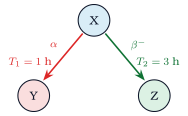
The figure shows the two decay routes of a nucleus X, with the half-life each route would have on its own.
Find the effective half-life of X.
Find the fraction of X nuclei that end up as Y.
After \(45\) min, what fraction of the original X remains?
Answer(i) \(45\) min (ii) \(\frac34\) (iii) \(\frac12\)
Solution
\(\dfrac{1}{T} = \dfrac{1}{1} + \dfrac{1}{3} = \dfrac{4}{3}\) h\(^{-1}\), so \(T = \dfrac34\) h \(= 45\) min.
Fraction to Y \(= \dfrac{\lambda_1}{\lambda_1 + \lambda_2} = \dfrac{1}{4/3} = \dfrac34\). Three quarters of the X nuclei become Y.
\(45\) min is one effective half-life, so \(\dfrac12\) remains.
How did it go?
Q6
The mean lives for two decay modes of a nucleus are \(\tau_1 = 2\) h and \(\tau_2 = 6\) h. Show that the effective mean life is \(\tau = \frac{\tau_1\tau_2}{\tau_1 + \tau_2}\) and find it.
Answer\(1.5\) h
Solution
\(\lambda = \dfrac{1}{\tau}\), so \(\dfrac{1}{\tau} = \dfrac{1}{\tau_1} + \dfrac{1}{\tau_2} = \dfrac{\tau_1 + \tau_2}{\tau_1\tau_2}\) and \(\tau = \dfrac{\tau_1\tau_2}{\tau_1 + \tau_2}\).
\(\tau = \dfrac{2 \times 6}{2 + 6} = 1.5\) h.
How did it go?
Successive decay and equilibrium
Q7
Consider the chain A \(\to\) B \(\to\) C. Nucleus A decays to B with constant \(\lambda_A\). B decays to C with constant \(\lambda_B\).
Write the equation for \(\frac{dN_B}{dt}\). Explain the two terms.
\(\dfrac{dN_B}{dt} = \lambda_A N_A - \lambda_B N_B\). The first term is the rate at which A decays into B (B is created). The second is the rate at which B itself decays into C (B is lost).
\(N_B\) is constant when \(\dfrac{dN_B}{dt} = 0\), that is, when \(\lambda_A N_A = \lambda_B N_B\): B is destroyed as fast as it is made.
How did it go?
Q8
When the parent lives far longer than the daughter, the two reach secular equilibrium: \(\lambda_A N_A = \lambda_B N_B\).
Show that \(\frac{N_B}{N_A} = \frac{T_B}{T_A}\), the ratio of the half-lives.
Radium-226 (\(T = 1600\) y) decays to radon-222 (\(T = 3.8\) days). Find \(\frac{N_{Rn}}{N_{Ra}}\) in equilibrium.
Answer(i) \(\lambda_A/\lambda_B = T_B/T_A\) (ii) \(6.5 \times 10^{-6}\)
Mass \(= \dfrac{1.75 \times 10^{16}}{6.02 \times 10^{23}} \times 222 \approx 6.5 \times 10^{-6}\) g \(= 6.5\ \mu\)g. A tiny mass, yet as active as the whole gram of radium.
How did it go?
Q11
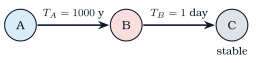
The figure shows a decay chain that has reached equilibrium.
Find the ratio of the numbers of B and A nuclei.
Compare the activities of A and B.
Does \(N_C\) stay constant? Why?
Answer(i) \(2.7 \times 10^{-6}\) (ii) equal (iii) no, grows
In equilibrium \(\lambda_A N_A = \lambda_B N_B\): the activities are equal. Every B that decays is replaced by a fresh one from A.
No. C is stable and is created at the rate \(\lambda_B N_B\), so \(N_C\) grows steadily.
How did it go?
Q12
In secular equilibrium the daughter has the same activity as the parent, yet there is almost none of it. Explain how both statements can be true.
Answer\(\lambda N\) equal: large \(\lambda\), small \(N\)
Solution
Activity is \(\lambda N\), the number decaying per second. The daughter has a huge \(\lambda\) (short half-life) and a tiny \(N\); the parent has a tiny \(\lambda\) and a huge \(N\). The products are equal.
The daughter is like a small tank with a wide outlet, fed by a slow tap. The level stays low, but the outflow equals the inflow.
How did it go?
Q-value of reactions
Q13
The \(Q\)-value of a reaction is \(Q = (m_{initial} - m_{final})c^2\). Take \(1\) u \(= 931.5\) MeV. Masses: \(^{14}\)N \(14.00307\) u, \(^4\)He \(4.00260\) u, \(^{17}\)O \(16.99913\) u, \(^1\)H \(1.00783\) u.
Find \(Q\) for \(^{14}\)N \(+\ ^4\)He \(\to\ ^{17}\)O \(+\ ^1\)H.
Is the reaction exothermic or endothermic? What does the sign of \(Q\) tell you?
Answer(i) \(-1.20\) MeV (ii) endothermic
Solution
Initial mass: \(14.00307 + 4.00260 = 18.00567\) u. Final mass: \(16.99913 + 1.00783 = 18.00696\) u.
\(Q < 0\): endothermic. The products are heavier than the reactants, so \(1.20\) MeV of kinetic energy must be supplied and turned into mass. A positive \(Q\) would mean energy released.
How did it go?
Q14
Masses: \(^2\)H \(2.01410\) u, \(^3\)He \(3.01603\) u, \(n\) \(1.00866\) u. Find \(Q\) for \(^2\)H \(+\ ^2\)H \(\to\ ^3\)He \(+ n\).
Answer\(3.27\) MeV
Solution
Initial: \(2 \times 2.01410 = 4.02820\) u. Final: \(3.01603 + 1.00866 = 4.02469\) u.
\(Q = 0.00351 \times 931.5 \approx 3.27\) MeV, released as kinetic energy of the products.
How did it go?
Q15
Masses: \(^7\)Li \(7.01600\) u, \(^1\)H \(1.00783\) u, \(^4\)He \(4.00260\) u. Find \(Q\) for \(^7\)Li \(+\ ^1\)H \(\to 2\,^4\)He.
Answer\(17.35\) MeV
Solution
Initial: \(7.01600 + 1.00783 = 8.02383\) u. Final: \(2 \times 4.00260 = 8.00520\) u.
\(Q = 0.01863 \times 931.5 \approx 17.35\) MeV. This large release is why the reaction was one of the first studied with accelerated protons.
How did it go?
Q16
A proton of kinetic energy \(1\) MeV hits a nucleus at rest. The products together have kinetic energy \(4\) MeV. Find the \(Q\)-value of the reaction. Write the energy equation you used.
Answer\(3\) MeV
Solution
Energy conservation: \(K_{initial} + Q = K_{final}\), so \(Q = K_{final} - K_{initial} = 4 - 1 = 3\) MeV.
The products carry more kinetic energy than came in; the extra \(3\) MeV came from the mass lost in the reaction.
How did it go?
Q17
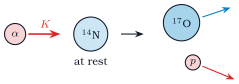
An \(\alpha\) particle hits a \(^{14}\)N nucleus at rest, as shown. The reaction has \(Q = -1.20\) MeV.
Why is a kinetic energy of exactly \(1.20\) MeV not enough to make the reaction happen?
The threshold energy is \(K_{th} = |Q|\,\frac{m + M}{M}\), with \(m\) the projectile mass and \(M\) the target mass. Find \(K_{th}\).
Answer(i) momentum must remain (ii) \(1.54\) MeV
Solution
The \(\alpha\) particle brings momentum. After the collision the products must carry the same momentum, so they cannot be at rest. Some kinetic energy must remain as motion, and is not available to supply \(|Q|\).
Derive the threshold formula of Question 17. At threshold the products move together with the velocity of the centre of mass. Use momentum conservation to find the kinetic energy that must remain after the collision.
Answer\(K - \frac{m}{m+M}K = |Q|\)
Solution
Before: momentum \(p = \sqrt{2mK}\). At threshold all products move together with total mass \(m + M\) and the same \(p\). Their kinetic energy is \(K' = \dfrac{p^2}{2(m + M)} = \dfrac{m}{m + M}K\).
The energy available for the reaction is \(K - K' = \dfrac{M}{m + M}K\). Setting this equal to \(|Q|\): \(K_{th} = |Q|\,\dfrac{m + M}{M}\).
How did it go?
Small situations
Q19
For the reaction \(^7\)Li \(+ p \to 2\alpha\) of Question 15, \(Q\) is positive.
Is there a threshold kinetic energy for the proton from energy conservation alone?
Why does the proton still need some kinetic energy for the reaction to occur in practice?
Answer(i) no (ii) Coulomb barrier
Solution
No. With \(Q > 0\) the products can be made even from reactants at rest; energy is released, not needed.
The proton and the lithium nucleus are both positive. They repel, and the proton must have enough kinetic energy to come within reach of the short-range nuclear force. This Coulomb barrier, not \(Q\), sets the practical minimum.
How did it go?
Q20
A photon can split a deuteron: \(\gamma + {}^2\)H \(\to p + n\), with \(Q = -2.22\) MeV. The deuteron rest energy is \(Mc^2 = 1876\) MeV.
What is the least photon energy, ignoring the recoil of the products?
The exact threshold is \(|Q|\left(1 + \frac{|Q|}{2Mc^2}\right)\). By how much does the recoil raise the threshold?
Answer(i) \(2.22\) MeV (ii) \(1.3\) keV
Solution
The photon must supply at least \(|Q| = 2.22\) MeV, the binding energy of the deuteron.
Correction \(= |Q| \times \dfrac{|Q|}{2Mc^2} = 2.22 \times \dfrac{2.22}{2 \times 1876} = 2.22 \times 5.9 \times 10^{-4} \approx 1.3 \times 10^{-3}\) MeV \(= 1.3\) keV. The recoil correction is tiny because the deuteron is so heavy compared with the photon energy.
How did it go?
Q21
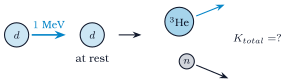
A deuteron of kinetic energy \(1\) MeV hits a deuteron at rest and the reaction of Question 14 takes place (\(Q = 3.27\) MeV).
Find the total kinetic energy of the products.
Is the total momentum of the products zero? Give the reason.
No. The incoming deuteron had momentum and the target had none, so the total momentum was not zero. It is conserved, so the products together carry the same momentum along the original direction.
How did it go?
Q22
A slow neutron (kinetic energy about zero) is captured: \(n + {}^{10}\)B \(\to {}^7\)Li \(+ \alpha\), with \(Q = 2.79\) MeV. Both products move off from rest.
Why do the two products have equal and opposite momenta?
Show that \(\frac{K_\alpha}{K_{Li}} = \frac{7}{4}\) and find \(K_\alpha\) and \(K_{Li}\).
Answer(i) zero initial momentum (ii) \(1.78\) MeV, \(1.01\) MeV
Solution
The neutron and the boron nucleus are both practically at rest, so the total momentum is zero. The two products must have equal and opposite momenta.
The electron has \(A = 0\), \(Z = -1\). So \(A = 14\), \(Z = 6 + 1 = 7\): \(^{14}_{7}\)N.
The positron has \(Z = +1\). So \(A = 22\), \(Z = 11 - 1 = 10\): \(^{22}_{10}\)Ne.
How did it go?
Q24
State how \(A\) and \(Z\) change in \(\alpha\) decay, \(\beta^-\) decay, \(\beta^+\) decay and \(\gamma\) decay. What actually happens inside the nucleus in \(\beta^-\) decay?
\(\alpha\): \(A\) falls by \(4\), \(Z\) falls by \(2\). \(\beta^-\): \(A\) unchanged, \(Z\) rises by \(1\). \(\beta^+\): \(A\) unchanged, \(Z\) falls by \(1\). \(\gamma\): \(A\) and \(Z\) unchanged; the nucleus only loses energy.
In \(\beta^-\) decay a neutron inside the nucleus turns into a proton: \(n \to p + e^- + \bar{\nu}\). The electron and the antineutrino are created at that moment and leave; they were not in the nucleus before.
How did it go?
Q25
The atomic masses are: \(^{238}\)U \(238.05079\) u, \(^{234}\)Th \(234.04363\) u, \(^4\)He \(4.00260\) u. Take \(1\) u \(= 931.5\) MeV. Find the \(Q\)-value of the \(\alpha\) decay of \(^{238}\)U.
Answer\(4.25\) MeV
Solution
\(\Delta m = 238.05079 - (234.04363 + 4.00260) = 238.05079 - 238.04623 = 0.00456\) u.
\(Q = 0.00456 \times 931.5 \approx 4.25\) MeV. The electron masses cancel because atomic masses are used on both sides.
How did it go?
Q26
The atomic masses of \(^{14}\)C and \(^{14}\)N are \(14.003242\) u and \(14.003074\) u.
Find the \(Q\)-value of the \(\beta^-\) decay of \(^{14}\)C.
Why can the emitted electron have any energy from zero up to this \(Q\)-value?
Answer(i) \(0.156\) MeV (ii) shared with \(\bar{\nu}\)
Solution
\(\Delta m = 14.003242 - 14.003074 = 0.000168\) u. \(Q = 0.000168 \times 931.5 \approx 0.156\) MeV. (The atomic mass of nitrogen already includes the extra electron.)
Three bodies share the energy: the daughter nucleus, the electron and the antineutrino. The energy can be divided between the electron and the antineutrino in any proportion. So the electron energy is spread from \(0\) to \(Q\).
How did it go?
Q27
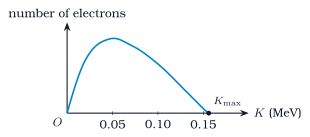
The figure shows the energy spectrum of the electrons from \(^{14}\)C.
Read the maximum kinetic energy \(K_{\max}\).
An electron is found with \(0.06\) MeV. What carries the remaining energy?
Why did the continuous spectrum once seem to break energy conservation?
Answer(i) \(0.156\) MeV (ii) antineutrino (iii) two bodies give one energy
Solution
The curve reaches zero at \(K_{\max} = 0.156\) MeV, the \(Q\)-value of the decay.
The antineutrino carries the rest, about \(0.156 - 0.06 = 0.096\) MeV (apart from the tiny recoil of the nucleus).
If only the electron and the nucleus were produced, every electron would have the same energy, as in \(\alpha\) decay. The spread suggested that energy was lost. Pauli proposed the neutrino, an unseen third particle, to carry the missing energy.
How did it go?
Q28
A \(^{238}\)U nucleus at rest decays with \(Q = 4.25\) MeV. The \(\alpha\) particle (\(A = 4\)) and the \(^{234}\)Th nucleus fly apart.
Why do the two products have equal and opposite momenta?
Show that the \(\alpha\) particle gets \(K_\alpha = Q\,\frac{234}{238}\). Find \(K_\alpha\) and the recoil energy of thorium.
Answer(i) momentum, from rest (ii) \(4.18\) MeV, \(0.07\) MeV
Solution
The nucleus was at rest, so the total momentum was zero. After the decay the two products must still have zero total momentum: equal magnitudes, opposite directions.
With equal momenta \(p\), \(K = \dfrac{p^2}{2m} \propto \dfrac{1}{m}\). So \(\dfrac{K_\alpha}{K_{Th}} = \dfrac{234}{4}\) and \(K_\alpha = Q\,\dfrac{234}{238}\).
\(K_\alpha = 4.25 \times \dfrac{234}{238} \approx 4.18\) MeV. Thorium gets \(4.25 - 4.18 = 0.07\) MeV. The light particle takes almost all the energy.
How did it go?
Decay law
Q29
A sample has half-life \(T_{1/2} = 6.93\) h. Take \(\ln 2 = 0.693\).
Find the decay constant \(\lambda\) and the mean life \(\tau\).
What does \(\lambda = 0.1\) per hour mean for one nucleus?
Answer(i) \(0.1\) h\(^{-1}\), \(10\) h (ii) \(10\%\) chance per hour
Each nucleus has a probability of \(0.1\) of decaying in any one hour, no matter how old it is. Which nucleus decays is pure chance; only the average rate is fixed.
How did it go?
Q30
Find the fraction of the original nuclei that remains, and the fraction that has decayed, after
one half-life,
three half-lives,
five half-lives.
Answer(i) \(\frac12\), \(\frac12\) (ii) \(\frac18\), \(\frac78\) (iii) \(\frac{1}{32}\), \(\frac{31}{32}\)
Solution
After \(n\) half-lives the fraction remaining is \(\dfrac{1}{2^n}\) and the fraction decayed is \(1 - \dfrac{1}{2^n}\).
\(\dfrac12\) remains, \(\dfrac12\) has decayed.
\(\dfrac18\) remains, \(\dfrac78\) has decayed.
\(\dfrac{1}{32}\) remains, \(\dfrac{31}{32}\) has decayed.
How did it go?
Q31
A sample contains \(8 \times 10^{20}\) nuclei of half-life \(5\) days.
How many nuclei remain after \(15\) days? How many have decayed?
Find the initial activity \(A_0 = \lambda N_0\) in becquerel.
Answer(i) \(10^{20}\), \(7 \times 10^{20}\) (ii) \(1.3 \times 10^{15}\) Bq
Solution
\(15\) days is \(3\) half-lives. \(N = \dfrac{8 \times 10^{20}}{8} = 10^{20}\) remain and \(7 \times 10^{20}\) have decayed.
\(A = \lambda N = 1.37 \times 10^{-11} \times 2.66 \times 10^{21} \approx 3.7 \times 10^{10}\) Bq. One curie is defined as \(3.7 \times 10^{10}\) decays per second.
How did it go?
Q34
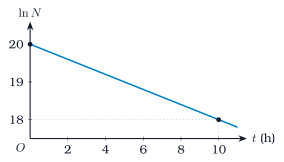
The figure shows \(\ln N\) against \(t\) for a sample.
Start from \(N = N_0 e^{-\lambda t}\). Show that \(\ln N = \ln N_0 - \lambda t\), a straight line.
Find \(\lambda\) from the slope and then the half-life.
Find \(N_0\). Take \(e^{20} \approx 4.9 \times 10^{8}\).
Answer(i) take \(\ln\) (ii) \(0.2\) h\(^{-1}\), \(3.5\) h (iii) \(4.9 \times 10^{8}\)
Solution
Take the natural log of both sides: \(\ln N = \ln N_0 + \ln e^{-\lambda t} = \ln N_0 - \lambda t\). This is \(y = c + mx\) with slope \(-\lambda\).
At \(t = \tau\): \(N = N_0 e^{-\lambda\tau} = N_0 e^{-1} = 0.37\,N_0\). About \(37\%\) remain, \(63\%\) have decayed.
How did it go?
Q37
Samples P and Q start with the same number of nuclei. P has half-life \(1\) h and Q has half-life \(2\) h.
Find the ratio of their activities at the start.
Find the ratio of their activities after \(2\) h.
Answer(i) \(2:1\) (ii) \(1:1\)
Solution
\(A = \lambda N\) and \(\lambda \propto \dfrac{1}{T_{1/2}}\). Same \(N\): \(\dfrac{A_P}{A_Q} = \dfrac{\lambda_P}{\lambda_Q} = \dfrac{2}{1}\).
After \(2\) h, P (\(2\) half-lives) has \(\dfrac{N_0}{4}\) and Q (\(1\) half-life) has \(\dfrac{N_0}{2}\). \(\dfrac{A_P}{A_Q} = \dfrac{\lambda_P N_0/4}{\lambda_Q N_0/2} = 2 \times \dfrac{1}{2} = 1\). The activities are equal.
How did it go?
Dating
Q38
Carbon-14 has half-life \(5730\) years.
How is carbon-14 produced, and why does a living plant hold a steady fraction of it?
What changes when the plant dies?
Answer(i) cosmic rays; intake balances decay (ii) intake stops
Solution
Cosmic rays strike nitrogen in the upper air and make \(^{14}\)C at a steady rate. It mixes into the CO\(_2\) of the air, which plants take in. Intake balances decay, so a living plant keeps a fixed ratio of \(^{14}\)C to ordinary carbon.
A dead plant takes in no new carbon. Its \(^{14}\)C decays with no replacement, so the ratio falls with time. The fall measures the time since death.
How did it go?
Q39
A piece of ancient wood has one quarter of the carbon-14 activity of fresh wood. Find its age.
Answer\(11460\) y
Solution
One quarter means two half-lives: \(t = 2 \times 5730 = 11460\) years.
How did it go?
Q40
A bone sample has \(12.5\%\) of the carbon-14 activity of a living bone. Find its age.
Answer\(17190\) y
Solution
\(12.5\% = \dfrac18 = \dfrac{1}{2^3}\): three half-lives. \(t = 3 \times 5730 = 17190\) years.
How did it go?
Q41
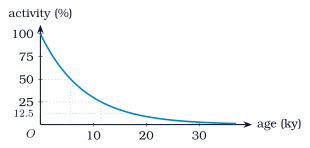
The figure shows the carbon-14 activity of a dead sample, as a percentage of a living one, against its age.
Read the age at which the activity is \(50\%\), \(25\%\) and \(12.5\%\).
A sample shows \(6\%\). Roughly how old is it? Why is carbon dating unreliable beyond about \(50000\) years?
Answer(i) \(5.7\), \(11.5\), \(17.2\) ky (ii) \(\approx 23\) ky
Solution
\(50\%\) at \(5.7\) ky (one half-life), \(25\%\) at \(11.5\) ky, \(12.5\%\) at \(17.2\) ky.
\(6\%\) is just under \(6.25\% = 1/16\), four half-lives, so the age is a little over \(23\) ky. Beyond about \(50000\) years (\(9\) half-lives) less than \(0.2\%\) remains. The activity is too weak to measure reliably.
How did it go?
Q42
Fresh wood gives \(15\) decays per minute per gram of carbon. A sample gives \(3\) per minute per gram. Take \(\ln 5 = 1.61\). Find the age of the sample.
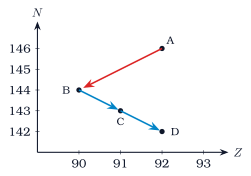
The figure plots neutron number \(N\) against proton number \(Z\) for the first steps of the uranium series: A \(\to\) B \(\to\) C \(\to\) D.
Which step is an \(\alpha\) decay and which are \(\beta^-\) decays? Give the reason.
Write the symbol (\(^A_Z\)X) of each of A, B, C and D. (Th is \(Z = 90\), Pa is \(Z = 91\).)
Answer(i) A\(\to\)B: \(\alpha\); others \(\beta^-\) (ii) \(^{238}_{92}\)U, \(^{234}_{90}\)Th, \(^{234}_{91}\)Pa, \(^{234}_{92}\)U
Solution
A\(\to\)B moves \(2\) left and \(2\) down: \(Z\) and \(N\) each fall by \(2\), the loss of an \(\alpha\) particle. B\(\to\)C and C\(\to\)D move \(1\) right and \(1\) down: \(Z\) rises by \(1\) and \(N\) falls by \(1\). A neutron has turned into a proton, which is \(\beta^-\) decay.
A hospital source of iodine-131 (half-life \(8\) days) has activity \(6400\) Bq. It may be discarded when the activity is below \(100\) Bq. After how many days can it be discarded?
Answer\(48\) days
Solution
\(\dfrac{6400}{100} = 64 = 2^6\): the activity must fall through six half-lives.