Questions on Elastic Energy, Thermal Stress and Real Materials, the kind your examinations ask. Solve one on paper. Then tell the book how it went. The book believes you, and it uses your answer to plan your revision.
0%
Nothing marked yetMark honestly. Peek at the answer only after your own attempt.
Searle's Experiment, Own-Weight Elongation, Strain Energy and Thermal Stress
21 questions · after Lesson 5, Thermal Stress
Searle's experiment
Q1
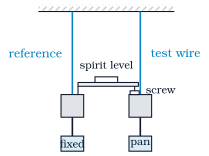
The figure shows Searle's apparatus for measuring Young's modulus.
Why are two wires used, when only one is being tested?
What is measured with the micrometer screw and the spirit level?
Why is a fixed load kept on the reference wire?
Answer(i) cancels temperature and support errors (ii) relative extension (iii) keeps it taut
Solution
Both wires hang from the same support and are at the same temperature. If the room warms, or the support yields, both wires lengthen equally.
Only the extra extension of the test wire, caused by the added load, moves the spirit level. So the errors cancel.
The extension of the test wire relative to the reference wire. The screw is turned until the spirit level is horizontal again, and the change in the screw reading is the extension.
The fixed load keeps the reference wire straight and taut, so that its kinks do not change during the experiment.
How did it go?
Q2
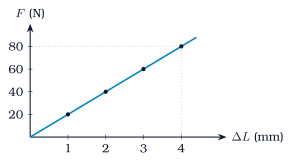
In Searle's experiment the test wire is \(2\) m long with a cross-section of \(0.2\) mm\(^2\). A load of \(2\) kg stretches it by \(1\) mm. Take \(g = 10\) m/s\(^2\). Find Young's modulus of the wire.
Answer\(2 \times 10^{11}\) Pa
Solution
\(F = 2 \times 10 = 20\) N, \(A = 0.2\) mm\(^2 = 2 \times 10^{-7}\) m\(^2\), \(\Delta L = 10^{-3}\) m.
A line drawn through many points averages the random errors of the single readings. A curved graph would also show at once that the elastic limit had been crossed.
How did it go?
Q4
In Searle's experiment the readings are taken while loading and again while unloading.
Why are both sets of readings taken?
Why does the student wait a little after each change of load before reading?
Answer(i) checks elasticity, averages (ii) lets the wire settle
Solution
If the loading and unloading readings agree, the wire has stayed elastic. Averaging the two readings also removes the backlash of the screw.
The wire takes a moment to reach its new length, and the added load sets the frame swinging. The student waits for the wire to settle.
How did it go?
Q5
Why is the test wire chosen long and thin? Why must the loads stay well below the breaking load?
Answerlarger extension; stay elastic
Solution
\(\Delta L = \dfrac{FL}{AY}\). A long wire (large \(L\)) and a thin wire (small \(A\)) give a larger extension for the same load. A larger extension is easier to measure accurately.
Beyond the elastic limit the wire takes a permanent set and Hooke's law no longer holds, so \(Y\) cannot be found from the readings.
How did it go?
Elongation under own weight and in accelerating frames
Q6
A uniform rod of length \(L\), area \(A\), density \(\rho\) and Young's modulus \(Y\) hangs from a ceiling.
Find the tension at a distance \(x\) above the lower end.
Show that the total elongation under its own weight is \(\Delta L = \frac{\rho g L^2}{2Y}\).
Write this as \(\Delta L = \frac{WL}{2AY}\), where \(W\) is the weight of the rod. Compare with a rod carrying the same \(W\) at its lower end.
Answer(i) \(\rho g A x\) (ii) \(\int_0^L \frac{\rho g x}{Y}dx\) (iii) half
Solution
The tension at height \(x\) holds the rod below it, of mass \(\rho A x\). So \(T(x) = \rho g A x\).
A small element of length \(dx\) at height \(x\) stretches by \(d(\Delta L) = \dfrac{T\,dx}{AY} = \dfrac{\rho g x\,dx}{Y}\).
\(\Delta L = \displaystyle\int_0^L \dfrac{\rho g x}{Y}\,dx = \dfrac{\rho g L^2}{2Y}\).
\(W = \rho g A L\), so \(\rho g = \dfrac{W}{AL}\) and \(\Delta L = \dfrac{WL}{2AY}\).
A rod with the same \(W\) hung at its end stretches by \(\dfrac{WL}{AY}\), twice as much. The own weight acts on average at half the length.
How did it go?
Q7
A steel rod \(10\) m long hangs from a ceiling. For steel \(\rho = 8000\) kg/m\(^3\) and \(Y = 2 \times 10^{11}\) Pa. Take \(g = 10\) m/s\(^2\). Find the elongation under its own weight.
Answer\(0.02\) mm
Solution
\(\Delta L = \dfrac{\rho g L^2}{2Y} = \dfrac{8000 \times 10 \times 100}{2 \times 2 \times 10^{11}} = \dfrac{8 \times 10^{6}}{4 \times 10^{11}} = 2 \times 10^{-5}\) m \(= 0.02\) mm.
How did it go?
Q8
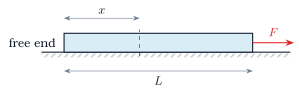
A uniform rod of length \(L\), area \(A\) and mass \(m\) lies on a smooth table. A force \(F\) pulls its right end.
Find the acceleration of the rod and the tension at a distance \(x\) from the free end.
Find the tension at the middle of the rod.
Show that the elongation of the rod is \(\frac{FL}{2AY}\).
Answer(i) \(F/m\); \(Fx/L\) (ii) \(F/2\) (iii) \(\int_0^L \frac{Fx}{LAY}dx\)
Solution
\(a = \dfrac{F}{m}\). The part of length \(x\) from the free end has mass \(\dfrac{mx}{L}\) and is pulled only by the tension at its right face: \(T(x) = \dfrac{mx}{L}a = \dfrac{Fx}{L}\).
At \(x = \dfrac{L}{2}\): \(T = \dfrac{F}{2}\). The tension grows from \(0\) at the free end to \(F\) at the pulled end.
\(\Delta L = \displaystyle\int_0^L \dfrac{T\,dx}{AY} = \dfrac{F}{ALY}\int_0^L x\,dx = \dfrac{FL}{2AY}\), half the value for a rod stretched by \(F\) at both ends.
How did it go?
Q9
The rod of Question 8 is \(1\) m long with area \(1\) mm\(^2\) and \(Y = 2 \times 10^{11}\) Pa. Forces of \(30\) N and \(10\) N pull its two ends in opposite directions.
Find the tension at the middle.
Find the elongation.
Answer(i) \(20\) N (ii) \(0.1\) mm
Solution
\(a = \dfrac{30 - 10}{m}\). The tension at distance \(x\) from the \(10\) N end is \(T = 10 + (30 - 10)\dfrac{x}{L}\), growing linearly from \(10\) N to \(30\) N.
At the middle: \(T = 10 + 10 = 20\) N.
The tension varies linearly, so the average tension \(20\) N gives the elongation: \(\Delta L = \dfrac{20 \times 1}{10^{-6} \times 2 \times 10^{11}} = 10^{-4}\) m \(= 0.1\) mm.
In general \(\Delta L = \dfrac{(F_1 + F_2)L}{2AY}\).
How did it go?
Strain energy
Q10
A steel wire (\(Y = 2 \times 10^{11}\) Pa) of length \(1\) m and area \(1\) mm\(^2\) carries a stress of \(2 \times 10^{8}\) Pa.
Find the strain.
Find the strain energy per unit volume.
Find the total strain energy.
Answer(i) \(10^{-3}\) (ii) \(10^{5}\) J/m\(^3\) (iii) \(0.1\) J
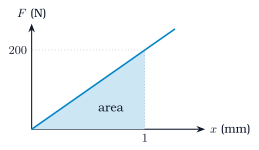
The figure shows the stretching force against the extension of the wire of Question 10. The force is \(200\) N at an extension of \(1\) mm.
Why is the work done equal to the area under the line?
Find the work done, and check it against Question 10.
Why is the work not simply \(F \times \Delta L\)?
Answer(i) \(W = \int F\,dx\) (ii) \(0.1\) J (iii) \(F\) grows from \(0\)
Solution
Work \(= \displaystyle\int F\,dx\), and an integral of \(F\) over \(x\) is the area under the \(F\)-\(x\) graph.
Area of the triangle \(= \dfrac{1}{2} \times 200 \times 10^{-3} = 0.1\) J, the same as the strain energy of Question 10 (stress \(2 \times 10^{8}\) Pa on \(1\) mm\(^2\) is \(200\) N).
The force is not \(200\) N throughout. It grows from zero to \(200\) N as the wire stretches, so only the average force, \(100\) N, does the work.
How did it go?
Q12
Two wires of the same material and length have radii \(r\) and \(2r\). They carry the same load. Find the ratio of the strain energies stored in them.
Answer\(4 : 1\)
Solution
\(U = \dfrac{1}{2}F\,\Delta L = \dfrac{F^2 L}{2AY}\). With the same \(F\), \(L\) and \(Y\): \(U \propto \dfrac{1}{A} \propto \dfrac{1}{r^2}\).
\(\dfrac{U_1}{U_2} = \dfrac{(2r)^2}{r^2} = 4\). The thin wire stores four times the energy; it stretches four times as much under the same pull.
How did it go?
Q13
A wire stretched by \(1\) mm stores \(0.1\) J. Find the energy stored when the same wire is stretched by \(3\) mm.
Answer\(0.9\) J
Solution
\(U = \dfrac{1}{2}k(\Delta L)^2 \propto (\Delta L)^2\). Three times the extension gives \(9\) times the energy: \(0.9\) J.
How did it go?
Q14
Show that the strain energy per unit volume can be written in three ways: \(\frac{1}{2}\,\text{stress} \times \text{strain}\), \(\frac{1}{2}Y(\text{strain})^2\) and \(\frac{(\text{stress})^2}{2Y}\).
Answeruse stress \(= Y \times\) strain
Solution
Start from \(u = \dfrac{1}{2}\,\text{stress} \times \text{strain}\) and use \(\text{stress} = Y \times \text{strain}\).
Replace the stress: \(u = \dfrac{1}{2}Y(\text{strain})^2\). Replace the strain by \(\dfrac{\text{stress}}{Y}\) instead: \(u = \dfrac{(\text{stress})^2}{2Y}\).
How did it go?
Thermal stress
Q15
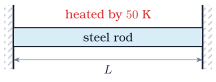
A steel rod of area \(2\) cm\(^2\) is clamped between two rigid walls and heated by \(50\) K. For steel \(\alpha = 1.2 \times 10^{-5}\) K\(^{-1}\) and \(Y = 2 \times 10^{11}\) Pa.
Show that the thermal stress is \(Y\alpha\,\Delta T\), whatever the length of the rod.
Find the stress and the force on each wall.
Answer(i) strain \(\alpha\Delta T\), no \(L\) in it (ii) \(1.2 \times 10^{8}\) Pa; \(2.4 \times 10^{4}\) N
Solution
Free, the rod would lengthen by \(\alpha L\,\Delta T\). The walls push it back by the same amount, a compressive strain of \(\dfrac{\alpha L\,\Delta T}{L} = \alpha\,\Delta T\).
Stress \(= Y \times \text{strain} = Y\alpha\,\Delta T\). The length \(L\) has cancelled.
Force \(= \text{stress} \times A = 1.2 \times 10^{8} \times 2 \times 10^{-4} = 2.4 \times 10^{4}\) N, about \(2.4\) tonnes weight.
How did it go?
Q16
Why does the rod of Question 15 develop a stress although its length does not change? Is the stress compressive or tensile?
Answerwalls stop the expansion; compressive
Solution
The natural length of the hot rod is longer than the gap between the walls. Keeping it at the old length means squeezing it from its new natural length, which is a real strain.
The walls push inward on the rod, so the stress is compressive.
How did it go?
Q17
A steel rail is \(10\) m long at the temperature of laying. On a hot day the temperature is \(40\) K higher. Use the constants of Question 15.
Find the free expansion of the rail.
A gap of \(2\) mm is left between rails. Find the stress in the rail after the gap closes.
Answer(i) \(4.8\) mm (ii) \(5.6 \times 10^{7}\) Pa
Solution
\(\Delta L = \alpha L\,\Delta T = 1.2 \times 10^{-5} \times 10 \times 40 = 4.8 \times 10^{-3}\) m \(= 4.8\) mm.
The first \(2\) mm of expansion is free. The remaining \(2.8\) mm is prevented: strain \(= \dfrac{2.8 \times 10^{-3}}{10} = 2.8 \times 10^{-4}\).
\(\Delta L = \dfrac{F}{k} = \dfrac{100}{10^{5}} = 10^{-3}\) m \(= 1\) mm.
How did it go?
Q19
A \(1\) kg block hangs from the wire of Question 18 and is pulled down slightly and released. Find the period and the frequency of the vertical oscillation. Take \(\pi^2 = 10\).
Answer\(0.02\) s; \(50\) Hz
Solution
\(T = 2\pi\sqrt{\dfrac{m}{k}} = 2\pi\sqrt{\dfrac{1}{10^{5}}} = \dfrac{2\pi}{316} \approx 0.02\) s (with \(\pi^2 = 10\), \(2\pi = 2\sqrt{10}\) and \(T = 2\sqrt{10^{-4}} = 0.02\) s exactly).
\(f = \dfrac{1}{T} = 50\) Hz. A stiff wire makes a fast oscillation.
How did it go?
Q20
A rod has stiffness \(k\).
The rod is cut into two equal halves. Find the stiffness of each half.
The two halves are placed side by side. Find the stiffness of the pair.
Two such rods are joined end to end. Find the stiffness.
Answer(i) \(2k\) (ii) \(4k\) (iii) \(k/2\)
Solution
\(k = \dfrac{YA}{L}\), so \(k \propto \dfrac{1}{L}\) and \(k \propto A\).
Half the length: \(2k\) each.
Side by side the areas add (or: springs in parallel add): \(2k + 2k = 4k\).
End to end the length doubles (springs in series): \(\dfrac{k}{2}\).
How did it go?
Q21
A \(2\) kg block is attached to the lower end of the wire of Question 18 and released from rest with the wire just taut. Take \(g = 10\) m/s\(^2\).
Find the maximum extension of the wire.
Compare with the extension when the block hangs at rest.
Answer(i) \(0.4\) mm (ii) twice (\(0.2\) mm at rest)
Solution
The block falls until the wire stops it. At the lowest point the block is momentarily at rest, so the loss of gravitational energy equals the strain energy: \(mgx = \dfrac{1}{2}kx^2\).
\(x = \dfrac{2mg}{k} = \dfrac{2 \times 20}{10^{5}} = 4 \times 10^{-4}\) m \(= 0.4\) mm.
At rest, \(kx_0 = mg\) gives \(x_0 = \dfrac{20}{10^{5}} = 0.2\) mm. A suddenly applied load stretches the wire twice as far, and the stress is momentarily doubled.