Questions on Pressure in Fluids, the kind your examinations ask. Solve one on paper. Then tell the book how it went. The book believes you, and it uses your answer to plan your revision.
0%
Nothing marked yetMark honestly. Peek at the answer only after your own attempt.
Pressure, Pascal's Law and Accelerated Vessels
20 questions · after Lesson 6, Rotating Liquids
Pressure in a liquid at rest
Q1
Take \(g = 10\) m/s\(^2\), the density of water as \(1000\) kg/m\(^3\) and atmospheric pressure as \(10^{5}\) Pa throughout this sheet.
Find the gauge pressure and the absolute pressure at a depth of \(10\) m in a lake.
At what depth is the absolute pressure three times the atmospheric pressure?
Answer(i) \(10^{5}\) Pa, \(2 \times 10^{5}\) Pa (ii) \(20\) m
Solution
Gauge pressure \(= h\rho g = 10 \times 1000 \times 10 = 10^{5}\) Pa, one atmosphere.
\(P_0 + h\rho g = 3P_0\) gives \(h\rho g = 2 \times 10^{5}\) Pa, so \(h = \dfrac{2 \times 10^{5}}{10^{4}} = 20\) m. Every \(10\) m of water adds one atmosphere.
How did it go?
Q2
A tank with a base \(2\) m by \(1\) m holds water \(0.5\) m deep.
Find the gauge pressure at the base and the force of the water on the base.
Find the force of the water on one of the \(2\) m long side walls.
Answer(i) \(5000\) Pa, \(10^{4}\) N (ii) \(2500\) N
Solution
Gauge pressure at the base \(= h\rho g = 0.5 \times 1000 \times 10 = 5000\) Pa.
Force \(= P \times A = 5000 \times 2 = 10^{4}\) N, the weight of the \(1000\) kg of water.
On the wall the pressure grows from \(0\) at the surface to \(5000\) Pa at the base. The average is \(2500\) Pa.
Force \(= 2500 \times (2 \times 0.5) = 2500\) N.
How did it go?
Q3
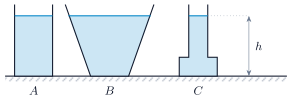
The three vessels have equal base areas and hold water to the same height \(h\). Vessel \(B\) holds the most water and \(C\) the least.
Compare the pressures at the three bases.
Compare the forces of the water on the three bases.
The force on the base of \(B\) is less than the weight of the water in \(B\). Where does the rest of the weight go?
Answer(i) equal (ii) equal (iii) onto the sloping walls
Solution
\(P = P_0 + h\rho g\) depends only on the depth. The three bases are at the same depth \(h\), so the pressures are equal.
Force \(= P \times\) base area. Equal pressures on equal areas give equal forces, even though the amounts of water differ.
The sloping walls of \(B\) press down on the water, and the water presses up on them. The walls carry the extra weight, and the base carries only the weight of the column directly above it.
How did it go?
Q4
A mercury barometer reads \(76\) cm. The density of mercury is \(13600\) kg/m\(^3\).
Find the atmospheric pressure.
How tall would a water barometer be?
Answer(i) \(1.03 \times 10^{5}\) Pa (ii) \(10.3\) m
Water is \(13.6\) times less dense, so the column must be \(13.6\) times taller: \(0.76 \times 13.6 = 10.3\) m.
This is why mercury, not water, is used in barometers.
How did it go?
Q5
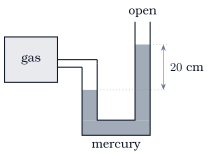
A gas container is joined to a mercury manometer. The mercury in the open arm stands \(20\) cm higher than in the arm joined to the gas.
Is the gas pressure above or below atmospheric? Find it.
What would the gas pressure be if the open arm stood \(20\) cm lower instead?
Answer(i) above; \(1.27 \times 10^{5}\) Pa (ii) \(0.73 \times 10^{5}\) Pa
Solution
The gas pushes the mercury down on its side and up on the open side, so the gas pressure is above atmospheric.
At the level of the lower mercury surface, both arms are at the same pressure: \(P_{\text{gas}} = P_0 + h\rho g = 10^{5} + 0.2 \times 13600 \times 10 = 1.272 \times 10^{5}\) Pa.
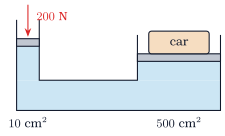
In a hydraulic lift the small piston has area \(10\) cm\(^2\) and the large piston \(500\) cm\(^2\). A force of \(200\) N is applied to the small piston.
State Pascal's law. Find the force on the large piston and the mass it can lift.
The small piston moves down \(50\) cm. How far does the large piston rise?
Compare the work done on the small piston with the work done by the large piston.
Answer(i) \(10^{4}\) N, \(1000\) kg (ii) \(1\) cm (iii) equal, \(100\) J
Solution
Pascal's law: a pressure applied to an enclosed liquid is passed on undiminished to every part of the liquid.
Pressure \(= \dfrac{200}{10 \times 10^{-4}} = 2 \times 10^{5}\) Pa. Force on the large piston \(= 2 \times 10^{5} \times 500 \times 10^{-4} = 10^{4}\) N, which lifts \(1000\) kg.
The liquid volume moved is the same: \(10 \times 50 = 500 \times d\), so \(d = 1\) cm.
Work on the small piston \(= 200 \times 0.5 = 100\) J. Work by the large piston \(= 10^{4} \times 0.01 = 100\) J. The lift multiplies force, not energy.
How did it go?
Q7
A tyre gauge reads \(2 \times 10^{5}\) Pa. What is the absolute pressure of the air in the tyre? What does a gauge read for a flat tyre?
Answer\(3 \times 10^{5}\) Pa; zero
Solution
A gauge reads the pressure above atmospheric. Absolute pressure \(= 2 \times 10^{5} + 10^{5} = 3 \times 10^{5}\) Pa.
A flat tyre holds air at atmospheric pressure, so the gauge reads zero.
How did it go?
Q8
A U-tube contains water. Oil is poured into one arm and forms a column \(20\) cm tall above the oil-water boundary. The water surface in the other arm is \(16\) cm above that boundary. Find the density of the oil.
Answer\(800\) kg/m\(^3\)
Solution
At the level of the oil-water boundary the pressure is the same in both arms. In the oil arm it is \(P_0 + 0.20\rho_{\text{oil}}g\); in the water arm it is \(P_0 + 0.16 \times 1000 \times g\).
\(0.20\rho_{\text{oil}} = 0.16 \times 1000\), so \(\rho_{\text{oil}} = 800\) kg/m\(^3\). The lighter liquid needs a taller column for the same pressure.
How did it go?
Q9
A beaker holds \(20\) cm of water with \(10\) cm of oil (density \(800\) kg/m\(^3\)) floating on it. Find the gauge pressure at the bottom of the beaker.
Answer\(2800\) Pa
Solution
Add the two columns: \(P = h_1\rho_1 g + h_2\rho_2 g = 0.10 \times 800 \times 10 + 0.20 \times 1000 \times 10 = 800 + 2000 = 2800\) Pa.
How did it go?
Q10
Two points lie at the same height inside a liquid at rest. Why must they be at the same pressure? Use this to explain why the free surface of a liquid at rest is horizontal.
Answerno sideways force in equilibrium
Solution
Consider a thin horizontal cylinder of liquid joining the two points. The only horizontal forces on it are the pressures on its two ends. At rest these must balance, so the two pressures are equal.
Every point of the free surface is at atmospheric pressure. Points at the same pressure lie at the same height, so the whole surface is at one height: it is horizontal.
How did it go?
Fluids in accelerated vessels
Q11
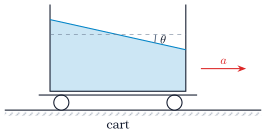
A tank of water on a cart accelerates to the right at \(a = 5\) m/s\(^2\).
Show that the free surface tilts at an angle \(\theta\) with \(\tan\theta = a/g\), and find \(\theta\).
Which end of the tank has the higher water level? Give the reason.
Answer(i) \(\tan\theta = 0.5\), \(\theta \approx 27^\circ\) (ii) rear
Solution
Consider a small drop on the surface. The forces on it are its weight \(mg\) downward and the push of the liquid, perpendicular to the surface. Their resultant must be \(ma\) horizontally.
The push is perpendicular to the surface and makes angle \(\theta\) with the vertical, so \(\tan\theta = \dfrac{ma}{mg} = \dfrac{a}{g} = 0.5\), giving \(\theta \approx 27^\circ\).
The rear end. The liquid needs a net forward force, which comes from a higher pressure at the rear. Higher pressure at the same level means a taller column, so the level rises at the rear.
How did it go?
Q12
The tank of Question 11 is \(2\) m long and the water was \(1\) m deep before the cart moved. Find the depth of the water at the rear end and at the front end while it accelerates.
Answer\(1.5\) m, \(0.5\) m
Solution
The surface tilts about its middle. Over half the length, \(1\) m, the level changes by \(1 \times \tan\theta = 0.5\) m.
Rear depth \(= 1 + 0.5 = 1.5\) m. Front depth \(= 1 - 0.5 = 0.5\) m.
How did it go?
Q13
For the tank of Question 12, find the difference in pressure between the two ends of the tank at the level of the base. Show that it equals \(\rho a L\).
Answer\(10^{4}\) Pa
Solution
Pressure at the base of the rear end \(= 1.5\rho g\); at the front end \(= 0.5\rho g\). Difference \(= \rho g \times 1 = 1000 \times 10 \times 1 = 10^{4}\) Pa.
Also \(\rho a L = 1000 \times 5 \times 2 = 10^{4}\) Pa. The two agree because \(\Delta h = L\tan\theta = La/g\), so \(\rho g\,\Delta h = \rho a L\).
How did it go?
Q14
A horizontal cylinder of liquid of length \(\Delta x\) and area \(A\) inside the tank accelerates with the tank. Show from Newton's second law that the pressure falls along the direction of the acceleration at the rate \(\frac{\Delta P}{\Delta x} = -\rho a\).
Answer\((P_1 - P_2)A = \rho A\,\Delta x\,a\)
Solution
The cylinder has mass \(\rho A\,\Delta x\). The pressure \(P_1\) on its rear face pushes it forward, and \(P_2\) on its front face pushes it back.
Newton's second law: \((P_1 - P_2)A = \rho A\,\Delta x\,a\), so \(P_2 - P_1 = -\rho a\,\Delta x\), that is, \(\dfrac{\Delta P}{\Delta x} = -\rho a\). The pressure falls along the acceleration.
How did it go?
Q15
A bucket of water \(1\) m deep is in a lift. Find the gauge pressure at the bottom in each case. The lift
moves up at \(2\) m/s\(^2\),
moves down at \(2\) m/s\(^2\),
falls freely.
Answer(i) \(12000\) Pa (ii) \(8000\) Pa (iii) \(0\)
Solution
In the lift the liquid behaves as if gravity were \(g_{\text{eff}} = g + a\) (accelerating up) or \(g - a\) (accelerating down). \(P = h\rho g_{\text{eff}}\).
\(g_{\text{eff}} = 0\): \(P = 0\). In free fall the water presses on nothing.
How did it go?
Q16
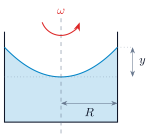
A cylinder of radius \(R = 10\) cm containing water rotates about its vertical axis at \(\omega = 10\) rad/s. The free surface takes the shape shown.
Find the height \(y\) of the rim of the surface above its centre.
Why is the surface higher at the rim?
Answer(i) \(5\) cm (ii) centripetal force needs higher pressure outside
Solution
\(y = \dfrac{\omega^2 R^2}{2g} = \dfrac{100 \times 0.01}{20} = 0.05\) m \(= 5\) cm.
Each ring of water moves in a circle and needs an inward force. That force comes from a pressure that grows outward. Higher pressure at the same level needs a taller column, so the liquid stands higher at the rim.
How did it go?
Q17
Show that the free surface of the rotating liquid of Question 16 is the curve \(y = \frac{\omega^2 r^2}{2g}\). Start from the pressure difference needed to give a ring of liquid at radius \(r\) its centripetal acceleration.
Answer\(dP/dr = \rho\omega^2 r\)
Solution
A thin element at radius \(r\), thickness \(dr\), area \(A\) facing the axis, needs an inward force \(dm\,\omega^2 r = \rho A\,dr\,\omega^2 r\). It comes from the pressure difference across it: \(dP\,A = \rho A\omega^2 r\,dr\), so \(\dfrac{dP}{dr} = \rho\omega^2 r\).
Integrate from the axis: \(P(r) - P(0) = \dfrac{1}{2}\rho\omega^2 r^2\) at one horizontal level. A pressure excess \(\dfrac{1}{2}\rho\omega^2 r^2\) needs an extra height \(y\) with \(\rho g y = \dfrac{1}{2}\rho\omega^2 r^2\).
So \(y = \dfrac{\omega^2 r^2}{2g}\), a parabola; turned about the axis it is a paraboloid.
How did it go?
Q18
A closed box partly filled with water slides down a smooth incline of angle \(30^\circ\). How is the free surface of the water oriented? Give the reason.
Answerparallel to the incline
Solution
On a smooth incline the box accelerates at \(g\sin 30^\circ\) down the slope. Inside the box the effective gravity is \(\vec g - \vec a\), which points perpendicular to the incline with size \(g\cos 30^\circ\).
The free surface is always perpendicular to the effective gravity, so it lies parallel to the incline.
How did it go?
Q19
A U-tube with vertical arms \(30\) cm apart is partly filled with water. It is accelerated horizontally at \(2\) m/s\(^2\) along the line of the arms. Find the difference in the water levels in the two arms. Which arm is higher?
Answer\(6\) cm; the rear arm
Solution
The pressure difference between the two arms at the base is \(\rho a L\) (Question 13). It is supported by a height difference \(\Delta h\) with \(\rho g\,\Delta h = \rho a L\).
\(\Delta h = \dfrac{aL}{g} = \dfrac{2 \times 0.30}{10} = 0.06\) m \(= 6\) cm. The rear arm is higher.
How did it go?
Q20
The cylinder of Question 16 held water \(20\) cm deep before it was set rotating.
Find the depth of the water at the centre and at the rim while it rotates. Use the fact that the volume is unchanged and that the rise at the rim equals the fall at the centre.
At what angular speed does the centre of the base just become dry?
Answer(i) \(17.5\) cm, \(22.5\) cm (ii) \(20\sqrt{2} \approx 28\) rad/s
Solution
The rim rises \(5\) cm above the centre (Question 16). For a paraboloid the average height is halfway between centre and rim, and the average must stay at \(20\) cm.
So the centre falls \(2.5\) cm to \(17.5\) cm and the rim rises \(2.5\) cm to \(22.5\) cm.
The centre depth is \(20 - \dfrac{\omega^2 R^2}{4g}\) cm. It is zero when \(\omega^2 = \dfrac{4gh}{R^2} = \dfrac{4 \times 10 \times 0.20}{0.01} = 800\), so \(\omega = \sqrt{800} = 20\sqrt{2} \approx 28\) rad/s.