Questions on Archimedes' Principle, the kind your examinations ask. Solve one on paper. Then tell the book how it went. The book believes you, and it uses your answer to plan your revision.
0%
Nothing marked yetMark honestly. Peek at the answer only after your own attempt.
Archimedes' Principle and Buoyancy
21 questions · after Lesson 5, Stability of Floating Bodies
The buoyant force
Q1
Take \(g = 10\) m/s\(^2\) and the density of water as \(1000\) kg/m\(^3\) throughout. A block \(0.5\) m by \(0.4\) m by \(0.2\) m is held fully under water.
State Archimedes' principle. Find the buoyant force on the block.
In which direction does the buoyant force act, and through which point?
Answer(i) \(400\) N (ii) up; centre of the displaced water
Solution
A body in a fluid is pushed up by a force equal to the weight of the fluid it displaces.
Mass \(= \dfrac{50}{10} = 5\) kg. Density \(= \dfrac{5}{2 \times 10^{-3}} = 2500\) kg/m\(^3\).
How did it go?
Q3
A block of wood of density \(600\) kg/m\(^3\) floats.
State the law of flotation. What fraction of the block is under water?
What fraction is under the surface when it floats in oil of density \(800\) kg/m\(^3\)?
Answer(i) \(0.6\) (ii) \(0.75\)
Solution
A floating body displaces its own weight of fluid. With \(V_s\) submerged: \(V_s\rho_w g = V\rho g\), so \(\dfrac{V_s}{V} = \dfrac{\rho}{\rho_w} = \dfrac{600}{1000} = 0.6\).
\(\dfrac{V_s}{V} = \dfrac{600}{800} = 0.75\). In a lighter liquid more of the block must go under to displace the same weight.
How did it go?
Q4
Ice has a density of \(900\) kg/m\(^3\). What fraction of a floating iceberg is below the surface of fresh water? Why is the fraction a little smaller in the sea?
Answer\(0.9\); sea water is denser
Solution
Fraction submerged \(= \dfrac{\rho_{\text{ice}}}{\rho_w} = \dfrac{900}{1000} = 0.9\). Nine tenths of the iceberg is hidden.
Sea water is denser than fresh water, so the same weight is displaced by a smaller volume and a little more of the iceberg shows.
How did it go?
Q5
A boat of mass \(200\) kg floats on a lake.
Find the volume of water it displaces.
Cargo of \(100\) kg is put in the boat. Find the new displaced volume.
The boat has vertical sides and a waterline area of \(2\) m\(^2\). By how much does it sink when the cargo is loaded?
Answer(i) \(0.2\) m\(^3\) (ii) \(0.3\) m\(^3\) (iii) \(5\) cm
Solution
The displaced water weighs \(200 \times 10 = 2000\) N: \(V = \dfrac{200}{1000} = 0.2\) m\(^3\).
Total mass \(300\) kg: \(V = \dfrac{300}{1000} = 0.3\) m\(^3\).
Extra volume \(0.1\) m\(^3\) over an area of \(2\) m\(^2\): the boat sinks \(\dfrac{0.1}{2} = 0.05\) m \(= 5\) cm.
How did it go?
Q6
A hollow steel ball has mass \(2\) kg and volume \(4 \times 10^{-3}\) m\(^3\). Does the ball float or sink in water? If it floats, what fraction is submerged? Why does a solid steel ball sink?
Answerfloats, half submerged; solid steel is denser than water
Solution
Average density \(= \dfrac{2}{4 \times 10^{-3}} = 500\) kg/m\(^3\), less than water. The ball floats with \(\dfrac{500}{1000} = \dfrac{1}{2}\) of its volume submerged.
A solid steel ball has density \(8000\) kg/m\(^3\). Even fully submerged it displaces less than its own weight of water, so it sinks. The hollow ball's air lowers its average density.
How did it go?
Apparent weight and equilibrium
Q7
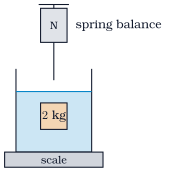
A \(2\) kg block of density \(4000\) kg/m\(^3\) hangs from a spring balance. It is lowered fully into a beaker of water that stands on a weighing scale.
Find the reading of the spring balance before and after the block enters the water.
By how much does the reading of the weighing scale change? Give the reason.
Answer(i) \(20\) N, \(15\) N (ii) rises by \(5\) N
Solution
In air: \(20\) N. Volume of the block \(= \dfrac{2}{4000} = 5 \times 10^{-4}\) m\(^3\), so \(F_B = 5 \times 10^{-4} \times 1000 \times 10 = 5\) N.
In water the balance reads \(20 - 5 = 15\) N.
The water pushes up on the block with \(5\) N, so the block pushes down on the water with \(5\) N (Newton's third law). The scale reading rises by \(5\) N.
How did it go?
Q8
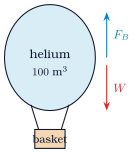
A balloon of volume \(100\) m\(^3\) is filled with helium of density \(0.2\) kg/m\(^3\). The air has density \(1.2\) kg/m\(^3\). The fabric and basket have a mass of \(60\) kg.
Find the buoyant force on the balloon.
Find the weight of the helium and the largest extra load the balloon can lift.
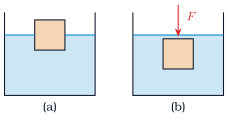
A cube of side \(10\) cm and density \(500\) kg/m\(^3\) floats in water.
How much of the cube is under water when it floats freely?
Find the downward force \(F\) needed to hold the cube fully under water.
Answer(i) \(5\) cm (ii) \(5\) N
Solution
Fraction submerged \(= \dfrac{500}{1000} = \dfrac{1}{2}\), so \(5\) cm of the \(10\) cm cube is under water.
Fully under, the buoyant force is \(V\rho_w g = 10^{-3} \times 1000 \times 10 = 10\) N. The weight is \(10^{-3} \times 500 \times 10 = 5\) N.
\(F = F_B - W = 10 - 5 = 5\) N. The force equals the weight of the extra water displaced.
How did it go?
Q11
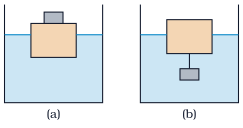
A wooden block floats in a beaker of water. A metal piece of mass \(0.8\) kg and density \(8000\) kg/m\(^3\) is placed on top of the block, figure (a). Later it is hung below the block on a string, figure (b).
Find the extra volume of the block that goes under water in case (a).
Find the extra volume of the block that goes under water in case (b).
Does the water level in the beaker differ between the two cases? Give the reason.
Answer(i) \(8 \times 10^{-4}\) m\(^3\) (ii) \(7 \times 10^{-4}\) m\(^3\) (iii) no
Solution
The block must displace the extra weight \(0.8 \times 10 = 8\) N of water: extra volume \(= \dfrac{0.8}{1000} = 8 \times 10^{-4}\) m\(^3\).
The metal now displaces its own volume, \(\dfrac{0.8}{8000} = 10^{-4}\) m\(^3\), and gets a buoyant force of \(1\) N. The string then pulls the block down with only \(8 - 1 = 7\) N.
The block sinks by the volume that displaces \(7\) N: \(7 \times 10^{-4}\) m\(^3\).
No. In both cases the block and the metal float together. The total displaced volume equals their total weight divided by \(\rho_w g\), which is \(9 \times 10^{-4}\) m\(^3\) either way. The level is the same.
How did it go?
Q12
An ice cube floats in a glass of water filled to the brim.
Does the water overflow when the ice melts? Give the reason.
A small stone is frozen inside the ice cube, and the cube still floats. Does the level rise, fall or stay when the ice melts?
Answer(i) no (ii) falls
Solution
No. The floating ice displaces exactly its own weight of water. When it melts it becomes that same weight of water, which fills exactly the volume it displaced. The level does not change.
Falls. While frozen in, the stone is floated by the ice and displaces its weight of water. After melting the stone sinks and displaces only its volume, which is less than its weight of water. The level drops.
How did it go?
Measuring density
Q13
A hydrometer floats in water with its mark \(A\) at the surface. In petrol (density \(700\) kg/m\(^3\)) its mark \(B\) is at the surface. Which mark is higher on the stem? Give the reason.
Answer\(A\); petrol is less dense
Solution
The hydrometer always displaces its own weight. In petrol, the lighter liquid, it must displace a larger volume, so it sinks deeper. Mark \(B\) is therefore higher on the stem than \(A\).
How did it go?
Q14
A body weighs \(100\) N in air, \(80\) N in water and \(84\) N in oil. Find the volume of the body and the density of the oil.
Buoyant force in water \(= 100 - 80 = 20\) N, so \(V = \dfrac{20}{1000 \times 10} = 2 \times 10^{-3}\) m\(^3\).
Buoyant force in oil \(= 100 - 84 = 16\) N \(= V\rho_{\text{oil}}g\), so \(\rho_{\text{oil}} = \dfrac{16}{2 \times 10^{-3} \times 10} = 800\) kg/m\(^3\).
How did it go?
Q15
A crown has mass \(1\) kg in air and an apparent mass of \(0.9\) kg in water. Find the density of the crown. Is it pure gold (\(19300\) kg/m\(^3\))?
Answer\(10^{4}\) kg/m\(^3\); no
Solution
Loss of mass in water \(= 0.1\) kg, which is the mass of water displaced: \(V = \dfrac{0.1}{1000} = 10^{-4}\) m\(^3\).
Density \(= \dfrac{1}{10^{-4}} = 10^{4}\) kg/m\(^3\). Pure gold would be \(19300\) kg/m\(^3\), so the crown is not pure gold.
How did it go?
Q16
A body floats with \(60\) percent of its volume submerged in water and \(75\) percent submerged in another liquid. Find the density of the body and of the liquid.
Answer\(600\) kg/m\(^3\); \(800\) kg/m\(^3\)
Solution
In water: \(\rho = 0.6 \times 1000 = 600\) kg/m\(^3\).
In the liquid: \(0.75\rho_L = 600\), so \(\rho_L = 800\) kg/m\(^3\).
How did it go?
Stability
Q17
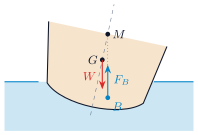
The figure shows a boat tilted slightly. \(G\) is its centre of gravity and \(B\) the centre of buoyancy of the tilted hull.
What is the centre of buoyancy? Why does it shift sideways when the boat tilts?
What is the metacentre \(M\)? Why do the two forces shown turn the boat back upright?
State the condition on \(M\) and \(G\) for a stable floating body.
Answer(i) centre of the displaced volume; hull shape changes (ii) where the buoyancy line meets the axis; restoring couple (iii) \(M\) above \(G\)
Solution
The centre of buoyancy is the centre of gravity of the displaced water. When the boat tilts, more hull goes under on the low side, so the displaced water's centre shifts towards that side.
\(M\) is the point where the vertical line through \(B\) meets the boat's own axis. The weight down through \(G\) and the buoyancy up through \(B\) are equal but not in line. They form a couple that turns the boat back towards upright when \(M\) is above \(G\).
Stable when \(M\) lies above \(G\). If \(M\) falls below \(G\) the couple turns the boat further over.
How did it go?
Q18
Why is a boat with its cargo on the floor more stable than the same boat with the cargo on the deck? Why is a wide flat boat more stable than a narrow deep one?
Answerlower \(G\); \(M\) higher
Solution
Cargo on the floor lowers \(G\), so \(M\) stays above \(G\) even for large tilts. Cargo on the deck raises \(G\) towards \(M\) and can put it above \(M\).
A wide boat shifts a large volume of hull under water when it tilts, so \(B\) moves far sideways and \(M\) is high. A narrow boat shifts little, so \(M\) is low.
How did it go?
Q19
For a fully submerged body such as a submarine, the centre of buoyancy does not move when the body tilts. State the condition for stability and give the reason.
Answer\(B\) above \(G\)
Solution
Fully submerged, the displaced volume is the whole body, so \(B\) is fixed at the centre of the body's volume. The body is stable when \(B\) is above \(G\).
Then any tilt puts the weight (down through \(G\)) and the buoyancy (up through \(B\)) out of line. The couple turns the body back. A submarine keeps its heavy machinery low to keep \(G\) below \(B\).
How did it go?
Two more
Q20
A cylinder \(20\) cm tall floats upright in water with \(16\) cm of its height submerged.
Find the density of the cylinder.
How would it float in oil of density \(800\) kg/m\(^3\)?
Answer(i) \(800\) kg/m\(^3\) (ii) just fully submerged
In oil of the same density the cylinder displaces its own weight only when fully submerged. It floats with its top level with the surface, just under.
How did it go?
Q21
The balloon of Question 8 has a total mass of \(80\) kg including its load. Find its upward acceleration at the moment it is released, ignoring air resistance.
Answer\(5\) m/s\(^2\)
Solution
Net upward force \(= F_B - mg = 1200 - 80 \times 10 = 400\) N.
\(a = \dfrac{400}{80} = 5\) m/s\(^2\) upward. Air resistance soon limits the speed.