Questions on Fluid Flow, the kind your examinations ask. Solve one on paper. Then tell the book how it went. The book believes you, and it uses your answer to plan your revision.
0%
Nothing marked yetMark honestly. Peek at the answer only after your own attempt.
Efflux: Torricelli, Range and Trajectory
20 questions · after Lesson 5, The Range of a Jet
The horizontal jet
Q1
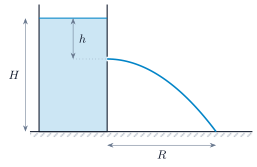
A tank on the ground holds water to a depth \(H = 5\) m. A small hole in its side is \(h = 1.8\) m below the surface. Take \(g = 10\) m/s\(^2\) throughout this sheet.
Find the speed of the jet leaving the hole.
Find the time the water takes to reach the ground.
Find the range \(R\), the distance from the tank at which the jet lands.
Answer(i) \(6\) m/s (ii) \(0.8\) s (iii) \(4.8\) m
The hole is \(H - h = 3.2\) m above the ground. \(3.2 = \dfrac{1}{2}gt^2\) gives \(t = \sqrt{0.64} = 0.8\) s.
\(R = vt = 6 \times 0.8 = 4.8\) m.
How did it go?
Q2
For a tank on the ground, show that the range of a jet from a hole at depth \(h\) below the surface is \(R = 2\sqrt{h(H - h)}\). Check the formula with the numbers of Question 1.
Answer\(2\sqrt{1.8 \times 3.2} = 4.8\) m
Solution
\(v = \sqrt{2gh}\) and the fall of \(H - h\) takes \(t = \sqrt{\dfrac{2(H - h)}{g}}\).
\(R = vt = \sqrt{2gh}\sqrt{\dfrac{2(H - h)}{g}} = 2\sqrt{h(H - h)}\). The value of \(g\) cancels.
Show that two holes, one at depth \(h\) and the other at depth \(H - h\), give the same range. Find the range for holes \(1\) m and \(4\) m below the surface of the \(5\) m tank.
Answer\(4\) m for both
Solution
Put \(h' = H - h\) in the formula: \(R' = 2\sqrt{(H - h)(H - (H - h))} = 2\sqrt{(H - h)h} = R\).
The upper hole gives a faster fall from a smaller speed; the lower hole gives a faster jet with a shorter fall. The two effects balance.
A jet from the \(5\) m tank of Question 1 lands \(4.8\) m from the tank. Find the possible depths of the hole below the surface.
Answer\(1.8\) m or \(3.2\) m
Solution
\(4.8 = 2\sqrt{h(5 - h)}\), so \(h(5 - h) = 5.76\), that is, \(h^2 - 5h + 5.76 = 0\).
\(h = \dfrac{5 \pm \sqrt{25 - 23.04}}{2} = \dfrac{5 \pm 1.4}{2} = 3.2\) m or \(1.8\) m. The two answers are the symmetric pair of Question 3.
How did it go?
Q7
Two holes in the \(5\) m tank are \(1.8\) m and \(3.2\) m below the surface. Both jets land at the same point.
Which jet is in the air for a shorter time? Find both times.
Show that both jets hit the ground with the same speed, and find it.
Answer(i) lower jet; \(0.8\) s, \(0.6\) s (ii) \(10\) m/s
Solution
The lower jet (\(3.2\) m deep) is only \(1.8\) m above the ground: \(t = \sqrt{\dfrac{2 \times 1.8}{10}} = 0.6\) s. The upper jet takes \(0.8\) s (Question 1). The lower jet lands first.
Energy: the water starts from rest at the surface and lands \(H\) below it, with no energy lost. So \(v^2 = 2gH\) for both jets: \(v = \sqrt{2 \times 10 \times 5} = 10\) m/s.
Check for the upper jet: horizontal \(6\) m/s, vertical \(gt = 8\) m/s, resultant \(\sqrt{36 + 64} = 10\) m/s.
How did it go?
Q8
A horizontal jet leaves a hole at depth \(h\). Take the hole as the origin, \(x\) horizontal and \(y\) measured downward. Show that the jet follows \(y = \frac{x^2}{4h}\).
Answereliminate \(t\) from \(x = vt\), \(y = \frac{1}{2}gt^2\)
Solution
\(x = vt\) with \(v = \sqrt{2gh}\), and \(y = \dfrac{1}{2}gt^2\).
\(t = \dfrac{x}{v}\), so \(y = \dfrac{g x^2}{2v^2} = \dfrac{g x^2}{2 \times 2gh} = \dfrac{x^2}{4h}\). The jet is a parabola whose shape depends only on \(h\).
How did it go?
Q9
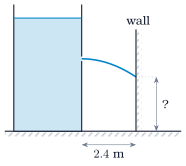
A wall stands \(2.4\) m from the tank of Question 1. At what height above the ground does the jet strike the wall?
Answer\(2.4\) m
Solution
Time to reach the wall: \(t = \dfrac{2.4}{6} = 0.4\) s. Drop in that time: \(\dfrac{1}{2} \times 10 \times 0.16 = 0.8\) m.
Height of impact \(= 3.2 - 0.8 = 2.4\) m above the ground. (Or from Question 8: \(y = \dfrac{2.4^2}{4 \times 1.8} = 0.8\) m.)
How did it go?
Q10
The \(5\) m tank has a hole in its base and a nozzle in its side, \(1.8\) m below the surface, that points vertically upward.
Find the speed of the water leaving the hole in the base.
How high does the jet from the upward nozzle rise? Why does a real jet rise a little less?
Answer(i) \(10\) m/s (ii) \(1.8\) m, to the surface level
Solution
The base is \(5\) m below the surface: \(v = \sqrt{2 \times 10 \times 5} = 10\) m/s, straight down.
The jet leaves at \(\sqrt{2gh}\) upward and rises until its speed is zero: a height \(\dfrac{v^2}{2g} = h = 1.8\) m, exactly back to the level of the surface.
A real jet loses energy to viscosity and air resistance, so it stops a little below the surface level.
How did it go?
Q11
Does the range of the jet depend on the area of the hole? Does it depend on the density of the liquid? Give the reasons.
Answerno; no
Solution
No. The speed \(\sqrt{2gh}\) and the fall time depend only on the heights, so \(R = 2\sqrt{h(H - h)}\) holds for any small hole. A larger hole gives a thicker jet, not a longer one.
No. The density cancels in Torricelli's law: a heavier liquid has more pressure at the hole and more mass to push.
How did it go?
Q12
The water in the tank of Question 1 drains until the surface is \(4\) m above the ground. The hole is still \(3.2\) m above the ground. Find the new range.
Answer\(3.2\) m
Solution
Now \(h = 4 - 3.2 = 0.8\) m and the hole is still \(3.2\) m above the ground: \(R = 2\sqrt{0.8 \times 3.2} = 2\sqrt{2.56} = 3.2\) m.
How did it go?
Forces
Q13
The hole of Question 1 has area \(a = 1\) cm\(^2\). Take the density of water as \(1000\) kg/m\(^3\).
Find the mass of water leaving per second and the momentum it carries away per second.
Show that the reaction force on the tank is \(2\rho g h a\), and find it.
The jet strikes a wall and stops. Find the force on the wall.
Answer(i) \(0.6\) kg/s, \(3.6\) N (ii) \(3.6\) N (iii) \(3.6\) N
Solution
Mass per second \(= \rho a v = 1000 \times 10^{-4} \times 6 = 0.6\) kg/s. Momentum per second \(= 0.6 \times 6 = 3.6\) kg m/s\(^2\), that is, \(3.6\) N.
Force \(=\) momentum per second \(= \rho a v^2 = \rho a (2gh) = 2\rho g h a\). The tank is pushed backward with \(2 \times 1000 \times 10 \times 1.8 \times 10^{-4} = 3.6\) N, twice the hydrostatic force \(\rho g h a\) on an area \(a\).
The wall must destroy the same momentum per second: \(3.6\) N.
How did it go?
Inclined nozzle, other cases
Q14
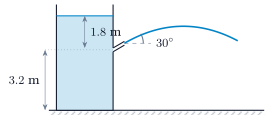
The nozzle is \(1.8\) m below the surface and \(3.2\) m above the ground. It points \(30^\circ\) above the horizontal.
Find the horizontal and vertical components of the jet's initial velocity.
Find the greatest height of the jet above the nozzle.
Find the time to reach the ground and the range. Take \(\sqrt{73} = 8.54\) and \(\sqrt{3} = 1.73\).
Answer(i) \(5.2\) m/s, \(3\) m/s (ii) \(0.45\) m (iii) \(1.15\) s; \(6\) m
The deeper hole lands farther, because \(2\) m is closer to the best depth \(H/2 = 2.5\) m.
How did it go?
Q16
Find the depths below the surface at which a hole in the \(5\) m tank gives a range of \(3\) m.
Answer\(0.5\) m or \(4.5\) m
Solution
\(3 = 2\sqrt{h(5 - h)}\), so \(h(5 - h) = 2.25\) and \(h^2 - 5h + 2.25 = 0\).
\(h = \dfrac{5 \pm \sqrt{25 - 9}}{2} = \dfrac{5 \pm 4}{2} = 4.5\) m or \(0.5\) m.
How did it go?
Q17
The tank of Question 1 is placed in a lift that accelerates upward at \(a\).
Write the speed of efflux and the time of fall in terms of \(g + a\).
Show that the range does not change. Would the range change on the Moon?
Answer(i) \(\sqrt{2(g + a)h}\); \(\sqrt{2(H - h)/(g + a)}\) (ii) no; no
Solution
In the lift the effective gravity is \(g + a\). Speed of efflux \(v = \sqrt{2(g + a)h}\); time of fall \(t = \sqrt{\dfrac{2(H - h)}{g + a}}\).
\(R = vt = 2\sqrt{h(H - h)}\): the factor \((g + a)\) cancels. The range is the same. On the Moon \(g\) is smaller, the jet is slower and falls more slowly, and the range is again unchanged.
How did it go?
Q18
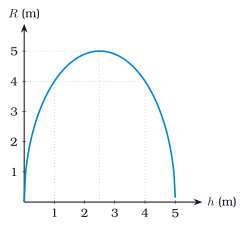
The graph shows the range \(R\) against the hole depth \(h\) for the \(5\) m tank on the ground.
Read the greatest range and the depth at which it occurs.
Read the two depths that give a range of \(4\) m.
Why is the curve symmetric about \(h = 2.5\) m?
Answer(i) \(5\) m at \(2.5\) m (ii) \(1\) m, \(4\) m (iii) \(R = 2\sqrt{h(H - h)}\)
Solution
The peak of the curve is \(R = 5\) m at \(h = 2.5\) m, as in Question 4.
The line \(R = 4\) m cuts the curve at \(h = 1\) m and \(h = 4\) m, as in Question 3.
\(R = 2\sqrt{h(H - h)}\) is unchanged when \(h\) is replaced by \(H - h\), so depths equally far above and below \(H/2\) give equal ranges.
How did it go?
Q19
A hole is \(20\) cm below the surface of the \(5\) m tank. Find the range. Take \(\sqrt{0.96} = 0.98\). Where else could the hole be to give the same range?
The symmetric hole is at depth \(H - h = 4.8\) m, that is, \(20\) cm above the base.
How did it go?
Q20
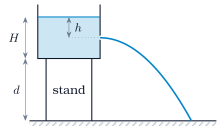
A tank holding \(2\) m of water has a hole \(1\) m below the surface. On what height of platform must the tank stand so that the jet lands \(6\) m from the tank?
Answer\(8\) m
Solution
\(R = 2\sqrt{h(H - h + d)}\): \(6 = 2\sqrt{1 \times (1 + d)}\), so \(1 + d = 9\) and \(d = 8\) m.
How did it go?
Continuity Equation and Bernoulli's Theorem
21 questions · after Lesson 6, Bernoulli at Work
The continuity equation
Q21
Take \(g = 10\) m/s\(^2\), the density of water as \(1000\) kg/m\(^3\) and atmospheric pressure as \(10^{5}\) Pa throughout. Water flows at \(1\) m/s in a pipe of area \(4\) cm\(^2\). The pipe narrows to \(2\) cm\(^2\).
Find the speed in the narrow part.
Find the volume flow rate in litres per second.
Find the mass flow rate.
Answer(i) \(2\) m/s (ii) \(0.4\) L/s (iii) \(0.4\) kg/s
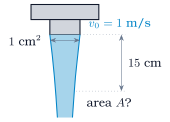
A tap with a nozzle of area \(1\) cm\(^2\) fills a \(0.5\) litre glass in \(5\) s. Find the volume flow rate and the speed of the water leaving the nozzle.
The same volume passes every section each second: \(A_0v_0 = Av\), so \(A = \dfrac{1 \times 1}{2} = 0.5\) cm\(^2\).
The water speeds up as it falls, so a smaller cross-section carries the same flow. The stream narrows.
How did it go?
Q24
Answer briefly.
What is a streamline? Why can two streamlines never cross?
What is the difference between streamline flow and turbulent flow? When does flow become turbulent?
Answer(i) path of a fluid particle; two velocities at one point (ii) turbulent above a critical speed
Solution
A streamline is the path of a fluid particle in steady flow. The velocity at each point is along the tangent to the streamline through that point.
If two streamlines crossed, a particle at the crossing would have two velocities at once, which is impossible.
In streamline flow every particle passing a point follows the same path, and the flow pattern does not change with time. In turbulent flow the paths are irregular and eddies form.
Flow becomes turbulent when the speed exceeds a critical value, which is lower for wider pipes and less viscous fluids.
How did it go?
Q25
A river \(20\) m wide and \(2\) m deep flows at \(0.5\) m/s. It enters a gorge \(10\) m wide where the depth is still \(2\) m. Find the volume flow rate and the speed in the gorge.
In the gorge \(A = 10 \times 2 = 20\) m\(^2\), so \(v = \dfrac{20}{20} = 1\) m/s.
How did it go?
Bernoulli's theorem
Q26
Write Bernoulli's equation for streamline flow of an ideal fluid. Name each term and show that each has the unit of energy per unit volume. For which kind of fluid does the equation hold?
\(P + \dfrac{1}{2}\rho v^2 + \rho g h = \) constant along a streamline.
\(P\) is the pressure energy per unit volume, \(\dfrac{1}{2}\rho v^2\) the kinetic energy per unit volume, and \(\rho g h\) the potential energy per unit volume.
Unit check: \(\rho v^2\) is kg m\(^{-3}\) m\(^2\) s\(^{-2}\), that is, N/m\(^2\). This equals J/m\(^3\), the same as \(P\).
It holds for an ideal fluid: incompressible, non-viscous, in steady streamline flow.
How did it go?
Q27
In the horizontal pipe of Question 1 the pressure in the wide part is \(1.2 \times 10^{5}\) Pa. Find the pressure in the narrow part. Why is it lower?
The water speeds up as it enters the narrow part. The push that speeds it up comes from the higher pressure behind, so the pressure ahead, in the narrow part, is lower.
How did it go?
Q28
Water flows at \(2\) m/s through a pipe of uniform area that rises \(5\) m. Find the fall in pressure between the lower and the upper ends.
Answer\(5 \times 10^{4}\) Pa
Solution
The speed is the same at both ends, so only the height term changes: \(P_1 - P_2 = \rho g h = 1000 \times 10 \times 5 = 5 \times 10^{4}\) Pa.
How did it go?
Q29
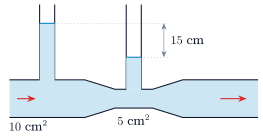
A venturimeter has an inlet of area \(10\) cm\(^2\) and a throat of \(5\) cm\(^2\). The water in the two vertical tubes differs in level by \(15\) cm.
Find the pressure difference between the inlet and the throat.
Find the speed of the water at the inlet and at the throat.
Find the volume flow rate.
Answer(i) \(1500\) Pa (ii) \(1\) m/s, \(2\) m/s (iii) \(1\) L/s
Solution
\(\Delta P = \rho g\,\Delta h = 1000 \times 10 \times 0.15 = 1500\) Pa.
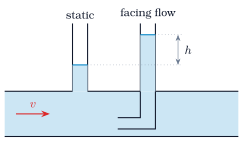
A Pitot tube is placed in a stream of water. The tube facing the flow shows a level \(h = 20\) cm higher than the straight tube.
Why does the water stand higher in the tube that faces the flow?
Show that \(v = \sqrt{2gh}\), and find the speed of the stream.
Answer(i) water brought to rest, pressure rises by \(\frac{1}{2}\rho v^2\) (ii) \(2\) m/s
Solution
The water entering the bent tube is brought to rest. Its kinetic energy per unit volume, \(\dfrac{1}{2}\rho v^2\), is converted into extra pressure, which supports a taller column.
Bernoulli between the moving stream and the stagnant water at the tube mouth: \(P + \dfrac{1}{2}\rho v^2 = P_{\text{stag}}\), so \(P_{\text{stag}} - P = \dfrac{1}{2}\rho v^2\).
The level difference gives \(P_{\text{stag}} - P = \rho g h\). So \(\dfrac{1}{2}\rho v^2 = \rho g h\) and \(v = \sqrt{2gh} = \sqrt{2 \times 10 \times 0.2} = 2\) m/s.
How did it go?
Q31
Air of density \(1.2\) kg/m\(^3\) flows over the top of an aircraft wing at \(60\) m/s and under it at \(50\) m/s. The wing area is \(20\) m\(^2\).
Find the pressure difference across the wing.
Find the lift force.
What mass can the wing support?
Answer(i) \(660\) Pa (ii) \(13200\) N (iii) \(1320\) kg
Lift \(= \Delta P \times A = 660 \times 20 = 13200\) N.
\(m = \dfrac{13200}{10} = 1320\) kg.
How did it go?
Q32
Use Bernoulli's principle to explain each observation.
A strong wind can lift the roof off a house.
Blowing between two hanging sheets of paper makes them move together.
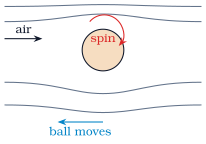
The spinning ball in the figure curves upward as it moves. Which side has the faster air?
Answer(i) fast air above, low pressure (ii) fast air between, low pressure (iii) top
Solution
Wind moves fast over the roof, so the pressure above it falls below the still-air pressure inside the house. The net upward push can lift the roof.
The air between the sheets moves fast, so its pressure drops. The still air outside pushes the sheets inward, towards each other.
On the top, the surface of the spinning ball moves with the air stream and drags the air along. So the air there is faster and the pressure lower. The net force is upward, so the ball curves upward. This is the Magnus effect.
How did it go?
Torricelli and the draining tank
Q33
A large open tank has a small hole \(5\) m below the water surface.
Use Bernoulli's equation to show that the water leaves the hole at \(v = \sqrt{2gh}\). State the assumptions.
Find the speed of efflux.
Answer(i) \(\rho g h = \frac{1}{2}\rho v^2\); steady, non-viscous, wide tank (ii) \(10\) m/s
Solution
Take the surface and the hole as two points of a streamline. Both are at atmospheric pressure. The tank is large, so the surface speed is negligible.
\(P_0 + 0 + \rho g h = P_0 + \dfrac{1}{2}\rho v^2 + 0\), so \(v = \sqrt{2gh}\). Assumptions: ideal fluid, small hole, wide tank.
\(v = \sqrt{2 \times 10 \times 5} = 10\) m/s, the speed of a body that has fallen \(5\) m.
How did it go?
Q34
The hole of Question 13 has area \(1\) cm\(^2\). Find the volume of water leaving per second, in litres.
Answer\(1\) L/s
Solution
\(Q = av = 10^{-4} \times 10 = 10^{-3}\) m\(^3\)/s \(= 1\) litre per second.
How did it go?
Q35
The tank of Question 13 is now closed, and the air above the water is kept at an absolute pressure of \(2.5 \times 10^{5}\) Pa. The hole opens to the atmosphere. Find the new speed of efflux.
Answer\(20\) m/s
Solution
Now the pressures at the two points differ: \(P_{\text{gas}} + \rho g h = P_0 + \dfrac{1}{2}\rho v^2\).
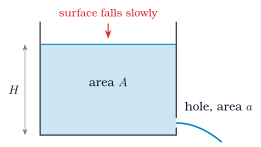
A tank of cross-section \(A = 1\) m\(^2\) holds water to a depth \(H = 5\) m. A hole of area \(a = 1\) cm\(^2\) is opened at the bottom.
Show that the time to empty the tank is \(t = \frac{A}{a}\sqrt{\frac{2H}{g}}\).
Find this time in seconds and in hours.
Answer(i) \(A\,dh = -a\sqrt{2gh}\,dt\) (ii) \(10^{4}\) s \(\approx 2.8\) h
Solution
When the depth is \(h\), water leaves at \(a\sqrt{2gh}\) per second, so the level falls at \(-\dfrac{dh}{dt} = \dfrac{a}{A}\sqrt{2gh}\).
\(dt = -\dfrac{A}{a}\dfrac{dh}{\sqrt{2gh}}\). Integrate from \(h = H\) to \(0\): \(t = \dfrac{A}{a\sqrt{2g}}\left[2\sqrt{h}\right]_0^H = \dfrac{A}{a}\sqrt{\dfrac{2H}{g}}\).
\(t = \dfrac{1}{10^{-4}}\sqrt{\dfrac{2 \times 5}{10}} = 10^{4} \times 1 = 10^{4}\) s, about \(2.8\) hours. The flow slows as the level falls.
How did it go?
Q37
For the tank of Question 16, find the time for the water level to fall from \(H\) to \(H/4\). Compare it with the time to empty completely.
Answer\(5000\) s, half the total
Solution
From the integral, the time to fall from \(H\) to \(h\) is \(t = \dfrac{A}{a}\sqrt{\dfrac{2}{g}}\left(\sqrt{H} - \sqrt{h}\right)\).
With \(h = \dfrac{H}{4}\): \(\sqrt{H} - \dfrac{\sqrt{H}}{2} = \dfrac{\sqrt{H}}{2}\), so \(t = \dfrac{1}{2} \times \dfrac{A}{a}\sqrt{\dfrac{2H}{g}} = 5000\) s.
The upper three quarters of the water take half the time. The last quarter takes the other half, because the flow is slow near the end.
How did it go?
Q38
Does the speed of efflux from a small hole depend on the density of the liquid? Does it depend on the size of the hole? Give the reasons.
Answerno; no
Solution
No. In \(v = \sqrt{2gh}\) the density has cancelled: a denser liquid has more pressure at the hole but also more mass to accelerate. Mercury and water leave at the same speed from the same depth.
No, as long as the hole is small compared with the tank, so that the surface hardly moves. A larger hole passes more volume per second, but at the same speed.
How did it go?
Three more applications
Q39
Water flows slowly along a horizontal pipe at an absolute pressure of \(1.5 \times 10^{5}\) Pa and then through a narrow throat. Find the speed at the throat for which the pressure there falls to zero. What happens to the water if the throat is made narrower still?
A liquid cannot have negative pressure. If the throat is narrowed further the water boils into vapour bubbles at the throat (cavitation), and the smooth flow breaks down.
How did it go?
Q40
In a spray pump, air is blown horizontally across the top of a vertical tube. The lower end of the tube dips into water \(10\) cm below the top. Take the air density as \(1.2\) kg/m\(^3\). Find the least air speed that lifts the water to the top of the tube.
Answer\(\approx 41\) m/s
Solution
The fast air lowers the pressure at the top of the tube by \(\dfrac{1}{2}\rho_{\text{air}}v^2\). The water rises when this equals the pressure of a \(10\) cm column, \(\rho_w g h = 1000 \times 10 \times 0.1 = 1000\) Pa.
A pump sends \(2\) litres of water per second through a hose. The water leaves the hose \(10\) m above the pump at \(10\) m/s and at atmospheric pressure. Find the power the pump must deliver to the water.
Answer\(300\) W
Solution
Each cubic metre of water gains \(\rho g h + \dfrac{1}{2}\rho v^2 = 1000 \times 10 \times 10 + \dfrac{1}{2} \times 1000 \times 100 = 1.5 \times 10^{5}\) J.
Power \(= Q \times 1.5 \times 10^{5} = 2 \times 10^{-3} \times 1.5 \times 10^{5} = 300\) W.