Questions on Surface Tension, the kind your examinations ask. Solve one on paper. Then tell the book how it went. The book believes you, and it uses your answer to plan your revision.
0%
Nothing marked yetMark honestly. Peek at the answer only after your own attempt.
Surface Tension, Surface Energy and Excess Pressure
21 questions · after Lesson 4, Bubbles in Contact
Surface tension as a force, surface energy
Q1
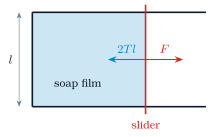
A soap film (\(T = 0.03\) N/m) is stretched on a U-shaped frame with a sliding wire of length \(l = 10\) cm. Take \(g = 10\) m/s\(^2\) and the surface tension of water as \(0.07\) N/m throughout this sheet.
Define surface tension. Write its SI unit in two ways.
Find the force \(F\) that holds the slider at rest. Why is there a factor of \(2\)?
Answer(i) N/m \(=\) J/m\(^2\) (ii) \(6 \times 10^{-3}\) N; two surfaces
Solution
Surface tension is the force per unit length acting along a liquid surface, perpendicular to any line drawn in the surface. Unit: N/m, which equals J/m\(^2\).
The film has two surfaces, front and back, and each pulls the slider with \(Tl\). So \(F = 2Tl = 2 \times 0.03 \times 0.10 = 6 \times 10^{-3}\) N.
How did it go?
Q2
The slider of Question 1 is pulled outward slowly by \(5\) cm.
Find the work done.
Find the increase in surface area of the film.
Show that the work equals \(T\) times the increase in area.
Answer(i) \(3 \times 10^{-4}\) J (ii) \(10^{-2}\) m\(^2\) (iii) \(T\Delta A = 0.03 \times 10^{-2}\) J
Solution
\(W = F \times d = 6 \times 10^{-3} \times 0.05 = 3 \times 10^{-4}\) J.
Each surface grows by \(l \times d = 0.10 \times 0.05 = 5 \times 10^{-3}\) m\(^2\). Two surfaces: \(\Delta A = 10^{-2}\) m\(^2\).
\(T\,\Delta A = 0.03 \times 10^{-2} = 3 \times 10^{-4}\) J \(= W\). The work goes into surface energy.
How did it go?
Q3
Find the surface energy of a soap bubble of radius \(5\) cm. Keep \(\pi\) symbolic and give the approximate value.
\(W = T\,\Delta A = 0.07 \times 16\pi \times 10^{-6} = 1.12\pi \times 10^{-6} \approx 3.5 \times 10^{-6}\) J.
Energy must be supplied to make the new surface. If it comes from the water itself, the water cools slightly.
How did it go?
Q6
Use the molecular picture to explain two things. Why does a molecule at the surface have more energy than one inside? Why does a free drop become a sphere?
Answernet inward pull; sphere has least area
Solution
A molecule inside is pulled equally by neighbours on all sides. A molecule at the surface has neighbours only below and beside it, so it feels a net inward pull.
Work must be done against this pull to bring a molecule to the surface, so surface molecules have extra potential energy. The liquid lowers its energy by making its surface as small as it can. The shape with the least surface for a given volume is a sphere.
How did it go?
Q7
How does the surface tension of a liquid change when it is warmed? What does soap do to the surface tension of water, and how does this help washing?
Answerfalls; lowers it
Solution
Surface tension falls as the temperature rises, because the faster molecules are held less strongly by their neighbours. It becomes zero at the critical temperature.
Soap lowers the surface tension of water. The water then spreads more easily into the fibres of cloth and around dirt particles, so it wets and washes better.
How did it go?
Excess pressure
Q8
A spherical drop of radius \(r\) has surface tension \(T\). Let the inside pressure exceed the outside pressure by \(\Delta P\). By considering the work done when the radius grows by a small \(dr\), show that \(\Delta P = \frac{2T}{r}\).
Answer\(\Delta P\,4\pi r^2\,dr = T\,8\pi r\,dr\)
Solution
Let the radius grow from \(r\) to \(r + dr\). The inside pressure does work \(\Delta P \times\) (area) \(\times dr = \Delta P \times 4\pi r^2\,dr\).
The surface area grows by \(d(4\pi r^2) = 8\pi r\,dr\), needing surface energy \(T \times 8\pi r\,dr\).
Equate: \(\Delta P \times 4\pi r^2\,dr = 8\pi r T\,dr\), so \(\Delta P = \dfrac{2T}{r}\). Smaller drops have larger excess pressure.
How did it go?
Q9
Find the excess pressure inside each of the following.
A water drop of radius \(1\) mm.
An air bubble of radius \(1\) mm in water.
A soap bubble of radius \(1\) cm (\(T = 0.03\) N/m).
Answer(i) \(140\) Pa (ii) \(140\) Pa (iii) \(12\) Pa
One surface again, water outside: \(\Delta P = \dfrac{2 \times 0.07}{10^{-3}} = 140\) Pa.
Two surfaces: \(\Delta P = \dfrac{4T}{r} = \dfrac{4 \times 0.03}{0.01} = 12\) Pa.
How did it go?
Q10
Why is the excess pressure inside a soap bubble \(\frac{4T}{r}\) and not \(\frac{2T}{r}\)?
Answertwo surfaces
Solution
A soap bubble is a thin film of liquid with air on both sides, so it has two surfaces, an inner and an outer one. Each surface needs \(\dfrac{2T}{r}\) of pressure difference across it, and the two add to \(\dfrac{4T}{r}\).
How did it go?
Q11
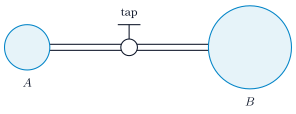
Two soap bubbles \(A\) (small) and \(B\) (large) are blown on the ends of a tube with a closed tap between them.
In which bubble is the pressure higher? Give the reason.
The tap is opened. What happens to the two bubbles?
Answer(i) \(A\) (ii) \(A\) shrinks, \(B\) grows
Solution
Bubble \(A\). The excess pressure \(\dfrac{4T}{r}\) is larger for the smaller radius.
Air flows from the higher pressure in \(A\) to the lower pressure in \(B\). \(A\) shrinks and \(B\) grows, until \(A\) is only a flat film across the end of the tube.
How did it go?
Q12
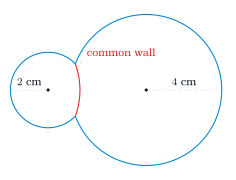
Soap bubbles of radii \(2\) cm and \(4\) cm are in contact. The common wall is curved.
Into which bubble does the common wall bulge? Give the reason.
Show that the radius of the common wall is \(r = \frac{r_1 r_2}{r_2 - r_1}\), and find it.
Answer(i) into the larger (ii) \(4\) cm
Solution
The smaller bubble has the higher pressure, so it pushes the common wall outward, into the larger bubble.
Pressure in the small bubble: \(P_0 + \dfrac{4T}{r_1}\); in the large one: \(P_0 + \dfrac{4T}{r_2}\). The common wall is a soap film of radius \(r\) with the small bubble on its concave side. The pressure difference across it is \(\dfrac{4T}{r}\).
\(\dfrac{4T}{r} = \dfrac{4T}{r_1} - \dfrac{4T}{r_2}\), so \(\dfrac{1}{r} = \dfrac{1}{r_1} - \dfrac{1}{r_2}\) and \(r = \dfrac{r_1 r_2}{r_2 - r_1} = \dfrac{2 \times 4}{4 - 2} = 4\) cm.
How did it go?
Q13
Two soap bubbles of radii \(3\) cm and \(4\) cm join into a single bubble in a vacuum, with no change of temperature. Show that the new radius \(R\) obeys \(R^2 = r_1^2 + r_2^2\), and find \(R\).
Answer\(5\) cm
Solution
In a vacuum the pressure inside a bubble is just \(\dfrac{4T}{r}\). Isothermal: \(PV\) of the air is conserved, \(P_1V_1 + P_2V_2 = PV\).
\(R = \sqrt{9 + 16} = 5\) cm. (The surface energy is conserved: \(T \times 8\pi R^2 = T \times 8\pi(r_1^2 + r_2^2)\).)
How did it go?
Q14
An air bubble of radius \(0.1\) mm is \(10\) cm below the surface of water. Atmospheric pressure is \(10^{5}\) Pa. Find the pressure of the air inside the bubble.
Answer\(1.024 \times 10^{5}\) Pa
Solution
Pressure of the water at the bubble: \(P_0 + h\rho g = 10^{5} + 0.10 \times 1000 \times 10 = 1.01 \times 10^{5}\) Pa.
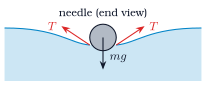
A steel needle \(5\) cm long rests on water. The surface dips and the surface tension acts along both sides of the needle.
Find the largest upward force the surface can give.
Can a needle of mass \(0.5\) g float? What if the needle is \(1\) g?
Answer(i) \(7 \times 10^{-3}\) N (ii) yes; no
Solution
The surface pulls along both sides of the needle, a total length \(2l = 0.10\) m. The largest upward force is when the surface is vertical at the needle: \(F = 2Tl = 2 \times 0.07 \times 0.05 = 7 \times 10^{-3}\) N.
A \(0.5\) g needle weighs \(5 \times 10^{-3}\) N, less than \(7 \times 10^{-3}\) N: it floats. A \(1\) g needle weighs \(10^{-2}\) N, more than the surface can hold: it sinks.
How did it go?
Q17
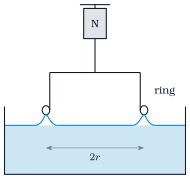
A thin wire ring of radius \(2\) cm hangs from a spring balance and touches a water surface. It is raised slowly. Take \(\pi = 3.14\).
Along what total length does the surface tension pull on the ring?
Find the extra force the balance reads just before the film breaks.
Answer(i) \(4\pi r \approx 25\) cm (ii) \(\approx 1.8 \times 10^{-2}\) N
Solution
The film clings to the inside and the outside of the ring: total length \(2 \times 2\pi r = 4\pi r = 4 \times 3.14 \times 0.02 \approx 0.25\) m.
Extra force \(= T \times 4\pi r = 0.07 \times 0.251 \approx 1.8 \times 10^{-2}\) N, about the weight of \(1.8\) g.
How did it go?
Q18
The slider of a U-frame is \(5\) cm long. A film of an unknown liquid holds the slider at rest against a weight of \(4 \times 10^{-3}\) N. Find the surface tension of the liquid.
Energy per area: \(\dfrac{\mathrm{ML^2T^{-2}}}{\mathrm{L^2}} = \mathrm{MT^{-2}}\), the same. Physically, the work to enlarge a surface by \(\Delta A\) against the force \(T\) per unit length is \(T\,\Delta A\) (Question 2). So \(T\) is also the energy stored per unit area.
How did it go?
Q20
One thousand tiny water droplets, each of radius \(0.1\) mm, merge into one drop.
Find the radius of the big drop.
Find the energy released.
Answer(i) \(1\) mm (ii) \(\approx 7.9 \times 10^{-6}\) J
Solution
\(1000 \times \dfrac{4}{3}\pi r^3 = \dfrac{4}{3}\pi R^3\), so \(R = 10r = 1\) mm.
Area lost \(= 1000 \times 4\pi(0.1)^2 - 4\pi(1)^2 = 40\pi - 4\pi = 36\pi\) mm\(^2 = 36\pi \times 10^{-6}\) m\(^2\).
Energy released \(= T\,\Delta A = 0.07 \times 36\pi \times 10^{-6} \approx 7.9 \times 10^{-6}\) J. The drop warms very slightly.
How did it go?
Q21
Why is a small drop of mercury on a table almost a sphere, while a large drop is flattened? Why do small bubbles in a fizzy drink merge into larger ones?
Answergravity flattens large drops; less surface energy
Solution
Surface tension pulls a drop into a sphere; gravity flattens it. For a small drop the surface energy (proportional to \(r^2\)) matters more than the gravitational energy (proportional to \(r^4\)). The drop stays round. For a large drop gravity wins and the drop spreads.
Two small bubbles have more surface area than one bubble of the same total volume. Merging lowers the surface energy, so the small bubbles join into larger ones.
How did it go?
Capillary Action and Contact Angle
21 questions · after Lesson 6, Capillarity in Odd Shapes
Contact angle
Q22
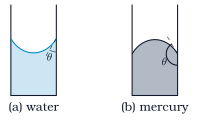
The figure shows water and mercury in glass tubes. Take \(g = 10\) m/s\(^2\), the surface tension of water as \(0.07\) N/m and its density as \(1000\) kg/m\(^3\) throughout this sheet.
Define the angle of contact. Mark on each figure the angle you mean.
Which liquid wets glass? Which has an angle of contact greater than \(90^\circ\)?
Answer(i) wall to liquid surface, inside the liquid (ii) water; mercury
Solution
Draw the tangent to the liquid surface where it meets the solid. The angle of contact is the angle between this tangent and the solid surface, measured inside the liquid.
For water it is the small angle between the glass and the meniscus, below the surface. For mercury it is the obtuse angle, again measured through the liquid.
Water wets glass (angle less than \(90^\circ\)). Mercury has an angle of about \(135^\circ\), greater than \(90^\circ\), and does not wet glass.
How did it go?
Q23
Use the ideas of cohesion and adhesion to explain why water climbs a little up the glass wall while mercury is pushed down.
Answeradhesion wins for water, cohesion for mercury
Solution
Cohesion is the attraction between molecules of the liquid; adhesion is the attraction between the liquid and the glass.
For water the adhesion to glass is stronger than the cohesion. The water near the wall is pulled up the glass, and the surface curves down towards the centre. For mercury the cohesion is much stronger, so the mercury pulls away from the glass and its surface curves the other way.
How did it go?
Q24
What happens to the angle of contact of water on glass when a little detergent is added? What happens to it when the water is warmed?
Answerfalls; falls
Solution
Detergent lowers the surface tension and makes water wet glass better, so the angle of contact falls. Warming also lowers the surface tension and lowers the angle of contact.
How did it go?
Q25
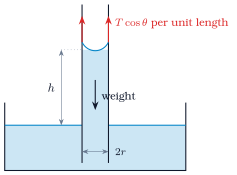
A capillary tube of radius \(r\) dips into a liquid of surface tension \(T\), density \(\rho\) and angle of contact \(\theta\). The liquid rises to height \(h\).
Along what length does the surface tension pull on the column, and with what upward component?
Balance this pull against the weight of the column and show that \(h = \frac{2T\cos\theta}{r\rho g}\).
Answer(i) \(2\pi r\); \(2\pi r T\cos\theta\) (ii) \(= \pi r^2 h\rho g\)
Solution
The surface meets the glass along the rim of the tube, a circle of length \(2\pi r\). The surface tension pulls along the surface, at angle \(\theta\) to the wall, so its upward component is \(T\cos\theta\) per unit length.
Total upward pull \(= 2\pi r T\cos\theta\).
Weight of the column \(= \pi r^2 h\rho g\). Equilibrium: \(2\pi r T\cos\theta = \pi r^2 h\rho g\), so \(h = \dfrac{2T\cos\theta}{r\rho g}\).
How did it go?
Jurin's law with numbers
Q26
A glass capillary of radius \(0.1\) mm dips into water. The angle of contact is zero. Find the height of the water column.
Answer\(14\) cm
Solution
\(h = \dfrac{2T}{r\rho g} = \dfrac{2 \times 0.07}{10^{-4} \times 1000 \times 10} = \dfrac{0.14}{1} = 0.14\) m \(= 14\) cm.
How did it go?
Q27
Find the capillary rise of water in tubes of radius:
\(0.5\) mm,
\(1\) mm.
State how \(h\) depends on \(r\).
Answer(i) \(2.8\) cm (ii) \(1.4\) cm; \(h \propto 1/r\)
Solution
\(h \propto \dfrac{1}{r}\): five times the radius gives one fifth of the rise.
\(r = 0.5\) mm: \(h = \dfrac{14}{5} = 2.8\) cm.
\(r = 1\) mm: \(h = \dfrac{14}{10} = 1.4\) cm.
How did it go?
Q28
A glass tube of radius \(0.5\) mm dips into mercury, for which \(T = 0.5\) N/m, density \(13600\) kg/m\(^3\) and angle of contact \(135^\circ\). Take \(\cos 135^\circ = -0.7\). Find the height of the mercury inside the tube relative to the outside level.
The mercury inside stands about \(1\) cm below the outside level: a capillary depression.
How did it go?
Q29
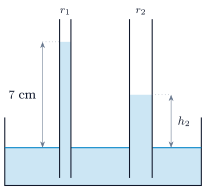
Two capillary tubes dip into the same water. In the tube of radius \(r_1 = 0.2\) mm the water rises \(7\) cm. The other tube has radius \(r_2 = 0.4\) mm.
Find the rise \(h_2\).
Check \(h_1\) from the formula.
Answer(i) \(3.5\) cm (ii) \(7\) cm
Solution
\(h \propto \dfrac{1}{r}\), so doubling the radius halves the rise: \(h_2 = 3.5\) cm.
\(h_1 = \dfrac{2 \times 0.07}{2 \times 10^{-4} \times 1000 \times 10} = 0.07\) m \(= 7\) cm, as read from the figure.
How did it go?
Q30
Show that the mass of water raised in a capillary tube is \(m = \frac{2\pi r T\cos\theta}{g}\), proportional to the radius. Find it for the tube of Question 5. Take \(\pi = 3.14\).
Answer\(4.4 \times 10^{-6}\) kg
Solution
\(m = \pi r^2 h\rho = \pi r^2\rho \times \dfrac{2T\cos\theta}{r\rho g} = \dfrac{2\pi r T\cos\theta}{g}\). The mass raised grows with \(r\), although the height falls.
The tube of Question 5 is only \(7\) cm long, half the height the water would rise.
Does the water flow out of the top? Give the reason.
Find the radius of curvature of the meniscus at the top of the tube.
Answer(i) no (ii) \(0.2\) mm
Solution
No. The water rises to the top and stops. The meniscus flattens until the pressure difference across it, \(\dfrac{2T}{R}\), is just enough to hold the shorter column. It cannot push water out, because a flat or less curved surface gives less lift, never more.
The excess pressure \(\dfrac{2T}{R}\) must equal \(h'\rho g\) with \(h' = 7\) cm. Since \(hR\) is constant for a given liquid, \(R = r \times \dfrac{14}{7} = 2r = 0.2\) mm, twice the tube radius.
How did it go?
Q32
The tube of Question 5 is in a lift. Find the rise when the lift accelerates upward at \(10\) m/s\(^2\). What happens to the water column when the lift falls freely?
Answer\(7\) cm; fills the tube
Solution
In the lift the effective gravity is \(g + a = 20\) m/s\(^2\). \(h \propto \dfrac{1}{g_{\text{eff}}}\), so the rise halves to \(7\) cm.
In free fall \(g_{\text{eff}} = 0\) and the formula gives an infinite height. The water rises to the top of the tube and fills it, whatever its length.
How did it go?
Q33
Find the rise of water in the tube of Question 5 on the Moon, where \(g\) is one sixth of its value on Earth.
Answer\(84\) cm
Solution
\(h \propto \dfrac{1}{g}\). With \(g\) six times smaller the rise is six times larger: \(6 \times 14 = 84\) cm.
How did it go?
Q34
The tube of Question 5 is tilted so that it makes \(60^\circ\) with the vertical. Find the vertical height of the column and the length of the column along the tube.
Answer\(14\) cm; \(28\) cm
Solution
The pressure balance fixes the vertical height of the column, which stays \(14\) cm.
Length along the tube \(= \dfrac{h}{\cos 60^\circ} = \dfrac{14}{0.5} = 28\) cm.
How did it go?
Q35
A liquid with the same surface tension and density as water has an angle of contact of \(60^\circ\) with glass. Find its rise in a tube of radius \(0.1\) mm.
Answer\(7\) cm
Solution
\(h \propto \cos\theta\) and \(\cos 60^\circ = 0.5\). The rise is half that of Question 5: \(7\) cm.
How did it go?
Other geometries
Q36
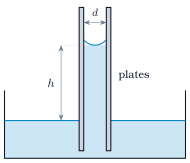
Two vertical glass plates stand in water with a gap \(d = 0.2\) mm between them. The angle of contact is zero.
Consider a width \(w\) of the film. Along what length does the surface tension pull it up?
Show that \(h = \frac{2T}{d\rho g}\) and find the rise.
Answer(i) \(2w\) (ii) \(7\) cm
Solution
The film of width \(w\) touches both plates along its top edge: total length \(2w\), so the upward pull is \(2wT\) (with \(\theta = 0\)).
Weight of the film \(= w d h\rho g\). Equilibrium: \(2wT = wdh\rho g\), so \(h = \dfrac{2T}{d\rho g}\).
\(h = \dfrac{2 \times 0.07}{2 \times 10^{-4} \times 1000 \times 10} = 0.07\) m \(= 7\) cm.
How did it go?
Q37
Compare the rise between the plates of Question 15 with the rise in a round tube whose diameter equals the gap \(d\). Which is greater, and by what factor?
Answertube; twice
Solution
A tube of diameter \(d\) has radius \(\dfrac{d}{2}\): \(h_{\text{tube}} = \dfrac{2T}{(d/2)\rho g} = \dfrac{4T}{d\rho g}\), twice the rise between the plates.
The tube pulls the water up along a circle all round, while the plates pull only along two lines. So the tube raises the water twice as high.
How did it go?
Q38
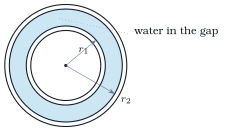
Two concentric glass tubes of radii \(r_1 = 0.5\) mm and \(r_2 = 0.7\) mm dip into water. Water rises in the ring-shaped gap.
Show that the rise is \(h = \frac{2T}{(r_2 - r_1)\rho g}\).
Find the rise.
Answer(i) \(2\pi(r_1 + r_2)T = \pi(r_2^2 - r_1^2)h\rho g\) (ii) \(7\) cm
Solution
The water touches the outer wall of the inner tube and the inner wall of the outer tube: total length \(2\pi r_1 + 2\pi r_2\). Upward pull \(= 2\pi(r_1 + r_2)T\).
Give three examples of capillary action in everyday life, and say in each case what plays the part of the narrow tube.
Answerblotting paper, wick, soil, towel
Solution
Blotting paper and a towel soak up water: the tiny gaps between the fibres act as capillaries. Oil climbs the wick of a lamp: the gaps between the threads are the tubes.
Water rises through soil to the roots of plants: the spaces between soil grains are the capillaries. Ink spreads along a nib for the same reason.