Questions on Viscosity, the kind your examinations ask. Solve one on paper. Then tell the book how it went. The book believes you, and it uses your answer to plan your revision.
0%
Nothing marked yetMark honestly. Peek at the answer only after your own attempt.
Viscosity, Terminal Velocity and Poiseuille's Law
21 questions · after Lesson 5, Poiseuille's Law
Newton's law of viscosity
Q1
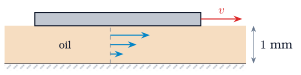
A flat plate of area \(0.1\) m\(^2\) slides at \(0.5\) m/s over a fixed surface. Between them is a film of oil \(1\) mm thick with viscosity \(\eta = 0.2\) Pa s. Take \(g = 10\) m/s\(^2\) throughout this sheet.
Write Newton's law of viscosity. Find the velocity gradient in the film.
Find the force needed to keep the plate moving.
Answer(i) \(500\) s\(^{-1}\) (ii) \(10\) N
Solution
\(F = \eta A\dfrac{dv}{dy}\): the viscous force is proportional to the area and to the velocity gradient.
The oil is at rest at the fixed surface and moves at \(0.5\) m/s at the plate: \(\dfrac{dv}{dy} = \dfrac{0.5}{10^{-3}} = 500\) s\(^{-1}\).
\(F = 0.2 \times 0.1 \times 500 = 10\) N.
How did it go?
Q2
Find the SI unit and the dimensions of viscosity. One poise is \(0.1\) Pa s. Write the viscosity of water, \(0.01\) poise, in SI units.
AnswerPa s; \(\mathrm{ML^{-1}T^{-1}}\); \(10^{-3}\) Pa s
Solution
\(\eta = \dfrac{F}{A\,(dv/dy)}\): unit \(\dfrac{\text{N}}{\text{m}^2\,\text{s}^{-1}} = \) N s/m\(^2 = \) Pa s.
Water: \(0.01\) poise \(= 0.01 \times 0.1 = 10^{-3}\) Pa s.
How did it go?
Q3
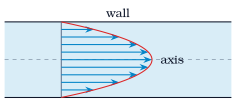
The figure shows the velocity of a viscous liquid across a pipe in streamline flow.
Where is the liquid fastest, and where is it at rest? Give the reason.
Where is the velocity gradient largest? Where is the viscous stress largest?
Answer(i) axis; wall (ii) wall; wall
Solution
Fastest on the axis, at rest at the wall. The layer touching the wall sticks to it. Each layer is dragged back by the slower layer outside it, so the speed grows towards the centre.
The gradient is the slope of the profile, which is steepest at the wall and zero on the axis. The viscous stress \(\eta\,dv/dy\) is therefore largest at the wall.
How did it go?
Q4
How does the viscosity of a liquid change when it is heated? How does the viscosity of a gas change? Give a reason for each.
Answerliquid: falls; gas: rises
Solution
A liquid becomes less viscous when heated. Its viscosity comes from the attraction between neighbouring molecules, and faster molecules break free of each other more easily.
A gas becomes more viscous when heated. Its viscosity comes from molecules crossing between layers and carrying momentum, and hotter molecules cross more often.
How did it go?
Q5
The plate of Question 1 is moved at the same speed over films of the same thickness of two liquids \(A\) and \(B\). Liquid \(B\) needs four times the force. Find \(\eta_B / \eta_A\).
Answer\(4\)
Solution
With the same \(A\) and the same gradient, \(F \propto \eta\). Four times the force means \(\eta_B = 4\eta_A\).
How did it go?
Stokes' law and terminal velocity
Q6
Write Stokes' law for the viscous force on a small sphere. Find the force on a sphere of radius \(1\) mm moving at \(0.1\) m/s through a liquid of viscosity \(0.1\) Pa s. Take \(\pi = 3.14\).
Answer\(F = 6\pi\eta r v\); \(1.9 \times 10^{-4}\) N
Solution
Stokes' law: \(F = 6\pi\eta r v\) for a small sphere in slow streamline motion.
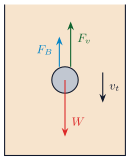
Weight \(W = \dfrac{4}{3}\pi r^3\rho g\) downward. Buoyancy \(F_B = \dfrac{4}{3}\pi r^3\sigma g\) upward. Viscous drag \(F_v = 6\pi\eta r v\) upward, growing with the speed.
At the terminal velocity the acceleration is zero: \(W = F_B + F_v\).
\(\dfrac{4}{3}\pi r^3(\rho - \sigma)g = 6\pi\eta r v_t\), so \(v_t = \dfrac{2r^2(\rho - \sigma)g}{9\eta}\).
How did it go?
Q8
A steel ball of radius \(3\) mm and density \(7500\) kg/m\(^3\) falls through oil of density \(1500\) kg/m\(^3\) and viscosity \(1.2\) Pa s. Find its terminal velocity.
A drizzle drop of radius \(0.03\) mm falls through air of viscosity \(2 \times 10^{-5}\) Pa s. Neglect the density of air. Find its terminal velocity. Why do clouds not fall out of the sky?
Cloud droplets are even smaller, and \(v_t \propto r^2\). They drift down at a few millimetres per second, slower than the air currents that lift them.
How did it go?
Q10
Eight small drops, each with terminal velocity \(v_0\), join into one drop.
Find the radius of the big drop in terms of the small radius \(r\).
Find the terminal velocity of the big drop.
Answer(i) \(2r\) (ii) \(4v_0\)
Solution
Volume is conserved: \(8 \times \dfrac{4}{3}\pi r^3 = \dfrac{4}{3}\pi R^3\), so \(R^3 = 8r^3\) and \(R = 2r\).
\(v_t \propto r^2\). Doubling the radius makes the terminal velocity \(4v_0\).
How did it go?
Q11
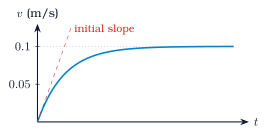
The graph shows the speed of the ball of Question 8 after it is released from rest in the oil.
Find the initial acceleration of the ball, before the viscous force has grown.
Read the terminal velocity from the graph and compare with Question 8.
Why does the slope of the graph fall to zero?
Answer(i) \(8\) m/s\(^2\) (ii) \(0.1\) m/s (iii) drag grows to balance
Solution
At the start the ball is at rest, so there is no viscous force. Net force \(= W - F_B\), so \(a = g\left(1 - \dfrac{\sigma}{\rho}\right) = 10 \times \dfrac{6000}{7500} = 8\) m/s\(^2\).
The graph levels off at \(0.1\) m/s, the same as the terminal velocity of Question 8.
As the ball speeds up the drag \(6\pi\eta r v\) grows. The net force, and so the acceleration, shrinks. When the drag equals \(W - F_B\) the acceleration is zero and the speed stays constant.
How did it go?
Q12
An air bubble of radius \(1\) mm rises through oil of density \(900\) kg/m\(^3\) and viscosity \(0.1\) Pa s. Neglect the density of air. Find its terminal velocity. In which direction does the viscous force act?
Answer\(2\) cm/s upward; downward
Solution
With \(\rho \approx 0\): \(v_t = \dfrac{2r^2(0 - \sigma)g}{9\eta} = -\dfrac{2 \times 10^{-6} \times 900 \times 10}{0.9} = -0.02\) m/s. The minus sign means upward: \(2\) cm/s.
The viscous force always opposes the motion, so on a rising bubble it acts downward, together with the (tiny) weight, against the buoyancy.
How did it go?
Q13
Water (\(\eta = 10^{-3}\) Pa s, density \(1000\) kg/m\(^3\)) flows at \(0.1\) m/s through a pipe of diameter \(2\) cm.
Find the Reynolds number \(R_e = \frac{\rho v D}{\eta}\). Is the flow streamline?
Flow becomes turbulent above \(R_e = 3000\). Find the speed at which this happens.
Answer(i) \(2000\); just streamline (ii) \(0.15\) m/s
Solution
\(R_e = \dfrac{1000 \times 0.1 \times 0.02}{10^{-3}} = 2000\). This is at the upper limit of streamline flow; the flow is just streamline.
Write Poiseuille's formula for the volume flow rate through a tube. Water flows through a tube of radius \(1\) mm and length \(1\) m under a pressure difference of \(800\) Pa. Find the flow rate. Take \(\eta = 10^{-3}\) Pa s.
A tube obeys Poiseuille's law. State the factor by which the flow rate changes in each case.
The radius is doubled.
The length is doubled.
The pressure difference is doubled.
Answer(i) \(16\) (ii) \(\frac{1}{2}\) (iii) \(2\)
Solution
\(Q \propto r^4\): \(2^4 = 16\) times.
\(Q \propto \dfrac{1}{l}\): half.
\(Q \propto P\): twice.
How did it go?
Q16
Define the fluid resistance \(R_f\) of a tube by \(\Delta P = R_f Q\), and write it in terms of \(\eta\), \(l\) and \(r\). Two tubes of equal length but radii \(1\) mm and \(2\) mm are joined end to end. What fraction of the total pressure difference appears across the narrow tube?
From \(Q = \dfrac{\pi P r^4}{8\eta l}\), \(P = \dfrac{8\eta l}{\pi r^4}Q\), so \(R_f = \dfrac{8\eta l}{\pi r^4}\), like an electrical resistance with \(P\) as the voltage and \(Q\) as the current.
In series the same \(Q\) passes through both tubes and the pressure differences add. \(R_f \propto \dfrac{1}{r^4}\), so the narrow tube has \(16\) times the resistance of the wide one.
Fraction across the narrow tube \(= \dfrac{16}{16 + 1} = \dfrac{16}{17}\). Almost all the pressure is used up in the narrow tube.
How did it go?
Q17
Two identical tubes are connected side by side between the same two pressures. How does the total flow compare with the flow through one tube? What is the combined fluid resistance?
Answertwice; half
Solution
Each tube carries the same \(Q\) as before, so the total flow is twice that of one tube.
Combined resistance \(= \dfrac{P}{2Q} = \dfrac{R_f}{2}\), half that of one tube, as for two equal resistors in parallel.
How did it go?
Q18
A blood vessel narrows so that its radius falls to half, with the same pressure difference.
By what factor does the flow fall?
By what factor must the pressure difference rise to restore the original flow?
Answer(i) \(\frac{1}{16}\) (ii) \(16\)
Solution
\(Q \propto r^4\): the flow falls to \(\left(\dfrac{1}{2}\right)^4 = \dfrac{1}{16}\).
\(Q \propto P\): the pressure must rise \(16\) times to restore the flow. This is why a narrowed artery raises blood pressure.
How did it go?
Q19
Check that Poiseuille's formula \(Q = \frac{\pi P r^4}{8\eta l}\) is dimensionally consistent.
Answerboth m\(^3\)/s
Solution
Left side: \([Q] = \) m\(^3\)/s.
Right side: \(\dfrac{[P][r^4]}{[\eta][l]} = \dfrac{\text{Pa} \times \text{m}^4}{\text{Pa s} \times \text{m}} = \) m\(^3\)/s. The two sides agree.
How did it go?
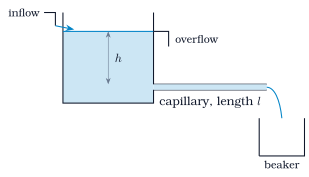
Q20
A constant-head tank keeps water \(h = 10\) cm above a horizontal capillary of radius \(0.5\) mm and length \(20\) cm. Take \(\eta = 10^{-3}\) Pa s and \(\pi = 3.14\).
Find the pressure difference across the capillary.
Find the volume flow rate, in m\(^3\)/s and in mL/s.
How long does it take to collect \(12\) mL?
Answer(i) \(1000\) Pa (ii) \(1.2 \times 10^{-7}\) m\(^3\)/s \(= 0.12\) mL/s (iii) \(100\) s
Why must the tube in a Poiseuille experiment be long and narrow, and the pressure difference small? What happens to the flow rate if the pressure difference is made very large?
Answerto keep streamline flow; turbulent, less than predicted
Solution
Poiseuille's law assumes streamline flow. A long narrow tube and a small pressure difference keep the speed, and so the Reynolds number, small. The tube must also be long so that the flow settles into its parabolic profile.
At a very large pressure difference the flow becomes turbulent. The eddies waste energy, and the flow rate is less than the formula predicts.