Questions on Motion in Two Dimensions, the kind your examinations ask. Solve one on paper. Then tell the book how it went. The book believes you, and it uses your answer to plan your revision.
0%
Nothing marked yetMark honestly. Peek at the answer only after your own attempt.
Projectile Motion: Ground to Ground
24 questions · after Lesson 6, The Trajectory as a Tool
Components, time, height, range
Q1
A ball is thrown at \(20\) m/s at \(30^\circ\) above the ground. Take \(g = 10\) m/s\(^2\) throughout this sheet.
Find \(u_x\) and \(u_y\).
Find the time of flight \(T\).
Find the greatest height \(H\) and the range \(R\).
Answer(i) \(10\sqrt{3}\); \(10\) m/s (ii) \(2\) s (iii) \(5\) m; \(20\sqrt{3} \approx 34.6\) m
\(H = \dfrac{u_y^2}{2g} = \dfrac{100}{20} = 5\) m. \(R = u_xT = 10\sqrt{3} \times 2 = 20\sqrt{3} \approx 34.6\) m.
How did it go?
Q2
A ball is thrown at \(50\) m/s at \(37^\circ\). Take \(\sin 37^\circ = 0.6\) and \(\cos 37^\circ = 0.8\). Find \(T\), \(H\) and \(R\).
Answer\(6\) s; \(45\) m; \(240\) m
Solution
\(u_x = 40\) m/s, \(u_y = 30\) m/s. \(T = \dfrac{2 \times 30}{10} = 6\) s. \(H = \dfrac{900}{20} = 45\) m. \(R = 40 \times 6 = 240\) m.
How did it go?
Q3
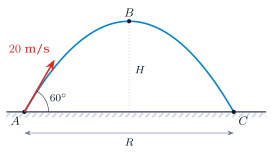
The figure shows a ball thrown at \(20\) m/s at \(60^\circ\), with \(A\) the launch point, \(B\) the top and \(C\) the landing point.
Find \(H\) and \(R\).
Write the velocity at \(B\): magnitude and direction.
Write the acceleration at \(A\), \(B\) and \(C\).
Answer(i) \(15\) m; \(20\sqrt{3} \approx 34.6\) m (ii) \(10\) m/s, horizontal (iii) \(10\) m/s\(^2\) down at all three
Solution
\(u_x = 10\) m/s, \(u_y = 10\sqrt{3}\) m/s. \(H = \dfrac{300}{20} = 15\) m. \(T = 2\sqrt{3}\) s, so \(R = 10 \times 2\sqrt{3} = 20\sqrt{3} \approx 34.6\) m.
At the top \(v_y = 0\), so the velocity is \(u_x = 10\) m/s, horizontal.
The only force is gravity, so the acceleration is \(10\) m/s\(^2\) downward at every point, including the top.
How did it go?
Q4
During the flight, which component of the velocity stays constant and which changes? Give the reason for each.
Answer\(v_x\) constant, no horizontal force; \(v_y\) changes, gravity
Solution
\(v_x\) stays constant because no force acts horizontally (air resistance is ignored). \(v_y\) changes at the rate \(g\) because gravity acts vertically. It decreases on the way up, is zero at the top and grows on the way down.
How did it go?
Q5
A stone is thrown at \(40\) m/s at \(45^\circ\). Find \(T\), \(H\) and \(R\). Leave \(\sqrt{2}\) in the answers where it appears.
Answer\(4\sqrt{2} \approx 5.7\) s; \(40\) m; \(160\) m
Use \(R = \frac{u^2\sin 2\theta}{g}\) with \(u = 30\) m/s to find the range at
\(15^\circ\),
\(45^\circ\),
\(75^\circ\).
Answer(i) \(45\) m (ii) \(90\) m (iii) \(45\) m
Solution
\(\dfrac{u^2}{g} = 90\) m.
\(90\sin 30^\circ = 45\) m.
\(90\sin 90^\circ = 90\) m, the greatest possible.
\(90\sin 150^\circ = 45\) m. \(15^\circ\) and \(75^\circ\) add to \(90^\circ\) and give the same range.
How did it go?
Q7
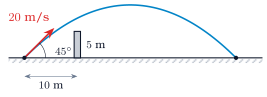
A ball's greatest possible range is \(100\) m. Find the speed of the throw. Show that at \(45^\circ\) the greatest height is \(\frac{R}{4}\), and find it.
At \(45^\circ\): \(H = \dfrac{u^2\sin^2 45^\circ}{2g} = \dfrac{u^2}{4g} = \dfrac{R_{\max}}{4} = 25\) m.
How did it go?
Q8
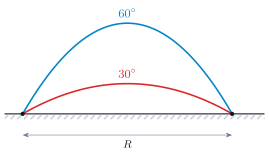
The figure shows two balls thrown at \(20\) m/s, at \(30^\circ\) and at \(60^\circ\).
Why do they have the same range? Find it.
Find the two greatest heights and their ratio.
Find the two times of flight and their ratio.
Answer(i) \(\sin 60^\circ = \sin 120^\circ\); \(20\sqrt{3}\) m (ii) \(5\) m, \(15\) m; \(1 : 3\) (iii) \(2\) s, \(2\sqrt{3}\) s; \(1 : \sqrt{3}\)
Solution
\(\sin 2\theta\) is the same for \(30^\circ\) and \(60^\circ\): \(\sin 60^\circ = \sin 120^\circ\). \(R = \dfrac{400 \times \sin 60^\circ}{10} = 20\sqrt{3} \approx 34.6\) m.
\(30^\circ\): \(H = \dfrac{(10)^2}{20} = 5\) m. \(60^\circ\): \(H = \dfrac{(10\sqrt{3})^2}{20} = 15\) m. Ratio \(1 : 3\).
\(T = \dfrac{2u_y}{g}\): \(2\) s and \(2\sqrt{3} \approx 3.5\) s. Ratio \(1 : \sqrt{3}\). The steeper throw stays up longer.
How did it go?
Q9
Show that \(\tan\theta = \frac{4H}{R}\) for any projectile. Find \(\theta\) when \(R = 4H\), and when \(R = 4\sqrt{3}H\).
A ball kicked at \(10\) m/s must land \(5\) m away on level ground. Find the two possible angles of the kick.
Answer\(15^\circ\) or \(75^\circ\)
Solution
\(5 = \dfrac{100\sin 2\theta}{10}\) gives \(\sin 2\theta = \dfrac{1}{2}\), so \(2\theta = 30^\circ\) or \(150^\circ\): \(\theta = 15^\circ\) or \(75^\circ\).
How did it go?
Equation of trajectory
Q11
Start from \(x = u\cos\theta\,t\) and \(y = u\sin\theta\,t - \frac{1}{2}gt^2\). Eliminate \(t\) to show that the path is \(y = x\tan\theta - \frac{gx^2}{2u^2\cos^2\theta}\). What curve is this?
Answer\(t = \frac{x}{u\cos\theta}\); parabola
Solution
\(t = \dfrac{x}{u\cos\theta}\). Put this into \(y\): \(y = u\sin\theta \cdot \dfrac{x}{u\cos\theta} - \dfrac{1}{2}g\dfrac{x^2}{u^2\cos^2\theta} = x\tan\theta - \dfrac{gx^2}{2u^2\cos^2\theta}\).
\(y\) is a quadratic in \(x\) with a negative \(x^2\) term: a parabola opening downward.
How did it go?
Q12
The path of a ball is \(y = x - \frac{x^2}{40}\). Here \(x\) and \(y\) are in metres.
Find the angle of throw.
Find the speed of the throw.
Find \(R\) and \(H\).
Answer(i) \(45^\circ\) (ii) \(20\) m/s (iii) \(40\) m; \(10\) m
Solution
Compare with \(y = x\tan\theta - \ldots\): \(\tan\theta = 1\), so \(\theta = 45^\circ\).
\(\dfrac{g}{2u^2\cos^2\theta} = \dfrac{1}{40}\) with \(\cos^2 45^\circ = \dfrac{1}{2}\): \(\dfrac{10}{u^2} = \dfrac{1}{40}\), so \(u^2 = 400\) and \(u = 20\) m/s.
\(y = 0\) at \(x = 40\) m, the range. The top is at \(x = 20\) m: \(H = 20 - 10 = 10\) m.
How did it go?
Q13
The ball of Question 12 is thrown towards a wall \(5\) m high and \(10\) m away.
Find the height of the ball when it reaches the wall. Does it clear the wall?
By how much does it clear the wall?
The wall is moved to \(x = 35\) m. Does the ball still clear it?
Answer(i) \(7.5\) m, yes (ii) \(2.5\) m (iii) \(4.4\) m, no
Solution
At \(x = 10\) m: \(y = 10 - \dfrac{100}{40} = 7.5\) m. This is more than \(5\) m, so the ball clears the wall.
\(7.5 - 5 = 2.5\) m.
At \(x = 35\) m: \(y = 35 - \dfrac{1225}{40} = 35 - 30.6 = 4.4\) m, less than \(5\) m. The ball hits the wall on its way down.
How did it go?
Q14
Show that the path can also be written as \(y = x\tan\theta\left(1 - \frac{x}{R}\right)\). Check it against Question 12.
\(R = \dfrac{2u^2\sin\theta\cos\theta}{g}\), so \(\dfrac{g}{2u^2\cos^2\theta} = \dfrac{\sin\theta}{R\cos\theta} = \dfrac{\tan\theta}{R}\). Then \(y = x\tan\theta - \dfrac{x^2\tan\theta}{R} = x\tan\theta\left(1 - \dfrac{x}{R}\right)\).
Question 12: \(\tan\theta = 1\), \(R = 40\): \(y = x\left(1 - \dfrac{x}{40}\right) = x - \dfrac{x^2}{40}\). It agrees.
How did it go?
Velocity at a point
Q15
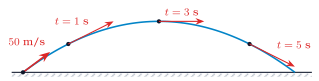
The ball of Question 2 (\(u_x = 40\) m/s, \(u_y = 30\) m/s) is shown at \(t = 1\), \(3\) and \(5\) s.
Find \(v_x\) and \(v_y\) at each of the three instants.
Find the speed at \(t = 1\) s and at \(t = 5\) s. Why are they equal?
At which instant is the speed least? Find it.
Answer(i) \(40\), \(20\); \(40\), \(0\); \(40\), \(-20\) m/s (ii) \(20\sqrt{5} \approx 44.7\) m/s, symmetry (iii) \(3\) s; \(40\) m/s
Solution
\(v_x = 40\) m/s always. \(v_y = 30 - 10t\): \(20\), \(0\) and \(-20\) m/s at \(1\), \(3\) and \(5\) s.
Both: \(\sqrt{40^2 + 20^2} = \sqrt{2000} = 20\sqrt{5} \approx 44.7\) m/s. The instants are \(2\) s before and after the top, so the ball is at the same height with \(v_y\) reversed.
At \(t = 3\) s, the top: \(v_y = 0\) and the speed is \(v_x = 40\) m/s, the least on the whole path.
How did it go?
Q16
A ball is thrown at \(u\) at \(60^\circ\). Show that its speed at the top is \(\frac{u}{2}\). What is its speed on landing?
Answer\(u\cos 60^\circ\); \(u\)
Solution
At the top only \(v_x = u\cos 60^\circ = \dfrac{u}{2}\) remains. On landing at the same level the speed is again \(u\), by symmetry: \(v_x = u\cos\theta\) and \(v_y = -u\sin\theta\).
How did it go?
Q17
Show that the velocity of a projectile becomes perpendicular to its initial velocity at \(t = \frac{u}{g\sin\theta}\). Find this time for \(u = 20\) m/s and \(\theta = 60^\circ\), and check that it is less than the time of flight.
Answer\(\vec u\cdot\vec v = 0\); \(\frac{4}{\sqrt{3}} \approx 2.3\) s \(< 2\sqrt{3}\) s
Solution
\(\vec u = (u\cos\theta, u\sin\theta)\) and \(\vec v = (u\cos\theta, u\sin\theta - gt)\). Perpendicular means \(\vec u\cdot\vec v = 0\): \(u^2\cos^2\theta + u\sin\theta(u\sin\theta - gt) = 0\), so \(u^2 = ugt\sin\theta\) and \(t = \dfrac{u}{g\sin\theta}\).
\(t = \dfrac{20}{10 \times \sqrt{3}/2} = \dfrac{4}{\sqrt{3}} \approx 2.3\) s. \(T = \dfrac{2u\sin\theta}{g} = 2\sqrt{3} \approx 3.5\) s, so it happens during the flight.
How did it go?
Q18
A ball is thrown at \(25\) m/s. Use the components to show that its speed at height \(h\) is \(\sqrt{u^2 - 2gh}\), whatever the angle. Find the speed at \(h = 20\) m.
Answer\(v_x^2 + v_y^2 = u^2 - 2gh\); \(15\) m/s
Solution
\(v_x = u\cos\theta\) and \(v_y^2 = u^2\sin^2\theta - 2gh\). So \(v^2 = u^2\cos^2\theta + u^2\sin^2\theta - 2gh = u^2 - 2gh\): the angle drops out.
\(v = \sqrt{625 - 400} = 15\) m/s.
How did it go?
Vector form
Q19
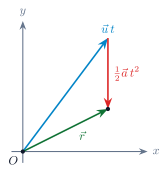
A particle leaves the origin with \(\vec u = 3\hat i + 4\hat j\) m/s and has \(\vec a = -10\hat j\) m/s\(^2\). Use \(\vec r = \vec u t + \frac{1}{2}\vec a t^2\).
Find \(\vec r\) at \(t = 0.5\) s.
Find \(\vec v = \vec u + \vec a t\) at \(t = 0.5\) s.
Find the time at which the particle returns to \(y = 0\), and \(\vec r\) then.
Answer(i) \(1.5\hat i + 0.75\hat j\) m (ii) \(3\hat i - \hat j\) m/s (iii) \(0.8\) s; \(2.4\hat i\) m
Solution
\(\vec r = (3\hat i + 4\hat j)(0.5) + \dfrac{1}{2}(-10\hat j)(0.25) = 1.5\hat i + 2\hat j - 1.25\hat j = 1.5\hat i + 0.75\hat j\) m.
\(\vec v = 3\hat i + 4\hat j - 5\hat j = 3\hat i - \hat j\) m/s: already moving down.
\(y = 4t - 5t^2 = 0\) at \(t = 0.8\) s. Then \(\vec r = 3 \times 0.8\,\hat i = 2.4\hat i\) m: the range.
How did it go?
Q20
A particle starts at \(\vec r_0 = 2\hat i + \hat j\) m with \(\vec u = 4\hat i\) m/s and \(\vec a = 2\hat j\) m/s\(^2\). Find \(\vec r\) and \(\vec v\) at \(t = 2\) s, and the speed then.
Answer\(10\hat i + 5\hat j\) m; \(4\hat i + 4\hat j\) m/s; \(4\sqrt{2}\) m/s
Solution
\(\vec r = \vec r_0 + \vec u t + \dfrac{1}{2}\vec a t^2 = (2\hat i + \hat j) + 8\hat i + 4\hat j = 10\hat i + 5\hat j\) m.
\(\vec v = \vec u + \vec a t = 4\hat i + 4\hat j\) m/s, of magnitude \(4\sqrt{2} \approx 5.7\) m/s.
How did it go?
Q21
A projectile leaves the ground with \(\vec u = 6\hat i + 8\hat j + 20\hat k\) m/s, with \(\hat k\) vertical, and \(\vec a = -10\hat k\) m/s\(^2\).
Find the time of flight.
Find the displacement on landing and its magnitude.
Answer(i) \(4\) s (ii) \(24\hat i + 32\hat j\) m; \(40\) m
Solution
Only the \(\hat k\) component feels gravity: \(z = 20t - 5t^2 = 0\) at \(t = 4\) s.
The horizontal components are unchanged: \(\vec r = (6\hat i + 8\hat j) \times 4 = 24\hat i + 32\hat j\) m, of magnitude \(\sqrt{576 + 1024} = 40\) m.
How did it go?
Small situations
Q22
A ball thrown at \(20\) m/s at \(30^\circ\) passes through a height of \(3.75\) m twice. Find the two times.
Answer\(0.5\) s, \(1.5\) s
Solution
\(u_y = 10\) m/s: \(3.75 = 10t - 5t^2\), so \(t^2 - 2t + 0.75 = 0\) and \((t - 0.5)(t - 1.5) = 0\): \(t = 0.5\) s going up and \(1.5\) s coming down.
How did it go?
Q23
The same throw is made on the Moon, where \(g\) is one sixth of its value on the Earth. By what factor do \(T\), \(H\) and \(R\) change?
Answerall \(\times 6\)
Solution
\(T = \dfrac{2u\sin\theta}{g}\), \(H = \dfrac{u^2\sin^2\theta}{2g}\) and \(R = \dfrac{u^2\sin 2\theta}{g}\) all have \(g\) in the denominator once. Dividing \(g\) by \(6\) multiplies each of them by \(6\).
How did it go?
Q24
For what angle of throw is the greatest height equal to the range? Give \(\tan\theta\).
Answer\(\tan\theta = 4\)
Solution
\(H = R\) gives \(\dfrac{u^2\sin^2\theta}{2g} = \dfrac{2u^2\sin\theta\cos\theta}{g}\), so \(\sin\theta = 4\cos\theta\) and \(\tan\theta = 4\) (\(\theta \approx 76^\circ\)).
How did it go?
Projectile from a Height and on an Incline
24 questions · after Lesson 6, The Trajectory as a Tool
Horizontal projection from a height
Q25
A ball rolls off the edge of a table \(20\) m high at \(5\) m/s. Take \(g = 10\) m/s\(^2\) throughout this sheet.
Find the time to reach the floor.
Find the horizontal distance covered.
Find \(v_x\) and \(v_y\) on landing.
Answer(i) \(2\) s (ii) \(10\) m (iii) \(5\) m/s; \(20\) m/s
Solution
Vertically the ball starts from rest: \(20 = 5t^2\), so \(t = 2\) s.
\(x = u_xt = 5 \times 2 = 10\) m.
\(v_x = 5\) m/s (unchanged) and \(v_y = gt = 20\) m/s. Speed \(= \sqrt{25 + 400} \approx 20.6\) m/s.
How did it go?
Q26
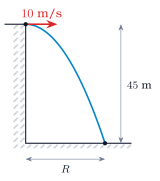
A ball is thrown horizontally at \(10\) m/s from the top of a \(45\) m cliff.
Find the time of flight.
Find the range \(R\).
Find \(\tan\phi\), where \(\phi\) is the angle the velocity makes with the ground on landing.
Answer(i) \(3\) s (ii) \(30\) m (iii) \(3\)
Solution
\(45 = 5t^2\) gives \(t = 3\) s.
\(R = 10 \times 3 = 30\) m.
\(v_y = 30\) m/s and \(v_x = 10\) m/s: \(\tan\phi = \dfrac{v_y}{v_x} = 3\).
How did it go?
Q27
From the same height, one ball is dropped and another is thrown horizontally at the same instant. Which lands first? Give the reason.
Answersame time; same vertical motion
Solution
They land together. The horizontal throw adds only a horizontal velocity. The vertical motion of both balls is a fall from rest under \(g\), so both take \(\sqrt{2h/g}\).
How did it go?
Q28
A ball is thrown horizontally from a height of \(80\) m. Find the time of flight and the range for a throw of \(15\) m/s, and then for \(30\) m/s. Why does the time not change?
Answer\(4\) s; \(60\) m; \(120\) m; vertical motion unchanged
Solution
\(80 = 5t^2\) gives \(t = 4\) s for both throws. Range \(= ut\): \(60\) m at \(15\) m/s and \(120\) m at \(30\) m/s. The throw speed is horizontal and does not affect the vertical fall, so the time is the same; doubling \(u\) doubles the range.
How did it go?
Q29
A ball is thrown horizontally at \(u\). Take \(x\) horizontal and \(y\) downward from the launch point. Show that the path is \(y = \frac{gx^2}{2u^2}\). For \(u = 10\) m/s, how far has the ball fallen when \(x = 20\) m?
Answer\(t = \frac{x}{u}\); \(20\) m
Solution
\(x = ut\) gives \(t = \dfrac{x}{u}\). Then \(y = \dfrac{1}{2}gt^2 = \dfrac{gx^2}{2u^2}\), a parabola. For \(u = 10\) m/s: \(y = \dfrac{10 \times 400}{200} = 20\) m.
How did it go?
Q30
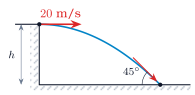
A ball thrown horizontally at \(20\) m/s from a height \(h\) hits the ground at \(45^\circ\).
What does the \(45^\circ\) tell you about \(v_x\) and \(v_y\) on landing?
Find the time of flight and \(h\).
Find the range.
Answer(i) \(v_y = v_x = 20\) m/s (ii) \(2\) s; \(20\) m (iii) \(40\) m
Solution
\(\tan 45^\circ = \dfrac{v_y}{v_x} = 1\), so \(v_y = v_x = 20\) m/s on landing.
\(v_y = gt\) gives \(t = 2\) s. \(h = \dfrac{1}{2}gt^2 = 20\) m.
\(R = 20 \times 2 = 40\) m.
How did it go?
Thrown at an angle from a height
Q31
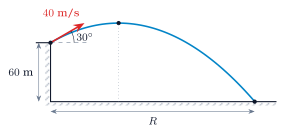
A ball is thrown at \(40\) m/s at \(30^\circ\) above the horizontal from the top of a \(60\) m tower. Take up as positive.
Write \(y(t)\) and find the time to reach the ground.
Find the horizontal distance from the foot of the tower.
Answer(i) \(20t - 5t^2\); \(6\) s (ii) \(120\sqrt{3} \approx 208\) m
Solution
\(u_y = 40\sin 30^\circ = 20\) m/s: \(y = 20t - 5t^2\). The ground is at \(y = -60\): \(t^2 - 4t - 12 = 0\), \((t - 6)(t + 2) = 0\), so \(t = 6\) s.
A ball is thrown at \(20\) m/s at \(30^\circ\) below the horizontal from a height of \(75\) m. Find the time to reach the ground and the horizontal distance covered.
Answer\(3\) s; \(30\sqrt{3} \approx 52\) m
Solution
Up positive: \(u_y = -20\sin 30^\circ = -10\) m/s. \(-75 = -10t - 5t^2\), so \(t^2 + 2t - 15 = 0\) and \(t = 3\) s. \(x = 20\cos 30^\circ \times 3 = 30\sqrt{3} \approx 52\) m.
How did it go?
Q33
The figure shows the throw of Question 7.
Find the greatest height above the ground.
At what time is the ball at the top, and how far is it then from the tower horizontally?
Find the speed with which the ball hits the ground.
Answer(i) \(80\) m (ii) \(2\) s; \(40\sqrt{3} \approx 69\) m (iii) \(20\sqrt{7} \approx 53\) m/s
Solution
Above the roof: \(H = \dfrac{u_y^2}{2g} = \dfrac{400}{20} = 20\) m. Above the ground: \(60 + 20 = 80\) m.
\(t = \dfrac{u_y}{g} = 2\) s. \(x = 20\sqrt{3} \times 2 = 40\sqrt{3} \approx 69\) m.
A ball is thrown from a height \(h\) at speed \(u\) at any angle. Show that it reaches the ground at speed \(\sqrt{u^2 + 2gh}\). Check the answer to Question 9 (iii).
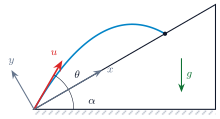
The greatest range up an incline is \(R_{\max} = \frac{u^2}{g(1 + \sin\alpha)}\), reached when the throw bisects the angle between the incline and the vertical. Find \(R_{\max}\) and the angle of throw for the data of Question 12, and compare.
Answer\(\frac{80}{3}\) m; \(30^\circ\) to the incline; same
Solution
\(R_{\max} = \dfrac{400}{10(1 + 0.5)} = \dfrac{80}{3}\) m. The angle between the incline and the vertical is \(60^\circ\); half of it is \(30^\circ\) from the incline. This is exactly the throw of Question 12, which is why the two ranges agree: that throw was already the best one.
How did it go?
Q38
Show that the time of flight on an incline is \(T = \frac{2u\sin\theta}{g\cos\alpha}\), where \(\theta\) is measured from the incline. Check that it reduces to the ground-to-ground result when \(\alpha = 0\).
Perpendicular to the incline: \(y = u\sin\theta\,t - \dfrac{1}{2}g\cos\alpha\,t^2\). Setting \(y = 0\) for \(t \ne 0\): \(T = \dfrac{2u\sin\theta}{g\cos\alpha}\).
With \(\alpha = 0\), \(\cos\alpha = 1\) and \(T = \dfrac{2u\sin\theta}{g}\), the usual time of flight.
How did it go?
Q39
For the throw of Question 12, find the greatest distance of the ball from the incline, measured perpendicular to it. At what time does this happen?
Answer\(\frac{10}{\sqrt{3}} \approx 5.8\) m; \(\frac{2}{\sqrt{3}} \approx 1.15\) s
Solution
The ball is farthest from the incline when \(v_y = 0\): \(t = \dfrac{u_y}{g\cos\alpha} = \dfrac{10}{5\sqrt{3}} = \dfrac{2}{\sqrt{3}} \approx 1.15\) s, half the time of flight.
Distance \(= \dfrac{u_y^2}{2g\cos\alpha} = \dfrac{100}{10\sqrt{3}} = \dfrac{10}{\sqrt{3}} \approx 5.8\) m.
How did it go?
Down an incline
Q40
The ball is now thrown down the same \(30^\circ\) incline at \(20\) m/s, at \(30^\circ\) above the incline.
What is the direction of the throw with respect to the horizontal?
Find the time of flight. Compare with Question 12.
Find the range along the incline.
Answer(i) horizontal (ii) \(\frac{4}{\sqrt{3}}\) s, same (iii) \(\frac{160}{3} \approx 53\) m
Solution
The incline slopes down at \(30^\circ\) and the throw is \(30^\circ\) above it, so the throw is horizontal.
\(T = \dfrac{2u\sin\theta}{g\cos\alpha} = \dfrac{4}{\sqrt{3}}\) s, the same as before: the perpendicular motion is unchanged.
Now gravity's component along the slope helps: \(R = u_xT + \dfrac{1}{2}g\sin\alpha\,T^2 = 40 + \dfrac{40}{3} = \dfrac{160}{3} \approx 53\) m, twice the range up the slope.
How did it go?
Q41
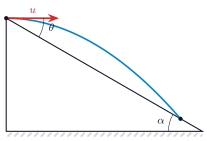
A ball is thrown horizontally at \(10\) m/s from the top of a \(30^\circ\) incline. Find the time at which it hits the incline and the distance along the incline.
Answer\(\frac{2}{\sqrt{3}} \approx 1.15\) s; \(\frac{40}{3} \approx 13\) m
Solution
Horizontal-vertical axes from the top: \(x = 10t\), \(y = 5t^2\) (down). The ball is on the incline when \(\dfrac{y}{x} = \tan 30^\circ\): \(\dfrac{5t^2}{10t} = \dfrac{1}{\sqrt{3}}\), so \(t = \dfrac{2}{\sqrt{3}} \approx 1.15\) s.
Then \(x = \dfrac{20}{\sqrt{3}}\) m, and the distance along the incline is \(\dfrac{x}{\cos 30^\circ} = \dfrac{20}{\sqrt{3}} \times \dfrac{2}{\sqrt{3}} = \dfrac{40}{3} \approx 13\) m.
How did it go?
Q42
For the same \(u\) and the best angle, the greatest range down an incline is \(\frac{u^2}{g(1 - \sin\alpha)}\). Find the ratio of the greatest ranges down and up a \(30^\circ\) incline.
A stone is thrown horizontally at \(15\) m/s from a bridge \(20\) m above a river. Find its speed on hitting the water and the angle its velocity makes with the water.
A plane flies horizontally at \(100\) m/s at a height of \(500\) m and drops a packet.
Find the time the packet takes to fall.
How far ahead of the drop point does it land?
Where is the plane when the packet lands?
Answer(i) \(10\) s (ii) \(1000\) m (iii) directly above it
Solution
\(500 = 5t^2\) gives \(t = 10\) s.
\(x = 100 \times 10 = 1000\) m.
The packet keeps the plane's horizontal velocity, so the plane is directly above it when it lands.
How did it go?
Q45
Water leaves a horizontal pipe at \(10\) m/s from a height of \(1.25\) m. How far from the pipe does it hit the ground?
Answer\(5\) m
Solution
\(1.25 = 5t^2\) gives \(t = 0.5\) s. Range \(= 10 \times 0.5 = 5\) m.
How did it go?
Q46
A gun is aimed straight at a monkey hanging from a branch. The monkey lets go at the instant the gun fires. Does the bullet hit the monkey? Give the reason.
Answeryes; both fall \(\frac{1}{2}gt^2\)
Solution
Yes. Without gravity the bullet would travel along the line of aim and reach the monkey's starting point. Gravity pulls the bullet and the monkey down by the same \(\dfrac{1}{2}gt^2\) in the same time, so they meet below that point.
How did it go?
Q47
A ball is thrown at \(\theta\) to an incline of angle \(\alpha\). What is its angle to the horizontal? For the throw of Question 12 find \(u_x\) and \(u_y\) in the horizontal-vertical axes and check the speed.
Answer\(\theta + \alpha\); \(10\); \(10\sqrt{3}\) m/s; \(20\) m/s
Solution
The incline is already at \(\alpha\) to the horizontal, so the throw is at \(\theta + \alpha\) to the horizontal: \(60^\circ\) in Question 12.
Show that a ball thrown horizontally at \(u\) from a height \(h\) has range \(R = u\sqrt{\frac{2h}{g}}\). Find \(R\) for \(u = 20\) m/s and \(h = 45\) m.
Answer\(t = \sqrt{2h/g}\); \(60\) m
Solution
The fall takes \(t = \sqrt{\dfrac{2h}{g}}\), and in that time the ball moves \(R = ut = u\sqrt{\dfrac{2h}{g}}\) horizontally.
\(R = 20\sqrt{\dfrac{90}{10}} = 20 \times 3 = 60\) m.