Questions on Thin Films, Newton's Rings and Other Interference, the kind your examinations ask. Solve one on paper. Then tell the book how it went. The book believes you, and it uses your answer to plan your revision.
0%
Nothing marked yetMark honestly. Peek at the answer only after your own attempt.
Thin Films, Newton's Rings, Lloyd's Mirror and the Biprism
24 questions · after Lesson 5, The Shape of Fringes and a Tilted Beam
Q1
State Stokes' rule for the phase change on reflection. A soap film hangs in air. Which of its two surfaces gives the reflected wave a phase change of \(\pi\)?
Answerreflection from a denser medium: \(\pi\) (or \(\frac{\lambda}{2}\)); the top surface only
Solution
Light may reflect from the surface of a denser medium, one of higher \(\mu\). The reflected wave then has its phase changed by \(\pi\), equivalent to an extra path of \(\dfrac{\lambda}{2}\). Reflection from a rarer medium gives no phase change. For a soap film in air the top surface is air to soap, denser, so that reflection gets the \(\pi\) shift. The bottom surface is soap to air, rarer, so no shift.
How did it go?
Q2
Light falls on a film of thickness \(t\) and index \(\mu\) at angle of refraction \(r\). Write the path difference between the two reflected waves. Hence write the conditions for the film to look bright and dark in reflected light at normal incidence.
Answer\(2\mu t\cos r\); bright \(2\mu t = (2n - 1)\frac{\lambda}{2}\), dark \(2\mu t = n\lambda\)
Solution
The wave reflected from the bottom travels an extra optical path \(2\mu t\cos r\) inside the film. The top reflection alone has the \(\pi\) shift, so the effective path difference is \(2\mu t\cos r \pm \dfrac{\lambda}{2}\). At normal incidence \(\cos r = 1\). Bright: \(2\mu t = (2n - 1)\dfrac{\lambda}{2}\). Dark: \(2\mu t = n\lambda\).
How did it go?
Q3
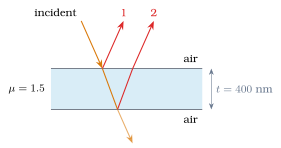
The film in the figure has \(t = 400\) nm and \(\mu = 1.5\). White light falls on it almost normally.
Find the path difference between rays 1 and 2.
Which visible wavelength (\(400\) to \(700\) nm) is reflected most strongly?
Which visible wavelengths are missing from the reflected light?
Bright when \(1200 = (2n - 1)\dfrac{\lambda}{2}\), so \(\lambda = \dfrac{2400}{2n - 1} = 2400, 800, 480, 343, \ldots\) nm. The visible one is \(480\) nm.
Dark when \(1200 = n\lambda\), so \(\lambda = 1200, 600, 400, 300, \ldots\) nm. Missing in the visible range: \(600\) nm and \(400\) nm.
How did it go?
Q4
Light of \(600\) nm falls normally on a film of \(\mu = 1.5\) in air. Find the least thickness for which the film looks bright in reflected light. Find the least non-zero thickness for which it looks dark.
Answer\(100\) nm; \(200\) nm
Solution
Bright: \(2\mu t = (2n - 1)\dfrac{\lambda}{2}\); the least \(t\) has \(n = 1\): \(t = \dfrac{\lambda}{4\mu} = \dfrac{600}{6} = 100\) nm. Dark: \(2\mu t = n\lambda\); with \(n = 1\), \(t = \dfrac{\lambda}{2\mu} = 200\) nm.
How did it go?
Q5
Why does a very thin part of a soap film, much thinner than a wavelength, look black in reflected light? What would it look like in transmitted light?
Answeronly the \(\pi\) shift remains, destructive; bright
Solution
When \(t \ll \lambda\) the path \(2\mu t\) is almost zero, so the only difference between the two reflected waves is the \(\pi\) shift of the top reflection. They cancel and the film looks black. Neither transmitted wave has a \(\pi\) shift, so in transmitted light the same part looks bright. The reflected and transmitted patterns are complementary.
How did it go?
Q6
A film of \(\mu = 1.5\) and \(t = 500\) nm is viewed at an angle of refraction \(53^\circ\) (take \(\cos 53^\circ = 0.6\)). Find the path difference between the reflected waves. Which visible wavelength is reflected most strongly and which is missing?
\(2\mu t\cos r = 2 \times 1.5 \times 500 \times 0.6 = 900\) nm. Bright: \(\lambda = \dfrac{1800}{2n - 1} = 1800, 600, 360, \ldots\) nm, so \(600\) nm is strongly reflected. Dark: \(\lambda = \dfrac{900}{n} = 900, 450, 300, \ldots\) nm, so \(450\) nm is missing.
How did it go?
Q7
A glass lens (\(\mu = 1.5\)) is coated with a film of \(\mu = 1.38\) to cut reflection at \(552\) nm. Both reflections now have a phase change of \(\pi\). Find the least thickness of the coating.
Answer\(100\) nm
Solution
Air to coating and coating to glass are both rarer to denser, so both reflections have the \(\pi\) shift and it cancels. The two reflected waves cancel when \(2\mu_c t = \dfrac{\lambda}{2}\). \(t = \dfrac{\lambda}{4\mu_c} = \dfrac{552}{4 \times 1.38} = 100\) nm.
How did it go?
Q8
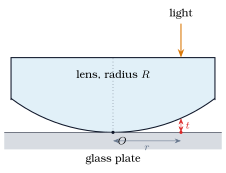
A plano-convex lens of radius of curvature \(R\) rests on a flat plate. Show that the thickness of the air film at distance \(r\) from the point of contact is \(t = \frac{r^2}{2R}\) when \(r \ll R\).
Answer\(r^2 = t(2R - t) \approx 2Rt\)
Solution
Let the centre of curvature be \(C\), a distance \(R\) above \(O\). The point on the lens surface at horizontal distance \(r\) is at height \(t\) above the plate. In the right triangle with \(C\): \(r^2 + (R - t)^2 = R^2\), so \(r^2 = 2Rt - t^2\). For \(t \ll R\) the \(t^2\) term is negligible and \(r^2 = 2Rt\), giving \(t = \dfrac{r^2}{2R}\).
How did it go?
Q9
Why is the centre of Newton's rings dark in reflected light? What is seen at the centre in transmitted light?
Answer\(t = 0\) but the \(\pi\) shift makes it dark; bright
Solution
At the point of contact the air film has zero thickness, so the geometric path difference is zero. But the reflection at the lower surface (air to glass) has the \(\pi\) shift and the upper one (glass to air) does not. The two reflected waves are in antiphase and the centre is dark. In transmitted light there is no net phase shift, so the centre is bright.
How did it go?
Q10
Show that the radius of the \(n\)th dark ring in reflected light is \(r_n = \sqrt{n\lambda R}\). With \(R = 1.6\) m and \(\lambda = 500\) nm, find the radius and the diameter of the fifth dark ring.
Answer\(2\mu t = n\lambda\) with \(\mu = 1\), \(t = \frac{r^2}{2R}\); \(2\) mm; \(4\) mm
Solution
For the air film \(\mu = 1\) and normal incidence. Dark rings (counting the \(\pi\) shift) need \(2t = n\lambda\). With \(t = \dfrac{r^2}{2R}\): \(\dfrac{r_n^2}{R} = n\lambda\), so \(r_n = \sqrt{n\lambda R}\). For \(n = 5\): \(r_5^2 = 5 \times 500 \times 10^{-9} \times 1.6 = 4 \times 10^{-6}\) m\(^2\), so \(r_5 = 2 \times 10^{-3}\) m \(= 2\) mm. Diameter \(= 4\) mm.
How did it go?
Q11
In a Newton's rings experiment with \(R = 1.6\) m, the diameters of the fifth and the twentieth dark rings are \(4\) mm and \(8\) mm. Find the wavelength of the light.
Why do the rings get closer together as one moves outward?
Water (\(\mu = \frac{4}{3}\)) fills the gap between lens and plate. By what factor does the radius of each ring change?
Answer(i) \(t \propto r^2\), equal steps in \(t\) give shrinking steps in \(r\) (ii) \(\frac{1}{\sqrt\mu} = \frac{\sqrt3}{2}\)
Solution
Consecutive dark rings differ by a fixed step in thickness, \(\dfrac{\lambda}{2}\). Since \(t \propto r^2\), equal steps in \(t\) need smaller and smaller steps in \(r\) as \(r\) grows: \(r_n \propto \sqrt n\). So the rings crowd together outward.
With water the condition becomes \(2\mu t = n\lambda\), so \(r_n^2 = \dfrac{n\lambda R}{\mu}\). Every radius shrinks by the factor \(\dfrac{1}{\sqrt\mu} = \sqrt{\dfrac{3}{4}} = \dfrac{\sqrt3}{2} \approx 0.87\).
How did it go?
Q13
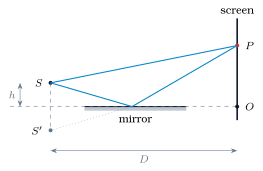
In Lloyd's mirror a slit \(S\) is \(h = 0.5\) mm above the plane of the mirror. The screen is \(D = 1\) m from \(S\) and \(\lambda = 600\) nm.
Which two sources interfere on the screen? What is their separation?
Find the fringe width.
Answer(i) \(S\) and its image \(S'\); \(2h = 1\) mm (ii) \(0.6\) mm
Solution
Light reaching the screen directly from \(S\) interferes with light reflected from the mirror. The reflected light appears to come from the image \(S'\), at \(h\) below the mirror plane. The two coherent sources are \(S\) and \(S'\), separated by \(d = 2h = 1\) mm.
In Q13 the point \(O\) on the screen is equidistant from \(S\) and \(S'\). Is the fringe at \(O\) bright or dark? On which side of \(O\) are fringes seen at all? Give reasons.
Answerdark, \(\pi\) shift on reflection; only above the mirror plane
Solution
At \(O\) the paths from \(S\) and \(S'\) are equal. But the reflected wave has an extra phase of \(\pi\) from the mirror (air to glass). So the two waves cancel and the fringe at \(O\) is dark, unlike the bright centre of a YDSE. Fringes appear only where both direct and reflected light arrive, which is above the mirror plane. Below it only direct light reaches the screen.
How did it go?
Q15
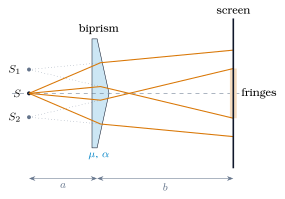
A Fresnel biprism of \(\mu = 1.5\) and refracting angle \(\alpha = 0.01\) rad is \(a = 10\) cm from the slit \(S\). The screen is \(b = 90\) cm beyond the biprism and \(\lambda = 600\) nm.
Find the separation \(d\) of the virtual sources \(S_1\) and \(S_2\).
Find the fringe width.
Answer(i) \(2a(\mu - 1)\alpha = 1\) mm (ii) \(0.6\) mm
Solution
Each half of the biprism is a thin prism and deviates light by \(\delta = (\mu - 1)\alpha\). The virtual source is displaced by \(a\delta\), so \(d = 2a(\mu - 1)\alpha = 2 \times 0.1 \times 0.5 \times 0.01 = 10^{-3}\) m \(= 1\) mm.
The screen is \(D = a + b = 1\) m from the virtual sources. \(\beta = \dfrac{\lambda D}{d} = \dfrac{600 \times 10^{-9} \times 1}{10^{-3}} = 0.6\) mm.
How did it go?
Q16
For the biprism of Q15, find the deviation each half produces. Explain why fringes are seen only in a limited region of the screen.
Answer\((\mu - 1)\alpha = 5 \times 10^{-3}\) rad; only where the two beams overlap
Solution
\(\delta = (\mu - 1)\alpha = 0.5 \times 0.01 = 5 \times 10^{-3}\) rad. The upper half bends its light downward and the lower half bends its light upward. The two refracted beams cross and overlap only in a wedge-shaped region behind the biprism. Fringes need both beams, so they are seen only where the beams overlap on the screen.
How did it go?
Q17
In Q13 the slit is moved closer to the mirror plane so that \(h = 0.25\) mm. Find the new fringe width. What happens to the position of the dark fringe at \(O\)?
Answer\(1.2\) mm; stays at \(O\)
Solution
\(d = 2h = 0.5\) mm, half the earlier value, so \(\beta = \dfrac{\lambda D}{d}\) doubles to \(1.2\) mm. The point \(O\) still has equal paths and the same \(\pi\) shift, so the dark fringe stays at \(O\).
How did it go?
Q18
Two coherent point sources are a distance \(d\) apart. What is the shape of the surface on which the path difference is constant? What shape do the fringes have on a distant screen parallel to the line joining the sources?
Answerhyperboloid of revolution about \(S_1S_2\); hyperbolae
Solution
The set of points with \(S_2P - S_1P = \) constant is a hyperboloid of revolution with the two sources as foci and \(S_1S_2\) as axis. A screen parallel to \(S_1S_2\) cuts these surfaces in hyperbolae, so the fringes are hyperbolae. Near the centre they are almost straight.
How did it go?
Q19
Two coherent sources \(1\) mm apart lie on the axis, one behind the other. A screen is perpendicular to the axis. The light has \(\lambda = 500\) nm.
What is the shape of the fringes?
Find the order of the fringe at the centre of the screen. Is it bright or dark?
Answer(i) concentric circles (ii) \(2000\); bright
Solution
The screen is perpendicular to the axis \(S_1S_2\), and the hyperboloids are symmetric about that axis. The screen cuts them in circles, so the fringes are concentric circles about the axis.
At the centre the path difference is the full separation, \(1\) mm. \(n = \dfrac{10^{-3}}{500 \times 10^{-9}} = 2000\), an integer, so the centre is bright, of order \(2000\).
How did it go?
Q20
The fringes in an ordinary YDSE are hyperbolae, yet the fringes seen near the centre look like straight lines. Explain.
Answernear the axis the hyperbolae are nearly straight
Solution
The fringes are hyperbolae with the slits as foci. Close to the central axis the hyperbolae have a very large radius of curvature. Over the few millimetres of the visible pattern they do not bend noticeably. So the fringes look like straight lines parallel to the slits.
How did it go?
Q21
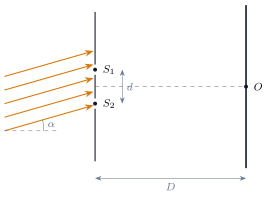
A parallel beam falls on the slits at a small angle \(\alpha\) to the axis, tilted upward as shown.
Which slit does the wavefront reach first? Write the path difference the beam brings to the slits.
Show that the central fringe moves to \(y_0 = D\sin\alpha \approx D\alpha\), and say which way.
Answer(i) \(S_2\); \(d\sin\alpha\) (ii) \(\frac{y_0 d}{D} = d\sin\alpha\); upward, along the beam
Solution
The beam travels upward, so its wavefront, perpendicular to the beam, reaches the lower slit \(S_2\) first. The wave at \(S_1\) lags by the extra path \(d\sin\alpha\).
For a point at height \(y\), the path from \(S_1\) to the screen is shorter by \(\dfrac{yd}{D}\). Total path difference \(= d\sin\alpha - \dfrac{yd}{D}\). It is zero at \(\dfrac{y_0 d}{D} = d\sin\alpha\), so \(y_0 = D\sin\alpha \approx D\alpha\). The central fringe moves upward, in the direction the beam is travelling.
How did it go?
Q22
In Q21 take \(\alpha = 2 \times 10^{-3}\) rad, \(D = 1\) m, \(d = 1\) mm and \(\lambda = 500\) nm. Find the shift of the central fringe in mm and in fringe widths.
Answer\(2\) mm; \(4\) fringe widths
Solution
\(y_0 = D\alpha = 1 \times 2 \times 10^{-3} = 2\) mm. \(\beta = \dfrac{\lambda D}{d} = \dfrac{500 \times 10^{-9}}{10^{-3}} = 0.5\) mm. So the shift is \(\dfrac{2}{0.5} = 4\) fringe widths.
How did it go?
Q23
A slab of \(\mu = 1.5\) is to bring the central fringe of Q22 back to \(O\). Before which slit must it go, and how thick must it be?
Answerbefore \(S_2\); \(4\) μm
Solution
The tilt makes the wave at \(S_1\) lag by \(d\sin\alpha = 10^{-3} \times 2 \times 10^{-3} = 2\) μm. To cancel this the path from \(S_2\) must be lengthened by the same amount, so the slab goes before \(S_2\). \((\mu - 1)t = 2\) μm gives \(t = \dfrac{2}{0.5} = 4\) μm.
How did it go?
Q24
A point source \(S\) is \(0.5\) m from the slits on the axis and the screen is \(1\) m beyond the slits. \(S\) is moved \(1\) mm above the axis. Find how far and to which side the central fringe moves.
Answer\(2\) mm below \(O\), the side opposite to \(S\)
Solution
With \(S\) at height \(s\) above the axis at distance \(a\) from the slits, \(S\) is closer to \(S_1\) by about \(\dfrac{sd}{a}\). The wave at \(S_2\) now lags, so the central fringe moves to the \(S_2\) side, below \(O\). Its position: \(\dfrac{y_0 d}{D} = \dfrac{sd}{a}\), so \(y_0 = \dfrac{sD}{a} = \dfrac{1 \times 1}{0.5} = 2\) mm below \(O\). The pattern moves opposite to the source.