Questions on Stress, Strain and Hooke's Law, the kind your examinations ask. Solve one on paper. Then tell the book how it went. The book believes you, and it uses your answer to plan your revision.
0%
Nothing marked yetMark honestly. Peek at the answer only after your own attempt.
Stress, Strain, Hooke's Law and the Moduli
22 questions · after Lesson 5, Shear Modulus and Poisson's Ratio
Stress, strain, Young's modulus
Q1
A wire of length \(2\) m and cross-section area \(1\) mm\(^2\) is pulled by a force of \(100\) N. It stretches by \(1\) mm.
Find the tensile stress.
Find the tensile strain.
Find Young's modulus \(Y\) of the material.
Answer(i) \(10^{8}\) Pa (ii) \(5 \times 10^{-4}\) (iii) \(2 \times 10^{11}\) Pa
\(\Delta L = \text{strain} \times L = 10^{-3} \times 4 = 4 \times 10^{-3}\) m \(= 4\) mm.
How did it go?
Q3
Write the SI unit of stress, of strain and of Young's modulus. Which of the three has no unit, and why?
AnswerPa; none; Pa; strain is a ratio
Solution
Stress is force per area: N/m\(^2\), that is, pascal (Pa). Young's modulus is stress divided by strain, so it also has the unit Pa.
Strain is a length divided by a length. The units cancel, so strain is a pure number.
How did it go?
Q4
Two wires \(A\) and \(B\) are of the same material and carry the same load. Wire \(B\) is twice as long as \(A\) and has twice the diameter. Find the ratio of the extensions \(\Delta L_B / \Delta L_A\).
Answer\(1 : 2\)
Solution
\(\Delta L = \dfrac{FL}{AY}\), and \(A \propto d^2\). So \(\Delta L \propto \dfrac{L}{d^2}\) for the same \(F\) and \(Y\).
A copper wire has length \(1\) m and area \(1\) mm\(^2\). For copper \(Y = 1.1 \times 10^{11}\) Pa. Find the force needed to stretch the wire by \(1\) mm.
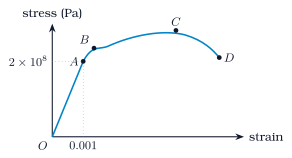
The figure shows the stress-strain curve of a metal wire.
Name the points \(A\), \(B\), \(C\) and \(D\).
Up to which point does Hooke's law hold? Up to which point does the wire return to its original length when unloaded?
What happens to the wire between \(C\) and \(D\)?
Answer(i) \(A\) proportional limit, \(B\) elastic limit, \(C\) ultimate strength, \(D\) fracture (ii) \(A\); \(B\) (iii) necks, then breaks
Solution
\(A\): proportional limit, the end of the straight part. \(B\): elastic limit (yield point). \(C\): ultimate tensile strength, the largest stress the wire can carry. \(D\): fracture point.
Hooke's law (stress proportional to strain) holds up to \(A\). The wire returns to its original length on unloading up to \(B\).
Beyond \(C\) the wire thins at one place (a neck forms). The stress needed falls, the neck grows, and the wire breaks at \(D\).
How did it go?
Q8
Use the readings marked on the figure of Question 7 to find Young's modulus of the metal.
Answer\(2 \times 10^{11}\) Pa
Solution
On the straight part \(OA\), \(Y\) is the slope. At \(A\): stress \(= 2 \times 10^{8}\) Pa, strain \(= 0.001\).
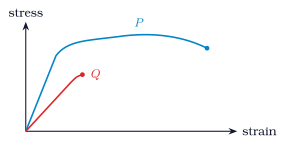
The figure shows the stress-strain curves of two materials \(P\) and \(Q\), drawn to the same scale. The dot marks the breaking point.
Which material is ductile and which is brittle? Give the reason.
Which material has the larger Young's modulus? Give the reason.
Which material has the larger breaking stress?
Answer(i) \(P\) ductile, \(Q\) brittle (ii) \(P\) (iii) \(P\)
Solution
\(P\) is ductile: after its elastic limit it takes a large extra strain before breaking. \(Q\) is brittle: it breaks almost as soon as it leaves the straight line.
\(P\). Its straight part is steeper, and the slope of the straight part is \(Y\).
\(P\). Its curve reaches a greater stress before the breaking point.
How did it go?
Q10
A rubber band can be stretched to twice its length and returns. A steel wire stretches by less than one part in a thousand before it yields. Which of the two has the larger Young's modulus? Which is "more elastic" in the physics sense? Give the reason.
Answersteel; steel
Solution
Steel has the larger Young's modulus. A large \(Y\) means a large stress is needed for a small strain; steel is hard to stretch, rubber is easy.
In physics a body is more elastic when it resists deformation more strongly and returns more exactly. Steel is more elastic than rubber. Rubber is only more stretchable.
How did it go?
Q11
A wire is loaded beyond its elastic limit and then unloaded.
Does the wire return to its original length? What is the strain that remains called?
On the stress-strain graph, how does the unloading line compare with the loading line \(OA\)?
Answer(i) no; permanent set (ii) parallel to \(OA\)
Solution
No. The wire stays a little longer than before. The strain that remains at zero stress is the permanent set.
The unloading line is straight and parallel to \(OA\), but it reaches the strain axis at the permanent set instead of at \(O\).
How did it go?
Bulk modulus, shear modulus, Poisson's ratio
Q12
The bulk modulus of water is \(B = 2 \times 10^{9}\) Pa. The pressure on a sample of water is increased by \(2 \times 10^{7}\) Pa.
Find the fractional change in volume.
Find the compressibility of water.
Answer(i) \(-0.01\) (\(1\) percent) (ii) \(5 \times 10^{-10}\) Pa\(^{-1}\)
One litre of water is taken to a depth where the pressure is greater by \(10^{7}\) Pa. Find the decrease in its volume in millilitres. Use \(B = 2 \times 10^{9}\) Pa.
\(\Delta V = 5 \times 10^{-3} \times 1000\) mL \(= 5\) mL. Water is nearly incompressible: a huge pressure squeezes a litre by only a teaspoon.
How did it go?
Q14
Show that when the pressure on a liquid rises by a small \(\Delta P\), its density rises by the fraction \(\frac{\Delta\rho}{\rho} = \frac{\Delta P}{B}\). Find the density of water at the depth of Question 12, taking \(1000\) kg/m\(^3\) at the surface.
Answer\(1010\) kg/m\(^3\)
Solution
The mass \(m\) is fixed and \(\rho = m/V\). A small change gives \(\dfrac{\Delta\rho}{\rho} = -\dfrac{\Delta V}{V}\).
With \(\dfrac{\Delta V}{V} = -\dfrac{\Delta P}{B}\) this is \(\dfrac{\Delta\rho}{\rho} = \dfrac{\Delta P}{B}\).
From Question 12, \(\dfrac{\Delta P}{B} = 0.01\). The density rises by \(1\) percent to \(1010\) kg/m\(^3\).
How did it go?
Q15
Write the definitions of Young's modulus, bulk modulus and shear modulus as ratios of a stress to a strain. Why does a liquid have a bulk modulus but no Young's modulus or shear modulus?
A liquid resists a change of volume, so it has a bulk modulus. It flows under any tangential force and has no fixed length or shape to restore, so it has no shear modulus and no Young's modulus.
How did it go?
Q16
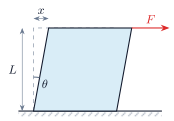
A rubber cube of side \(L = 10\) cm is glued to the floor. A tangential force \(F = 200\) N on the top face shifts it sideways by \(x\). The shear modulus of the rubber is \(2 \times 10^{6}\) Pa.
Find the shear stress.
Find the shear strain \(\theta\) and the shift \(x\).
Answer(i) \(2 \times 10^{4}\) Pa (ii) \(0.01\); \(1\) mm
Solution
Area of the top face \(= (0.1)^2 = 0.01\) m\(^2\). Shear stress \(= \dfrac{F}{A} = \dfrac{200}{0.01} = 2 \times 10^{4}\) Pa.
\(V = \pi r^2 L\). For small changes, \(\dfrac{\Delta V}{V} = 2\dfrac{\Delta r}{r} + \dfrac{\Delta L}{L}\).
\(\dfrac{\Delta L}{L} = \epsilon\) and \(\dfrac{\Delta r}{r} = -\sigma\epsilon\) (the radius shrinks). So \(\dfrac{\Delta V}{V} = -2\sigma\epsilon + \epsilon = (1 - 2\sigma)\epsilon\).
The volume is unchanged when \(1 - 2\sigma = 0\), that is, \(\sigma = 0.5\) (rubber is close to this).
For \(\sigma = 0.25\): \(\dfrac{\Delta V}{V} = (1 - 0.5) \times 10^{-3} = 5 \times 10^{-4}\). The volume grows a little.
How did it go?
Q19
Name the modulus that governs each situation.
A lift cable stretches under load.
A submarine hull is squeezed by the sea.
A rivet is cut across by the plates it joins.
Air in a bicycle pump is compressed.
Answer(i) \(Y\) (ii) \(B\) (iii) \(\eta\) (iv) \(B\)
Solution
A change of length under a pull: Young's modulus \(Y\).
A change of volume under pressure from all sides: bulk modulus \(B\).
Layers sliding across each other: shear modulus \(\eta\).
A change of volume of a gas: bulk modulus \(B\).
How did it go?
Wires in series and in parallel
Q20
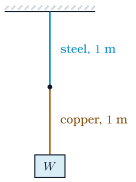
A steel wire and a copper wire are joined end to end and carry a load \(W = 100\) N. Each is \(1\) m long and \(1\) mm\(^2\) in area. Take \(Y_{\text{steel}} = 2 \times 10^{11}\) Pa and \(Y_{\text{copper}} = 1 \times 10^{11}\) Pa.
Is the tension the same in both wires? Find the extension of each wire.
Find the total extension.
Answer(i) yes; \(0.5\) mm, \(1\) mm (ii) \(1.5\) mm
Solution
Yes. The wires are in series, so the same \(100\) N acts through both.
Steel: \(\Delta L = \dfrac{FL}{AY} = \dfrac{100 \times 1}{10^{-6} \times 2 \times 10^{11}} = 5 \times 10^{-4}\) m \(= 0.5\) mm.
Copper: \(\Delta L = \dfrac{100 \times 1}{10^{-6} \times 10^{11}} = 10^{-3}\) m \(= 1\) mm. The softer wire stretches more.
Total extension \(= 0.5 + 1 = 1.5\) mm.
How did it go?
Q21
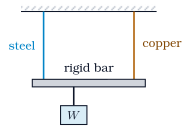
A steel wire and a copper wire of the same length and area hang side by side and hold a rigid bar. A load \(W = 300\) N hangs from the bar at the point that keeps the bar horizontal. Use the moduli of Question 20.
Why are the strains in the two wires equal?
Find the tension in each wire.
Answer(i) same length, same \(\Delta L\) (ii) steel \(200\) N, copper \(100\) N
Solution
The bar stays horizontal, so both wires stretch by the same amount. They have the same length, so the strains are equal.
Equal strain means \(\dfrac{T_s}{AY_s} = \dfrac{T_c}{AY_c}\), so \(\dfrac{T_s}{T_c} = \dfrac{Y_s}{Y_c} = 2\).
\(T_s + T_c = 300\) N gives \(T_c = 100\) N and \(T_s = 200\) N. The stiffer wire carries the larger share.
How did it go?
Q22
The breaking stress of a steel wire is \(4 \times 10^{8}\) Pa. The wire has area \(2\) mm\(^2\). Take \(g = 10\) m/s\(^2\).
Find the largest load the wire can hold.
With a safety factor of \(4\), what mass may be hung from the wire?
Answer(i) \(800\) N (ii) \(20\) kg
Solution
Largest load \(=\) breaking stress \(\times\) area \(= 4 \times 10^{8} \times 2 \times 10^{-6} = 800\) N.
Safe load \(= \dfrac{800}{4} = 200\) N, a mass of \(\dfrac{200}{10} = 20\) kg.